

Google Cloud NEXT ’25: Accelerating Software and Application Modernization with AI

At Google Cloud NEXT ’25, we witnessed a significant transformation in how modern applications are built, deployed, and maintained. As a Google Cloud Premier Partner, Making Science was there to see how Google is reimagining the software development lifecycle with AI at its core. This blog post explores the key innovations in software and application modernization that will enable organizations to build and deploy applications faster, more reliably, and with greater intelligence than ever before.

The AI-Powered Application Development Landscape

Google’s vision for application modernization centers around integrating AI throughout the entire software development lifecycle. The company revealed that internally, more than 25% of new code at Google is already generated by AI and reviewed by Google engineers—a testament to AI’s transformative impact on software development.

Gemini Code Assist: The AI-Powered Development Partner

Gemini Code Assist has evolved into a comprehensive solution for developers with several new capabilities:

  • Kanban Board: Developers can now interact with AI agents on a Kanban board, tracking agent assistance across common developer tasks such as code migration, new feature implementation, code review, test generation, model testing, and documentation.
  • Enhanced Partner Integration: Gemini Code Assist now integrates with tools from partners such as Atlassian, Sentry, Snyk, and others, providing a more connected development experience.
  • Android Studio Integration: Gemini Code Assist is now available in Android Studio for professional developers who want AI coding assistance with enterprise security and privacy features.
  • App Prototyping Agent: A new agent in preview for Gemini Code Assist within Firebase Studio can turn app ideas into fully functional prototypes, including UI, backend code, and AI flows.

Application Design and Management Reinvented

Google introduced several new tools to simplify application design and management:

  • Application Design Center (in preview): Provides a visual, canvas-style approach to designing and modifying application templates, allowing developers to configure application templates for deployment, view infrastructure as code in-line, and collaborate with teammates on designs.
  • Cloud Hub (in preview): A central command center for the entire application landscape, providing insights into deployments, health and troubleshooting, resource optimization, maintenance, quotas and reservations, and support cases.
  • App Hub: Now integrated with over 20 Google Cloud products, this service models applications as interconnected services and workloads for an application-centric view.
  • Application Monitoring (in public preview): Supports automatically tagging telemetry (logs, metrics, and traces) with application context, application-aware alerts, and out-of-the-box application dashboards.
  • Cost Explorer (in private preview): Provides visibility into granular application costs and utilization metrics, allowing teams to identify efficiency opportunities.

Gemini Cloud Assist: AI for Infrastructure and Operations

Beyond coding, Google is extending AI assistance to cloud operations with Gemini Cloud Assist:

  • Integration with Application Design Center: Accelerates application infrastructure design and deployment.
  • Investigations: Leverages data in your cloud environment to accelerate troubleshooting and issue resolution.
  • Cross-Service Integration: Now integrated across Google Cloud services including Storage Insights, Cloud Observability, Firebase, Database Center, Flow Analyzer, and FinOps Hub, as well as security and compliance-related services.
  • FinOps Hub 2.0: Now includes waste insights and cost optimization opportunities from Gemini Cloud Assist.

Container and Kubernetes Innovations for AI Workloads

Google Kubernetes Engine (GKE) has been enhanced to better support AI workloads:

  • GKE Inference Gateway: Offers intelligent scaling and load-balancing capabilities, helping handle request scheduling and routing with gen AI model-aware scaling and load-balancing techniques.
  • GKE Inference Quickstart: Allows developers to choose an AI model and desired performance, with GKE automatically configuring the right infrastructure, accelerators, and Kubernetes resources.
  • RayTurbo on GKE: In partnership with Anyscale, Google announced an optimized version of open-source Ray that delivers 4.5x faster data processing and requires 50% fewer nodes for serving.
  • Cluster Director for GKE (formerly Hypercompute Cluster, now GA): Lets developers deploy and manage large clusters of accelerated VMs with compute, storage, and networking — all operating as a single unit.
  • GKE Autopilot Improvements: Including faster pod scheduling, scaling reaction time, and capacity right-sizing.

Firebase: The Full-Stack AI App Development Platform

Firebase has evolved into a comprehensive platform for building AI-powered applications:

  • Firebase Studio (in preview): A cloud-based, agentic development environment powered by Gemini that includes everything developers need to create and publish production-quality full-stack AI apps quickly, all in one place.
  • Genkit: An open-source framework for building AI-powered applications using your preferred language, now with early support for Python and expanded support for Go.
  • Vertex AI in Firebase: Now includes support for the Live API for Gemini models, enabling more conversational interactions in apps, such as allowing customers to ask audio questions and get responses.
  • Firebase Data Connect (now GA): Offering the reliability of Cloud SQL for PostgreSQL with instant GraphQL APIs and type-safe SDKs.
  • Firebase App Hosting (now GA): Providing an opinionated, git-centric hosting solution for modern, full-stack web apps.
  • App Testing Agent (in preview): Prepares mobile apps for production by generating, managing, and executing end-to-end tests.

Real-World Impact: Customer Success Stories

Google’s application modernization innovations are already delivering significant impact across industries:

  • Deutsche Bank: Built DB Lumina, a new Gemini-powered tool that can synthesize financial data and research, turning hundreds of pages into a one-page brief in seconds for traders and wealth managers.
  • Nokia: Built a coding tool to speed up app development with Gemini, enabling developers to create 5G applications faster.
  • Reddit: Using Gemini on Vertex AI to power “Reddit Answers,” its AI-powered conversation platform, and Enterprise Search to improve its homepage experience.
  • Samsung: Integrating Gemini on Google Cloud into Ballie, its newest AI home companion robot, enabling more personalized and intelligent interactions.
  • The Sphere: Created an immersive “Wizard of Oz” experience reconceptualized through AI, bringing the classic film to life on the 160,000-square-foot domed screen at The Sphere in Las Vegas.

Developer Program Enhancements

To support the developer community, Google introduced:

  • Enterprise Tier of the Google Developer Program (in limited preview): Providing a safe and affordable way to explore Google Cloud and its AI products for a set monthly cost of $75/month per seat.

Making Science Perspective

As a Google Cloud Premier Partner, Making Science sees these software and application modernization innovations as game-changing for development teams. The integration of AI throughout the development lifecycle—from ideation and design to coding, testing, deployment, and operations—represents a fundamental shift in how applications are built and maintained.

For technical decision-makers, the most significant takeaways are:

  1. AI-augmented development: Gemini Code Assist is evolving from a coding assistant to a comprehensive development partner, handling increasingly complex aspects of the development lifecycle.
  2. Simplified application management: New tools like Application Design Center and Cloud Hub provide a more visual, intuitive approach to application design and management.
  3. Kubernetes optimized for AI: GKE enhancements make it the platform of choice for deploying AI workloads at scale with optimal performance and cost.
  4. Full-stack AI development: Firebase Studio provides an end-to-end environment for building AI-powered applications quickly.

Organizations that leverage these capabilities can expect:

  • Accelerated development cycles
  • Improved code quality and security
  • More efficient resource utilization
  • Faster deployment of AI-powered applications

The companies that embrace these innovations will be better positioned to respond to market changes, deliver better customer experiences, and maintain a competitive edge in an increasingly AI-driven world.

Looking to modernize your application development practices or build AI-powered applications? Contact our team at Making Science to discover how we can help accelerate your organization’s application modernization journey.

[button open_new_tab=”true” color=”accent-color” hover_text_color_override=”#fff” size=”medium” url=”https://www.makingscience.com/contact/” text=”Contact Us” color_override=”#f0076f”]
Google Cloud NEXT ’25: Revolutionizing Data and Business Intelligence with AI

The ability to extract actionable insights from data separates market leaders from the rest of the pack. At Google Cloud NEXT ’25, Google unveiled a transformative vision for data and analytics that promises to change the economics and accessibility of business intelligence fundamentally. As a Google Cloud Premier Partner, Making Science witnessed these game-changing announcements and assessed their business impact on our clients.

The Business Case for Data Transformation

Before diving into specific announcements, it’s essential to understand the business challenges Google’s new data strategy addresses:

  • Data silos persist despite decades of investment: Most organizations still struggle with fragmented data across systems, making comprehensive analysis difficult and time-consuming.
  • Technical complexity limits data democratization: Business users cannot directly access the insights they need to make decisions without specialized skills.
  • The time from raw data to business action remains too long: Traditional analytics workflows involve too many steps and dependencies.

The Autonomous Data to AI Platform: Business Benefits Beyond Technology

Google’s data strategy, centered around BigQuery, tackles these challenges head-on with an approach that delivers tangible business advantages:

Immediate Business Benefits

  • Reduced data integration costs: By accessing data in any storage system, SaaS application, or cloud without migration, organizations can save 40-60% on traditional data integration costs.
  • Faster time to insight: Organizations report 50-70% reductions in the time required to transform raw data into actionable business insights.
  • Broader data utilization: Making analytics accessible to business users has increased data-driven decision-making by 3 to 5x in early adopter organizations.

AI-Powered Data Teams: Redefining Analytics Economics

Google’s AI enhancements for data teams fundamentally change the economics of analytics:

Data Science Productivity Revolution

  • 50-70% reduction in model development time: The new Data Science Agent automates routine aspects of the data science workflow, dramatically increasing productivity.
  • 30-50% more models in production: Organizations using these tools report getting significantly more models into production with the same team size.
  • 40-60% faster time-to-value: The combination of intelligent SQL assistance and native exploratory analysis capabilities accelerates the path from question to answer.

Real Business Impact Examples:

  • A global retailer reduced time-to-insight for inventory analysis from 2 weeks to 2 days.
  • A financial services firm increased the number of risk models in production by 65% without adding staff.
  • A healthcare provider reduced patient readmission rates by 18% using models they couldn’t previously deploy due to development complexity.

Business Value of Multimodal Data

The ability to combine traditional structured data with unstructured content (images, text, video) unlocks entirely new business capabilities:

  • Enhanced customer insights: Analyzing customer feedback text alongside purchase data provides a 30-40% more accurate understanding of customer preferences.
  • Supply chain optimization: Combining image data from warehouses with inventory systems has helped organizations reduce inventory costs by 15-25%.
  • Product development acceleration: Companies integrating product images, customer reviews, and sales data report 20-30% faster product development cycles.

Future-Proofing Data Investments

Google’s commitment to open formats and interoperability delivers strategic business benefits:

  • Reduced vendor lock-in risk: Support for open formats like Apache Iceberg preserves flexibility and negotiating leverage.
  • Lower total cost of ownership: The ability to use Google’s analytics with data in other clouds eliminates costly data transfers and duplications.
  • Faster adaptation to emerging technologies: The unified catalog approach means new AI and analytics capabilities can be immediately applied to existing data assets.

Enterprise Economics: Scalability Without Compromise

Google’s enterprise workload management innovations deliver cost and operational benefits:

  • 15-30% reduction in analytics costs: Advanced workload management capabilities optimize resource usage while maintaining performance.
  • Simplified budgeting and procurement: The new BigQuery Spend Commit model reduces administrative overhead and improves financial predictability.
  • Enhanced business continuity: Managed Disaster Recovery reduces the risk and cost of ensuring analytics availability, with recovery times 5-10x faster than traditional approaches.

Conversational Analytics: Democratizing Data for Business Impact

Perhaps the most transformative announcements center around Looker’s new conversational capabilities:

Business Impact of Democratized Analytics

  • 3-5x increase in data utilization: Organizations report dramatically more employees actively using data when conversational interfaces are available.
  • 30-50% reduction in decision latency: Business decisions that previously took days or weeks due to reliance on analyst teams can now be made in hours.
  • 20-40% improved decision quality: With easier access to data, decisions previously made on gut instinct are now informed by actual evidence.

Real-World Business Transformation Examples

  • A retail chain increased store manager productivity by 25% by enabling them to directly ask questions about store performance without analyst support.
  • A manufacturing company reduced quality issues by 30% by making production data accessible to floor supervisors through natural language queries.
  • A financial services firm reduced report creation time from days to minutes with the new drag-and-drop Looker Reports, freeing analysts for higher-value work.

Embedded Analytics Business Value

The new Looker Conversational Analytics API enables organizations to:

  • Embed analytics directly into customer-facing applications, increasing customer engagement by 35-50%.
  • Integrate analytics into operational systems, reducing process exceptions by 20-30%.
  • Create analytics-driven products and services, opening new revenue streams.

Database Innovations: Modernizing the Data Foundation for AI

Google’s database announcements reflect a pragmatic approach to modernization that prioritizes business continuity alongside innovation:

AlloyDB AI: Business Applications Beyond Traditional Databases

AlloyDB AI transforms traditional operational databases into AI-ready platforms:

  • Reduced application development costs: Natural language querying reduces the specialized knowledge required to build data-driven applications by 40-60%.
  • Enhanced customer experiences: Vector search capabilities enable semantic understanding of user intent, increasing conversion rates by 15-30% in customer-facing applications.

Practical Migration Path: Balancing Innovation and Continuity

Google’s pragmatic approach to database modernization delivers measurable business benefits:

  • 30-50% reduction in database licensing costs: Organizations migrating from commercial databases to open-source alternatives like PostgreSQL report significant cost savings.
  • 70-85% reduction in database administration overhead: The unified Database Center reduces management complexity across heterogeneous database environments.

Real-World Impact: Customer Success Stories

Google’s data and analytics innovations are delivering quantifiable business results across industries:

  • Retail: Updating product attributes 5x faster, resulting in increased conversion rates and reduced return rates.
  • Financial Services: Reducing investment advisory administration time by 66%, allowing advisors to serve more clients with the same staffing.
  • Energy: Reducing safety audit costs by 99% while improving audit coverage by 300%, enhancing both efficiency and safety outcomes.

Making Science Perspective: Translating Data Innovation into Business Value

As a Google Cloud Premier Partner, Making Science is helping organizations turn Google’s data and analytics innovations into concrete business outcomes. Based on our experience implementing these solutions, we’ve developed a framework for maximizing ROI:

Embracing the Generative Business Intelligence (GenBI) Revolution

We believe that Generative Business Intelligence (GenBI) represents a fundamental paradigm shift in how organizations interact with data. Technologies like Looker Explore Assistant are democratizing data access across the organization in unprecedented ways:

  • From technical queries to natural conversations: Business users can now ask complex analytical questions in plain language, removing the technical barriers that previously limited data utilization.
  • From static dashboards to dynamic exploration: Users can follow their analytical curiosity wherever it leads rather than being limited to predefined views.
  • From specialized expertise to universal access: Data insights are no longer the exclusive domain of analysts and data scientists but accessible to everyone who needs to make data-driven decisions.

Our early GenBI implementations have shown that organizations can achieve 5- 7x more employees actively engaging with data, fundamentally transforming the decision-making culture.

1. Value-First Implementation Strategy

Rather than pursuing comprehensive data transformation, we recommend starting with targeted initiatives that align with specific business priorities:

  • Revenue Enhancement: Implementing conversational analytics for sales teams has delivered 15-25% revenue increases through improved opportunity identification.
  • Cost Optimization: Our clients have reduced their analytics spending by 20-40% by using BigQuery’s workload management capabilities.
  • Risk Mitigation: Implementing managed disaster recovery has reduced both outage risk and the cost of business continuity planning by 30-50%.

2. Practical Migration Approach

Our database modernization methodology focuses on business continuity and measurable outcomes:

  • Phased Migration: We help clients first move 20% of their most valuable workloads, demonstrating value before broader migration.
  • Hybrid Operations: Our approach ensures seamless operation during transition periods, with zero business disruption.

3. Data-Driven Culture Development

Technology alone doesn’t create value – organizations must evolve how they use data:

  • Executive Data Literacy: Our leadership programs ensure executives can ask the right questions and interpret AI-powered insights.
  • Business Analyst Enablement: We help analysts transition from data gatherers to insight generators using new conversational capabilities.

The organizations that act quickly to implement these data innovations will gain significant competitive advantages – not just in analytics efficiency, but in their fundamental ability to make better decisions faster than competitors.

In our next blog post, we’ll explore Google’s latest innovations in Software and Application Modernization. Stay tuned!

Ready to transform your data into a competitive advantage? Contact our team at Making Science to discover how we can help you achieve measurable business outcomes with Google Cloud’s latest data innovations.


[button open_new_tab=”true” color=”accent-color” hover_text_color_override=”#fff” size=”medium” url=”https://www.makingscience.com/contact/” text=”Contact Us” color_override=”#f0076f”]

Create your search strategy with Search Ads 360

Google has long been at the forefront of technological innovation, consistently striving to meet the evolving needs of its users. This commitment is evident in their ongoing efforts to enhance the Google Marketing Platform, particularly Search Ads 360 (SA360).

In today’s fast-paced digital landscape, consumers demand immediate and relevant results that align with their search queries. SA360 is designed to equip businesses with the tools they need to deliver personalized and timely advertisements that resonate with their target audience.

By incorporating innovative features and improving platform usability, SA360 empowers marketers to streamline their workflows and achieve better results. With enhanced search engine and campaign support, marketers can accomplish more tasks from a single location, boosting efficiency and driving success.

What do we like about SA360?

  1. SA360 offers a centralized platform for managing search campaigns across multiple search engines, empowering marketers to streamline their workflows and enhance campaign performance. With its advanced automation capabilities, you can automate tasks such as bidding, budget allocation, and structural modifications, saving time and effort.
  2. The platform is designed for flexibility, supporting multi-advertiser workflows and offering customizable reporting options. This allows you to manage and analyze account activity across various levels, tailoring reports to your needs.
  3. SA360 also provides enhanced support for search engines, paid advertising platforms, and third-party partners. This means you can benefit from new features and capabilities specific to each platform, such as Google Ads’ support for Local, Discovery, and Performance Max campaigns.
  4. The user interface of SA360 is designed for intuitive navigation, making it easy to manage your campaigns and access key metrics. With a familiar look and feel, SA360 integrates views from Google Ads and Microsoft Advertising, providing a seamless user experience.

By leveraging SA360’s comprehensive features, you can achieve greater efficiency, improve campaign performance, and unlock the full potential of your search marketing efforts.

Google is always introducing new features to make their products better and more user-friendly. To stay ahead of the game and learn about the newest features being released by Google, subscribe to our GMP newsletter by clicking the button below!

[button open_new_tab=”true” color=”accent-color” hover_text_color_override=”#fff” size=”medium” url=”https://cloud.mail.makingscience.com/subscription-GMP-newsletter?_ga=2.17350203.365612531.1728314914-344431337.1715013298&_gl=1*f5k68*_ga*MzQ0NDMxMzM3LjE3MTUwMTMyOTg.*_ga_H0CK132HF1*MTcyODM5NzE1Ny42My4xLjE3Mjg0MDQzMDguNjAuMC4xNzYxMjg1NTQ.” text=”Subscribe Now” color_override=”#f0076f”]

Insights from Google Cloud Next: Navigating the IT-Marketing Bridge & Harnessing AI and Cloud for Future Growth

The main insight from Google Next was that IT and marketing still have very different functions, and the bridge needs to be navigated. For a typical brand, the organizations are separate and have different skill sets and different priorities. However – in 2024 and going forward, it has never been more critical for the two to find common ground.

AI

As AI continues to evolve (both predictive AI and generative AI), it is important for brands to understand the value of AI to directly influence their KPIs, grow their revenue, and make their operations and marketing spend more efficient.

Cloud-Powered Marketing

The opportunity to differentiate on Cloud-based AdTech for marketing is massive right now.

The spectrum of cloud for marketing maturity is wide. Some brands are using Cloud instances, CDPs, BigQuery, and digital infrastructure to test predictive AI tactics today. Others are not.  Some own their data, and some don’t.

The quote of the week that embodies this thinking is: “If you don’t have a data strategy, you can’t have an AI strategy.” AI needs input. And the input, ideally, will include the best data possible, as your results will be as good as the data you put in. This then embodies the relationship between the brand and the consumer.

There are many ways to design the strategy and infrastructure to make that happen.  Brands need to be intentional about selecting vendors and service partners to help.  And it needs to start now. Start now, because you’re never going to finish!

Partner Ecosystem

The partner ecosystem is evolving. There aren’t many true Cloud for Marketing partners. The big SIs that are great at Cloud don’t do marketing use cases much whereas the big Agencies don’t do IT much. And here’s the thing: these facts won’t change much going forward. Steering a battleship with a toothpick is hard to do, and there isn’t much incentive to try and grow tiny practices within a giant revenue base.

So new partners are springing up that can tie together all the pieces that are needed to do marketing in this new AI era. Connecting cloud, CDP, martech, adtech, measurement, and back again.

Brands will do well to consider investing intentionally in this IT/Marketing gap, for the sake of using AI better and better as it evolves.

Get in touch with our experts to learn more about our Google Cloud services and AI at Making Science!


[button color=”accent-color” hover_text_color_override=”#fff” size=”large” url=”www.makingscience.com/contact” text=”Contact Making Science” color_override=”#ff0067″]

BigQuery Studio Insights: Navigate, Analyze, and Unleash Your Data’s Full Potential

Many organizations recognize the value of their data, but they’re stumped on how to fully leverage its potential. There’s an overwhelming volume of data, existing systems are complex, and regulatory challenges abound. Plus, the rush to adopt artificial intelligence often leads to fragmented ecosystems that are tough to navigate.

On August 31st, Google launched BigQuery Studio in response to this scenario. This is a game-changing platform that offers a solution to these issues and makes BigQuery Studio insights easily accessible. This innovative platform is designed to bring together analysis, AI capabilities, and data governance in a single unified ecosystem within Google Cloud Platform‘s data analytics suite. Here’s how BigQuery Studio is aimed at addressing the following key issues:

  • Data Overload: As data production increases, analysts often find themselves drowning in a sea of data, making it hard to gain actionable insights.
  • Platform Fragmentation: Companies frequently use different platforms for analytics, AI, and machine learning, complicating the workflow even more.

How BigQuery Studio Helps Businesses and Data Professionals:

One of the key features of BigQuery Studio is that it offers a unified workflow for data specialists. It eliminates the complexity of navigating multiple platforms while enhancing the efficiency and performance of the overall team.

  • Comprehensive Solution: It integrates every step of the data process, from collection to analysis, to generating AI-driven insights. You can edit and execute SQL, Python, and Spark in the same interface. This creates a truly streamlined workflow among data scientists, data engineers, and data analysts through version histories and source control.
  • Data Compliance and Governance: BigQuery Studio features robust governance and security functions. This makes it easier to adhere to changing data privacy laws, like GDPR and CCPA.
  • AI-Enabled Insights: Thanks to integrated AI technology like Duet AI, BigQuery Studio makes data analysis more accessible AND smarter. Start with a basic programming notebook for data preparation and then move on to specialized services like machine learning with Vertex AI.

In addition to all of this, Google has boosted its drive for AI innovation by including its assistant Duet AI directly in BigQuery Studio. This addition leverages natural language processing and generative algorithms, introducing:

  • Coding Assistant: Think of Duet AI as your coding buddy. It’s there to help you craft SQL queries and Python code for precise data queries.
  • Free-form Data Queries: Users can make data queries using natural language and receive answers through contextual chat, making analysis more user-friendly.

Openness and Compatibility: BigQuery Studio in a Multi-Cloud Landscape:

Google has demonstrated its commitment to open-source compatibility and the cloud by making BigQuery Studio a suitable option for businesses operating with multi-cloud or hybrid cloud strategies:

  • Run AlloyDB on any cloud or local setup
  • Support for open-source formats like Apache Hudi and Delta Lake
  • Optimize performance for large data ingestion through Apache Iceberg

BigQuery Studio is not just another tool; it promises to break down silos, simplify workflows, and enable smarter decision-making through AI integration. For e-commerce managers and data analysts looking to keep up in a constantly evolving digital landscape, adopting BigQuery Studio could be a strategic move to consolidate their data analysis and AI efforts, maximizing BigQuery Studio insights.

Ready to dive deeper? Don’t get left behind in the big data activation race. Contact our team to schedule a demo and take the first step toward transforming your business insights.

Get in touch

Embracing the Best of Both Worlds: The Benefits of Hybrid Multi-Cloud Environments

Introduction to Multi-Cloud/Introduction: The Rise of Cloud Technology

In today’s fast-paced digital landscape, cloud technology has firmly established itself as an indispensable tool for companies to develop adaptable, scalable, secure, and efficient technological solutions capable of addressing evolving business needs.

Large companies such as Google, Microsoft, Amazon, IBM and many others have democratized access to cloud services, making previously unattainable computing capabilities accessible to both businesses and individuals. 

However, as cloud technology evolves, so do the strategies for harnessing its power. Different integration approaches and architectures have emerged to fully exploit the cloud’s potential, including connecting on-premise and cloud environments, bridging private and public clouds, and collaborating with multiple cloud service vendors.

We will focus on this last scenario. 

Understanding Multi-Cloud Architecture

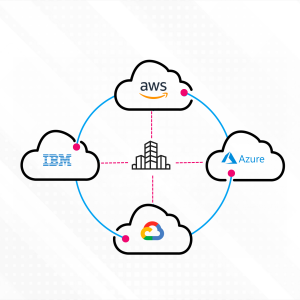
This Hybrid Multi-Cloud architecture refers to a system combining the services of two or more cloud providers working together into a unified ecosystem, leveraging each provider’s unique strengths, region availability and capabilities.

With numerous cloud providers offering various services, pricing models, and geographic availability, Multi-Cloud architecture has emerged as a strategic choice for businesses looking to maximize the potential of the cloud.

Why choose Multi-cloud?

Businesses are rapidly adopting this architectural approach for several reasons:

  • Enhanced Security: Mitigating Risks and Fortifying Infrastructure

This kind of architecture improves the system security in multiple ways. It mitigates risks by allowing workloads distributed across different cloud providers, ensuring that if one encounters issues, others can seamlessly take over. Additionally, it helps tackle “Shadow IT”, the use of unauthorized or unapproved technology solutions, applications, or services within an organization by employees, providing them with different cloud-based secure alternatives. Choosing cloud over on-premise software helps to avoid “Shadow IT”, while security and lack of governance risks can be significantly reduced. This architecture also adds extra resilience and redundancy, hardening overall application robustness.

  • Unmatched Flexibility: Breaking Free from Vendor Lock-ins

Cloud providers often offer similar products, but on certain occasions, some unique products and differences can be critical when choosing one over another. Multi-Cloud allows administrators to select the tools that best align with their specific needs, promoting closer alignment to business requirements.  It also allows you to choose each provider’s most powerful products and combine those to create a more robust solution.

  • Proximity and Compliance: Navigating Data Regulation and Geographical Challenges

High availability and fast response time are paramount in modern systems. Multi-cloud environments ensure multiple endpoints, optimizing response times by directing requests to the closest data center. Moreover, they facilitate compliance with data sovereignty laws and regulations, enabling services in regions where certain cloud providers may be restricted.

The Rise of Multi-Cloud Implementations

There are many other reasons why Multi-Cloud implementations are gaining popularity among companies seeking to improve security and performance while building robust applications or solutions with high availability, hybrid workflows and seamless DevOps integration. This approach recognizes that the cloud landscape is continually evolving. With providers improving their services or pricing models, deciding to rely on a single provider for a significant project is increasingly challenging.

In conclusion, The Future is Multi-Cloud

Julio Cesar’s wisdom, “Divide and conquer”, becomes particularly relevant here. In the short term, the benefits mentioned above make a strong case for Multi-cloud architecture. Although some can also be achieved with a Hybrid Cloud model, combining private and public clouds, there are strong reasons to believe that leveraging multiple clouds will result in more agile, secure and reliable systems.

Embrace the Multi-Cloud Revolution by Making Science and Propel Your Business to New Heights!

Transform your business with the power of multi-cloud, guided by the expertise of Making Science. Our team of certified experts are here to help you achieve real-world advantages by addressing complex challenges, streamlining operations and driving innovation that translates into measurable benefits for your business.

Google Next ’23: Unveiling the AI Revolution | Part 1

Google Next ’23, the annual event that brings together tech enthusiasts, industry leaders, and innovators, was a remarkable showcase of Google’s commitment to revolutionizing technology across Google Cloud’s extensive portfolio spanning Infrastructure, Data and AI, Workspace Collaboration, and Cybersecurity solutions.

Given our longstanding relationship as a Google Cloud Premier Partner, the Making Science team attended the event to get a first glance at the main innovations and gain insights that will shape the future of our work and value to our customers. 

At the heart of the event, one theme was the main character approaching the future of technology: Artificial Intelligence. The event unfolded as a dynamic showcase of AI’s transformative power across industries and its pivotal role in shaping the future of technology. 

In this Blog Post, we dive into the different dimensions of AI that took center stage at Google Next ’23.

AI-Optimized Infrastructure

Google Cloud is committed to providing cutting-edge AI-optimized infrastructure that empowers businesses to train and deploy AI models efficiently. This infrastructure is available across Google’s global cloud regions, on customer premises through Google Distributed Cloud, and at the edge. Notably, over 70% of “gen AI unicorns” are Google Cloud customers, emphasizing the platform’s dominance in this transformative field. Key infrastructure advancements announced at the event include:

  • Cloud TPU v5e: This state-of-the-art AI accelerator platform is cost-efficient, versatile, and scalable. It enables customers to perform large-scale AI training and inference on a single platform, offering significant improvements in training and inference performance per dollar compared to its predecessor.
  • A3 VMs with NVIDIA H100 GPU: Powered by NVIDIA’s H100 GPU, these virtual machines offer superior performance, high-speed networking, and advancements to support demanding gen AI and large language model (LLM) applications.
  • GKE Enterprise: Enabling multi-cluster horizontal scaling, GKE Enterprise enhances productivity while reducing software deployment times, catering to mission-critical AI and ML workloads.
  • Cross-Cloud Network: This global networking platform simplifies application connectivity and security across multiple cloud environments, offering reduced network latency and improved accessibility to Google services.
  • Google Distributed Cloud: Designed for organizations running workloads at the edge or in their data centers. Google Distributed Cloud is being enhanced to bring AI capabilities to the edge.

Vertex AI: Building, Deploying, and Scaling ML Models

Vertex AI is Google Cloud’s comprehensive AI platform, empowering customers to build, deploy, and scale machine learning (ML) models effectively. The platform’s usage has grown substantially, with the number of gen AI customer projects surging over 150 times quickly. Main updates on this platform include:

  • Vertex AI Search and Conversation: These tools enable organizations to quickly create Search and Chat applications using their data, with minimal coding and robust enterprise-grade management and security features.
  • New Models and Tooling: Updates to PaLM 2 for processing large documents efficiently, extended support for new languages available in Codey, and increased capabilities for Imagen regarding visual appeal and new tuning methods to create images aligned to specific requirements with a few references.
  • Vertex AI Extensions: Developers can now access, build, and manage extensions that provide real-time information and actions, enabling gen AI applications to interact with enterprise systems and third-party platforms.
  • Digital Watermarking: Leveraging Google DeepMind SynthID technology, digital watermarking is now available for AI-generated images, offering scalability and security in image generation.
  • Colab Enterprise: A service for Data Scientists to accelerate AI workflows, access the whole Vertex AI platform, integrate with BigQuery and benefit from code completion and advanced generation features.

If you’re a cloud or data expert, we encourage you to learn more about these new features and capabilities so you can start using them to build and deploy innovative solutions. 

These are just a few of the many announcements made at Google Cloud Next 2023. Stay in touch for an upcoming post on how AI is shaping Cloud, Data and Security.

Contact us

Unlocking the Power of Data with Google’s Looker Studio and Data Studio Integration

In October, 2022, Google announced the imminent integration between its BI tool, Looker, and Data Studio, its dashboarding and reporting tool. They took the best of each product to create Looker Studio (formerly Data Studio), a tool capable of unleashing the power of your data with interactive and visually attractive dashboards that enable you to make smarter business decisions.

This is not the first time we have talked about Looker Studio on the Making Science blog, and it won’t be the last. Google is enhancing this BI tool to enable businesses to utilize data for efficient and scalable growth. The recent release of Looker Studio Pro, the paid version, offers enhanced business features and technical support.

Today, we will delve into both versions of Looker Studio, exploring which one best caters to specific business needs. Let’s get started! 🚀

Looker Studio (formerly Data Studio)

With the free version, you can explore the tool’s features and unlock its potential:

  • Unlock the full value of your data: Looker Studio enables you to capitalize on your data by creating interactive dashboards and reports from a myriad of sources, facilitating smarter business decisions.
  • Looker Studio API: This feature lets organizations using Google Workspace or Cloud Identity automate the management and migration of Looker Studio resources, streamlining the process.
  • Unrestricted connection with your data sources: Exactly as it sounds! You have access to a plethora of data sources via more than 600 partner connectors, allowing instantaneous connection to almost any data type, no coding or software necessary.
  • Share reports with your team: Collaborate in real time on reports and share them with anyone, or integrate them into your website or intranet.

Looker Studio Pro

As hinted earlier, Looker Studio Pro is the premium version of Looker Studio. Besides encompassing all the features of Looker Studio, it sets itself apart with a few crucial functionalities:

  • Customizable access management: Looker Studio Pro allows you to conveniently control access to your reports and data sources at scale using two new additions: group workspaces and linking to a Google Cloud project.
  • Group workspaces: These spaces let Looker Studio Pro users manage access and share Looker Studio content as per team collaboration needs. Your team will have automatic access to the content, and you can allocate specific workspace permissions based on each member’s role: administrator, content manager, or collaborator.
  • Linking Looker to a Google Cloud project: This allows your organization to control Looker Studio Pro resources via a linked Google Cloud project. The reports and data sources under Looker Studio Pro belong to the organization, not individual users. Therefore, key resources remain operational even if their creator leaves the company. Additionally, Cloud administrators can configure project-level permissions using identity and access management to regulate access to these resources.
  • Cloud Customer Care: Looker Studio Pro users get access to Google Cloud Customer Care’s scalable and flexible support services.

Product updates

On April 17, 2023, Google released a product update to further improve Looker’s capabilities. Enhancements include:

  • Sparklines that show historical trends for a scorecard value over time, give you a dynamic visual of your data’s progress.
  • Progress visuals illustrate the advancement of a scorecard value towards a predefined goal, making goal tracking a breeze.
  • The comparison feature allows you to juxtapose the scorecard metric with a specific time period, target value, or another metric, allowing for nuanced performance evaluation.

See more product details here.

Want to maximize Looker Studio’s potential? Tell us about your specific case, and our team of experts will be happy to help you. Write to us, or learn more about our Data, Analytics & AdTech services! 🚀🚀

Contact here

Looker and Data Studio: an integration that enhances Google’s BI

Today, companies must provide information to users in a way they can understand. They must generate reports with reliable data that visually represent their commercial efforts. 

Data-driven companies want to democratize access to relevant data in their organizations and empower their employees to get answers quickly. On one hand, companies want to create a single shared source of truth, with granular control of data access and secure centralized storage. While we realize that these capabilities are necessary to take our business to the next level, we must also think about whether these tools are reliable and have the necessary degree of security.

Companies today are looking for BI solutions that can be easily used by all members of an organization (both technical and non-technical) while producing real-time metrics.

Google understands this need, and that is why last April it announced its intention to integrate its Looker and Data Studio tools to offer companies a unified experience for self-service, well-governed BI.

Thanks to this integration, users will now be able to access and import governed data from Looker within the Data Studio interface, and create visualizations and dashboards for additional self-service analysis.

This union allows us to offer a better Google Cloud BI experience to our users. Business users will feel more empowered than ever, while data leaders will be able to preserve the trust and security their organization needs.

Looker and Data Studio: better together 

Looker and Data Studio are complementary tools. The union of Looker and Data Studio opens exciting opportunities to combine the strengths of both products and a wide range of BI and analytics capabilities to help clients reimagine the way they work with data. 

Looker is a modern enterprise platform for business intelligence and analytics, helping organizations create data-rich experiences tailored to every part of their business. Data Studio is an easy-to-use, self-service BI solution that enables ad hoc reporting, analysis, and data blending across more than 500 data sets. 

How will the integration work?

According to Google Cloud, this first integration between these products will allow users to connect to Looker’s semantic model directly from Data Studio. 

Users can bring the data they want to analyze, connect it to other available data sources, and easily explore and create visualizations within Data Studio. The integration will follow three principles with respect to governance:

  1. Access to the data will be carried out having the capabilities using Looker’s security measures.
  2. Looker will remain the single point of access to your data.
  3. Administrators will have full ability to manage Data Studio and Looker in an integrated manner.

How is Google integrating these products?

Looker’s semantic model allows metrics to be centrally defined and widely used, ensuring a single version of the truth across all your data. This integration allows Looker’s semantic model to be used within Data Studio reports, allowing people to use the same tool to create reports that are based on both ad-hoc and governed data. This brings together the best of both worlds: a governed data layer and a self-service solution that enables the analysis of governed and ungoverned data.

With this announcement, the following use cases will be supported:

  • Users can turn their Looker-driven data into informative and highly customizable dashboards and reports in Data Studio.
  • Users can combine Looker’s governed data with data available from more than 500 data sources in Data Studio, to rapidly generate new insights.
  • Users can quickly analyze and prototype raw data—from spreadsheets, CSV files, or other cloud sources—within Data Studio.
  • Users can collaborate in real-time to create dashboards with teammates or people outside the company. 

When will this integration be available for use?

This integration is the first of many in Google’s effort to bring Looker and Data Studio closer together. Future versions will introduce additional features to create a more seamless user experience for these two products. 

In short, Google will implement new capabilities in the coming months. So, don’t miss any Making Science articles as we will be publishing all the news on this topic.

Do you want to know more about the Looker + Data Studio integration and the benefits it can bring to your online business? Our team of experts will be happy to attend to your specific case. Get in touch today!

Get in touch