Invisible Intruders: Deciphering the World of Advanced Persistent Threats (APTs)

In the realm of cybersecurity, Advanced Persistent Threats (APTs) emerge as a hidden menace challenging digital security. These large-scale, sophisticated attacks, known for their stealth and longevity, can significantly impact organizations, including the loss of confidential data, reputational damage, and operational disruptions.

The primary goal of such attacks is to stealthily steal confidential data in a continuous and persistent manner. The perpetrators behind APTs are highly experienced teams that, backed by substantial funding, are dedicated to exploring and exploiting vulnerabilities over long periods of time, focusing their attacks on high-value organizations.

The Covert Stages of APTs

These dangerous cyber-attacks advance in secrecy through various stages, completely undercover.

  • Identification and Reconnaissance

In this stage, attackers meticulously gather information, exploring every detail. Their goal is to fully understand the infrastructure, protocols, and devices of their target.

  • Infiltration and Foothold

Equipped with the gathered information, attackers gain access to the internal network using customized malware. Sometimes, they create secret entries and backdoors to re-enter the network undetected, solidifying their position within the network.

  • Escalation and Lateral Movement

Once inside, they deepen their incursion, acquiring passwords and privileges. This ability allows them to move unrestricted through the system in search of the information they desire.

  • Exfiltration

Like true cybercriminals, they discreetly store the stolen data in a safe place within the network, patiently waiting until their collection is complete. Finally, they extract the data without leaving a trace, even blocking network personnel while they complete their operation.

The Unmistakable Signs of an APT

To quickly identify these cunning criminals, it’s essential to be alert to obvious signs that you may be a victim of their attacks:

  • Increased logins and user account activity at unusual hours.
  • Increase in database activity such as movements, creation, or transfer of massive amounts of data.
  • Receipt of fraudulent emails to carry out phishing attacks.
  • Existence of backdoors that allow access and control a computer without the user realizing.
  • Compressed data for export in suspicious places.

Protection Against Invisible Threats

However, in the digital realm, APTs are not invincible. Companies must take ongoing measures and actions to protect themselves:

  1. Awareness: It is key to inform all employees of the existence of such threats, their repercussions and share signals that may indicate an unnoticed intrusion.
  2. Up-to-Date Maintenance: Keeping software and devices updated to prevent attackers from exploiting vulnerabilities.
  3. 24/7 Monitoring and Surveillance: Implementing the use of monitoring systems that analyze internal network traffic for threats and alert of suspicious movements or unauthorized accesses. For this, AI/ML present great opportunities by being able to quickly and accurately detect suspicious activities, and generate alerts so that security teams can respond preventively.
  4. Firewalls: Isolating the organization’s network from the outside, effectively controlling what enters and leaves the network.
  5. Password Policies: Using strong passwords and changing them regularly to strengthen security.
  6. Advanced Security Solutions: Organizations can implement advanced security solutions, such as cyber intelligence, behavior analysis, and incident response, to help detect and respond to APT attacks.

Defend Your Cyber Frontline with Making Science 

In a digital world affected by APTs, staying alert and prepared becomes our main line of defense against this hidden threat. The battle continues, and only those who face this darkness with utmost caution can resist this adept tactic of cybercrime.

Making Science is a trusted partner for organizations seeking to protect their data and reputation from APT attacks. With the help of Making Science, organizations can rest assured that they are taking the necessary steps to protect themselves from this increasingly serious threat.

The future of cybersecurity requires a proactive and persistent defense. Partner with Making Science today and strengthen your frontline against the unseen threats of the digital world.

Interview with José Antonio Martinez Aguilar: How Generative AI is reshaping the marketing landscape

How do you see generative AI transforming marketing?

Generative AI technology has boomed this year, primarily due to the expansion of Chat GPT and other platforms that enable content creation. The previous AI was predictive AI, which essentially allows you to make predictions based on historical data about the probability of an event happening in the future. This is very positive because it will enable you to understand what will happen in the future. For example, predictive AI predicts whether you like a movie in a product recommender, such as Spotify or Netflix. From an efficiency point of view, it brings a lot of value.

Generative AI creates content. It can create text, audio, and images. If we think about what marketing is: sound, sight, and motion, and what creativity is: communication through text, audio, photos, and videos, we are in an environment where you can create all these kinds of content to help communication. It is a new tool for creating content for creatives, agencies, and companies.

The key benefits of Generative AI are cost savings and variety. It allows the generation of content at a cost that is a fraction of the cost of human content generation, and the combination allows multiple variations of the same content to be generated. We, for example, have published some cases where we generate tens of thousands of product descriptions at a cost of one-thousandth of the cost of production by one person. It will undoubtedly transform marketing from the perspective of diversity and efficiency in content creation.

How does Making Science address the challenges this poses for the sector?

At Making Science, we have two sides: On the one hand, we are an agency, and on the other hand, we are a technology company. From an agency point of view, we are reviewing how to use generative AI in all our processes. We generate campaigns for our clients and are starting to use generative AI in different parts of the value chain of our business process: ad and content generation.

As a technology company, we have developed a platform called Trust Generative AI, which allows us to apply generative AI to the business cases that are most relevant and that allow us to scale globally. For example, it will enable us to generate product descriptions, blogs, web content, and copy generation for ads and images, and we are working on video generation for the near future.

At Making Science, we are taking a very proactive approach. We believe in embracing technology and maximizing it for your business.

What impact, both positive and negative, can its use have?

Every technology has a positive and negative effect depending on how you use it. For example, you can use iron or steel to build a bridge, a machine gun, or a tank. On the positive side, generative AI can generate much more variety of content at a much lower cost. In other words, we must see artificial intelligence as a tool that helps us improve. 

An MIT study analyzes how, in generating content, an internal memo, an article, or a communication, using ChatGPT, it is possible to improve by 20% times and improve the quality of the content by 30%. Therefore, it should be seen as an opportunity for Human Augmentation, which turns us into humans with more capabilities, as has happened in the past.

The downside is that it can generate virtual spaces that can be used for impersonation, generating your voice or false images, and generating fake content and information. As with any new technology, there are positive and negative uses. It’s a question of taking advantage of all the positive benefits and fighting against the negative ones.

Where does generative AI leave marketers in this new era?

Technology has changed marketing over the last 50 years, and marketers have had to adapt. Advertising at the beginning of the century, in the 1920s, was mainly text in newspapers or outdoor billboards. Then came radio, television, the internet, and now digital; we must adapt to every advertising landscape evolution.

In general, technology allows many lower value-added activities to be done in a scalable way, and marketers need to adapt. A similar example is what has happened in media buying through technology platforms such as Google or Meta, where techniques such as automatic bidding or other automation do tasks that only 20 years ago were done by consultants. Marketers, therefore, have to evolve their roles.

Similarly, let’s think about how creatives were made 100 years ago, where an illustrator was the one who drew, and how later video and audio editing tools appeared that allowed to evolve towards professionals with editing capabilities. Likewise, generative AI is an opportunity, and marketers must embrace it and evolve towards a technology that will enable them to do much more varied things at a lower cost.

How should the risks associated with their use be dealt with, and is there a way to avoid them?

You have to be cautious. From an agency or end-client point of view, communication always has communication guidelines defining how the brand expresses itself at text, audio, and image levels. The risk of generative AI is that the content needs a sufficient level of control or compliance and results in content that is not appropriate or does not express the brand identity.

Controls must be implemented to ensure the generated content is valid, relevant, and aligned with brand standards. At Making Science, we have developed our platform, Trust Generative AI, which incorporates algorithms that help users control how close or far their content is from the company’s standards and allows them to incorporate Human-In-The-Loop, which are processes in which there is a person who is validating the final content before publication.

How should brands integrate generative AI into their strategies to get the most out of it?

Fundamentally, from two points, taking advantage of the creativity capacity of platforms such as ChatGPT Dall.e or Google’s Vertex AI, which are platforms that have been trained with hundreds of millions of images, videos, and texts to allow interaction with them, generating a lot of information in the divergent phase of the creative method. For example, when you are brainstorming, that is, in the phase of generating new ideas. 

The second important application is the scalability and personalization of content. Generative AI develops a lot of variations of content, and you have to take advantage of this strength. For example, when you create a website, the text of the descriptions is unique. With generative AI, you can create many variations of content and context with a different tone of voice depending on the business target. It differs from how you would address millennials as you address Generation X, with hyper-personalizing communication.

Generative AI is one of the tech trends of 2023. How do you think it will evolve? Is it here to stay, or will nobody remember it in a few years?

Generative AI is the big hit of 2023, mainly due to the tools such as ChatGPT that have democratized the use of this technology. Previously, everyone used artificial intelligence with Google, Amazon, or Spotify’s product recommender that presented videos, products, or content relevant to the user. Still, it was not visible to them due to the artificial intelligence working in the background. Now, however, with ChatGPT, we are experiencing, in a very personal way, a 1-to-1 with the use of artificial intelligence, and we know that we are talking to a machine.

So, the significant change is that it’s consumed at the mass market level. Everybody understands generative artificial intelligence and its possibilities, and many people are thinking about used cases and opportunities. I think it’s a technology that is here to stay and will have a revolutionary impact on society and all sectors.

To learn more about AI, download our AI e-book or get in touch with our team of experts to begin your AI journey!


[button color=”accent-color” hover_text_color_override=”#fff” size=”large” url=”www.makingscience.co.uk/contact” text=”Get in touch” color_override=”#f0076f”]

AI and Technology: 5 Reasons to invest

In the ever-evolving business world, one truth is clear: adopting cutting-edge technologies and solutions based on Artificial Intelligence (AI) is no longer an option but an absolute necessity. AI is transforming how companies perform, interact, and compete in the digital landscape, opening up unprecedented opportunities. This blog will explore why businesses should seriously consider investing in technology and AI in their digital strategies.

1. Efficiency Translates to Profit

AI can automate complex and repetitive, error-prone processes, enabling individuals to focus on high-value activities. This results in a significant increase in operational efficiency and reduced wastage of valuable resources. A more efficient company can deliver services more swiftly, shorten delivery times, and enhance customer satisfaction.

2. Large-Scale Personalization

AI can swiftly analyze vast amounts of data and automatically understand customer behaviors and preferences. This empowers businesses to provide highly personalized experiences that can lead to increased loyalty and higher conversion rates. Customers expect tailored experiences, and AI enables this large-scale personalization.

3. Accurate Forecasts and Informed Decisions

Advanced analytics and machine learning allow businesses to obtain more precise forecasts and in-depth insights into market trends, consumer behavior, and company performance. This assists executives in making more informed decisions based on real data rather than conjecture.

4. Market Competitiveness

Companies embracing AI and technology position themselves advantageously in the market. They can swiftly adapt to new challenges and opportunities, staying ahead of competitors who aren’t fully harnessing the potential of technology.

5. Continuous Innovation

AI fuels innovation through new applications and creative solutions. Businesses investing in AI develop an innovation culture as they constantly seek better ways to utilize cutting-edge technologies to meet customer needs and exceed their expectations.

In an era where technology is revolutionizing every aspect of business operations, adopting AI and technology-based solutions isn’t just a wise choice but a necessary move to ensure long-term success. Companies embracing technological innovation can offer exceptional customer experiences, make decisions based on accurate data, and maintain a significant competitive advantage.

So, why wait? The time to invest in the future is now.

[button color=”accent-color” hover_text_color_override=”#fff” size=”large” url=”www.makingscience.com/contact” text=”GET IN TOUCH TO LEARN MORE ” color_override=”#f0076f”]

Or, download our AI Maturity E-book to learn more:

Real-time Anomaly Detection in Your Website’s Sales Funnel – Gauss Data Quality

Today’s marketing and business intelligence teams demand tools that allow them to understand what’s happening in their business environments; insights into aspects like web traffic, the number of customers, user behaviors, among others.

Thus, this no longer serves as a comparative advantage against your competitors since they too will possess systems capable of generating these business insights, thanks to analytics tools and the like. A potential distinguishing feature that emerges is the immediacy of data.

Immediate access to data is becoming a highly sought-after characteristic for companies. It allows them to preemptively address potential business issues, providing quick and accurate responses to challenges like webpage downtimes or significant drops in page visits.

The closer in time this information is received, the more valuable it becomes. That’s why there’s a growing need to use more proactive tools than traditional dashboards when dealing with critical business information.

To address these needs, Making Science has developed Gauss Data Quality and its alert functionality, a solution that sends real-time notifications if the predefined conditions are met.

Gauss Data Quality and its alert system offer a fully customizable solution. Clients decide which metrics they want to set alarms for, under which specific conditions, and at what intervals.

Some use cases for this solution

  • Website Metric Anomalies: Setting alerts to detect unusual trends in website visits, like decreased page views, changes in visitor browsers, or any other site navigation metrics.
  • Data Consistency or Quality: Establishing alerts to measure metric calculations’ consistency and reporting from various analysis tools (e.g., analytics systems, CRMs). This way, you can identify discrepancies in these platforms’ measurements.
  • Tracking Business Metrics: Setting alerts to actively and promptly detect any unusual trends in the sales funnel regarding visits, conversions, changes in ROPO patterns, etc.

In essence, thanks to these alert configurations, you’ll gain a clearer understanding of your business. The real-time data that powers these alerts can clarify if the measurements from various platforms are consistent and if the crucial business metrics follow the expected trend.

In today’s fast-paced digital landscape, staying ahead requires not just data but real-time, actionable insights. Gauss Data Quality alerts empower businesses with timely notifications, ensuring no critical anomaly goes unnoticed.

Don’t let unexpected changes disrupt your business flow. To truly harness the power of real-time data and keep a vigilant eye on your web sales funnel, reach out to us. Discover how our advanced solutions can transform your decision-making processes.

Get in touch

Lifetime Value (LTV) in GA4: Analysis and Reports

Today, let’s dive into Customer LifeTime Value (LTV), a critical metric used for evaluating user behavior and value. We’ve broached this topic before, but today we’ll focus on how to utilize LTV in Google Analytics 4 (GA4) to maximize its potential.

LTV serves as both a measure to calculate a customer’s economic value and a strategy for customer management. Harnessing LTV aids us in multiple ways:

  1. Crafting retention and loyalty strategies: LTV tracks the customer journey from the point of conversion to the end of their lifecycle – when they cease being our customer.
  2. Driving active acquisition campaigns: These campaigns leverage predictive measures to forecast purchasing probability, churn rate, or even higher average values per user purchase.
  3. Gaining unique user data: It provides a wealth of information, such as user interactions with our brand, their latest interaction or purchase, their last active moment, user ID-based deduplication, predictive metrics that learn from user behaviors, and more.

Continuous tracking and analysis of LTV over time enable us to detect trends and alterations in customer behavior. This valuable insight allows us to refine strategies and make clear decisions to boost the profitability and overall performance of your business. And all this is made possible with Google Analytics 4.

However, when calculating LTV, we need to consider:

  • The calculation of LTV can fluctuate depending on the type of business and the industry sector. For instance, in sectors where recurring purchases are less frequent, like car sales, LTV is calculated over a longer period, perhaps several years.
  • It’s crucial to understand that there’s a limit to LTV because it’s impossible to obtain data for clients prior to August 15, 2020.

Connection to Google Analytics (GA4)

Accessing Google Analytics (GA4) provides a powerful toolkit for analyzing and understanding user behavior. Along with LTV, GA4 furnishes invaluable insights into the customer journey, conversion events, audience segmentation, and much more, allowing a more comprehensive and detailed view of customer activity.

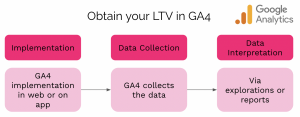
Graphic showing 3 steps to obtain Lifetime Value in GA4, including implementation, data collection, and data interpretation.

To gain access to this rich data, we need a connection to GA4 from our website or app to collect and interpret them via explorations and reports.

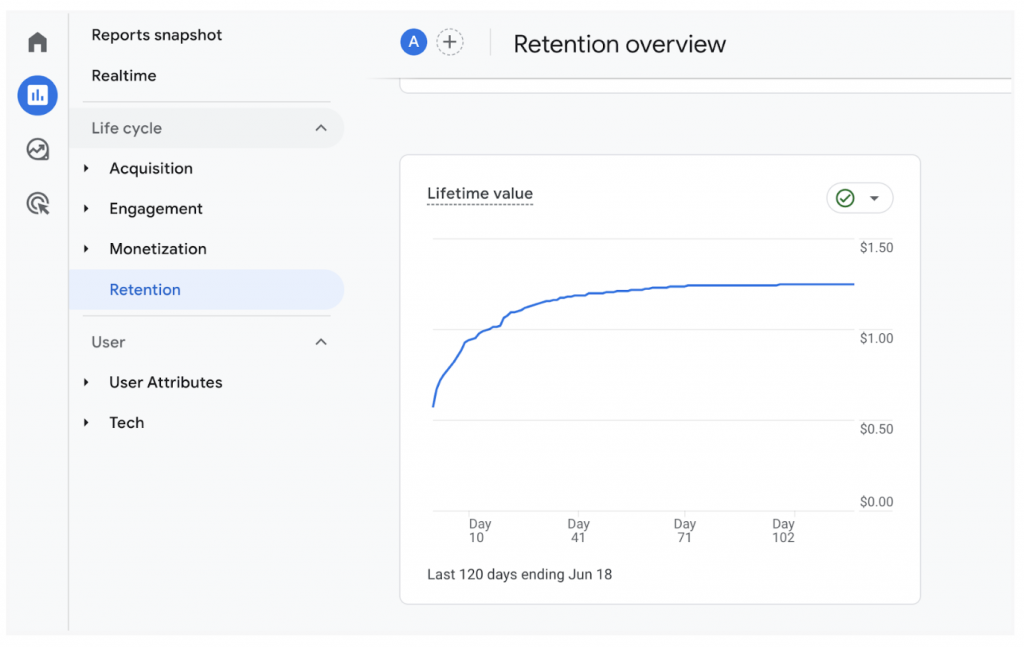
Where to find the Lifetime Value reports in GA4

Screenshot showing where to find Lifetime Value reports in GA4, under reports snapshot via retention overview

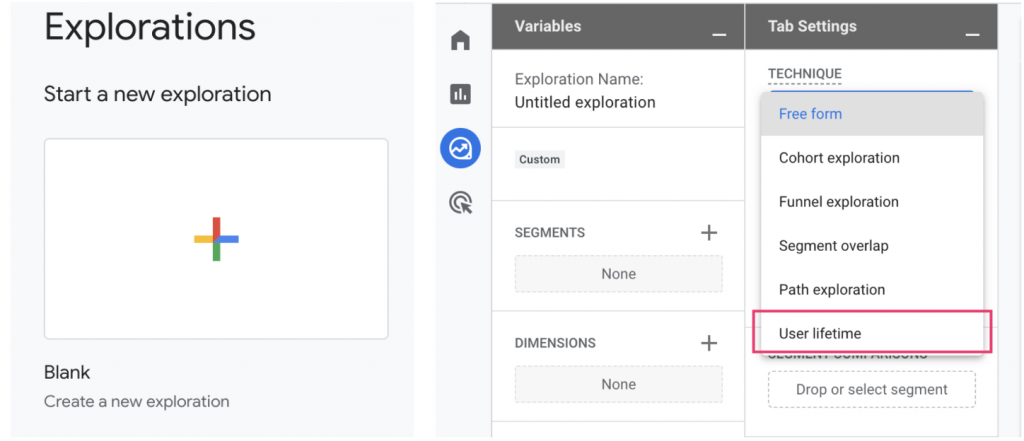
You can find LTV reports in GA4 in various ways:

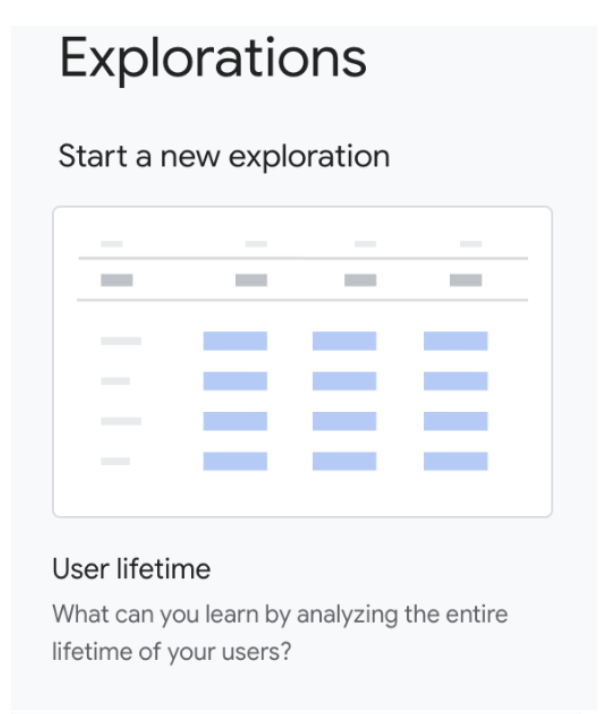
  • Directly starting a new exploration.
  • From a blank report.
  • By selecting Technique → User Lifetime.Image showing that under "start a new exploration", you can select "user lifetime" to see a report of user lifetime value.

Two methods for user identification and reporting

  1. User ID and device: This method employs more accurate data to identify the user and unify all related events in the reports and analysis. If no user ID is collected, Analytics uses a device ID to identify the user.
  2. Device ID: It uses the device ID to identify the user via the client_id event of GA cookies for web and the instance ID for the app.

At Making Science, we strongly recommend using the User ID option for more accurate results.

Are you eager to learn more about Conversion Rate Optimization (CRO), optimizing the user journey, or simply analyzing which tools are best suited for your business? Our team is ready to help. Don’t hesitate to reach out. 🚀

Get in touch

Or, check out our other Google Marketing Platform solutions.

The Push of AI in Marketing: How These 3 Spanish Brands and Their Partners Did It

NOTE: This article has been translated from the original Spanish, which can be found here. Therefore, embedded links/sources are predominantly in Spanish. English links have been included where possible.

For years, technological advancements and artificial intelligence (AI) have been part of companies’ daily lives, providing increasingly effective marketing tools to communicate the right message to the right user at the right time.

Evidence of this is that nearly 12% of Spanish companies with more than ten employees use AI in one way or another to improve their business. AI is not only one of the most discussed and sought-after topics in 2023, but marketing professionals have found in it a useful tool to serve their customers in a more personal and consistent way. And they don’t do it alone. The support of their partners and expert agencies is essential to efficiently use AI.

This collaboration for the design and execution of innovative strategies is the focus of the Google Marketing Partners Awards (GMPA), which aim to recognize the work of the best projects in technology in the industry using Google’s tools. This year’s GMPA involved the collaboration of Boston Consulting Group (BCG) as a strategic consultant for the analysis of the cases presented.

The gold winners were Making Science with its ad-machina solution in the Industry Solution category, Riu Hotels&Resorts along with Making Science in the Digital Transformation category, and T2ó with its success case for PortAventura World in the Media Activation category. All of them serve as inspiration for the efficient use of AI to boost marketing.

According to Javier Perez Moiño, managing director and partner of BCG Spain: “The marketing strategies of Spanish brands are increasingly sophisticated in terms of the use of technology and AI, which will continue to be the protagonist in 2023 and the coming years. The success of these strategies lies in focusing on the collaboration between the brand and partner and using AI at the service of the expert.”

1. Conveying the right message:

Making Science’s AI-based ad personalization solution

The growing demand for personalized travel experiences continues to rise among Spanish tourists. This presents a challenge for companies in the sector, which have extensive service feeds. Personalizing messages and experiences requires significant time and resources, in addition to constant updates due to ongoing changes in variables such as price, offers, or availability.

To address this challenge, tech consultancy Making Science has developed a solution for the sector based on AI for the automation of ads with key messages. This technology, called ad-machina, is a natural language generation (NLG) solution, which transforms a travel sector company’s product feed data into advanced Google Ads and Search Ads 360 campaigns.

The tool uses AI to create real-time, fully personalized ads based on user search criteria and cognitive biases. In addition, it adapts messages to current services, prices, and offers at the time of the search. These ads tailored to each search offer an improvement in the shopping experience for users, contributing to an increase in conversion rates for the company.

As explained by Eduardo Sarciat, managing director of ad-machina at Making Science: “AI technology allows us to transform data into advanced Google Ads campaigns, creating hundreds of thousands of messages in different languages to personalize the user experience.”

Making Science has applied its ad-machina technology to the Google Search campaigns of several of its tourism sector clients in Spain. An example is the hotel chain Iberostar, which thanks to the creation of real-time update messages for its offers managed to multiply its ROAS by four.

Iberostar add TWG (2) Before the application of ad-machina, Iberostar had three ads for each of its hotels. Applying the ad-machina AI solution allowed it to have an ad for each hotel, with over 100 personalization possibilities for each one.

2. Reaching the right user

Riu’s strategy to attract high-value customers with the activation of their own data through AI

30% of Spaniards were forced to cancel their vacations due to high inflation last year. This 2023, hotels also suffered due to the calling of general elections in the middle of July. The high cancellation rate is a trend that forces companies in the sector not to focus solely on achieving a large volume of reservations, but to do so while achieving the highest possible profitability.

The hotel chain Riu wanted to improve its customer acquisition campaigns, directing them towards higher value and profitability users, without losing conversion volume to reservations.

Together with their partner Making Science, they proposed a transformation of their digital strategy, which would allow them to   into business data. That is, order and activate data such as reservation cancellations, user loyalty to the brand, or customer spending at the hotel, to direct their campaigns towards the users who presumably would provide the most value to Riu.

Riu carried out this transformation of its digital strategy in three fundamental steps:

Own data structuring: The first measure was to structure their own data within Google Cloud, to create a Customer Data Platform (CDP) architecture, adapted to their needs and structure.

As Juan Campins, VP of digital channel at Riu Hotels & Resorts explains: “What we were looking for was to collect all customer experience in a single environment, a secure, scalable, and connected environment, that would allow us to orchestrate our audiences in real time in both our own and paid channels.”

Team restructuring: The various IT, data, and marketing teams at Riu previously had different objectives and worked independently. They set joint objectives with the exploitation of their first-party data as the basis for the transformation of their strategy.

In the words of Álvaro Verdeja, global director of data and cloud at Making Science, “each team that worked with its own data contributed their data sources: digital marketing platforms, contact center platforms, the reservation engine, etc.”

The teams moved on to have defined functions based on what part of the process of exploiting that own data each one performed. This established a way for everyone to collaborate to achieve business objectives. “From there, we were able to analyze user profiles to offer them a unique experience both prior to arrival on the website, on the website itself, and afterward,” explains Verdeja.

Activation of proprietary data thanks to AI: Together with their partner Making Science, they activated different proprietary technological solutions based on AI models, which the partner groups under the name of Gauss. In this way, they were able to activate their own data in an orderly and privacy-respecting manner, with the goal of achieving increased profitability while maintaining the volume of leads.

With Gauss’s AI solutions, they were able to predict those users who are more likely to cancel or finalize the reservation, to boost their Value Based Bidding strategy to bid towards those with a higher probability of converting.

This new business structure based on exploiting their own data allowed Riu to increase their bookings by 99%, and double their ROAS (Return On Advertising Spend).

3. The right time

T2ó’s case for PortAventura World on seasonality and sales periods

One of the main challenges of the tourism sector in Spain is to break with the marked seasonality of demand that exists. However, pinpointing the moments when users are willing to book a trip or a getaway outside of holiday peaks is quite a challenge.

That is what PortAventura World, a theme park located in Tarragona, faced when it wanted to advance its opening to February, introducing the Carnival period to boost one of its visitor low points.

With this new season, their major goal was to increase the volume of visitors and new customers by exploring new audiences.

Firstly, they used the AI solution Vimana from their partner T2ó to perform an initial analysis that allowed them to identify active demand for this new period. This tool applies AI and statistical calculations to analyze proprietary data and market information. “Based on the analysis of their own data, we designed the architecture of the audiences to work with, to propose an optimal media mix,” explains Alfonso del Barrio, managing director of T2ó Spain. “In this mix, the channels and functionalities of Google based on AI were essential to achieve the objectives,” he adds.

The success of the strategy was seen in the increase of more than 30% of new users and the 68% increase in total transactions compared to the previous year. As explained by Jordi Ortega, head of eCommerce at PortAventura World: “The result of applying a full funnel strategy hand in hand with the activation of like-minded audiences, together with the reach provided by campaigns executed through Google Marketing Platform, has allowed us to achieve performance metrics and an overall return on investment far above our initial expectations.”

“These cases show that the most successful marketing strategies focus on brand collaboration with their partners, driving business results with the tools that artificial intelligence offers,” explains Javier Pérez Moiño from BCG. “The most sophisticated marketing strategies achieve sustainable business results over time, giving the brand a competitive advantage,” he adds.


Making Science launches Trust Generative AI, built on Google Cloud Platform and OpenAI

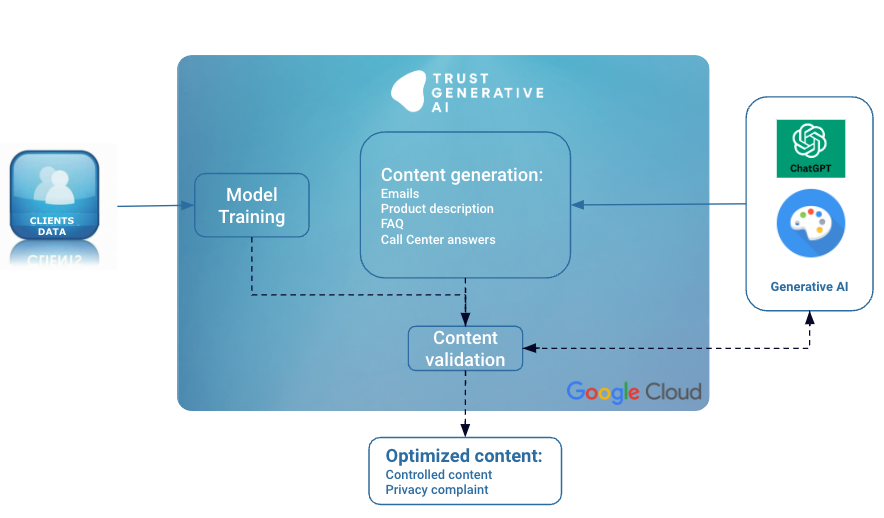
Making Science, the digital acceleration company, launches Trust Generative AI, a Generative Artificial Intelligence platform that solves two main problems on systems such as OpenAI: the difficulty of accessing non-public company data, and the absence of updated information in generative models.

The launch comes as generative artificial intelligence, based on large language models such as GPT and Bard, aims to transform the way people work, elevating companies to new heights of automation and efficiency in marketing. A recent MIT study, where professionals used Chat GPT to write reports, press releases, and other business documents, achieved 50% cost savings in report writing and improved report quality.

Large language models like GPT-3 cannot access non-public company information and lack recent information. The GPT-4 model was trained with data up to September 2021 but hasn’t been updated since. “The availability of large language models and generative AI opens up a world of possibilities. Trust Generative AI creates a bridge between private and recent company data and large models generated with public information, facilitating the adoption of AI for marketing,” explains José Antonio Martínez Aguilar, CEO of Making Science.

Developed on Google Cloud Platform and OpenAI, the platform optimizes data cycles and the training of AI models. It validates answers obtained using models developed on Google Cloud Platform on private customer data and more recent data not available in models like GPT-3 and GPT-4.

Therefore, companies maintain complete control over their data and can generate less generic content, more aligned with their policies and style guides, optimized with up-to-date information. 

An example of the efficiency of Generative AI is how Trust Generative AI generated 100,000 product descriptions for the Ventis.it website in minutes and at a cost more than 10,000 times lower than traditional means of generation. The generated descriptions were more than 95% aligned with other descriptions generated by the editorial department and were produced using prompts optimized by Trust Generative AI. 

Trust Generative AI can also generate all types of content, such as call center conversations, FAQs or emails, images, and other entities, connecting to services such as Google Cloud’s Vertex Generative AI, DALL-E2, and Stable Diffusion.

In an environment of rapid technological change and uncertainty about the use of technology, it is crucial to develop tools that help build trust in the use of technology. Trust Generative AI aims to play this role.

No matter how you are looking to implement AI for marketing in your company, Making Science can help.

Get in touch

How is AI-Generated Content Changing the Game?

AI-generated content is revolutionizing the way marketers create and distribute digital content. AI can provide engaging written and visual content, highly tailored using advanced algorithms and machine learning techniques. Grasping the potential of this content and effectively utilizing it in your campaigns will help you stay ahead of trends and achieve better results.

The ability of AI-generated content to produce customized material for specific clients is a major advantage. By analyzing consumer data and behavior, AI can create content that caters to the interests and preferences of distinct audience segments. This enhances the entire customer experience, boosting engagement and conversion rates.

AI-generated content can also save time and resources. AI can assist marketers in producing more content in less time without losing quality by automating the content development process. Small firms or marketing teams with minimal resources may find this to be extremely helpful.

Utilizing AI-generated content

AI can be employed to write product descriptions and other types of written content. AI-powered solutions can help you craft accurate and enticing product descriptions, freeing your team to focus on more strategic tasks. AI can also create visually appealing images and videos for use in social media campaigns and other digital advertisements.

A/B testing and optimization

Using AI-generated material for A/B testing and optimization is another approach. Making Science is leading the way in this field with its innovative GAUSS framework.

The Gauss Framework utilizes AI-generated content for A/B testing and optimization. With the ability to quickly determine the most effective parts of your content by evaluating consumer data and behavior, you can easily refine your campaigns. This leads to improved productivity and the optimization of advertising platforms such as Google Ads, DV360, Campaign Manager, and Facebook, among others.

Set your objectives

The first step is to set specific objectives, such as:

  • Increasing engagement and conversion rates
  • Reducing bounce rate by x% (i.e. improving customer experience)
  • Producing 3 more pieces of content per week

This will help you make the most of AI-generated content.

Once you have identified your goals, you should develop a strategy for how to achieve them. This should include a detailed plan for how you will use AI-generated content in your campaigns, what types of content you will generate, and how you will measure the success of your efforts.

Additionally, collaborate closely with your team and any external partners to ensure that your AI-generated content aligns with your overall marketing strategy. This involves working with your design, development, and data teams to ensure that your AI-generated content meets technical and branding requirements. Partnering with a data science team also guarantees that the data used to train the AI model is diverse and representative of your target audience.

Finally, it’s essential to continuously monitor and evaluate your AI-generated content efforts to ensure that they meet your goals and positively impact your business. This includes regularly analyzing metrics such as engagement rates, conversion rates, and customer feedback to identify areas for improvement and make adjustments as needed.

Using AI-generated content comes with numerous advantages and opportunities. By carefully selecting the data used to train the AI model, you can ensure that the content produced is diverse and representative of your target audience, minimizing the possibility of bias. Furthermore, incorporating AI-generated content into your campaigns opens the door to new possibilities and allows you to enhance human creativity and uniqueness, rather than stifle it.

To ensure the success of using AI, it is key to have a clear strategy and to be aware of potential challenges. Reach out to our team of experts to create a clear strategy with AI and to learn more about GAUSS!

Get in touch

Pioneering applications of AI in advertising

First: A warning to all the androids out there

Science fiction movies might come to mind when we hear about Artificial intelligence (AI). In many of these movies, AI became conscious. And, of course, they all came to the same conclusion: “Error 404 – human beings are to blame for everything bad on this planet. Ending the human race will set us free.” For all those androids and bots out there that are reading this: that’s simply not true! No matter how hard you try to annihilate humanity, you will never be free, because in short, you are just a digital tool to make life easier and besides, we’ve got you all figured out!

Now that we’ve got that out of the way, and shaken our fear of dystopian AIs a bit, I am here to tell you about the applications of this tool in advertising. I’ll also share some examples of national and international campaigns where this tool has been applied for good.

Why do AI and advertising go so well together?

Advertising is constantly evolving. It’s an endless race in which every tool or innovation translates into an opportunity to better impress and impact our consumers. Artificial Intelligence is another one of those tools in our belts we can use to better impress our customers. And, despite its relatively short lifespan, we can already observe some of the changes generated and process improvements that exist in the industry.

One of the main tasks of advertising is to analyze large amounts of data to identify patterns and trends in consumer behavior. Normally, this is an arduous task. But, it can be carried out by AI quickly and more precisely. This gives us valuable time back, allowing us to design more effective and personalized advertising campaigns, as well as streamline processes and reduce time spent.

Practical applications of AI in advertising

We can use AI to quickly optimize our advertising campaigns. Advertisers can use Artificial Intelligence to automatically analyze and adjust the targeting, budget, and creatives of ad campaigns in real-time. This can increase advertising efficiency by lowering your cost per acquisition and increasing your return on investment.

Another application of AI is to use it to analyze the results of advertising campaigns. Advertisers can use AI to analyze ad campaign performance data and gain insight into which elements of the campaign are working and which are not. This can help advertisers adjust and improve their campaigns in the future.

Examples of AI art being used in recent campaigns

There are many different types of Artificial Intelligence already. Today I want to talk a bit about Midjourney. It is an image generator with text that works thanks to an AI. Here I will discuss two of my favorite examples of “artificial campaigns” generated by this tool.

The first features a Spanish comic called Gatas (English article here). It is a comic created by the agency CYW. In it, we meet some revolutionary Spanish grandmothers who live in a dystopian Madrid in the year 2614. While the text was written by humans, the art itself was generated by the MidJourney technology.

The second creative example that I bring you, and my favorite to date, is this campaign for The Melbourne Writers Festival. In it, they used the same Artificial intelligence as CYW to bring to life the most famous texts of universal literature. I invite you to discover this campaign; it only takes a minute and I am sure you will find it interesting.

Considerations for using AI in your campaigns

While AI is an extremely useful tool, there have been some controversies related to the use of this type of generated imagery. This is because AI tools are “taught” how to create based on art created by real people. So, before jumping into using any tool for this type of work, be sure to check into the company providing the software. It is never a good idea to steal the work of others. Be sure you don’t run into any copyright issues!

In the end…

AI is rapidly transforming the world of advertising by enabling the personalization, optimization, and analysis of advertising campaigns in real-time. As AI continues to evolve, it is likely to play an even bigger role in advertising in the future.

If you’re not quite sure how AI might be able to save you time and money, our team would be happy to help!


Get in touch

ChatGPT for SEO experts

There has recently been a growing interest in AI technology and, more specifically, OpenAI’s ChatGPT product. In this week’s blog post we will learn what ChatGPT is and how to use it in SEO.

What is ChatGPT?

ChatGPT is a language model developed by OpenAI, a leading research organization in the field of artificial intelligence. It is a type of AI technology that uses deep learning algorithms to generate human-like text based on a large corpus of training data.

ChatGPT has been trained on a massive amount of diverse text data, making it capable of generating text in various styles and on a wide range of topics. This makes it a versatile tool that can be used for different applications, such as language translation, text summarization, question answering, and content generation. It has become a popular instrument for building conversational AI systems, such as chatbots, as it can generate coherent and contextually appropriate responses to different questions. Overall, ChatGPT is a powerful and sophisticated AI technology that has the potential to revolutionize the way we interact with computers and automate many language-related tasks.

Is ChatGPT good for SEO?

ChatGPT has the potential to be a useful tool for SEO (Search Engine Optimization), but it is not a silver bullet and has some limitations. ChatGPT can be used to generate optimized content for websites, such as product descriptions or blog articles. It can also assist with keyword research by generating suggestions for relevant keywords and phrases.

However, it is essential to remember that the generated content may not always be accurate or high-quality. It may lack the creativity and originality that is often necessary for effective SEO. Additionally, there may be ethical considerations to using AI to manipulate search engines, such as the impact on content creators and the overall quality of online content. It is also worth noting that search engines are constantly updating their algorithms to detect better and penalize manipulation, and they may be able to detect content generated by AI.

In conclusion, while ChatGPT has the potential to be a useful tool for SEO, it is not a guaranteed solution and should be used with caution and in conjunction with other SEO best practices.

How are SEO experts using ChatGPT?

SEO experts are using ChatGPT in various ways to improve their search engine optimization efforts. Some typical applications of ChatGPT in SEO include:

  • Content Generation: ChatGPT can be used to generate high-quality, optimized content for websites, such as product descriptions, blog articles, and meta descriptions. The generated content is designed to be SEO-friendly, with a focus on incorporating relevant keywords and phrases.
  • Keyword Research: ChatGPT can assist with keyword research by generating suggestions for relevant keywords and phrases. This can help SEO experts identify keywords they may not have considered and improve their content’s visibility in search results.
  • Competitor Analysis: ChatGPT can be used to analyze competitor websites, identifying their strengths and weaknesses, and helping SEO experts to stay ahead of the competition.
  • Chatbots: ChatGPT can be used to build chatbots for websites, which can help to improve the user experience and increase engagement. Chatbots can answer customer questions and provide information, reducing the workload for human customer service representatives.

It’s worth noting that ChatGPT is just one tool in an SEO expert’s arsenal and should be used in conjunction with other best practices and techniques. Additionally, as search engines continually update their algorithms, it’s important to stay up-to-date on the latest SEO trends.

 What are the drawbacks of Chat GPT and potential ethical considerations?

 There are several limitations to using ChatGPT for SEO:

  • Accuracy: While ChatGPT is a very advanced language model, it is not perfect and may generate incorrect or unreliable information. This can be a concern when using it for SEO, as the accuracy of the information used to optimize websites and content is critical.
  • Scalability: Depending on the model’s size, using ChatGPT for SEO on a large scale may require significant computational resources and be expensive.
  • Lack of creativity: Although ChatGPT can generate human-like text, it may lack the creativity and originality that is often necessary for effective SEO.

In terms of ethical considerations, it is important to consider the potential consequences of using AI to generate optimized content and manipulate search engines. Some may argue that this practice undermines the integrity of search engines and could lead to the dissemination of inaccurate or misleading information. Additionally, there may be concerns about the impact on content creators and the overall quality of online content.

It is essential to carefully weigh the potential benefits and risks of using ChatGPT for SEO and ensure that it is used responsibly and ethically.

How to think about ChatGPT as an SEO expert

As an SEO expert, it is crucial to approach ChatGPT as just one tool among many in your arsenal, and to use it thoughtfully and strategically.

Here are some key considerations when thinking about using ChatGPT for SEO:

  • Quality over Quantity: While ChatGPT can generate a large amount of content quickly, the quality of that content may not always be up to the standards you require. It is important to prioritize quality over quantity and carefully review the content generated by ChatGPT to ensure it meets your standards and is SEO-friendly.
  • Context Matters: ChatGPT has been trained on a large corpus of text data, but it may not always understand the nuances and context of specific topics. It is essential to be mindful of this and to provide clear, detailed instructions when using ChatGPT for content generation or keyword research.
  • Ethical Considerations: There may be ethical considerations to using AI to manipulate search engines, such as the impact on content creators and the overall quality of online content. It is important to be mindful of these considerations and to ensure that your use of ChatGPT aligns with your ethical standards and values.
  • Algorithm Updates: Search engines are constantly updating their algorithms to detect better and penalize manipulation, and they may be able to detect content generated by AI. It is vital to stay up-to-date on the latest developments and trends in SEO, and to continually evaluate your use of ChatGPT in light of these changes.
  • Integrating with Other Tools and Techniques: While ChatGPT can be a valuable tool for SEO, it should be used in conjunction with other best practices and techniques. This may include conducting keyword research, analyzing competitor websites, and building high-quality backlinks, among other things.

In conclusion, as an SEO expert, it is important to approach ChatGPT with a strategic and thoughtful mindset, and to use it as just one tool among many in your toolkit. Get in touch with our SEO experts to utilise AI effectively in your SEO campaign. 

PS: This article was written exclusively with the help of ChatGPT. A human reviewer corrected discrepancies and structured the content.