

Responsive Design and Accessibility: Mastering User-Centric Web Frontends

The Surprising Reality of Mobile Web Accessibility

One might think that it’s a battle won. Web accessibility has been a resonating theme for over two decades now, emphasizing the importance of ensuring an inclusive online experience for all users. 

65% of web traffic in Europe comes from mobile devices, and Google has clearly indicated its support for mobile-optimized websites by favoring them in its ranking.

Mobile Optimization: Expectation vs. Reality

Nowadays, all advertisers should have a mobile-optimized website that adheres to the basics of accessibility – how could it be otherwise?

However, despite advancements, the reality is quite different. A study conducted by Making Science in 2022 shows that, among other findings, 72% of the websites of the companies from the IBEX 35 (Spain’s principal stock exchange), exhibit mobile accessibility deficiencies.

Similarly, we still encounter clients asking us to audit their website, only to find that the design was not initially intended for mobile.

This is particularly serious because not optimizing the experience for the majority of traffic exposes one to losing conversion points, leads, and sales.

Responsive Design vs. Mobile First.

Moreover, just because a website displays decently on a mobile device doesn’t mean it’s optimized for the best conversion. To explain, the term “responsive” is not equivalent to “Mobile First.”

When designing a website, there are generally 2 or 3 versions for different device types: Desktop, Mobile, and sometimes Tablet. There are fundamentally two ways to work: either start with mobile and progress to larger formats, known as “Mobile First”, or the other way around. This first approach makes the most sense since it caters to the majority of users, leveraging additional space on desktop.

The other approach, unfortunately still too common, goes in the opposite direction, known as “Graceful Degradation.” The designer starts with the largest version and then adapts it to mobile. This is not the right approach as it optimizes work for a minority, requiring adjustments for content and functionality in a confined space.

You might say, “But if we’re talking about ‘Graceful Degradation,’ it can’t be that bad.” Let me give you an example to explain why it’s not the case.

Imagine a product website presenting its main selling points to visitors. On the desktop version, a common way to present them would be using elements called “Cards,” with 3 or 4 cards in a row. This layout is suitable for a large horizontal screen but we can immediately intuit that it doesn’t fit very well into a vertical screen. 
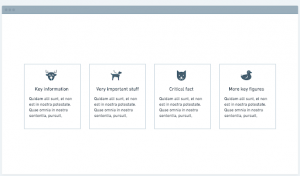
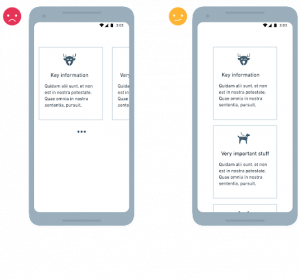
When translated to mobile, these cards often end up either in a horizontal carousel or a simple vertical stack, neither of which is optimal. In the first case, the user will have to interrupt his horizontal scroll to scroll horizontally in order to see the info. (Spoiler: he won’t do so, and will lose an important part of the product pitch.)

Vertical stacking is a better option, but in terms of design and space optimization, it’s really not that great. 

The Case for Progressive Enhancement
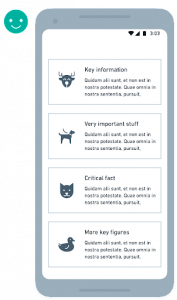
Working in the direction of “Progressive Enhancement,” starting with mobile, forces us to optimize information presentation for mobile constraints, resulting in a better-adapted version.

Here, all information is visible on a single screen, giving the user access to all arguments in a nutshell.
The errors caused by the Desktop First approach can be even more dramatic and lead to significant drops in conversion. For example, forgetting to provide a mobile user with a link to return to the filtered list from a product page because the Desktop version lacks it (desktop users are generally relying on the browser’s back button).

Breaking Free from Old Design Habits

Unfortunately, many agencies and designers still follow a Desktop First approach, either out of habit or comfort.  It’s more rewarding to design a beautiful layout on a large screen than starting with mobile.  Another downside is that since mobile design comes at the end of the creation process, it often gets rushed to meet deadlines.

It’s time for agencies and designers to break free from old habits and prioritize the quality of the user experience across all platforms.

Advertisers must also ensure that teams responsible for designing digital assets opt for a “Progressive Enhancement” approach, starting with mobile. This represents a strategic approach to overcome constraints while ensuring a consistent and optimal user experience.

The journey towards universal web accessibility and an exceptional user experience requires constant evolution of methodologies and a reassessment of established practices. Only those who anticipate these changes and adopt innovative approaches can hope to stay in sync with the growing expectations of users.

Making Science expands US service offerings with new Google Marketing Platform Sales Partner Certification

Certified to deliver all 11 Google Marketing Platform (GMP) services, Making Science is now a GMP Sales Partner licensed to resell contracts for the full suite of GMP products

Chicago, January 30, 2024 – Making Science, a global digital marketing company, today announced its official status as a Google Marketing Platform (GMP) Sales Partner in the United States. This strategic partnership empowers Making Science to resell contracts for the full suite of GMP products, providing brands and agencies with platform access to help navigate the evolving digital marketing landscape.

“We couldn’t be more excited about our newly minted status as a Google Marketing Platform Sales Partner,” commented Jason Downie, the US CEO of Making Science. “By delivering GMP services over the years, we observed the transformative power of GMP to connect brands with audiences. Our elevated partnership formalizes our commitment to democratizing access to these cutting-edge tools, allowing Making Science to resell GMP products and help US brands and agencies unlock the full potential of Google and accelerate their digital transformation.”

As a new GMP Sales Partner, Making Science continues to offer unparalleled expertise and comprehensive services, which include:

  • Data + Activation: Making Science helps brands develop strategies to collect, analyze, and transform first-party data from site analytics, CRM, and Cloud platforms into assets for media activation.
  • Performance Enhancing Technology: Making Science has built award-winning automation and AI technologies that supercharge Google Ads and GMP media performance. With 400+ engineers, they are the rare marketing consultancy backed by proven IT and developer horsepower.
  • Privacy-Forward Solutions: Making Science helps brands prepare for third-party cookie deprecation and navigate a rapidly evolving digital marketing landscape with proprietary reporting technology, audits, privacy-preserving consultation, and mitigation plans.
  • Strategic Partnership Development: The US leadership team has 30+ years of combined experience at Google and across the broader AdTech industry. They have an unmatched understanding of multi-partner collaboration with Google, agencies, and industry-leading data and technology providers. 
  • Delivery at Scale: Making Science offers agile, on-demand service teams dedicated to US customers with the ability to scale globally.

“As one of only a few certified GMP resellers in the US, our unmatched expertise offers clients a competitive edge as they navigate cookie deprecation and bolster their first-party data assets,” commented Founder and Chairman of Making Science, José Antonio Martínez Aguilar. “This is an exciting step in our growth and enables us to truly collaborate with and support our clients in every aspect of their digital marketing initiatives.”  

This alliance marks a significant milestone for Making Science and the company’s global expansion while further solidifying its position as a trusted global guide for brands seeking to unlock the full potential of their digital marketing efforts. Organizations can gain a competitive edge, achieve measurable results, and drive sustainable growth by leveraging the power of GMP and Making Science’s expert guidance.

[button color=”accent-color” hover_text_color_override=”#fff” size=”large” url=”www.makingscience.com/contact” text=”Get In Touch To Accelerate Your Buisness with GMP” color_override=”#f0067f”]

About Making Science 

Making Science is a global digital acceleration company with a dynamic team of over 1,200 experts across 15 markets, including Spain, Portugal, Mexico, Colombia, France, Italy, the UK, Ireland, Sweden, Denmark, Norway, Finland, Germany, Georgia, and the USA. As a proud consulting partner of Local Planet — the world’s premier network of independent media agencies — we deliver a suite of digital, technology, and performance marketing services to a global clientele. Our expertise spans digital marketing and MarTech, software and cloud solutions, artificial intelligence, and SaaS, all underscored by a relentless pursuit of innovation.

As part of its commitment to innovation, Making Science offers its clients end-to-end capabilities required for consulting, developing, integrating, and maintaining advanced IT solutions. Our global network of delivery hubs not only fosters job growth but also serves as an incubator for cultivating top-tier tech talent, fueling projects that accelerate transformation and modernization.

Committed to making a positive impact, Making Science actively engages in various ESG initiatives. We’ve joined forces with the Climate Pledge, the United Nations Global Compact, and Pledge1%, dedicating resources and efforts to support non-profit organizations. Through these endeavors, we are committed to driving meaningful change for a brighter, more sustainable future.

In conversation with The Drum: Clients want to know about agency AI capabilities. How can you stand out?

Read the full article: www.thedrum.comJTNDc2NyaXB0JTNFJTBBJTJGJTJGJTIwR2V0JTIwYWxsJTIwZWxlbWVudHMlMjB3aXRoJTIwY2xhc3MlMjAlMjJpbm5lciUyMiUwQXZhciUyMGlubmVyRWxlbWVudHMlMjAlM0QlMjBkb2N1bWVudC5xdWVyeVNlbGVjdG9yQWxsJTI4JTI3LmlubmVyJTI3JTI5JTNCJTBBJTBBJTJGJTJGJTIwSXRlcmF0ZSUyMG92ZXIlMjBlYWNoJTIwJTIyLmlubmVyJTIyJTIwZWxlbWVudCUwQWlubmVyRWxlbWVudHMuZm9yRWFjaCUyOGZ1bmN0aW9uJTI4aW5uZXJFbGVtZW50JTI5JTIwJTdCJTBBJTIwJTIwJTIwJTIwJTJGJTJGJTIwR2V0JTIwdGhlJTIwZWxlbWVudHMlMjB5b3UlMjB3YW50JTIwdG8lMjBtb3ZlJTBBJTIwJTIwJTIwJTIwdmFyJTIwaW1hZ2VJY29uJTIwJTNEJTIwaW5uZXJFbGVtZW50LnF1ZXJ5U2VsZWN0b3IlMjglMjcuaW1hZ2UtaWNvbiUyNyUyOSUzQiUwQSUyMCUyMCUyMCUyMHZhciUyMHdyYXBTcGFuJTIwJTNEJTIwaW5uZXJFbGVtZW50LnF1ZXJ5U2VsZWN0b3IlMjglMjcud3JhcCUyNyUyOSUzQiUwQSUwQSUyMCUyMCUyMCUyMCUyRiUyRiUyMFJlbW92ZSUyMHRoZSUyMGVsZW1lbnRzJTIwZnJvbSUyMHRoZWlyJTIwY3VycmVudCUyMHBvc2l0aW9ucyUwQSUyMCUyMCUyMCUyMGlubmVyRWxlbWVudC5yZW1vdmVDaGlsZCUyOGltYWdlSWNvbiUyOSUzQiUwQSUyMCUyMCUyMCUyMGlubmVyRWxlbWVudC5yZW1vdmVDaGlsZCUyOHdyYXBTcGFuJTI5JTNCJTBBJTBBJTIwJTIwJTIwJTIwJTJGJTJGJTIwSW5zZXJ0JTIwdGhlJTIwZWxlbWVudHMlMjBpbiUyMHRoZSUyMGRlc2lyZWQlMjBvcmRlciUwQSUyMCUyMCUyMCUyMGlubmVyRWxlbWVudC5pbnNlcnRCZWZvcmUlMjh3cmFwU3BhbiUyQyUyMGlubmVyRWxlbWVudC5maXJzdENoaWxkJTI5JTNCJTBBJTIwJTIwJTIwJTIwaW5uZXJFbGVtZW50Lmluc2VydEJlZm9yZSUyOGltYWdlSWNvbiUyQyUyMGlubmVyRWxlbWVudC5maXJzdENoaWxkJTI5JTNCJTBBJTBBJTdEJTI5JTNCJTBBdmFyJTIwZmlyc3RJbWFnZUljb24lMjAlM0QlMjBkb2N1bWVudC5xdWVyeVNlbGVjdG9yJTI4JTI3LmltYWdlLWljb24lMjclMjklM0IlMEElMkYlMkYlMjBDaGFuZ2UlMjB0aGUlMjBiYWNrZ3JvdW5kJTIwaW1hZ2UlMjBvZiUyMHRoZSUyMGZpcnN0JTIwJTIyLmltYWdlLWljb24lMjIlMjBlbGVtZW50JTBBJTIwJTIwJTIwJTIwJTIwJTIwJTIwJTIwZmlyc3RJbWFnZUljb24ucmVtb3ZlQXR0cmlidXRlJTI4JTI3c3R5bGUlMjclMjklM0IlMEElMjAlMjAlMjAlMjAlMjAlMjAlMjAlMjBmaXJzdEltYWdlSWNvbi5yZW1vdmVBdHRyaWJ1dGUlMjglMjdkYXRhLWJnJTI3JTI5JTNCJTBBJTIwJTIwJTIwJTIwJTIwJTIwJTIwJTIwZmlyc3RJbWFnZUljb24uc3R5bGUuYmFja2dyb3VuZEltYWdlJTIwJTNEJTIwJTI3dXJsJTI4aHR0cHMlM0ElMkYlMkZ0aGVkcnVtLW1lZGlhLmltZ2l4Lm5ldCUyRnRoZWRydW0tcHJvZCUyRnMzJTJGczNmcy1wdWJsaWMlMkZwaWN0dXJlcyUyRnBpY3R1cmUtMTQ3MTU0LTE2MjE5Mzg1MDguanBnJTI5JTI3JTNCJTBBJTBBJTNDJTJGc2NyaXB0JTNF

AR and VR in the Digital Age: Uphill Battle or Future of Opportunity?

Augmented Reality (AR) and Virtual Reality (VR) have made their mark in the digital landscape, promising to revolutionize our interactions with the world. Yet, despite their potential, these technologies are still striving to attain mainstream acceptance. Does AR/VR signal an uphill battle or do they hold a future of opportunity?

Unique UX/UI Design Principles in AR/VR

AR and VR have found success within niche applications. Google, for instance, has made impressive advancements in AR by enabling users to visualize certain products before purchase, and platforms like YouTube now use AR for innovative features like makeup trials. However, these successes are more exceptions than the norm.

Even with tech giants like Meta and Apple delving into this realm, their offerings haven’t ignited the market as expected. Meta’s AR/VR headset and Apple’s VisionPro are yet to showcase their full potential.

A key factor in the adoption of these technologies is the user experience they provide. The UX/UI design principles for AR/VR go beyond the conventional ones like user-centered design, consistency, and hierarchy. AR/VR environments, due to their three-dimensional nature, necessitate a detailed understanding of depth, proximity, and motion, thus broadening the horizon of UX/UI design principles.

Comfort: A Critical Factor in AR/VR Adoption

Comfort in AR/VR settings is a significant aspect that influences user acceptance. The immersive nature of VR can cause discomfort or even trigger motion sickness in users. To encourage user adoption, designers must explore and implement strategies to mitigate these discomforts, thereby ensuring an engaging and enjoyable experience.

Emerging Technologies: A Ray of Hope?

Despite these challenges, emerging technologies offer a glimmer of hope for AR and VR. Products like XREAL’s connected glasses and Mojo Vision’s connected lenses could potentially revolutionize the game. These devices aim to seamlessly merge the virtual and real worlds, making AR/VR more accessible and practical for everyday use.

 Envisioning the Future with AR/VR

The journey of AR and VR technologies in the digital age has been challenging, primarily due to factors like user comfort and the need for innovative UX/UI design principles. However, with the emergence of new devices and a focus on enhancing user experience, these technologies have the potential to take off in a significant way.

Whether AR and VR will become a mainstay in our everyday lives or remain a promising yet unrealized innovation is a narrative that continues to unfold. What’s clear is that these technologies are shaping our present and have the potential to significantly influence the future of digital transformation.

Integrating AR/VR technologies into digital transformation strategies is not just about keeping pace with the latest tech trends. It’s about envisioning a future where businesses can provide unprecedented value to their customers, enhance business operations, and gain a stronger competitive position in an increasingly digital market. AR and VR are not just technologies of the future—they are shaping the present and have the potential to drive significant value in the digital transformation journey. Businesses that understand this will be well-positioned to thrive in the digital age.

Leading the way in this digital era, Making Science is committed to leveraging new technologies to drive digital transformation. Our team of experts, armed with solid UX/UI design principles, is dedicated to helping businesses harness the full potential of AR/VR technologies, enhance customer experiences, and secure a competitive edge in the digital age. Ready to embark on your digital transformation journey with AR/VR? Partner with Making Science today!

Customer Data Platforms: Taking Customer Experience Personalization to the Next Level

The digital ecosystem’s ongoing evolution gives organizations more touchpoints with users and access to richer data. Due to the rapid evolution of digital touchpoints, companies face significant challenges. Their primary task is to efficiently collect and organize the growing volume and variety of data. Overcoming information silos is essential. Leveraging this data from the cloud—where it remains securely under the company’s governance—is crucial. By doing so using Customer Data Platforms, companies can enhance the user experience and maximize the data’s business value.

How can we achieve this? 

Various technologies exist in the market, but at Making Science, we’ve learned that each company requires a solution specifically designed for its unique business and organizational needs. To address this, we’re working closely with our clients to create Composable Customer Data Platforms (CCDPs) and Customer Data Architecture (CDAs) using Google Cloud.

  • CDAs aggregate information from different domains of a company, making it accessible, and facilitating subsequent activation. It is also a long-term solution that allows it to build future business use cases, enabling organizations to own their data.
  • On the other hand, CCDPs are market tools designed to activate use cases in a ‘simple’ way, without dependencies on technology teams.

So, which one should you choose? A Composable CDP or a CDA? 

Composable CDPs have revolutionized the way we handle customer data. Previously, tools such as Customer Relationship Management Data Management Platforms (CRM DMPs) dominated the landscape. However, a CDP operates as an ‘open platform’, letting us merge diverse data sources and dismantle longstanding information silos. To truly unlock the potential of a CDP, it’s essential to establish a data architecture (CDA) that facilitates real-time data activation.

This solution offers numerous benefits pivotal to the success of a comprehensive 360-degree marketing strategy: profile alignment, enhanced segmentation, implementation of predictive models and Generative AI solutions, enhanced customer insights, unified multichannel marketing resource optimization, and the eradication of data silos.

How do we measure the success of a Composable Customer Data Platform/CDA? 

Every investment should have a measurable ROI, a return for the business, and in the case of CDP/CDAs, there are three aspects to consider and measure: sales, speed, and cost savings.

Undoubtedly, incredible challenges are arising in data, cloud, and AI for companies, which will change how they make decisions, conduct marketing, integrate advanced marketing analytics, and manage their organizations. Is your company ready to extract the maximum value from its data?

Do you want to learn more about Customer Data Platforms for your business? At Making Science, we have a specialized team of experts who can help you define your CDP/CDA strategy for your specific case. Contact us!

Gauss: Artificial Intelligence Engine for Marketing and Sales

Marketing has transformed from traditional methods like newspaper ads and billboards to advanced digital techniques. As customer behavior evolves, companies heavily invest in technology and digital marketing to maintain a strong presence. This shift brings challenges in planning, measuring, and analyzing marketing strategies, requiring data-driven decisions for effective customer attraction and retention.

Investing in marketing technology (Martech) is crucial for companies aiming to outperform competitors. Martech tools streamline marketing processes and boost performance, providing a competitive edge. Embracing modern technology allows companies to harness data for strategic marketing and informed decisions, meeting customers’ changing needs and ensuring long-term success in today’s market.

Our Solution

Gauss, developed by Making Science, is a marketing technology platform leveraging AI and First-Party Data (FPD) to boost customer campaign performance. Making Science created Gauss to address market gaps in existing Martech solutions, and provide comprehensive solutions for clients.

Gauss was launched in 2018. Since then, it has transformed marketing approaches, attracting 75% of companies seeking Making Science’s services. Designed for businesses of all sizes, the platform enhances marketing strategies and results. Its use of AI and FPD sets it apart, analyzing data to offer valuable customer insights and informing marketing decisions.

Meanwhile, FPD allows businesses to track and analyze every step of the customer journey, from initial contact to conversion. This helps companies to understand which marketing channels are most effective at each customer journey stage, allowing them to optimize their campaigns for maximum impact.

In addition to AI and FPD, Gauss also offers a range of other features and services, including:

  • Multi-channel marketing: Gauss supports various marketing channels, including email, social media, display advertising, and more.
  • Real-time reporting: Gauss provides real-time insights into campaign performance, allowing businesses to adjust their strategies.
  • Customer segmentation: Gauss allows businesses to segment their customers based on various factors, including demographics, behavior, and preferences.
  • Personalization: Gauss enables businesses to personalize their marketing messages and content to each customer based on their unique preferences and behavior.

Gauss, an all-in-one marketing platform, equips businesses with tools for optimizing campaigns and driving results. Utilizing AI and FPD, Gauss offers previously unavailable insights and optimization, making it essential for competitive businesses.

Since its launch in 2018, Gauss has evolved into a parent platform for several products, each designed to cater to specific marketing needs. Let’s take a closer look at each of these products:

Attribution

Attribution is a product that helps businesses accurately attribute sales and revenue to their marketing efforts. With it, companies can track the customer journey from initial contact to conversion. They can also identify which channels and tactics are most effective in driving sales.

Connected TV 

Connected TV enables businesses to integrate the planning and reporting of their linear and connected TV campaigns. It allows advertisers to plan, measure, and optimize campaigns by allocating investment to channels where their target audience is located. Connected TV integrates measurement of online and offline TV, showing the incremental reach offered by media and channels to test and run on the most effective channels.

Data Collection

Data Collection is a tool that disaggregates and analyzes real-time data from various sources, such as consumer transactions, social media, and websites. It offers valuable insights into consumer behavior to refine marketing strategies, optimize campaigns, and improve performance metrics. With advanced consumer analytics, businesses can make data-driven decisions for better outcomes.

Data Quality

Data Quality is a product that helps businesses ensure the accuracy and reliability of their data. With this product, companies can identify and eliminate duplicate or inconsistent data, ensuring their marketing decisions are based on reliable information. 

Dynamic Creatives

Dynamic Creatives is a product that enables businesses to create personalized ads that change dynamically based on the user’s behavior and preferences. With this product, companies can deliver ads tailored to each customer, increasing the likelihood of conversion.

Marketing Mix Modeling (MMM)

MMM optimizes marketing spending across channels and tactics, helping businesses measure and quantify online and offline impacts for ROI maximization. Integrating data from digital and traditional media, predicts marketing activity influence on KPIs like sales or web traffic. MMM also considers contextual factors that may affect sales, helping CMOs better allocate their media budgets.

Offline Conversions

Offline Conversions is a product that helps businesses track the impact of their online advertising on offline sales. With this product, companies can attribute offline sales to their online marketing efforts, allowing them to measure their campaigns’ effectiveness accurately.

Shopping 

Shopping optimizes e-commerce companies’ Google Shopping campaigns by automating bidding, optimizing product feeds, and creating dynamic campaigns. It updates the feed in real-time, ensuring customers find what they’re looking for at the right price while preventing unhelpful clicks due to out-of-stock items.

Smart Advertising

Smart Advertising uses AI to optimize digital ad investments for businesses. It enables CMOs to efficiently allocate ad budgets while monitoring and improving KPIs like CPA and sales ratio, in real-time. The product captures data, predicts sales, increases sales by 20%, and decreases CPA by 15%, making it a valuable tool for companies seeking growth and cost control.

Overall, Gauss’ suite of products provides businesses with everything they need to create effective, data-driven marketing campaigns. Whether tracking the customer journey, optimizing advertising spend, or creating personalized ads, Gauss has a product that can help businesses achieve their marketing goals.

To learn more about Gauss, contact our team of experts to learn more about our technology and start your digital transformation.

Let’s activate your data, let’s Gauss!