

Key Takeaways for Travel Brands from Digital Travel Connect

I recently had the privilege of engaging with numerous travel industry professionals at Digital Travel Connect. The energy and insights were fantastic, and it’s always valuable to connect with people facing the same challenges and opportunities. My workshop, in particular, sparked some really important conversations, and I walked away with a renewed sense of the direction travel brands need to take.

One of the most persistent issues raised was the challenge of generic bidding. It’s a David vs. Goliath situation out there. Too many travel operators, especially smaller and mid-sized businesses, are consistently outbid by the major Online Travel Agencies (OTAs) for those crucial generic keywords. This dynamic creates a bottleneck, restricting these operators largely to branded search terms and severely limiting their ability to expand their reach and acquire new customers cost-effectively. We must find strategies to level the playing field and empower these brands to compete for valuable generic traffic.  

Closely related to this is the ongoing puzzle of SEO and landing page optimization. Driving direct bookings is the holy grail for travel brands, as it allows them to maximize margins and own the customer relationship. However, achieving this requires a sophisticated approach to SEO and the creation of compelling, high-converting landing pages. Many brands struggle with this, lacking the resources or expertise to consistently produce optimized content that ranks well and drives action. This is a missed opportunity, as users are searching for information, and we need to ensure our clients’ properties appear at the top of the search results.  

These challenges aren’t just abstract concepts; they have a real impact on the bottom line. Travel brands need actionable solutions that enable them to:

  • Compete effectively for generic search traffic, breaking free from the constraints of branded search.  
  • Optimize their digital presence to capture more direct bookings, increasing profitability and customer ownership.  
  • Deliver personalized, relevant digital experiences that meet the evolving expectations of today’s travelers.  

This is where I believe Making Science can make a real difference. Our expert report, “How automated solutions can transform your performance marketing,” directly addresses these pain points. We delve into the power of AI and automation to revolutionize performance marketing strategies, with a particular focus on our ad-machina technology.

Ad-machina automates and personalizes SEM campaigns at scale. This is crucial for tackling both the bidding and the SEO challenges. By generating highly relevant ads tailored to specific search queries, ad-machina helps brands improve their visibility, increase click-through rates, and ultimately drive more conversions. It also enables the creation of personalized landing pages, ensuring a seamless user experience from search to booking.  

I left Digital Travel Connect energized and optimistic. The travel industry is dynamic and resilient, and by embracing innovative solutions, brands can overcome these challenges and achieve sustainable growth. I encourage everyone to explore our expert report; it provides a roadmap for navigating the complexities of digital marketing and unlocking the full potential of your travel brand.

[button open_new_tab=”true” color=”accent-color” hover_text_color_override=”#fff” size=”medium” url=”https://www.makingscience.com/networking/pmw-report/” text=”Download the Expert Report” color_override=”#f0076f”]
 

5 Key Takeaways from CES Las Vegas 2025: From our US CEO

I had the pleasure of attending CES 2025 last week. It was a whirlwind of innovation and excitement, and observing the latest trends shaping the digital landscape was fascinating. To summarize my trip, here are five key takeaways that resonated with me:

  1. The Rise of AI in Search: The battle for lower-funnel dollars intensifies as AI-generated results gain prominence. As search engines increasingly rely on AI to deliver results, organic traffic to publishers and brands is under pressure. This shift necessitates a critical re-evaluation of search strategies, including budget allocation, ad formats (text, image, video), and the role of search within the overall marketing mix.
  2. The Convergence of Lower and Middle Funnel: I observed a significant shift in budget allocation, with many brands moving spend from search to social media. This highlights the growing importance of upper-funnel activities and the need for a more holistic marketing approach. Google and other search engines must adapt to this changing landscape by emphasizing search value and providing brands with the tools and resources to effectively leverage search in their marketing strategies.
  3. The Cloud is King: The cloud is rapidly becoming the central hub for all things data. Businesses are increasingly migrating their data to the cloud, driven by the need for data interoperability and privacy. This trend extends across the entire ecosystem, including publishers, data providers, and brands. To effectively utilize data, businesses need to embrace cloud-based solutions for data collection, storage, analysis, and activation.
  4. The Imperative of Continuous Experimentation: The digital landscape is constantly evolving, driven by rapid advancements in AI and technology. To stay ahead, businesses must embrace a culture of experimentation. This means testing new strategies, embracing new technologies, and learning from both successes and failures. As I’ve stated before, “fail fast and fail cheap” is more important than ever.
  5. Data Quality Remains Paramount: Despite the advancements in AI, the importance of high-quality data cannot be overstated. “You can’t have good AI without good data” remains a fundamental truth. Collecting, organizing, and activating data accurately and efficiently is essential for any successful AI-powered marketing strategy.

I’m excited to see how these trends unfold in the coming year. In tandem with our own launch of RAISING, the new technology division of Making Science, I expect that the digital landscape will undoubtedly continue to evolve at a rapid pace, and businesses that embrace innovation and adapt to these changes will be well-positioned for success. I expect I will be saying more of the same come January 2026. This stuff is hard. Start now, because you’re never going to finish.

Get in touch with us at Making Science and talk to a digital expert about how we can help you succeed in 2025.

[button open_new_tab=”true” color=”accent-color” hover_text_color_override=”#fff” size=”medium” url=”https://www.makingscience.com/contact/” text=”Contact Us” color_override=”#ef076e”]

Customer Data Platforms: Taking Customer Experience Personalization to the Next Level

The digital ecosystem’s ongoing evolution gives organizations more touchpoints with users and access to richer data. Due to the rapid evolution of digital touchpoints, companies face significant challenges. Their primary task is to efficiently collect and organize the growing volume and variety of data. Overcoming information silos is essential. Leveraging this data from the cloud—where it remains securely under the company’s governance—is crucial. By doing so using Customer Data Platforms, companies can enhance the user experience and maximize the data’s business value.

How can we achieve this? 

Various technologies exist in the market, but at Making Science, we’ve learned that each company requires a solution specifically designed for its unique business and organizational needs. To address this, we’re working closely with our clients to create Composable Customer Data Platforms (CCDPs) and Customer Data Architecture (CDAs) using Google Cloud.

  • CDAs aggregate information from different domains of a company, making it accessible, and facilitating subsequent activation. It is also a long-term solution that allows it to build future business use cases, enabling organizations to own their data.
  • On the other hand, CCDPs are market tools designed to activate use cases in a ‘simple’ way, without dependencies on technology teams.

So, which one should you choose? A Composable CDP or a CDA? 

Composable CDPs have revolutionized the way we handle customer data. Previously, tools such as Customer Relationship Management Data Management Platforms (CRM DMPs) dominated the landscape. However, a CDP operates as an ‘open platform’, letting us merge diverse data sources and dismantle longstanding information silos. To truly unlock the potential of a CDP, it’s essential to establish a data architecture (CDA) that facilitates real-time data activation.

This solution offers numerous benefits pivotal to the success of a comprehensive 360-degree marketing strategy: profile alignment, enhanced segmentation, implementation of predictive models and Generative AI solutions, enhanced customer insights, unified multichannel marketing resource optimization, and the eradication of data silos.

How do we measure the success of a Composable Customer Data Platform/CDA? 

Every investment should have a measurable ROI, a return for the business, and in the case of CDP/CDAs, there are three aspects to consider and measure: sales, speed, and cost savings.

Undoubtedly, incredible challenges are arising in data, cloud, and AI for companies, which will change how they make decisions, conduct marketing, integrate advanced marketing analytics, and manage their organizations. Is your company ready to extract the maximum value from its data?

Do you want to learn more about Customer Data Platforms for your business? At Making Science, we have a specialized team of experts who can help you define your CDP/CDA strategy for your specific case. Contact us!

BigQuery Studio Insights: Navigate, Analyze, and Unleash Your Data’s Full Potential

Many organizations recognize the value of their data, but they’re stumped on how to fully leverage its potential. There’s an overwhelming volume of data, existing systems are complex, and regulatory challenges abound. Plus, the rush to adopt artificial intelligence often leads to fragmented ecosystems that are tough to navigate.

On August 31st, Google launched BigQuery Studio in response to this scenario. This is a game-changing platform that offers a solution to these issues and makes BigQuery Studio insights easily accessible. This innovative platform is designed to bring together analysis, AI capabilities, and data governance in a single unified ecosystem within Google Cloud Platform‘s data analytics suite. Here’s how BigQuery Studio is aimed at addressing the following key issues:

  • Data Overload: As data production increases, analysts often find themselves drowning in a sea of data, making it hard to gain actionable insights.
  • Platform Fragmentation: Companies frequently use different platforms for analytics, AI, and machine learning, complicating the workflow even more.

How BigQuery Studio Helps Businesses and Data Professionals:

One of the key features of BigQuery Studio is that it offers a unified workflow for data specialists. It eliminates the complexity of navigating multiple platforms while enhancing the efficiency and performance of the overall team.

  • Comprehensive Solution: It integrates every step of the data process, from collection to analysis, to generating AI-driven insights. You can edit and execute SQL, Python, and Spark in the same interface. This creates a truly streamlined workflow among data scientists, data engineers, and data analysts through version histories and source control.
  • Data Compliance and Governance: BigQuery Studio features robust governance and security functions. This makes it easier to adhere to changing data privacy laws, like GDPR and CCPA.
  • AI-Enabled Insights: Thanks to integrated AI technology like Duet AI, BigQuery Studio makes data analysis more accessible AND smarter. Start with a basic programming notebook for data preparation and then move on to specialized services like machine learning with Vertex AI.

In addition to all of this, Google has boosted its drive for AI innovation by including its assistant Duet AI directly in BigQuery Studio. This addition leverages natural language processing and generative algorithms, introducing:

  • Coding Assistant: Think of Duet AI as your coding buddy. It’s there to help you craft SQL queries and Python code for precise data queries.
  • Free-form Data Queries: Users can make data queries using natural language and receive answers through contextual chat, making analysis more user-friendly.

Openness and Compatibility: BigQuery Studio in a Multi-Cloud Landscape:

Google has demonstrated its commitment to open-source compatibility and the cloud by making BigQuery Studio a suitable option for businesses operating with multi-cloud or hybrid cloud strategies:

  • Run AlloyDB on any cloud or local setup
  • Support for open-source formats like Apache Hudi and Delta Lake
  • Optimize performance for large data ingestion through Apache Iceberg

BigQuery Studio is not just another tool; it promises to break down silos, simplify workflows, and enable smarter decision-making through AI integration. For e-commerce managers and data analysts looking to keep up in a constantly evolving digital landscape, adopting BigQuery Studio could be a strategic move to consolidate their data analysis and AI efforts, maximizing BigQuery Studio insights.

Ready to dive deeper? Don’t get left behind in the big data activation race. Contact our team to schedule a demo and take the first step toward transforming your business insights.

Get in touch

Embracing the Best of Both Worlds: The Benefits of Hybrid Multi-Cloud Environments

Introduction to Multi-Cloud/Introduction: The Rise of Cloud Technology

In today’s fast-paced digital landscape, cloud technology has firmly established itself as an indispensable tool for companies to develop adaptable, scalable, secure, and efficient technological solutions capable of addressing evolving business needs.

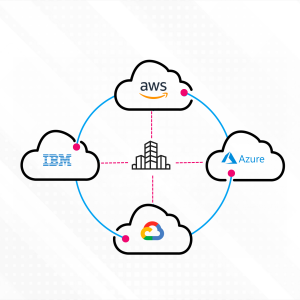
Large companies such as Google, Microsoft, Amazon, IBM and many others have democratized access to cloud services, making previously unattainable computing capabilities accessible to both businesses and individuals. 

However, as cloud technology evolves, so do the strategies for harnessing its power. Different integration approaches and architectures have emerged to fully exploit the cloud’s potential, including connecting on-premise and cloud environments, bridging private and public clouds, and collaborating with multiple cloud service vendors.

We will focus on this last scenario. 

Understanding Multi-Cloud Architecture

This Hybrid Multi-Cloud architecture refers to a system combining the services of two or more cloud providers working together into a unified ecosystem, leveraging each provider’s unique strengths, region availability and capabilities.

With numerous cloud providers offering various services, pricing models, and geographic availability, Multi-Cloud architecture has emerged as a strategic choice for businesses looking to maximize the potential of the cloud.

Why choose Multi-cloud?

Businesses are rapidly adopting this architectural approach for several reasons:

  • Enhanced Security: Mitigating Risks and Fortifying Infrastructure

This kind of architecture improves the system security in multiple ways. It mitigates risks by allowing workloads distributed across different cloud providers, ensuring that if one encounters issues, others can seamlessly take over. Additionally, it helps tackle “Shadow IT”, the use of unauthorized or unapproved technology solutions, applications, or services within an organization by employees, providing them with different cloud-based secure alternatives. Choosing cloud over on-premise software helps to avoid “Shadow IT”, while security and lack of governance risks can be significantly reduced. This architecture also adds extra resilience and redundancy, hardening overall application robustness.

  • Unmatched Flexibility: Breaking Free from Vendor Lock-ins

Cloud providers often offer similar products, but on certain occasions, some unique products and differences can be critical when choosing one over another. Multi-Cloud allows administrators to select the tools that best align with their specific needs, promoting closer alignment to business requirements.  It also allows you to choose each provider’s most powerful products and combine those to create a more robust solution.

  • Proximity and Compliance: Navigating Data Regulation and Geographical Challenges

High availability and fast response time are paramount in modern systems. Multi-cloud environments ensure multiple endpoints, optimizing response times by directing requests to the closest data center. Moreover, they facilitate compliance with data sovereignty laws and regulations, enabling services in regions where certain cloud providers may be restricted.

The Rise of Multi-Cloud Implementations

There are many other reasons why Multi-Cloud implementations are gaining popularity among companies seeking to improve security and performance while building robust applications or solutions with high availability, hybrid workflows and seamless DevOps integration. This approach recognizes that the cloud landscape is continually evolving. With providers improving their services or pricing models, deciding to rely on a single provider for a significant project is increasingly challenging.

In conclusion, The Future is Multi-Cloud

Julio Cesar’s wisdom, “Divide and conquer”, becomes particularly relevant here. In the short term, the benefits mentioned above make a strong case for Multi-cloud architecture. Although some can also be achieved with a Hybrid Cloud model, combining private and public clouds, there are strong reasons to believe that leveraging multiple clouds will result in more agile, secure and reliable systems.

Embrace the Multi-Cloud Revolution by Making Science and Propel Your Business to New Heights!

Transform your business with the power of multi-cloud, guided by the expertise of Making Science. Our team of certified experts are here to help you achieve real-world advantages by addressing complex challenges, streamlining operations and driving innovation that translates into measurable benefits for your business.

Google Next ’23: Unveiling the AI Revolution | Part 1

Google Next ’23, the annual event that brings together tech enthusiasts, industry leaders, and innovators, was a remarkable showcase of Google’s commitment to revolutionizing technology across Google Cloud’s extensive portfolio spanning Infrastructure, Data and AI, Workspace Collaboration, and Cybersecurity solutions.

Given our longstanding relationship as a Google Cloud Premier Partner, the Making Science team attended the event to get a first glance at the main innovations and gain insights that will shape the future of our work and value to our customers. 

At the heart of the event, one theme was the main character approaching the future of technology: Artificial Intelligence. The event unfolded as a dynamic showcase of AI’s transformative power across industries and its pivotal role in shaping the future of technology. 

In this Blog Post, we dive into the different dimensions of AI that took center stage at Google Next ’23.

AI-Optimized Infrastructure

Google Cloud is committed to providing cutting-edge AI-optimized infrastructure that empowers businesses to train and deploy AI models efficiently. This infrastructure is available across Google’s global cloud regions, on customer premises through Google Distributed Cloud, and at the edge. Notably, over 70% of “gen AI unicorns” are Google Cloud customers, emphasizing the platform’s dominance in this transformative field. Key infrastructure advancements announced at the event include:

  • Cloud TPU v5e: This state-of-the-art AI accelerator platform is cost-efficient, versatile, and scalable. It enables customers to perform large-scale AI training and inference on a single platform, offering significant improvements in training and inference performance per dollar compared to its predecessor.
  • A3 VMs with NVIDIA H100 GPU: Powered by NVIDIA’s H100 GPU, these virtual machines offer superior performance, high-speed networking, and advancements to support demanding gen AI and large language model (LLM) applications.
  • GKE Enterprise: Enabling multi-cluster horizontal scaling, GKE Enterprise enhances productivity while reducing software deployment times, catering to mission-critical AI and ML workloads.
  • Cross-Cloud Network: This global networking platform simplifies application connectivity and security across multiple cloud environments, offering reduced network latency and improved accessibility to Google services.
  • Google Distributed Cloud: Designed for organizations running workloads at the edge or in their data centers. Google Distributed Cloud is being enhanced to bring AI capabilities to the edge.

Vertex AI: Building, Deploying, and Scaling ML Models

Vertex AI is Google Cloud’s comprehensive AI platform, empowering customers to build, deploy, and scale machine learning (ML) models effectively. The platform’s usage has grown substantially, with the number of gen AI customer projects surging over 150 times quickly. Main updates on this platform include:

  • Vertex AI Search and Conversation: These tools enable organizations to quickly create Search and Chat applications using their data, with minimal coding and robust enterprise-grade management and security features.
  • New Models and Tooling: Updates to PaLM 2 for processing large documents efficiently, extended support for new languages available in Codey, and increased capabilities for Imagen regarding visual appeal and new tuning methods to create images aligned to specific requirements with a few references.
  • Vertex AI Extensions: Developers can now access, build, and manage extensions that provide real-time information and actions, enabling gen AI applications to interact with enterprise systems and third-party platforms.
  • Digital Watermarking: Leveraging Google DeepMind SynthID technology, digital watermarking is now available for AI-generated images, offering scalability and security in image generation.
  • Colab Enterprise: A service for Data Scientists to accelerate AI workflows, access the whole Vertex AI platform, integrate with BigQuery and benefit from code completion and advanced generation features.

If you’re a cloud or data expert, we encourage you to learn more about these new features and capabilities so you can start using them to build and deploy innovative solutions. 

These are just a few of the many announcements made at Google Cloud Next 2023. Stay in touch for an upcoming post on how AI is shaping Cloud, Data and Security.

Contact us

Efficiently maintaining serverless data lakes in Google BigQuery

Google’s BigQuery serverless data warehouse makes life so much easier and so much safer in terms of having all the data in one location however, the house-keeping and data governance are left for you to administer and manage.

At Making Science we work with numerous Google BigQuery customers, some small, some large and some very large corporate groups.  Most of our experience shows that customers are rolling out data governance tools but most of our customers are typically still offering the “SQL knowledgeable/connected” departments direct access to BigQuery. This all in the spirit of self-service analytics moving their business to be more data-driven.

Even with the advances in Google’s data catalog and data governance capabilities, the data administrators are left with challenges keeping data lakes and data warehouses operating efficiently.

The Making Science teams are always looking for ways to make themselves more effective at performing their work with the construction of methodologies and tools.  Making Science has tools specifically for Data Quality projects, Data Discovery and a most recent addition is BigQuery Intelligence.  The tool offers value to the roles presented in the data governance model below:[image_with_animation image_url=”48047″ animation=”Fade In” hover_animation=”none” alignment=”center” border_radius=”none” box_shadow=”none” image_loading=”default” max_width=”100%” max_width_mobile=”default”]The BigQuery Intelligence tool was built to help the data warehouse/lake architects/administrators/custodians manage house-keeping activities regarding datasets, tables and views and optimize these same objects.  Many of our larger and very large customers have 100’s of datasets and 100’s of tables and 100s of views within each dataset making it very challenging to keep on-top of house-keeping activities.

BigQuery provides data lake administrators with a simple visual interface for listing datasets, tables, and views.  The BigQuery explorer panel interface allows you to collapse tables and views under their given dataset simplifying the visualization.[image_with_animation image_url=”48053″ animation=”Fade In” hover_animation=”none” alignment=”center” border_radius=”none” box_shadow=”none” image_loading=”default” max_width=”100%” max_width_mobile=”default”]But the BigQuery Explorer does not offer data lake administrators a simple visual interface to understand usage statistics regarding datasets, tables and views; this is where BigQuery intelligence collects underlying data previously collected by the GCP + BigQuery environment and offers visualizations to understand the usage patterns across the nodes in the data warehouse.

The Data Scientists and Data Engineers at Making Science had a look and found that GCP offers a tremendous amount of data lake usage statistics. But, there was no easy way to retrieve the data and visualize the usage patterns in the data lake. The team chose to use Sankey visualizations, built with Python and D3, to better understand the usage patterns between the nodes (datasets, tables, views and jobs/queries) in the data warehouse. [image_with_animation image_url=”48059″ animation=”Fade In” hover_animation=”none” alignment=”center” border_radius=”none” box_shadow=”none” image_loading=”default” max_width=”100%” max_width_mobile=”default”]As the team worked with some very large data lakes they quickly found it necessary to allow data custodians to apply filters to limit views of the data lake to make the Sankey diagram more readable.  Most typically they would select logical groupings of datasets to give a complete view but without making the visualization undecipherable.  BigQuery Intelligence actually allows filtering both on datasets and tables.[image_with_animation image_url=”48104″ animation=”Fade In” hover_animation=”none” alignment=”center” border_radius=”none” box_shadow=”none” image_loading=”default” max_width=”100%” max_width_mobile=”default”]The team also found that by including the possibility to define color based on criteria; by default, the color criteria is “dataset” so that each dataset is distinguished by a specific color in the Sankey visualization.[image_with_animation image_url=”48073″ animation=”Fade In” hover_animation=”none” alignment=”” border_radius=”none” box_shadow=”none” image_loading=”default” max_width=”100%” max_width_mobile=”default”]The team decided to include a “change color criteria” filter, where we can choose between additional criteria including bytes, jobs, inherited jobs, recency, and inherited recency. With this kind of plot, we can check if there exist inefficient nodes in the data lake.[image_with_animation image_url=”48079″ animation=”Fade In” hover_animation=”none” alignment=”center” border_radius=”none” box_shadow=”none” image_loading=”default” max_width=”100%” max_width_mobile=”default”]

HotSpots

A couple of use cases helped by changing the color criteria is the location of “hot spots”, i.e. those nodes which process too many bytes or have too many jobs, and “cold spots” or those nodes that have not been used in a long time and hence could be removed/deleted from the data lake.  In the following screenshot, we can see that the color indicates the volume of data each node has processed. Red indicates too much, and green indicates a reasonable volume. Grey indicates that we don’t have information about this particular node. It is interesting to see nodes that have a deep level and are very red. This usually means that those nodes could be optimized by creating aggregated/intermediate tables.[image_with_animation image_url=”48085″ animation=”Fade In” hover_animation=”none” alignment=”center” border_radius=”none” box_shadow=”none” image_loading=”default” max_width=”100%” max_width_mobile=”default”]

Unused nodes

If we change the color criteria to “inherited recency”, we can search for nodes that have not received any query/job in a long time. The meaning of “inherited” is that we take the smallest recency among one node and its children, given that if one child node receives a job, in some way, the parent node also receives that job. Here, red indicates very high inherited recency and green indicates very small inherited recency. Grey, indicates that we have no info about the particular node. We could analyze the plot to search for unused nodes (red and grey) and clean the data lake.[image_with_animation image_url=”48091″ animation=”Fade In” hover_animation=”none” alignment=”center” border_radius=”none” box_shadow=”none” image_loading=”default” max_width=”100%” max_width_mobile=”default”]

Metrics

The team included a mouse-over capability to display relevant metrics of a node, as you can see in the following screenshot:[image_with_animation image_url=”48097″ animation=”Fade In” hover_animation=”none” alignment=”center” border_radius=”none” box_shadow=”none” image_loading=”default” max_width=”100%” max_width_mobile=”default”]

The Conclusion

Making Science teams, acting as Data Custodians for some of our customers, have found that conversations with Data Business Owners/Stewards regarding optimizations and housekeeping are greatly facilitated by the use of the BigQuery Intelligence tool.  Sitting down with the Data Steward with data and visualizations in hand enables a transparent, data-driven conversation.

The value to the business from a tool such as BigQuery Intelligence comes in the form of improved performance for systems accessing/consuming the data and ensures a reduced GCP operating costs.

The Making Science team members have feature additions already in the works and we will share some of the use cases and the corresponding benefits as they are available.

The future is in the cloud: Advantages of cloud computing services

These days, many companies are opting to migrate to the cloud. The technology media company, Foundry (formerly IDG) annually conducts a study called Cloud Computing Study that measures trends in the world of cloud computing. According to its most recent study, nearly 70% of companies have accelerated migration to the cloud in the last year. It is expected that the percentage of companies with their IT infrastructure in the cloud will increase from 41% to 63% in just over a year.

Now, why do companies decide to migrate to the cloud instead of having their data on-site? Below we examine the main advantages of cloud computing services.

Scalability and elasticity

One of the main disadvantages of companies that have their servers on-site is that they permanently need to have enough capacity to cope with peaks in resource demand. Formerly, this inherently meant a waste of resources during times of falling demand, since many of those servers became unnecessary.

On the other hand, companies that use cloud-based services can scale according to the pace at which their computing needs grow (or decrease). It is easier and less expensive than scaling their on-site infrastructure, and deployment times are much shorter. The cloud allows companies to scale resources quickly to cope with prominent traffic peaks and unexpected usage (scalability), as well as reducing those resources when traffic decreases (elasticity).

Arguably the best part is the simplicity of scaling in the cloud. With just a few clicks we can increase or reduce the available resources according to our needs. In addition, many cloud services have the function of autoscaling, thanks to which resources increase or decrease automatically.

High availability and more local resources

Having more local resources with high availability improves the user experience, bypassing system failures and reducing latency.

If we had our servers on-site, these would probably be located together in a single place. If a user tried to connect from the other side of the world, they would experience a significant delay. To avoid this type of problem, cloud computing services have different points of presence with servers spread all over the world grouped in regions. This way we can host a copy of our application in each of these regions (this creates redundancy). In turn, this redundancy helps protect our system from failures, preventing our service from being interrupted. If an event were to occur that caused servers in one of these regions to fail (power outage, fire, flood, etc.), we could quickly redirect traffic to any of the other servers where we have our application hosted until we could recover the fallen server. In this way, we essentially achieve 100% availability of our service.

Remote access

By not having the information in a physical location, you can access it from anywhere in the world. Cloud solutions can be accessed at any time, from any device, through a simple internet connection, making it a real advantage when it comes to improving the availability and mobility of employees. Additionally, it allows for improved collaboration with other colleagues or external contacts, allowing for coordinated work from different locations. This translates to greater work flexibility and a significant improvement in productivity.

Security

For companies that are transitioning to the cloud, the solid security that cloud computing services offer is essential. Typically, companies that provide cloud computing services have much better security systems than those that we could implement on our on-site servers and at a lower cost. Some of the security measures that are usually offered are:

  • Identity and Access Management (IAM): The main functionality of IAM is to create digital identities for all users with only exclusively necessary permissions for the tasks they will perform, so that we can control who does what with a certain resource.
  • Advanced firewalls and security filters: These prevent attempts of attacks that exist today and that are constantly evolving.
  • Data encryption: Cloud services keep our data safe by encrypting it both at rest and in transit, minimizing the risk of data theft.
  • Periodic and automatic backups: This helps to avoid a possible loss of data in case of any failure.
  • Strict physical security measures: Cloud computing provider’s data centers have a large number of security measures to prevent servers hosted there from being compromised in any way. Some of these measures are:
    • Secure locations, which are built away from areas with a high risk of natural disasters and other threats.
    • Access controls to the facilities, to allow only authorized personnel to pass.
    • Video surveillance systems and security personnel in all facilities.

Cost savings

Investing in cloud computing leads to significant cost savings. Companies only pay for the services they contract, without having to pay large amounts of money to buy and maintain equipment. Some other advantages include:

  • It does not require a large initial investment in infrastructure, as cloud services are responsible for managing it. This reduces the economic risk assumed.
  • We avoid our equipment becoming obsolete, as the provider is responsible for keeping the equipment always updated, using the latest technologies. This, in turn, increases your competitiveness against other companies.
  • Cloud computing services offer tools to manage our expenses so that we have complete control of how much we will spend each month.

Sustainability

Environmental concerns and a sustainable model have become major drivers of innovation in companies. One of the main goals of companies dedicated to cloud computing is often to minimize their carbon footprint. In fact, according to a recent study by Accenture, companies that migrate their services to the cloud can reduce their carbon emissions to the environment by up to 84%.

For example, one of the largest companies offering cloud computing services, Google, states that by 2030 it will supply all its data centers with 100% carbon-free energy on an uninterrupted basis.

After analyzing some of the main advantages that cloud computing services have over companies that have their servers on-site, it is not surprising that the majority of companies are switching to this model. It is increasingly clear that any company that wants to be competitive in its sector should bet on the cloud.

Check out Google’s latest video about their Cloud solution: Let’s solve for what’s next

Do you want to migrate your business to the cloud? At Making Science we have a team of experts capable of advising you on your specific case. Write us! ⛅️

Get in touch

Protect your websites and applications with Google Cloud Armor WAF

Web application security is crucial for the protection of organizational and client data. In 2021, cyber ​​attacks caused approximately 6 trillion USD in damage, which is expected to increase by 15% annually over the next 5 years. Thus, it is essential to use all possible tools to reduce the risk of these cyber attacks.

Google Cloud Armor is a web-application level “firewall” (WAF) capable of protecting companies from a wide variety of cyberattacks in a simple and efficient way. In order to use this tool, we will have to use Google Cloud Platform’s load balancers since that is where Cloud Armor can be enabled on the backend services.

Once the load balancer has been configured and a security policy has been activated for a backend service, it is time to adjust which WAF rules should be applied. There is a wide variety available depending on our needs. The following table shows a list of some of these preconfigured rules grouped by categories:

Name of the rule  Name of the ModSecurity rule
sqli-stable SQL injection
xss-stable Cross-site scripting
lfi-stable Local file inclusion
rfi-stable Remote file inclusion
rce-stable Remote code execution
scannerdetection-stable Scanner detection

Each of these rules contains dozens of signatures that are compiled from ModSecurity v3.0.2. Google Cloud Platform (GCP) provides a controlled way to debug these rules with real traffic. The best part is that users are not affected, since we can select them in “preview only” mode. This means that every time one of these rules is triggered, it will simply be logged and let the traffic through. Obviously, by activating preview mode, we will not be securing our platform in any way, Still, in this way, we are able to avoid false positives and gradually add each of these rules. 

In addition to the preview-only mode, GCP uses verbose logging capabilities. What does this mean? For each request blocked by these rules, we will see detailed information in the log on which signature and what part of the request has caused the block. As previously mentioned, each of the rules listed in the previous table contains a number of signatures, so some of these signatures may cause false positives and should thus be disabled.

With this protection we can avoid the following attacks:

  • SQL injection
  • Cross-site scripting
  • Local file inclusion
  • Remote file inclusion
  • Remote code execution
  • Method enforcement (public preview)
  • Scanner detection
  • Protocol attack
  • PHP injection attack
  • Session fixation attack

Do you want to know more about how to better secure your websites and applications? The Making Science Cloud team can help. Get in touch at info@makingscience.com. We look forward to hearing from you!