
From volume to value: Improve your campaigns with Gauss Smart Advertising

Align your advertising investment with your business strategy

The automatic bidding strategies offered by the different advertising platforms have become one of our best allies when it comes to campaign optimization. Specifically, those known as Value Based Bidding allow us to align our advertising investment with our business objectives in an automated way.

If you are using Value Based Bidding, simply configure your pixels so that they collect the conversions that you want to optimize. Then, indicate the objectives you want to achieve through your campaigns (whether it is maximizing the value of the conversions or optimizing the return on our investment). From there, algorithms take care of learning everything necessary to find and bid for users to achieve your goals.

The main issues with Value Based Bidding

Conversions, in this case, act as signals that tell the algorithm whether or not users are valuable for our campaign. But, sometimes you may not have enough conversion volume for VBB to work. And sometimes, web conversions do not fully reflect the reality of our business.

Furthermore, it is estimated that the Google and Meta algorithms only consider signals for the first 7 days since the user entered through a paid campaign. For user acquisition data, the most recent signals are the ones that the algorithms give the most importance to. What happens when a lead’s final conversion takes place beyond that 7-day window?

How Gauss Smart Advertising can help you

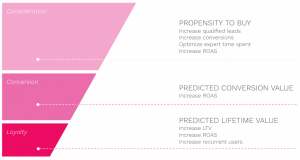
To cover this gap between what the algorithm is able to see and the real objectives and KPIs of your business, Making Science developed Gauss Smart Advertising. This is a proprietary technology that allows you to anticipate the future value of a user and improve signals throughout the entire sales funnel. With Gauss, we can predict a lead’s propensity to buy, the expected purchase value, and even the long-term value of the lead (customer lifetime value). Then, we translate it into signals that provide the algorithm with a more realistic vision of your business. Furthermore, what makes the difference is that we not only create predictive models, but we can activate them in real-time to anticipate and communicate those signals without losing the benefits of the cross-device, nor the freshness that Smart Bidding algorithms require. Additionally, we develop agnostic models that can be activated on any of your marketing platforms.
How it works

Advertising platforms have the ability to collect web browsing data for campaign optimization. Gauss Smart Advertising collects browsing data, but also from other data sources to issue a more accurate assessment of the user that it then sends as a signal to the platforms.
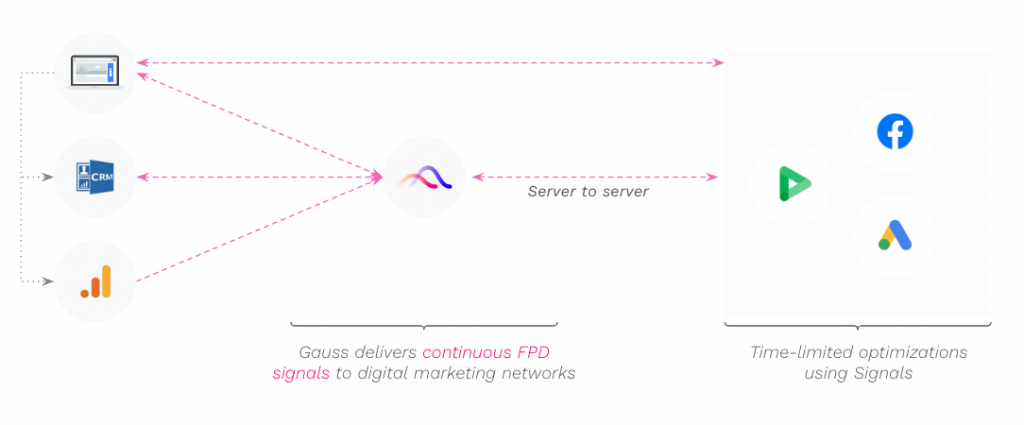
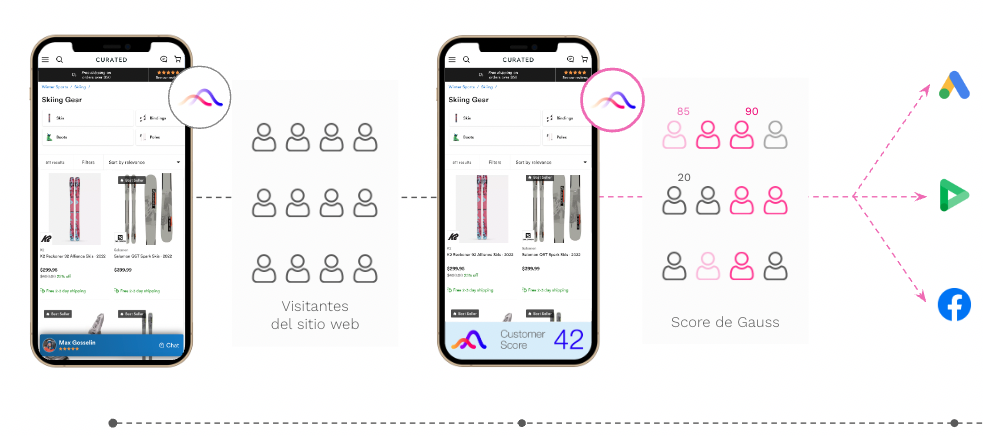
In essence, based on previously trained machine learning models, it predicts and issues a score/value for each of the users that enter the website and communicates it to the platforms in real time:
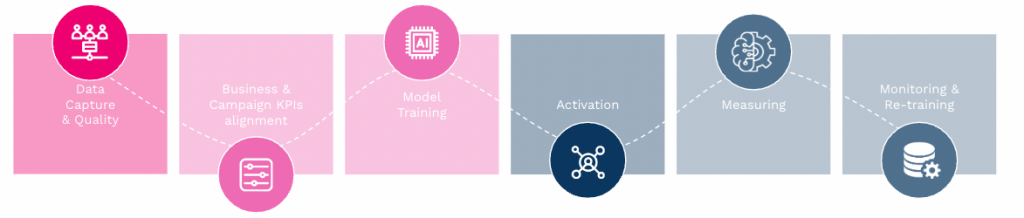
A methodology for automation and activation

Our solution is optimized to cover all the critical phases of its implementation, from the collection and evaluation of the quality of the data that feeds our models to the activation and monitoring of campaigns and models:
With Gauss Smart Advertising we have managed to increase our clients’ conversions by 20% and reduce their CPL/CPA by up to 50%.

Gauss Smart Advertising can be used to

  • Communicate to the algorithms that someone has made a purchase when the lead is more than 7 days old (for example, longer tail conversions like university enrollments, vehicle purchases in the automobile industry, insurance or mortgage purchases in the banking sector, etc.)
  • Adjust conversion values ​​when refunds and cancellations represent an important part of the business and these occur outside the scope of action of the algorithms (example: in the hotel industry where cancellations tend to take place closer to check-in than to reservation)
  • Amplify and provide a greater volume of signals to the algorithms in order to improve their performance in industries or advertising channels (for example, display) where few conversions are collected
  • Adjust the signals captured by the algorithms to the KPIs and business objectives (for example, increase customer lifetime value for e-commerce businesses)

Do you want to know more about Gauss Smart Advertising? Write to us! Our team of experts will be happy to help you.
Get in touch

Increase your sales by up to 20% by activating AI in your digital advertising campaigns

Data collected without a purpose and without proper processing is virtually useless and becomes an expense that quickly escalates. It is not until we enrich it intelligently that we can truly consider it an investment. This helps us uncover the (often surprising) stories it holds.

Considering our data as one of our most critical corporate assets is imperative. Monitoring customer interactions provides a wealth of knowledge to guide our marketing, sales, and product development efforts while monitoring internal processes generates valuable information to optimize operations and improve productivity.

This knowledge value chain is composed of technical and non-technical components. It includes business processes and understanding that a systematic approach allows us to put data-driven predictive models into production through a strategy tailored to each business objective.

Once we have extracted the relevant insights from the predictive models, the next crucial step begins: turning this information into action to generate measurable business impact. 

This requires three key aspects: 

  1. Understanding the business environment we operate, our acquisition, sales, and loyalty processes.
  2. In-depth knowledge of the different profiles and purchase drivers of each customer segment to which we direct our advertising campaigns.
  3. The creation of tools that automate or facilitate decision-making.

At Making Science, we have been innovating in this context for years with ad-machina and Gauss Smart Advertising. These machine-learning solutions optimize your advertising campaigns on digital platforms (Google Ads, DV360, Campaign Manager, and Meta, among others), making the most of First Party Data (from CRMs, call centers, or other available data sources) and managing to improve sales ratios by up to 20%.

Making Science brings you technology geared towards automation and activation.

Interested in learning more about how we can help you do more with less? Get in touch today!

Contact us

Maximize your sales with Marketing Mix Modeling

What is Marketing Mix Modeling?

According to the paper “Challenges and Opportunities in Media Mix Modeling” by Chan, D., & Perry, M. (2017),

Marketing Mix Modeling (MMM) refers to statistical models used by advertisers to measure the effectiveness of their advertising investments and have existed in various forms since the 1960s. MMMs, as we will call them from now on, use aggregated historical time series data to model sales outcomes based on advertising variables, other marketing variables, and control variables such as weather, seasonality, and market competition.

Metrics like the return on ad spend (ROAS) and optimized advertising budget allocations are derived from these models, relying on the assumption that they provide valid causal results.

In other words, MMMs attempt to answer causal questions for advertisers. For example:

  • What was my ROAS on television last year?
  • What would my sales be if more or less money were spent next year?
  • How should my media budgets be allocated to maximize sales?

What does Marketing Mix Modeling bring to our business?

With MMM, we will achieve two different things:

  1. Attribution: We will obtain an analysis of all variables that influence the client’s business results, and we will know which are the most relevant to enhance them. The advantage over user-level models is that this model doesn’t only talk about digital data, but by using aggregated data, it can incorporate offline investment data, types of offers, seasonality, and more.
  2. Predictions: We will be able to discover the most relevant variables in the analyzed period; an MMM will indicate how to enhance each variable and predict how the results will change in each proposed scenario.

We can only carry out high-value activations for decision-making, and for this, an analyst will be needed to interpret the data. However, since aggregated data is used, users are not identified, so an MMM cannot be used to activate audiences or optimize campaign algorithms.

Choosing the best model for our business

In an MMM project, we will work on and create different types of models, and the initial goal will be to choose the one that best suits our business:

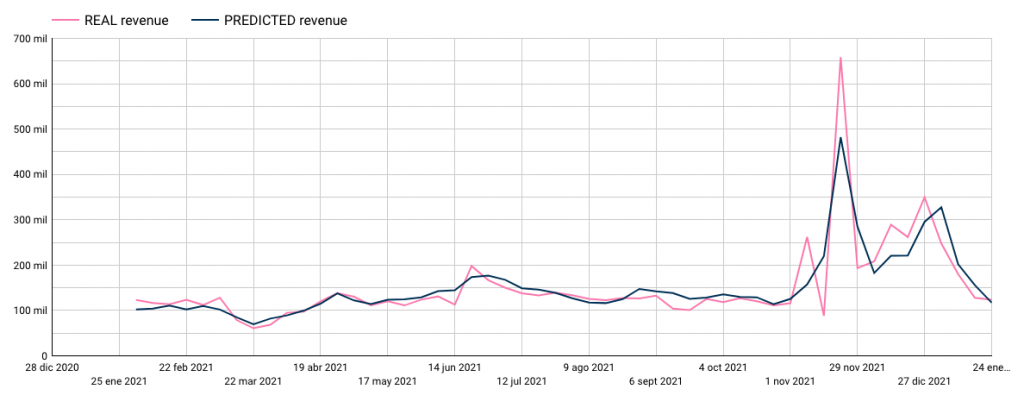
Below, we can see the client’s actual sales history (pink line) and how this model has predicted that period (blue line).

In the end, we will choose the model that best fits the client’s sales trend and peaks.

What insights can we extract from our MMM?

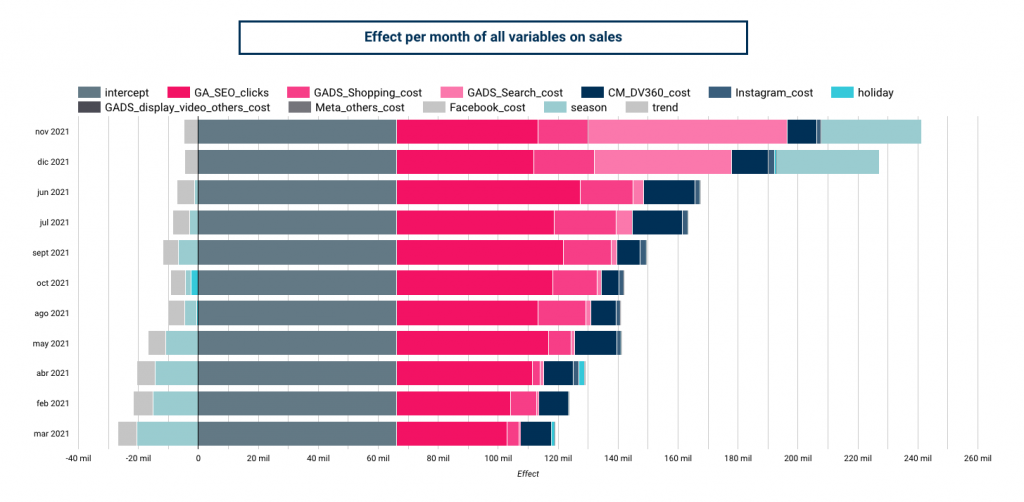
horizontal bar graph which demonstrates effect per month of all variables on sales to show how much each making channel contributes to sales

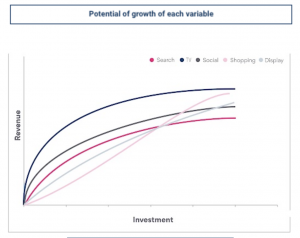
  • Prediction of potential sales increase:  This graph shows all campaigns or actions included in the model. The dots represent the investment and actual sales of that campaign, and thanks to the trend lines, we can see the sales potential of each campaign as we increase the investment.

  • ROI of campaigns and variables: In the graph, we can see in dark blue the percentage weight of total sales that a campaign or action has had (calculated by the model). In light blue, we can see the weight that action has had on the total investment (data we give to the model). Lastly, the orange dots show us the ROI of each action, identifying which are the most profitable for our business.

Do you want to know more about what Marketing Mix Modeling can bring to your business? Don’t hesitate to contact our team of experts. We are waiting for you! 🚀

Get in touch

Personalize your ads and reduce costs with Gauss Dynamic Creatives

We live in a world where people have become accustomed to receiving hundreds of advertising impacts every day. One of the main problems that users mention is that many of the ads they see are not related to their interests. This generates fatigue and frustration. Relatedly, most advertisers state that it’s difficult to personalize each of their advertising impacts due to the creative cost and the management time involved in generating personalized ads that help them overcome the aforementioned barriers.

Dynamic ads can be an effective solution that allows advertisers to generate more personalized ads and offer customers what they demand, improving brand perception, reducing advertising fatigue, and improving the conversion rates of their campaigns.

How does it work?

Dynamic ads build on previous customer interactions to deliver an ad tailored to one’s needs and interests. Based on these interests, a personalized final piece is composed for each user, generating an authentic user-centric strategy and activating the first-party data that we have about the user. That allows us to fine-tune commercial opportunities, appearing at the right time with the right product.

Building dynamic ads in Meta

Meta’s advertising tool offers us a native solution for generating dynamic ads thanks to product catalogs that we link to user activity. We use the data collected by pixels on the same platform. However, this tool has a limitation at a creative level, since the final creativity is made up exclusively of the image of the product for which they have shown interest, without the possibility of adding dynamic creative elements such as prices, descriptions, logos, or CTAs.

Go a step further with our solution: Gauss Dynamic Creatives

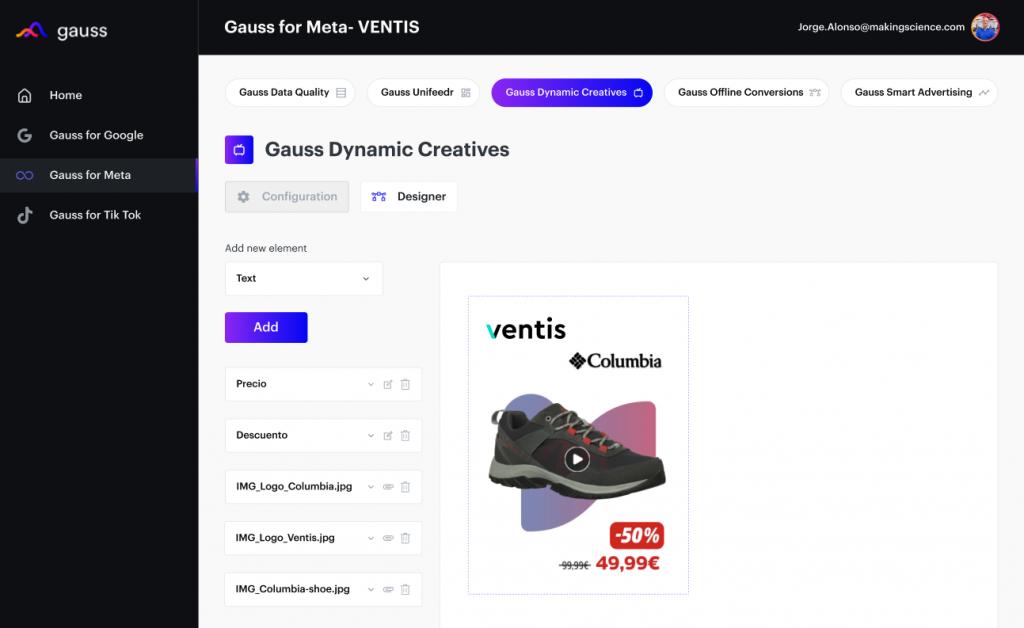
At Making Science, we offer a solution that allows us to customize all aspects of our final creative dynamically. Adding the specific price of the product visited, a description, a logo, or any dynamic or static element to the final creative to improve its performance, taking into consideration branding boosts that are generated with impressions that do not end in conversion.

You just need to connect your product feed to our platform. From there, you can generate a template defining which elements will be dynamic or static and select the feed column from which we will take the value for the dynamic elements. 

Activating it is as easy as uploading the catalog to your Business Manager and selecting it when creating a campaign, either remarketing with catalog sales or prospecting with dynamic ads for wide audiences. Once that’s done, a dynamic creative is automatically generated for each user based on their behavior.

The main benefits of using dynamic ads are:

  • Higher CTRs
  • Higher conversion rates
  • Improved brand perception
  • Reduced creative costs
  • Improved user experience

Now that you know how dynamic ads work, let us help you get started!

Get in touch

Trends that are (already) revolutionizing interaction with mobile devices

Due to the current, constant technological evolution, there are significant challenges for user experience and user interface designers in the immediate future. There is a clear tendency to simplify traditional graphical interfaces more and more. With this commitment to a simple design, there has come a point where we cannot simplify things any further. 

On the other hand, with today’s fast pace of life, there is a tendency to make interaction with devices more organic, without the need to take your phone out of your pocket. 

Although some of these technologies have already been around for some time, today I will tell you about the trends in mobile interaction that will explode in the coming years. 

Voice interaction 

It is the most widely known and applied and is currently the primary trend because it allows users to interact while performing other tasks, thus improving productivity. Voice interaction will enable us to search and obtain information, make notes, and even play audiovisual content through interfaces such as Siri, Cortana, and Alexa. However, there are still many options to explore! 

Most smartphones and new generation devices include the technology necessary for their use. It becomes a unique challenge for UX designers because it is essential to design a user-friendly, intuitive, and practical experience that is not based on “classic” visual and touch interfaces. 

The adoption rate of this technology is expected to reach 80% of users in the next five years. 

Gesture recognition 

Anyone who watches futuristic action or science fiction films can find characters interacting through gestures with holographic devices, operating interfaces, and interactive futuristic devices. Perhaps it’s not as eye-catching yet, but this technology is already on its way. 

Gesture recognition technology can achieve much more natural interactions than classic text and touchscreen interaction. It can be very intuitive, with reduced hardware requirements (one integrated video camera) and fully customizable to associate actions or tasks with static and dynamic gestures. 

Gaze recognition 

This technology is also based on recognizing movements, in this case, and opens the door to interfaces outside a conventional screen, moving into virtual reality (VR) or augmented reality (AR). 

Although this change will not happen rapidly (the transition will be more gradual), interface designers need to be familiar with new 3D imaging techniques to increasingly drive the evolution toward augmented and virtual reality. It shares excellent advantages with voice interaction, as it is also customizable, user-friendly, convenient in situations where hands are busy, and highly useful for users with specific disabilities. 

This technology will be available “on the street” in the medium term. However, these interactions require additional hardware, such as head-mounted devices like Oculus and HoloLens, glasses, or even contact lenses. “Smart” lenses, such as Mojo Vision lenses, can recognize all eye movements required for interaction, using movement patterns pre-set customizations. Still, they may face limitations for the time being. 

Wearables 

These devices, whose implementation is advancing by leaps and bounds, offer an increasing variety of types of interaction without the need to take your phone out of your pocket. In the coming years, these devices will become cheaper, more functional, and more independent of the smartphone so that they will multiply. 

According to reports from Statista, between 2019 and 2022, the number of these devices is expected to triple to one billion. These devices will base their interaction on all the technologies we have just discussed. 

The trends focused on interaction with CONTACTLESS interfaces, to which users will be very attracted; in which it seems that mobile devices will be relegated to the pocket,  and designers and developers have to be attentive and adapt to these new needs. 

Undoubtedly, brands betting on these trends will be vital in defining and delivering better experiences for their users. Do you want to know more about these trends and how to use them for your users? Email us at  info@makingscience.com, and we will help you in your specific case.