Enhancing Customer Service Efficiency with Einstein Bots

Delivering exceptional customer service is not just a competitive advantage; it is a prerequisite for long-term success. Technology streamlines operations in today’s business landscape, while human interaction injects vitality. Yet, bridging human expertise and availability can prove challenging. Enter ChatBot Technology is revolutionizing client engagement by leveraging AI and natural language processing. It’s the go-to for companies aiming to enhance communication and customer experiences. Let’s explore what makes Einstein ChatBot exceptional and the industry’s top choice!

Salesforce Einstein ChatBot harnessing Salesforce’s AI capabilities, empowers businesses to integrate chatbots into diverse real-time customer engagement processes. With its advanced Natural Language Processing (NLP) and machine learning, the chatbot comprehends customer requests and delivers relevant responses. Enabling Einstein ChatBot via native Salesforce settings eliminates integration complexities.

Furthermore, seamless integration with Salesforce’s CRM tools enhances customer experiences. Einstein bots excel in aiding customers, addressing queries, and augmenting customer support representatives’ insights. They analyze data, predict outcomes, suggest optimal actions, and streamline automation across tasks.

Understanding customer expectations is pivotal and Salesforce chatbots delve into backend systems to guide agent actions. Complex issues trigger seamless transfers to available Live Agents. Subsequently, agents can review bot-customer interactions for adequate support provision. Einstein ChatBot revolutionizes customer engagement through its dynamic AI-powered assistance and deep integration with Salesforce’s ecosystem.

Why Should You Use an Einstein Bot?

Consider these points when considering the adoption of Salesforce Einstein Bot:

  • Faster Responses: Unlike email, text, calls, or social media, it delivers faster responses to frequently asked questions, bolstering customer engagement.
  • Time Efficiency: Einstein Bot’s intelligent solutions save customers and support reps time, enabling agents to focus on strategic aspects of their roles.
  • Reduced Cases: Addressing a wide array of questions curtails the need for cases to escalate to live agents, thus lowering case volumes.
  • Intelligent Functionality: Leveraging Natural Language Understanding (NLU), Einstein bots continuously learn and evolve, enhancing their intelligence and capabilities.
  • Rapid Query Resolution via Knowledge Articles: Einstein ChatBot harnesses Salesforce’s knowledge base to provide accurate responses, leveraging NLP to match customer queries with relevant articles. This enhances the customer experience through quick and precise answers derived from a product, service, and standard issue information repository.

Looking Ahead: The Future of Customer Engagement with AI

Salesforce Einstein ChatBot represents a significant leap forward in customer service, blending AI efficiency with the nuanced understanding of human agents. Its ability to deliver swift responses, manage time effectively, and reduce case loads while continually learning from interactions makes it an invaluable asset for any forward-thinking business.

At Making Science, we specialize in harnessing such cutting-edge technologies to not only meet current demands but to anticipate future needs. Our approach is to partner with you to ensure these tools are integrated smoothly and effectively, empowering your business to deliver exceptional customer experiences.

AI comes to Google: The future of SEO with SGE

SGE (Search Generative Experience) will be a major change in the search experience and the way results are displayed in the SERPs.

But first of all, what exactly is SGE? It’s a radical update from Google, which will start using AI to generate contextual answers to complex questions.

AI in search engines

The impact of ChatGPT since the end of 2022 and its very rapid integration into the digital status quo, especially among young people, has led tech giants (such as Google) to further accelerate the deployment of their AI-related technologies.

Within the search engine market, Microsoft has moved ahead with the integration of ChatGPT into Bing as early as 2023 and Google has responded quickly with the announcement of SGE, based on Gemini, its LLM that promises to be more powerful than GPT-4.

The common formula is the integration of an AI module on top of the search engine that not only directly answers complex queries accurately, but also enables deeper searches through a conversational interface.

What do we know so far about the impact of SGE on SEO?

SGE will bring about an evolution in the way we search for information on the Internet, as ChatGPT has already done.

SGE is being tested in the USA, and the SEO team at Making Science has already been testing this new experience to draw some preliminary conclusions before its final international roll-out:

Several sources of information

This new AI module draws from many sources to offer more complete information:

  • Media: Very relevant, especially in information searches. Media attention, through PR teams, is essential to manage the conversation around brands.
  • Shopping feeds: PDPs everywhere in searches closer to conversion. A good product feed is essential to appear here. It seems that achieving a more complete shopping experience is one of SGE’s main objectives.
  • Reviews: Google knows that reviews are powerful conversion triggers, and integrates them into SGE for searches close to conversion. The focus should be on optimal Schema markup and online reputation management.
  • Social media: Social media conversation is especially relevant for topical or trending searches. Inspirational approach.
  • Google Maps / Business Profile: Many of the searches, even when not explicitly geolocated from the query, return local SEO results.
  • Multimedia: Text, images, video, FAQs, social media… what seems evident is that covering searches with multiple formats is going to be essential to capture the key terms in SGE

SEO strategies impact

There are a few things that seem to be clear, and that don’t really change the ‘traditional’ approaches to SEO strategies that much:

  • The classic Google Top 3 will determine what comes out of this block.
  • There will still be ads (as they are Google’s main revenue stream), but to a lesser extent. At least at launch.
  • SEO-optimized elements or content will continue to be relevant in order to match users’ searches

And what will the SEO performance be like?

Organic traffic is expected to decrease because it is assumed that the traditional SEO results will show even lower in the SERPs (with the consequent drop in CTR): Google as a “media” in its own right, which means a drop in overall SEO CTR.

However, the user has the opportunity to become more qualified in conversational mode before clicking on a link, which could benefit SEO conversion.

In addition, users could make even more intensive use of Google, especially younger audiences, who now turn to platforms such as TikTok. In any case, it remains to be seen if this hypothesis is true and, if so, if it will compensate in terms of traffic for the drop in positions of traditional organic results.

Types of content that could be most affected by SGE

We predict that the impact of SGE will be even greater for some types of content:

  • General informational content: Direct answers to factual questions, definitions of concepts, general explanations of a topic, etc. SGE could directly answer many general information queries without the need to take the user to another website.
  • Comparative content: Such as product comparisons, rankings of best options, pros and cons reviews. SGE could generate this comparative content in an automated way.
  • Simplified content: Such as summaries, simplified guides, step-by-step explanations of a process. SGE could extract and synthesize the most relevant information.
  • Repetitive content: Such as similar listings on a topic, frequently asked questions, duplicate content. SGE would reduce the need for multiple pages of redundant information.
  • Local content: Location-specific answers, such as business hours, local business addresses, geolocated recommendations.

Websites that rely on this type of content for their organic visibility should rethink their SEO strategy with the arrival of SGE if they don’t want to be negatively affected.

Conclusion

Essentially, Google’s SGE marks a revolutionary development in SEO. With AI shaping the digital realm, it’s vital to keep pace with these shifts and comprehend their significance to uphold an advantage in online presence

What is the Best Speech-to-Text foundational model ?

A Benchmark of Models for a Call Center Analytics use case

Call centers are one of the main communication channels between customers and companies. The calls to/from the call center contain a gold-mine of valuable information about the customer and its relationship with the companies. At Making Science we are helping customers leverage this value in the business delivering significant ROI on conversational analytics projects.

Before the advent of the modern speech-to-text models, it was almost impossible to process these calls on an industrial scale, since it was a manual process. A very resource-intensive one.

Modern speech-to-text models allow companies to convert call audio records into text, and analyze them to extract valuable insights. With this technology, transcribing a single call can take as little as 4 seconds. However, in-production systems have many challenges:

  1. PII(personally identifying information) data in call center audios: these calls may contain several pieces of sensitive information (names, addresses, credit card numbers, etc.). If the transcripted calls are stored without PII remotion, this may lead to a potential data leakage.
  2. Audio records caveats: depending on the call center setup, the records may be stored as mono or stereo audio files. In terms of this particular use case, this has a deep impact. If the audio is stored as a mono file, the recording from the call center operator and the recording from the caller are in the same audio channel; they aren’t separated. In this case, besides the speech-to-text model, an additional diarization step must be included to separate the parts of the audio that belong to each speaker.

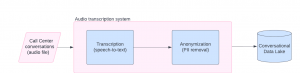
From the previous discussion, it is possible to conclude that an in-production audio transcription system must have two core components: the transcription module itself (the one that converts the audio into text) and an anonymization module (to remove all the sensitive data from the transcripts). The following image shows a high-level architecture for this solution.

Figure 1. High-level architecture for an audio transcription module.

Implementing an end-to-end speech-to-text system for call center records is the first step required to extract value for the transcripts by adding other features on top of it. Some of these features are:

  1. Topic modeling. To know which are the topics discussed in every single conversation.
  2. Sentiment analysis. To know the client’s sentiment regarding the brand and/or about the outcome of the call.
  3. Script monitoring. To validate if the call center operator is following the script and analyze the impact of script variations in the communication output.

From audio to text on an industrial scale – the current landscape

To convert audio to text, there are many different speech-to-text models. At Making Science, we compared several models to see which one performs better. The benchmark dataset we used is the Gridspace-Stanford Harper Valley speech dataset, which contains 1446 call center conversations manually transcribed. These recordings are divided into two audio files, one for the call center operator and the other for the caller. Because of that, no diarization is required.

The metric used to evaluate the model’s performance is WER (Word Error Rate). This metric quantifies the mistakes made by the model, taking into account the substitutions, the mistaken insertions, and the deletions done by it. The lower the WER is, the better the model performance is. Since the WER can be greater than one, it isn’t a transcription accuracy percentage. The WER metric is defined as:

Besides how the WER is, there are also other relevant metrics to evaluate which model is the best one for an industrial-scale application. For example, a few relevant dimensions to take into account for this decision are:

  • How much does it cost to translate a minute of audio?
  • The latency if your use case requires rapid translation and analytics; how long does it take for the model to transcribe audio?
  • Parallelism if your use case has a large number of users waiting for “intelligence”; how many API requests per unit of time can the model provider handle?
  • The Privacy; How does the model provider handle our data? Is it possible to deploy a private instance of the model?

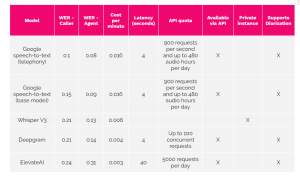
For this benchmark, we considered several models from different providers. Also, we tried models that allow the user to deploy a private instance of it and models that are available via a public API. The results we obtained are available in Table 1.

Table 1: benchmark results for speech-to-text task.

Key takeaways:

  1. Google speech-to-text models are the best-performing models at the time of this benchmark(lower WER) for both agent and caller transcriptions.
  2. In general, the models tend to transcribe better the agent audio than the caller audio. This is an expected behavior because, in general, the audio quality for the agent audio is better.
  3. Whisper V3 has quite good performance, especially for the caller audio. However, the Whisper model doesn’t support diarization. Because of that, to use it in a production environment when audios can be mono audios, a diarization module should be developed (using, for example, pyannote).

Keeping Pace with Speech-to-Text Advancements

In the fast-paced world of speech-to-text technology, it’s crucial to keep pace with innovation. The performance benchmarks we rely on today may shift as advancements continue.

At Making Science, we understand the importance of adaptability and regularly update our approach to ensure we harness the best tools for unlocking customer insights. Stay informed, stay agile, and stay ahead with us as your analytics ally.

Web3: The Next Wave of the Internet

From the very heart of blockchain technology, a quiet revolution is stirring the foundations of the web as we know it. A new era is upon us, where digital pioneers rise to reclaim the throne of digital sovereignty, and decentralization takes center stage. Web3 beckons us back to the protocols that birthed the internet, offering transparency, freer systems, and a renewed online interaction structure that removes intermediaries.

The Promise of Web3: A Shift Towards Decentralization

Let’s focus on what Web3 brings to the table: a transformative network that combines the advanced functionality and user interfaces of Web2 with the neutrality of Web1’s protocols. Unlike the centralized databases of tech giants, Web3 allows us to store information across distributed public databases, harnessing blockchain technology, and potentially resolving issues of trust and transparency.

Imagine extending community-based domain protocols, creating an internet layer free from corporate governance. This enables direct connections between audiences and platforms without algorithms or ads, akin to using email, but with the added capability to develop functionalities atop the protocol—ushering in decentralized finance and autonomous organizations that challenge traditional structures.

Learning from the Past and Navigating the New Web

The battle between Encarta and Wikipedia in the early 2000s is a telling historical parallel. Encarta’s centralized model was supplanted by Wikipedia’s decentralized, community-driven content control. This shift indicates how a decentralized approach can be more aligned with user needs and preferences, foretelling the potential advantages of Web3.

In Web3, we use wallets and tokens on various blockchains, interacting with Smart Contracts. While this may seem daunting, it’s a learning curve comparable to the advent of the internet or smartphones. Web3 introduces new concepts like NFTs and DAOs, and paradigm shifts that demand a deeper understanding, yet the innovation potential is as vast as the challenges we face.

Cryptographic Ownership and Exchange

Tokens symbolize ownership in this new web. They’re cryptographic units of value created by entities, and they come in different types, such as NFTs, which follow the ERC-721 standard. Wallets are programs that allow us to autonomously transact with our tokens. They serve as our interface with the blockchain, the decentralized database that records token ownership, and smart contracts are the self-executing agreements that facilitate this trustless exchange.

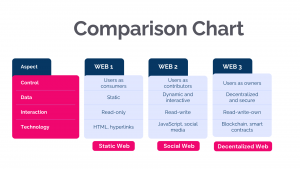
Comparative Analysis Between Web1, Web2, and Web3:

Before we delve further into the implications of Web3, let’s take a moment to compare the three generations of the web:

Use Cases: Web3 in Action

Web3’s potential is not limited to theoretical discussions; it’s already causing ripples across various industries. Let’s delve into some tangible applications that illustrate the power of Web3 in the real world:

  • Supply Chain Management:  Utilizing blockchain technology, Web3 enhances supply chain transparency, allowing us to track the journey of products from manufacturer to consumer. This not only ensures authenticity but also greatly improves the efficiency of tracking items in real-time, a crucial factor for recalls or verifying the supply chain’s integrity.
  • Insurance: Smart contracts in Web3 are set to revolutionize the insurance industry. By automating claims processing, these contracts execute when predefined conditions are met, minimizing the possibility of fraudulent claims and ensuring that genuine claims are paid out more quickly and efficiently.
  • Telecom: Web3 technologies are reinventing the telecom sector with NFT-based mobile identities. These digital identities are secure and portable across services, offering a new level of control and personalization for users while also opening up possibilities for cross-service integration and loyalty programs without compromising privacy.

Conclusion and the Road Ahead

In conclusion, as we stand at the dawn of an internet revolution that lays a new conceptual framework for the future, we must also acknowledge the accompanying challenges, such as an increased risk of scams and the steep learning curve for new users. History shows that once technology solves a problem, it becomes a staple in our lives—like fire, airplanes, and the internet. Innovations may evolve, but the solutions they offer create lasting impact. The shift from Web2 to Web3 is underway; it’s not a question of if, but when it will become mainstream. The time to educate ourselves and safely navigate this new frontier is now.

If you’re ready to unlock the potential of Web3 and transform your business operations, Making Science is here to guide you every step of the way.

AMA Quarterly: Using AI to Create Innovation and Collaboration

Navigating 2024: Top 10 Strategic Technology Trends You Need to Know

As we wave goodbye to 2023 and prepare to embrace the opportunities of the coming year, it’s a perfect time to look ahead toward the future. What innovations and technological advancements await us in the new year and beyond?

From evolutionary to revolutionary changes, thoughtful consideration of how new technologies might affect your business could provide strategic advantages. With this in mind, let’s explore the top tech trends Gartner predicts will play a significant role in 2024 and beyond.

What trends will shape 2024?

1. AI Trust, Risk and Security Management (AI TRiSM)

As the adoption of Artificial Intelligence (AI) continues to accelerate, organizations are increasingly seeking frameworks to manage the associated risks and ensure responsible AI development. AI Trust, Risk, and Security Management (AI TRiSM) is emerging as a prominent approach, offering a comprehensive approach to governance, trustworthiness, fairness, reliability, robustness, transparency, and data protection for AI models.

This framework is gaining traction due to its demonstrated ability to enhance the success of AI projects, increase model precision, and promote fairness in AI-driven applications. Additionally, it emphasizes the importance of continuous model monitoring to ensure that interpretability and explanations remain consistent throughout the AI lifecycle. Organizations that embrace AI TRiSM are laying the foundation for responsible and trustworthy AI deployments that deliver real business value.

2. Continuous Threat Exposure Management (CTEM)

Cybersecurity remains a top priority. organizations seek pragmatic and systemic approaches to optimize their risk mitigation strategies. CTEM, emerges as a forward-thinking approach that aligns exposure assessment cycles with business projects and threat vectors, ensuring security efforts align with organizational objectives.

Beyond traditional vulnerability management, CTEM addresses both patchable and unpatchable exposures, recognizing the need for comprehensive risk mitigation. To validate security controls and prioritization decisions, it incorporates an attacker’s perspective, simulating real-world attacks to test the resilience of defenses. This evidence-based approach shifts focus from tactical responses to informed decisions based on threat analysis, enabling organizations to effectively address emerging threats and enhance overall cybersecurity posture.

3. Sustainable Technology

As the world confronts pressing environmental, social, and governance (ESG) issues, Sustainable Technology stands as a compelling framework for digital solutions to foster positive change: environmental technologies that safeguard the natural world, social technologies that promote human rights and well-being, and governance technologies that strengthen ethical business practices.

Effective implementation of Sustainable Technology hinges on selecting relevant technologies aligned with industry priorities and stakeholder expectations. Cloud services, AI, and other innovative tools can play a transformative role in driving sustainability initiatives.

4. Developer-Driven Self-Service: Platform Engineering

In the pursuit of rapid software delivery and enhanced developer productivity, Platform Engineering focuses on constructing and maintaining self-service internal platforms as layers of abstraction for streamlining the development process and easing the cognitive burden for developers.
By carefully curating reusable, composable, and configurable platform components, knowledge, and services empowers developers to independently manage and develop applications while guaranteeing reliability and security.

This approach not only optimizes the developer experience but also expedites time to market and augments business value. To effectively implement Platform Engineering, organizations should treat the platform as a product, actively engaging with end users to identify and prioritize their requirements. Additionally, fostering a product management culture promotes open communication and collaboration between platform engineers and end users, enabling continuous improvement and feedback loops.

5. AI-Augmented Development

This approach leverages AI technologies like GenAI and Machine Learning (ML) to aid software engineers across the development lifecycle. These tools seamlessly integrate into developers’ environments, helping generate application code, convert legacy code to modern languages, facilitate design-to-code transformation, and improve application testing. 

By automating routine tasks and offering intelligent guidance, AI-augmented development significantly boosts developer productivity, allowing them to concentrate on higher-level tasks like crafting innovative business applications. This not only streamlines the development process but also empowers developers to efficiently deliver software solutions, keeping pace with the escalating needs of today’s businesses.

6. Industry Cloud Platforms

In the dynamic landscape of modern business, Industry Cloud Platforms (ICPs) can revolutionize the way organizations approach IT infrastructure and solutions. These platforms seamlessly integrate underlying SaaS (Software as a Service), PaaS (Platform as a Service), and IaaS (Infrastructure as a Service) services into a unified offering crafted specifically for distinct industries. This tailored approach addresses the unique challenges and requirements of each industry, providing a comprehensive solution that optimizes IT capabilities and drives business success.

At the heart of ICPs lies composability, a key feature that empowers organizations to flexibly combine and customize platform functionalities to align with their specific needs. This agility enables businesses to swiftly adapt to evolving market trends and business requirements, fostering innovation and resilience. Moreover, ICPs are designed with industry-specific outcomes in mind, ensuring that the platform’s features and capabilities are tailored to address the mission-critical priorities of each vertical segment. This focus on industry-specific value ensures that organizations maximize the return on their cloud investments and gain a competitive edge.

7. Intelligent Applications

Intelligent Applications, infused with AI capabilities and diverse data sources, are revolutionizing organizational interactions with users. They offer real-time insights, personalized experiences, and predictive features beyond traditional functionalities. By analyzing user behavior and external trends, these applications proactively cater to user needs, enhancing experiences and driving superior outcomes. This data-centric approach empowers informed decision-making, operational optimization, and competitive advantage.

This paradigm shift in business interactions is driven by Intelligent Applications, leveraging AI and data to transform customer experiences, streamline operations, and foster innovation. They position organizations to flourish in the dynamic digital landscape.

8. Democratized Generative AI

Democratized Generative AI (DGAI) is revolutionizing how organizations operate and engage with stakeholders in the digital realm. By democratizing content creation, it boosts productivity through automation, cuts costs, and empowers a wider workforce with new skills and opportunities. Its personalized content capabilities enhance customer experiences, while unified data access aids decision-making and workflow efficiency. 

As DGAI evolves, its impact promises to transform industries, streamlining processes, elevating customer interactions, and transform how virtually all enterprises compete by empowering users across roles.

9. Augmented Connected Workforce

As remote work persists, Augmented Connected Workforce (ACW) seamlessly integrates intelligent technologies and analytics to empower employees with the tools and insights crucial for success. This approach bridges human expertise with technological capabilities, enabling better decision-making, heightened productivity, and a more adaptable workforce ready to tackle the demands of the digital age.

Beyond individual empowerment, it drives organizational agility by rapidly acquiring new skills and adapting to market shifts. It fosters a motivated workforce, enhancing retention and reducing turnover costs. As workplaces embrace automation and AI, it prepares employees to thrive in this intelligent setting.

10. Machine Customers

Businesses will cater not only to human customers but also to machines. Proliferating connected products with purchasing autonomy in 2024 and beyond will disrupt trillions in sales as non-human economic actors impact business models. Innovatively serving algorithmic customers presents new opportunities for those adapting early.

These non-human economic players, enabled by connected devices, signify a paradigm shift in commerce. With an estimated 15 billion connected devices by 2028, poised to engage in transactions independently. Their impact extends across business realms, offering expanded consumer markets, personalized experiences, streamlined operations through automation, and invaluable data insights for market research and product development.

Conclusion

The opportunities and challenges these emerging technologies present are complex to navigate.  By carefully considering strategic implications and staying informed about the evolving landscape, technology leaders can position their organizations to capitalize on promising innovations while mitigating risks.

As we venture into the future, we’re committed to being your trusted partner, staying ahead of the curve, and delivering value through responsible innovation. At Making Science, we’re ready to ride the wave of these technological advancements, guiding you on your journey from insight to actionable strategy. 

Understand emerging influences, equip yourself to seize opportunities, and safeguard your organization’s future success!


In conversation with The Drum: Clients want to know about agency AI capabilities. How can you stand out?

Read the full article: www.thedrum.comJTNDc2NyaXB0JTNFJTBBJTJGJTJGJTIwR2V0JTIwYWxsJTIwZWxlbWVudHMlMjB3aXRoJTIwY2xhc3MlMjAlMjJpbm5lciUyMiUwQXZhciUyMGlubmVyRWxlbWVudHMlMjAlM0QlMjBkb2N1bWVudC5xdWVyeVNlbGVjdG9yQWxsJTI4JTI3LmlubmVyJTI3JTI5JTNCJTBBJTBBJTJGJTJGJTIwSXRlcmF0ZSUyMG92ZXIlMjBlYWNoJTIwJTIyLmlubmVyJTIyJTIwZWxlbWVudCUwQWlubmVyRWxlbWVudHMuZm9yRWFjaCUyOGZ1bmN0aW9uJTI4aW5uZXJFbGVtZW50JTI5JTIwJTdCJTBBJTIwJTIwJTIwJTIwJTJGJTJGJTIwR2V0JTIwdGhlJTIwZWxlbWVudHMlMjB5b3UlMjB3YW50JTIwdG8lMjBtb3ZlJTBBJTIwJTIwJTIwJTIwdmFyJTIwaW1hZ2VJY29uJTIwJTNEJTIwaW5uZXJFbGVtZW50LnF1ZXJ5U2VsZWN0b3IlMjglMjcuaW1hZ2UtaWNvbiUyNyUyOSUzQiUwQSUyMCUyMCUyMCUyMHZhciUyMHdyYXBTcGFuJTIwJTNEJTIwaW5uZXJFbGVtZW50LnF1ZXJ5U2VsZWN0b3IlMjglMjcud3JhcCUyNyUyOSUzQiUwQSUwQSUyMCUyMCUyMCUyMCUyRiUyRiUyMFJlbW92ZSUyMHRoZSUyMGVsZW1lbnRzJTIwZnJvbSUyMHRoZWlyJTIwY3VycmVudCUyMHBvc2l0aW9ucyUwQSUyMCUyMCUyMCUyMGlubmVyRWxlbWVudC5yZW1vdmVDaGlsZCUyOGltYWdlSWNvbiUyOSUzQiUwQSUyMCUyMCUyMCUyMGlubmVyRWxlbWVudC5yZW1vdmVDaGlsZCUyOHdyYXBTcGFuJTI5JTNCJTBBJTBBJTIwJTIwJTIwJTIwJTJGJTJGJTIwSW5zZXJ0JTIwdGhlJTIwZWxlbWVudHMlMjBpbiUyMHRoZSUyMGRlc2lyZWQlMjBvcmRlciUwQSUyMCUyMCUyMCUyMGlubmVyRWxlbWVudC5pbnNlcnRCZWZvcmUlMjh3cmFwU3BhbiUyQyUyMGlubmVyRWxlbWVudC5maXJzdENoaWxkJTI5JTNCJTBBJTIwJTIwJTIwJTIwaW5uZXJFbGVtZW50Lmluc2VydEJlZm9yZSUyOGltYWdlSWNvbiUyQyUyMGlubmVyRWxlbWVudC5maXJzdENoaWxkJTI5JTNCJTBBJTBBJTdEJTI5JTNCJTBBdmFyJTIwZmlyc3RJbWFnZUljb24lMjAlM0QlMjBkb2N1bWVudC5xdWVyeVNlbGVjdG9yJTI4JTI3LmltYWdlLWljb24lMjclMjklM0IlMEElMkYlMkYlMjBDaGFuZ2UlMjB0aGUlMjBiYWNrZ3JvdW5kJTIwaW1hZ2UlMjBvZiUyMHRoZSUyMGZpcnN0JTIwJTIyLmltYWdlLWljb24lMjIlMjBlbGVtZW50JTBBJTIwJTIwJTIwJTIwJTIwJTIwJTIwJTIwZmlyc3RJbWFnZUljb24ucmVtb3ZlQXR0cmlidXRlJTI4JTI3c3R5bGUlMjclMjklM0IlMEElMjAlMjAlMjAlMjAlMjAlMjAlMjAlMjBmaXJzdEltYWdlSWNvbi5yZW1vdmVBdHRyaWJ1dGUlMjglMjdkYXRhLWJnJTI3JTI5JTNCJTBBJTIwJTIwJTIwJTIwJTIwJTIwJTIwJTIwZmlyc3RJbWFnZUljb24uc3R5bGUuYmFja2dyb3VuZEltYWdlJTIwJTNEJTIwJTI3dXJsJTI4aHR0cHMlM0ElMkYlMkZ0aGVkcnVtLW1lZGlhLmltZ2l4Lm5ldCUyRnRoZWRydW0tcHJvZCUyRnMzJTJGczNmcy1wdWJsaWMlMkZwaWN0dXJlcyUyRnBpY3R1cmUtMTQ3MTU0LTE2MjE5Mzg1MDguanBnJTI5JTI3JTNCJTBBJTBBJTNDJTJGc2NyaXB0JTNF

AR and VR in the Digital Age: Uphill Battle or Future of Opportunity?

Augmented Reality (AR) and Virtual Reality (VR) have made their mark in the digital landscape, promising to revolutionize our interactions with the world. Yet, despite their potential, these technologies are still striving to attain mainstream acceptance. Does AR/VR signal an uphill battle or do they hold a future of opportunity?

Unique UX/UI Design Principles in AR/VR

AR and VR have found success within niche applications. Google, for instance, has made impressive advancements in AR by enabling users to visualize certain products before purchase, and platforms like YouTube now use AR for innovative features like makeup trials. However, these successes are more exceptions than the norm.

Even with tech giants like Meta and Apple delving into this realm, their offerings haven’t ignited the market as expected. Meta’s AR/VR headset and Apple’s VisionPro are yet to showcase their full potential.

A key factor in the adoption of these technologies is the user experience they provide. The UX/UI design principles for AR/VR go beyond the conventional ones like user-centered design, consistency, and hierarchy. AR/VR environments, due to their three-dimensional nature, necessitate a detailed understanding of depth, proximity, and motion, thus broadening the horizon of UX/UI design principles.

Comfort: A Critical Factor in AR/VR Adoption

Comfort in AR/VR settings is a significant aspect that influences user acceptance. The immersive nature of VR can cause discomfort or even trigger motion sickness in users. To encourage user adoption, designers must explore and implement strategies to mitigate these discomforts, thereby ensuring an engaging and enjoyable experience.

Emerging Technologies: A Ray of Hope?

Despite these challenges, emerging technologies offer a glimmer of hope for AR and VR. Products like XREAL’s connected glasses and Mojo Vision’s connected lenses could potentially revolutionize the game. These devices aim to seamlessly merge the virtual and real worlds, making AR/VR more accessible and practical for everyday use.

 Envisioning the Future with AR/VR

The journey of AR and VR technologies in the digital age has been challenging, primarily due to factors like user comfort and the need for innovative UX/UI design principles. However, with the emergence of new devices and a focus on enhancing user experience, these technologies have the potential to take off in a significant way.

Whether AR and VR will become a mainstay in our everyday lives or remain a promising yet unrealized innovation is a narrative that continues to unfold. What’s clear is that these technologies are shaping our present and have the potential to significantly influence the future of digital transformation.

Integrating AR/VR technologies into digital transformation strategies is not just about keeping pace with the latest tech trends. It’s about envisioning a future where businesses can provide unprecedented value to their customers, enhance business operations, and gain a stronger competitive position in an increasingly digital market. AR and VR are not just technologies of the future—they are shaping the present and have the potential to drive significant value in the digital transformation journey. Businesses that understand this will be well-positioned to thrive in the digital age.

Leading the way in this digital era, Making Science is committed to leveraging new technologies to drive digital transformation. Our team of experts, armed with solid UX/UI design principles, is dedicated to helping businesses harness the full potential of AR/VR technologies, enhance customer experiences, and secure a competitive edge in the digital age. Ready to embark on your digital transformation journey with AR/VR? Partner with Making Science today!

Creating a Greener Web: The Importance of Sustainable Websites

By now, you’ve surely heard the term “sustainability.” It’s a concept that should be applied to all human practices – including websites. The Internet has become a vital tool for economic growth and societal development, significantly impacting our daily lives. However, it’s not exactly a clean technology.

The Environmental Impact of the Internet

The Internet has a considerable impact on people’s development and daily life. To achieve sustainable development as outlined by the 2030 Agenda, we must harmonize economic growth, social inclusion, and environmental protection. These elements are interconnected and crucial for the well-being of individuals and societies.

So, what does sustainability have to do with the use of the Internet? A great deal. While the Internet is an indispensable facilitator for economic growth and human progress, it’s not as green as we might hope. With the operation of devices and the dependence on servers (the true heart of the Internet), substantial amounts of energy are used and CO2 is generated.

Here are some startling statistics:

    • The Internet represents approximately 10% of global electricity consumption.
    • If the Internet were a country, it would rank as the sixth largest consumer of electricity on the planet.
    • The Internet produces around 2% of global CO2 emissions annually, equivalent to the aviation industry.
    • An average web page produces 1.76 grams of CO2 for each page visit.
    • Streaming Netflix for one hour a week requires more electricity than the annual production of two new refrigerators.
    • Data centers alone consume approximately 200 terawatt-hours (TWh), that is, more energy than the entire country of Iran.

In addition to these, consider the excessive water consumption in data centers, necessary for their cooling systems and proper maintenance. Most of this water is potable, with non-potable water making up less than 5%. This can cause serious problems for populations and agriculture, especially in the increasingly common scenario of drought.

If this data doesn’t concern you, maybe Google’s penalty will. Google uses metrics called Core Web Vitals to score your website and index it in its search engine more or less favorably. Among these metrics are accessibility, loading speed, and now, sustainability.

How can I build a more sustainable website?

The most basic tips would be to take care of the load time, font and image optimization, js and css rendering, using clean code and simple designs. This it’s just a complement of the good practices that all companies need to apply to reduce their carbon footprint, including the use of clean and renewable energy sources.

The “Sustainable Web Manifesto” proposes certain rules that all digital products and services should follow:

  • Clean. Digital products and services must be powered by clean, renewable energy.
  • Efficient. The products and services provided digitally will use the least amount of energy possible, as well as the minimum material resources.
  • Open. Digital products and services must be accessible, allow the free exchange of information, and allow users to control their data.
  • Honest. The products and services will not deceive or exploit users in their design or content.
  • Regenerative. The products and services will support an economy that takes care of people and the planet.
  • Resilient. The products and services will work at times when people need them most.

The Role of Large Companies: Democratizing Green Websites

Do large companies really take sustainability into account? Undoubtedly, Google’s focus on sustainability is starting to influence designers, developers, and companies worldwide to do things better and apply sustainable practices. Companies like Google, Amazon, Facebook, and Apple still have to set a better example and be responsible for the high social and environmental impact they have. A good example of this is Apple’s recent campaign “2030 Status: Mother Nature“. Some see it as an aspirational, emotional, and hopeful campaign, while others see it as pure greenwashing, especially when considering the company’s blatant planned obsolescence practices and its closed ecosystem that didn’t adopt the USB-C connector until the iPhone 15 (2023). This change was forced by a European Parliament resolution that will require a unified smartphone charger by 2024 to enable reuse and reduce electronic waste.

Conclusion: Towards More Sustainable Websites

Sustainability in web design is more than an emerging trend; it’s a necessity. As the digital world continues to grow, so does its environmental impact. At Making Science, we strive to be part of the solution, not the problem.

Our team of expert back-end and front-end developers, teamed with specialized UI/UX designers, work together to create digital solutions that are not only functional and user-friendly but also sustainable. We leverage our collective expertise to reduce the digital carbon footprint, demonstrating our commitment to making the web greener, one website at a time.

Interested in building a more sustainable web presence? 

Demystifying Google’s Enhanced Conversions

In an era where digital footprints are becoming increasingly elusive, understanding the nuances of conversion tracking is critical for marketers. Conversion modeling stands at the forefront of this change, providing an innovative way to capture data without infringing on user privacy. Today, we explore the depths of Google’s Enhanced Conversions and the crucial role of conversion modeling.

Understanding Conversion Modeling

Conversion modeling is a method that uses aggregated and anonymized data to predict conversions that aren’t directly observable. Instead of relying solely on the decreasing pool of observable data due to privacy changes, it fills in the gaps, offering a more comprehensive view of campaign performance. Google’s approach to modeling ensures that reported conversions present a complete picture, not just a snapshot.

Introducing Enhanced Conversions

In a world where traditional tracking cookies are crumbling, Google’s Enhanced Conversions emerge as a beacon for accurate conversion measurement. This feature utilizes conversion modeling to ensure that advertisers can gauge the efficacy of their campaigns, even as third-party cookies become obsolete.

The Necessity of Enhanced Conversions

As reliance on third-party cookies fades, the risk of digital media performance measurement becoming less reliable grows. Enhanced Conversions serve as the necessary bridge to a future where privacy concerns and marketing analytics can coexist harmoniously.

How Enhanced Conversions Work

  1. A logged-in Google user clicks on your ad.
  2. They make a conversion on your website.
  3. The conversion tag on your site captures a predefined piece of user data (like an email), hashes it, and securely transmits it to Google.
  4. Google then matches this hashed data against its own, noting a conversion in your account, thereby preserving the integrity of your ad performance data.

You can learn more about how Enhanced Conversions work by clicking here.

The Advantages of Enhanced Conversions

Adopting Enhanced Conversions isn’t just about keeping up with privacy standards—it’s about achieving tangible benefits:

  • 5% Increase in Search Conversions: On average, brands adopting Enhanced Conversions for search campaigns see a 5% uptick in conversions.
  • 17% Rise in YouTube Conversions: Similarly, a notable 17% average increase in conversions is observed for YouTube campaigns.
  • 10%+ Boost for Real Estate: In the real estate sector, one of our clients experienced over a 10% increase in total measured conversions after implementing Enhanced Conversions.

What We’ve Learned from Implementing Enhanced Conversions

  • Stakeholder Alignment: It’s crucial to get marketing, legal, privacy, and IT on the same page early in the process to streamline implementation and address compliance concerns proactively.
  • Start Small & Scale: Beginning with a single site allows for benchmarking results and a more manageable scale-up process. However, if there’s consistency across brands or sub-brands, a more comprehensive rollout may be feasible.
  • Defining Success: It’s important to establish what success looks like upfront, considering the balance between implementation costs and the anticipated lift in conversion tracking.

Unlock the Full Potential of Your Campaigns

Understanding and leveraging foundational data is critical in harnessing the full potential of Enhanced Conversions. The “Foundational Data” section of our AI Essentials Playbook provides you with a deep dive into strategies for creating a strong data strategy, designed for marketers aiming to refine their digital approach in line with Google’s AI Essentials checklist.

Ready to elevate your conversion tracking and embrace the next level of digital marketing maturity?

📘 Download the “Foundational Data” section of our AI Essentials Playbook and begin your journey toward a sophisticated, AI-accelerated marketing strategy today.

Read Now