

Enterprise AI Agents: Transforming Business with Intelligence and Autonomy

As artificial intelligence continues to reshape business landscapes, Making Science and Google Cloud recently brought together industry leaders at Google’s Madrid headquarters to explore the transformative power of Enterprise AI Agents. This event highlighted how companies are moving beyond basic automation to adopt intelligent, autonomous systems that redefine customer engagement and operational efficiency.

The Strategic Evolution of Enterprise AI: From Tools to Autonomous Entities

The evolution of AI in enterprise settings has been remarkably rapid. Businesses have progressed from experimental AI in 2023 to real-world implementations in 2024. Now, in 2025, the emergence of AI agents is driving the next stage of transformation. These intelligent systems are no longer just tools but autonomous decision-makers capable of optimizing operations, automating complex workflows, and accelerating business growth.

Key Themes & Insights:

  • From White Box to Black Box AI: Embracing Agility over Algorithmic Detail

Enterprises are moving away from the need to understand every algorithmic detail (white box AI) toward testing AI-driven outcomes (black box AI). As Large Language Models (LLMs) become more advanced, the focus is shifting to “trusting” the LLM while applying the required prompting, grounding and testing; leveraging AI’s agility, rather than dissecting every aspect of each neural network supporting each LLM in an AI Agent.. This approach allows businesses to prioritize adaptability, performance, and user experience over algorithmic transparency.

  • AI Assistants vs. AI Agents: Understanding the Difference

AI Assistants support customer interactions and internal processes but still require human supervision. AI Agents function independently, making decisions and taking actions without direct human input. However, effective governance is essential to ensure reliability and trust in fully autonomous systems.

  • AI Adoption: Bridging Innovation and Practical Implementation

Despite the rapid advancements in generative AI, widespread adoption in business remains in its early stages. Organizations seeking to maximize AI’s potential must focus on:

  • Seamless integration with business processes and APIs
  • High-quality, structured data to improve AI-driven insights
  • Interconnected platforms to enhance automation and decision-making

A case study presented at the event illustrated how Conversational AI and Retrieval-Augmented Generation (RAG) are transforming real estate searches. With over 30,000 successful AI-driven interactions with improved conversion rates, this solution has significantly improved customer engagement while reducing operational costs. AI-powered chatbots in real estate now maintain conversation context, understand user needs, and provide personalized recommendations. One of the key propositions of the AI Agent was the continuous incorporation of new real estate inventory and the enrichment of the data applying points of interest such as schools, hospitals, metro stops, police stations, airports, etc from Google Maps.

  • Expanding AI Applications Across Industries

Predictive Analytics – AI detects fraud and prevents network abuse by analyzing suspicious activity patterns.

Legacy System Migration – Generative AI evaluates risks, costs, and timelines for transitioning outdated IT systems.

Data Integration – AI enhances cross-platform data consistency, improving analytics and business intelligence.

  • Security and Compliance in AI: Ensuring Responsible Deployment

As AI adoption scales, data security, privacy, and compliance remain critical priorities. Discussions at the event underscored the importance of:

  • Regulatory alignment to meet evolving data privacy laws
  • Ethical AI governance to ensure responsible decision-making
  • Robust security frameworks to prevent misuse and protect sensitive information

A well-structured approach to AI governance will be essential to maintain trust and unlock AI’s full potential.

Google Cloud’s Innovations for Enterprise AI Agents

Google Cloud continues to lead enterprise AI innovation, equipping businesses with powerful tools to integrate AI Agents effectively into their operations.

Customer Engagement Suite (CES): Gemini 2.0 and the Future of Multimodal AI

One of the key announcements at the event was the introduction of Customer Engagement Suite’s (CES) integration of Gemini 2.0, a multimodal AI solution integrated into the. This advancement enables businesses to facilitate seamless interactions across voice, text, and visual inputs, ensuring a fluid and personalized customer experience.

For example, a customer support system powered by Gemini 2.0 can interpret a mix of text-based queries, voice commands, and image uploads, all while maintaining contextual understanding. This level of interaction enhances customer satisfaction and streamlines service efficiency.

The adoption of multimodal AI represents a major leap forward in enterprise AI, providing organizations with an intuitive and adaptable engagement platform.

Revolutionizing Workplace Efficiency with AgentSpace

The introduction of Google’s AgentSpace platform addresses a critical challenge in modern enterprises: the fragmentation of information and tools. By integrating advanced search capabilities with AI-powered assistance, AgentSpace transforms how employees interact with enterprise systems. This integration reduces the time spent switching between applications while enhancing decision-making through improved access to organizational knowledge. 

Employees are no longer bound by siloed data or the need to navigate multiple interfaces. AgentSpace intelligently connects relevant information, allowing for faster, more informed decisions and a more productive work environment.

NotebookLM: Advancing Enterprise Intelligence

A significant advancement in enterprise tools, NotebookLM Enterprise demonstrates the power of AI in research and information synthesis. The platform’s ability to process diverse content types – from documents to video content – while maintaining context and generating actionable insights represents a new paradigm in enterprise information management. Imagine being able to analyze a complex research paper, a lengthy video presentation, and a series of internal reports, all within a single interface. 

NotebookLM not only processes these diverse formats but also identifies key themes, synthesizes information, and generates actionable insights, effectively turning raw data into strategic knowledge. This tool empowers professionals across various sectors to accelerate research, enhance analysis, and ultimately, make more informed decisions.

Looking Ahead: The Future of Enterprise AI

Enterprise AI is advancing at an unprecedented pace. The integration of intelligent AI agents marks not just an evolution in technology but a fundamental shift in how businesses operate, engage with customers, and drive innovation.

As a strategic Google Cloud partner, Making Science continues to play a pivotal role in guiding organizations through AI adoption, implementation, and optimization. For businesses looking to leverage AI-driven transformation, our team of experts is ready to support their journey toward greater efficiency, agility, and intelligence.

The future of enterprise AI is here, and organizations that embrace it today will define the market leaders of tomorrow.
Creativity as the New Target: How ad-machina Makes It Possible

In the era of automated advertising and artificial intelligence, we have more tools than ever to unlock the full potential of our campaigns. A prime example is Meta’s Advantage+ Shopping Campaigns, where AI plays a fundamental role in optimizing results. These campaigns analyze millions of signals to identify users most likely to engage, purchase, or click on an ad, maximizing performance through data-driven insights.

With automation handling campaigns and audience targeting, creativity becomes the primary focus for optimization. Studies show that creativity is a major driver of campaign performance on platforms like Meta, where brands have only milliseconds to capture users’ attention in an increasingly competitive environment. Additionally, the high volume of ad impressions can lead to creative fatigue, significantly impacting campaign results.

This new digital paradigm highlights the importance of audience automation, but above all, positions creativity as a key lever for advertisers. Recognizing this shift, Making Science launched ad-machina for Social, extending its automated creative generation capabilities from Search and Performance Max to Meta. ad-machina leverages AI to enhance Meta campaign management, helping brands maximize their advertising investments.

What can ad-machina offer you?

ad-machina is designed to help advertisers maximize the value of their Meta campaigns through automation and the use of AI. Through the API, the tool allows campaigns to be created, managed and published in record time, giving advertisers a competitive advantage by significantly reducing execution times while ensuring continuous optimization.

What sets ad-machina apart is its ability to connect to the customer’s first-party data. This opens up a range of possibilities to automate campaigns directly aligned with business objectives, using customized rules such as:

  • Automation based on sales data: The advertiser can set up rules so that sale ads automatically include the best-selling or high in-stock products. This not only saves time, but also ensures that ads are always aligned with business needs.
  • Adaptation to seasonality and local behavior: for global brands, ad-machina can adjust creatives based on seasonality and local preferences. This is especially relevant for industries like fashion, where demand greatly varies depending on location, seasonality and the weather. By connecting weather data, advertisers can show different product categories for each geographic location. 
  • Margin optimization: by connecting product margin data, ad-machina can prioritize the promotion of categories, brands or products that offer higher margins, helping to maximize the value of each euro invested in Meta.

The most disruptive aspect of ad-machina is its ability to apply AI to analyze and improve creative. Meta uses creative as a crucial signal in its Advantage+ campaigns, and ad-machina leverages this intelligence to help advertisers discover which elements within their creative drive better campaign performance.

For example, ad-machina can analyze factors such as:

  • Whether the people in the images are smiling.
  • Whether natural light is used in the photos.
  • The visual style of creativity.

These details, often overlooked because they are difficult to analyze, can make all the difference in a campaign’s performance. Once the technology identifies key success factors, it allows AI-enabled creative to be adapted to incorporate these improvements. This ability to generate new creative quickly solves one of the biggest challenges facing Meta advertisers: creative fatigue.

In a dynamic environment like Meta, where ads quickly reach their fatigue point, the ability to refresh creatives frequently is essential to maintain performance. ad-machina simplifies this process, reducing dependence on creative teams to perform constant refreshes, helping Meta’s algorithms find the right audience through signals like CTR (Click-Through Rate). In automated campaigns like Advantage+, where the audience is no longer selected by the advertiser, CTR becomes a crucial signal to guide the algorithms towards users with the highest purchase intent.

This all happens in real time and without human intervention, allowing advertisers to focus on strategy while the tool takes care of the entire execution. 

Making Science: Leader in AI for Creativity

With ad-machina, Making Science positions itself at the forefront of AI-powered creativity. This tool not only enables advertisers to optimize their campaigns on Meta, but also transforms the way they manage their advertising spend, aligning creative with business needs and using AI to maximize performance.

In an era where automation is redefining digital advertising, creativity is the key to success.  ad-machina empowers brands to thrive in this new era, ensuring campaigns remain fresh, engaging, and highly effective.


DevOps as a Growth Strategy: How Businesses Gain Speed, Security, and Scalability

Slow IT is dead. In a world where speed defines winners, sticking to old ways means falling behind. Businesses that fail to innovate at speed while ensuring security and scalability risk being left behind. Traditional IT models can no longer handle the relentless demand for rapid software releases, resilient cloud infrastructures, and frictionless user experiences. This is where DevOps steps in, not as a mere technical fix but as a strategic weapon for survival and growth.

Companies that successfully integrate DevOps see faster time-to-market, reduced costs, and improved system reliability. Research shows that high-performing DevOps teams:

  • Deploy software 30 times more frequently than traditional IT teams
  • Experience 75% fewer failed deployments
  • Recover from failures 24 times faster

As businesses accelerate their cloud adoption, Google Cloud’s DevOps Specialization serves as a benchmark for expertise in delivering these benefits. Making Science recently achieved this specialization, reinforcing our ability to help companies automate operations, enhance security, and scale cloud environments efficiently.

How DevOps Delivers Measurable Business Value

1. Accelerating Software Delivery with Automation

Companies that rely on manual development and deployment processes often struggle with long release cycles and inconsistent software quality. DevOps introduces continuous integration and continuous deployment (CI/CD) pipelines, enabling organizations to:

  • Deploy new features faster and more frequently
  • Reduce human error by automating repetitive tasks
  • Improve collaboration between development and operations teams

Use Case: An e-commerce company struggling with frequent website crashes during high-traffic sales events implemented DevOps automation to streamline deployments. By automating testing and release management, they reduced deployment time from weeks to hours, ensuring a seamless shopping experience for customers.

2. Enhancing Security Without Slowing Innovation

Security is often treated as a separate process, leading to vulnerabilities being detected too late in the development cycle. DevSecOps, a key component of DevOps, integrates security checks from the start, reducing risks while maintaining agility. Businesses benefit from:

  • Automated security scans and compliance checks
  • Faster identification and resolution of vulnerabilities
  • Reduced downtime due to security incidents

Use Case: A financial services company dealing with strict regulatory requirements adopted DevSecOps to automate compliance reporting and security audits. This cut their compliance costs while ensuring that every software update met industry standards.

3. Scaling Cloud Infrastructure Efficiently

Many organizations face challenges in scaling their applications without over-provisioning resources and inflating costs. DevOps, combined with Google Cloud’s scalable infrastructure, enables:

  • Auto-scaling to handle traffic spikes efficiently
  • Cost optimization by aligning cloud resources with demand
  • Improved system resilience with automated failover mechanisms

Use Case: A telecom provider expanded its services to new markets but needed to ensure consistent application performance across different regions. By adopting DevOps practices, they optimized their cloud infrastructure, reducing server downtime and lowering cloud costs. 

Why DevOps is Now a Competitive Advantage

Businesses that embrace DevOps gain operational efficiency, stronger security, and cost savings, but more importantly, they stay ahead of the competition. DevOps is no longer just for tech companies—retailers, banks, healthcare providers, and manufacturers are all leveraging it to:

  • Reduce time-to-market for new products and services
  • Optimize IT and development costs with automation
  • Strengthen security while maintaining agility
  • Enhance customer experiences with more reliable applications

With digital transformation accelerating across industries, companies that fail to adopt DevOps risk falling behind. A modern business strategy must include automated, secure, and scalable cloud operations—which is exactly what DevOps enables.

How to Get Started with DevOps for Your Business

Implementing DevOps requires more than just tools; it involves a cultural and operational shift. Here are key steps businesses can take:

  1. Assess current processes – Identify bottlenecks in development, deployment, and security workflows.
  2. Automate where possible – Introduce CI/CD pipelines, infrastructure as code (IaC), and automated security testing.
  3. Adopt cloud-native practices – Use scalable cloud infrastructure, serverless computing, and containerization.
  4. Ensure security is built-in – Implement DevSecOps to maintain compliance without slowing innovation.
  5. Partner with specialists – Work with certified experts to accelerate adoption and maximize impact.

Future-Proofing Your Business with DevOps

DevOps isn’t just about improving IT efficiency—it’s about enabling business growth. Companies that integrate DevOps into their cloud strategy, security model, and automation efforts gain a significant edge.

Google Cloud’s DevOps Specialization provides reliability for businesses, ensuring they wor with proven experts in cloud transformation. Making Science, with its six Google Cloud specializations, offers end-to-end support for companies looking to:

  • Scale cloud operations efficiently
  • Strengthen security while accelerating innovation
  • Reduce costs through automation and optimized cloud usage
  • Improve software reliability and customer satisfaction

Staying ahead in the digital race requires more than just technology… It demands a shift in mindset and strategy.

Want to explore how DevOps can transform your business? Get in touch with our team to discuss a tailored strategy that aligns with your goals.

5 Critical Data Protection Mistakes of 2024 and Keys to Avoid Them in 2025

In a world where data is the new gold, its protection has become an absolute priority for companies of all sizes. The year 2024 has taught us important lessons about digital security, with cases that have exposed critical vulnerabilities in personal data management. City councils, hospitals, newspapers, the DGT, and major companies like Telefónica, Deloitte, and Banco Santander have been just some examples of victims affected by exposed sensitive data issues. 2025 will be no different, as cybercriminals, increasingly prepared and innovative, are ready to improve their attack vectors.

Is your organization prepared for the data protection challenges of 2025? Discover the most significant data protection errors of the past year and how to avoid them in your company during this new year.

1. AI Misuse: The Double-Edged Sword

Artificial Intelligence continues to transform everything in its path. The proliferation of models and their integration with various tools have significantly expanded access to information, often without considering how this data is used in model training processes.

For example, lawsuits against OpenAI for privacy violations marked a turning point in how we consider data use in AI model training. The AI tools available in today’s market are endless – models, platforms, extensions, code assistants – all are very useful and make our work more efficient, but users often have no idea what happens with the information they use.

How to protect your company in 2025?

  • Implement privacy impact assessments before adopting any AI tool
  • Implement sandboxing for AI applications (usually possible with paid instances)
  • Develop clear policies on what information can be shared with AI assistants
  • Focus on education about responsible AI use rather than excessive restrictions

2.Unencrypted Communications: An Open Door for Cybercriminals

Unencrypted communications have become one of the main access routes for cybercriminals, who exploit this vulnerability to intercept sensitive data in transit. It’s like sending all letters in transparent envelopes.

Unencrypted communications are particularly dangerous in today’s hybrid business ecosystem, where data constantly travels between offices, homes, and the cloud. When this data travels “in plain text,” any malicious actor with network access can intercept, read, and manipulate the information without leaving a trace. It’s like shouting confidential information in a public square hoping no one else is listening.

The problem is magnified in multi-cloud environments, where data passes through multiple network points before reaching its destination. In 2024, 40% of data breaches occurred precisely because of this vulnerability, with an average cost exceeding 5 million euros per incident. More worryingly, these breaches took an average of 283 days to detect, during which attackers had free access to sensitive information.

Your shield for 2025:

  • Implement end-to-end encryption in all communications
  • Adopt robust key management solutions
  • Establish regular encryption system audit schedules

3. Poor Access Control: The Weakest Link

Imagine a corporate building where all doors are open, with no record of who enters or leaves, and where any employee can access the safe. This is the perfect analogy to describe how many companies managed their digital access in 2024.

The complexity and workload involved in properly managing and monitoring access means many organizations fail in critical aspects: former employees maintain active credentials months after their departure, elevated privileges granted for specific projects remain indefinitely, and when attackers manage to compromise a single access point, they find an almost clear path to move laterally throughout the corporate network.

The 2024 Snowflake case taught us a clear lesson: more than 165 companies suffered security breaches for not activating multi-factor authentication. A basic error with devastating consequences.

Your winning strategy for 2025:

  • Rigorously implement the principle of least privilege
  • Invest in next-generation IAM systems
  • Use mandatory MFA systems
  • Schedule quarterly access permission reviews

4. Insufficient Monitoring: The Price of Neglect

The math is simple: according to IBM, organizations with reduced security teams paid $1.76 million more in breach costs. Investment in cybersecurity continues to be underestimated; it’s a matter of priorities – SMEs don’t consider cybersecurity one of them, and this can lead to data leaks, loss of money, customers, or reputation.

Your action plan for 2025:

  • Implement 24/7 monitoring systems with behavior analysis
  • Adopt AI-powered threat detection tools
  • Partner with specialists for implementing monitoring measures and tracking hybrid multi-cloud environments

5. Insufficient Investment in Training and Systems: The False Economy

Companies that invested in AI and security automation saved $2.2 million in breach costs during 2024. Training and awareness play a fundamental role in this area – if your employees know the risks and problems, they’ll be much more alert in their daily work. At Making Science, around 2,500 phishing cases were detected, which is why we raise awareness among our employees with internal tests updated with the latest attack methodologies, keeping us trained and in shape.

Your smart investment for 2025:

  • Allocate specific budget for cybersecurity training
  • Modernize your infrastructure with advanced security technologies
  • Implement regular security drill programs such as phishing campaigns

Conclusion: Data Protection as a Competitive Advantage

In 2025, data protection won’t just be a legal obligation but a crucial competitive advantage. Companies that learn from past mistakes and implement proactive solutions will not only protect their sensitive information but will also gain the trust of their customers and partners.

Are you ready to turn data protection into your strategic ally? The time to act is now. Investment in data security isn’t an expense; it’s an investment in your company’s future.

Need help implementing these measures in your organization? Contact us for a free assessment of your data security.

Making Science launches RAISING, its new AI technology division to power marketing strategies 

  • RAISING combines the company’s business expertise in data science to develop advanced AI-based solutions.


  • This new division includes technological tools such as ad-Machina, Gauss AI, and Trust Generative AI, offering innovative solutions for measuring and optimizing marketing strategies.


Chicago, IL, January 08, 2025 – Making Science, a technology and digital marketing consultancy specializing in e-commerce and digital transformation, has announced the launch of RAISING, its new technology division that combines the company’s business expertise with data science to develop advanced solutions based on Artificial Intelligence. This new venture aims to transform brands’ marketing strategies through predictive, generative, and automated AI technologies, optimizing results throughout the entire funnel.


AI-based solutions to transform marketing

RAISING integrates cutting-edge tools that reinforce its technology proposition. These include ad-machina, Making Science’s flagship technology that uses generative AI to automate the creation and multi-platform activation of personalized ads in real-time. The tool has proven its effectiveness on platforms such as Performance Max and Meta, achieving up to 30% more conversions compared to traditional methods. Its advanced functionalities allow the dynamic adaptation of text, image, or video ads to market and user needs, incorporating detailed data analysis, automatic translation, and large-scale optimization, ensuring more effective and profitable campaigns, which relevant companies such as Banco Santander or MediaMarkt have already integrated into their business plans.


Another key product of this new division is Gauss AI, which is designed to predict user behavior and optimize attribution, measurement, and media planning strategies. This system helps companies to identify the most relevant and profitable interactions, increasing the effectiveness of their campaigns. Trust Generative AI is positioned as a versatile and secure tool for content generation at scale, automating internal and external processes in areas such as marketing, SEO, and human resources while ensuring regulatory compliance and ultimate human control.


A step forward in technological innovation

The launch of RAISING reinforces Making Science’s position as a benchmark in technological innovation applied to marketing. 


According to José Antonio Martínez Aguilar, founder and CEO of Making Science: “With the launch of RAISING, we reaffirm our commitment to innovation and our ability to deliver disruptive technology solutions that transform how brands engage with their audiences. With this division, we want our clients to optimize their results and access new opportunities in an increasingly competitive and complex digital environment, offering technology (SaaS) so that their own teams can develop their business strategies”.


In conjunction with the launch of RAISING, Making Science also announced a fully paid capital increase of €10 million in its subsidiary Making Science Marketing & AdTech. This investment is part of the investment agreement with the SOPEF II fund (Spain Oman Private Equity Fund), managed by MCH, to enhance the company’s growth and expansion.


2025 Technology Landscape: Strategic Imperatives for Business Leaders

As we approach 2025, technology leaders face a pivotal moment. The convergence of AI autonomy, quantum advancements, and human-machine collaboration isn’t just reshaping technology – it’s fundamentally transforming how businesses create and capture value. Drawing from extensive Gartner and IDC research, we explore how forward-thinking CIOs and technology leaders will navigate this new landscape.

The stakes have never been higher. With 50% of G1000 organizations facing divergent regulatory changes by 2025 and 85% implementing formal AI governance policies, technology leaders must balance innovation with responsibility. This isn’t just about adopting new technologies – it’s about architecting the future of business itself.

The New AI Paradigm

The landscape of AI is rapidly evolving, with Generative AI emerging as a powerful force. This transformative technology is not only automating tasks but also creating entirely new products, services, and business models. As Conversational AI continues to advance, organizations are increasingly leveraging AI to drive innovation, optimize operations, and enhance customer experiences.

According to recent research from Google Cloud, early adopters are seeing significant benefits, including:

  • Productivity Boost: A 45% increase in productivity.
  • Enhanced User Experience: An 85% improvement in user engagement.
  • Strengthened Security: A 56% fortification of security posture.
  • Revenue Growth: An 86% increase in revenue.

To fully realize the potential of AI, organizations must adopt a strategic approach. This includes:

  • Ethical AI Governance: Establishing guidelines to ensure responsible AI development and deployment.
  • Quantum Readiness: Preparing for the quantum computing era by implementing quantum-resistant cryptographic algorithms.
  • Human-AI Collaboration: Leveraging AI to augment human capabilities and drive innovation.

Generative AI represents a fundamental shift in how organizations approach automation and decision-making. Autonomous agents capable of planning, adapting, and executing complex strategies independently will handle 15% of daily business decisions by 2028, necessitating both vision and careful governance.

The research reveals that organizations must formalize policies and oversight to address AI risks, including ethical considerations, brand protection, and personal information security. By 2025, 85% of organizations will align AI governance with strategic business objectives, making it a cornerstone of digital transformation.

By embracing these principles and recognizing the transformative potential of Generative AI, organizations can navigate the complexities of the AI landscape and emerge as leaders in the digital age.

Key Security Trends

Two critical security trends are emerging:

  • Quantum-Ready Infrastructure: By 2027, only 50% of organizations will effectively leverage AI for incident detection and resolution. Organizations must begin transitioning to quantum-resistant algorithms now, following a structured approach from evaluation to implementation.
  • Defense Against Disinformation: By 2028, 50% of companies will invest in specialized security capabilities to combat disinformation, up from just 5% in 2024. This investment reflects the growing recognition that reputation and trust are as crucial as data protection in an AI-driven world.

The Evolution of Computing

The future of computing is neither purely cloud-based nor exclusively on-premises—it is intelligent hybrid computing. This new paradigm combines:

  • Energy-Efficient Computing: As AI workloads intensify, sustainability becomes a board-level priority. New computing architectures promise substantial efficiency gains while meeting environmental responsibilities.
  • Ambient Invisible Intelligence: Through 2028, the proliferation of low-cost sensors and IoT devices will focus on practical applications: reducing costs, improving efficiency, and enabling real-time decision-making.
  • Hybrid Architectures: Organizations must balance security with innovation, combining on-premises control with cloud scalability to optimize performance and compliance.

Human-Machine Collaboration

Perhaps most transformative is the evolution of how humans and machines work together. By 2030, 80% of humans will regularly interact with smart robots, while spatial computing creates new paradigms for collaboration and creativity.

Research predicts that by 2028, 80% of G1000 CIOs will be recruited externally, highlighting the need for leaders who can orchestrate this human-machine synergy effectively. Success will require:

  • Expertise in digital innovation
  • Strategic leadership capabilities
  • Industry versatility
  • Change management proficiency

Strategic Implications

For technology leaders, these trends converge to create both opportunities and imperatives. Success in 2025 and beyond will require:

  • A balanced approach to AI autonomy and governance
  • Proactive preparation for quantum security threats
  • Strategic investment in sustainable computing infrastructure
  • Thoughtful orchestration of human-machine collaboration

Another report predicts that by 2028, 50% of organizations will adopt cutting-edge tools to address the digital and AI skills gap, reducing dependence on specialized talent while enhancing workforce capabilities for innovation.

Conclusion

The technology landscape of 2025 demands more than technical expertise: it requires strategic vision and deep business insight. Leaders who can interpret these converging trends and focus on value creation will define the next era of digital transformation.

The future is arriving faster than we think. Is your organization ready for these transformative changes? At Making Science, we understand the implications of these trends and know how to help organizations manage change effectively. Get in touch with our experts to explore how these trends align with your business strategy and prepare for the changes ahead.

The Dawn of Conversational Analytics: Reflections from the GenAI + Looker Event

As businesses strive to gain a competitive edge, the ability to transform raw data into actionable insights has become paramount. However, the path to leveraging data effectively has often been an uphill climb plagued by technical hurdles and siloed information. At our recent event “GenAI + BI: Accelerating Time-to-Insight with Looker” in collaboration with Google Cloud, we witnessed how generative AI is revolutionizing this paradigm, ushering in a new era of conversational analytics.

The Evolution of Business Intelligence

For decades, extracting insights from data meant wrestling with complex queries, static dashboards, and clunky reporting processes accessible only to the technically skilled. While tools like Looker provided powerful data exploration and visualization capabilities, ensuring data democratization remained an uphill battle. What set Looker apart was its robust data governance foundation – a centralized model that promoted trust and accuracy while unlocking self-service analytics across an organization.  However, even with these advancements, a gap persisted between businesses and the true democratization of data they sought.

This disconnect has been a driving force for our team at Making Science. As I shared during the event, “For too long, data democratization and getting insights from data has been an uphill climb.” But the integration of Looker and generative AI (GenAI) is profoundly changing the game.

Fostering True Data Literacy

At the core of this transformation lies the power of natural language interaction. Through Looker’s GenAI capabilities, users across an organization can simply ask questions and receive accurate, real-time insights without grappling with SQL, data modeling, or visualizations. This intuitive approach empowers teams to become active participants in data-driven decision-making, fostering a culture of true data literacy.

Fabrizio Russo, Cloud BI Specialist at Google Cloud, encapsulated this shift perfectly: “With Looker and GenAI, you can ask complex questions and receive answers instantly, without the need for technical expertise or data manipulation. This is data democratization in action.”

From Data to Profit: AI-Powered Monetization

But the potential of Looker’s GenAI integration extends far beyond interactive Q&A. Through live product demonstrations, we witnessed firsthand how these capabilities enable users to automatically generate visualizations, build custom dashboards, rapidly develop data-driven applications, and much more – all via simple natural language prompts.

This seamless translation from insights to action unlocks new frontiers in monetizing data. Tools like Looker Actions and Embedded Analytics empower businesses to package and monetize their analytics offerings, create tiered pricing models for differentiated data access, embed insights into customer-facing platforms, and drive sustainable revenue growth.

We had the privilege of hearing from Sergio Pescador, Corp Dev. & BI Director at Playtomic, the leading padel reservation app. Sergio detailed their inspiring journey of leveraging Looker to unify organizational data, enabling data-backed decision-making across departments while maintaining their competitive edge.

Looking Ahead: Embracing the Future of BI

As this groundbreaking event made clear, the fusion of Looker and GenAI is merely the beginning of a seismic shift in how businesses will interact with and extract value from their data. Generative AI will continue to push the boundaries of what’s possible, propelling us toward an era of hyper-personalized data experiences and unprecedented efficiencies.

At Making Science, we remain committed to staying at the forefront of these transformative AI capabilities in the BI space. Our team of seasoned experts stands ready to guide organizations in navigating this new frontier and unlocking the full potential of a conversational, AI-driven approach to data analytics.

The path from insights to impact has never been more clear or achievable. The dawn of conversational analytics is here, and those who embrace it will gain a decisive competitive advantage. I encourage you to explore Making Science’s comprehensive offerings and engage our team to begin your data transformation journey.

Data Exploration Reimagined: GenAI Meets Looker

Let’s face it: data is the lifeblood of modern business and extracting valuable insights from complex data sets has become crucial for organizations to maintain a competitive edge. 

But what good is a wealth of data if you can’t easily unlock its secrets? Traditional BI tools often felt like navigating a labyrinth, requiring technical expertise and time-consuming queries.

What if you could simply converse with your data?

Looker’s Explore Assistant, powered by Generative AI’s remarkable capabilities, makes this a reality by enabling conversational analytics and making data exploration more accessible and intuitive than ever before. With GenAI, interacting with data becomes as natural as having a conversation that instantly and accurately answers your business questions in plain language.

From Dashboards to Dialogue: The Evolving Landscape of Business Intelligence

Business intelligence has undergone a dramatic transformation over the years. We’ve progressed from static reports and cumbersome spreadsheets to interactive dashboards that offer a visual representation of information. However, even with these advancements, a certain level of technical proficiency and a deep understanding of data structures, SQL queries, and data manipulation techniques were still required, often posing a new set of challenges for users.

According to a report by MarketsandMarkets, “The global conversational AI market is expected to grow from USD 13.2 billion in 2024 to USD 49.9 billion by 2030, at a CAGR of 24.9%.” This rapid growth underscores the increasing demand for intuitive, conversational analytics tools that can democratize data access and empower users across all levels of an organization.

Source: MarketsandMarkets’ “Conversational AI Market by Component, Type, Application Area, Business Function, Vertical and Region – Global Forecast to 2028” (Estimated release in Q4 2023)

Looker’s Explore Assistant breaks down barriers, ushering in a new era of conversational analytics. Now, anyone in your organization, regardless of their technical background, can effortlessly ask questions and obtain instant answers from their data – no coding required!

The Benefits of Conversational Analytics

Looker’s Explore Assistant offers a multitude of advantages for businesses seeking to become truly data-driven:

  • Increased Accessibility: Empowers users across all departments and skill levels to interact with data and gain valuable insights.
  • Faster Insights: Eliminates the need for complex data manipulation, providing real-time answers to your business questions.
  • Improved Decision-Making: Enables quicker and more informed decisions based on data-driven insights.
  • Enhanced Data Governance: Fosters a data-driven culture by encouraging exploration and understanding of data.
  • Time Savings: Frees up valuable time for analysts and other team members, allowing them to focus on more strategic tasks.

By leveraging the power of conversational analytics and generative AI, businesses across different industries can uncover actionable insights, make data-driven decisions, and drive meaningful results.

Ready to Experience the Future of BI?

Join us for our exclusive event, “GenAI + BI: Accelerating Time-to-Insight with Looker,” taking place on September 19th, 2024, at Google Madrid. Together with Fabrizio Russo, Cloud BI Specialist at Google Cloud, we will delve deeper into the world of conversational analytics with live demos. Plus, you’ll hear from one of our clients, who will share their experience and success story by applying these innovative tools.

Making Science: Your Partner in Data-Driven Transformation

At Making Science, we’re passionate about helping businesses harness the power of Looker and Generative AI to achieve their goals. Our team of experts has a proven track record of successful implementations across a wide range of industries.

We understand that every business is unique, and we work closely with our clients to develop tailored solutions that address their specific needs

The future of business intelligence is conversational, and Looker’s Explore Assistant is leading the way. Partner with Making Science and embark on a journey of data-driven discovery that will transform your business.

The Growing Threat of Cybersecurity Talent Shortage: Lessons Learned from Cloud Maturity Journey Podcast Series

The digital world is under siege. Cyberattacks are becoming more sophisticated and frequent, yet a critical line of defense is worryingly thin: the cybersecurity workforce. The stark reality is that there simply aren’t enough skilled professionals to combat the growing threat, leaving organizations vulnerable.

This alarming talent shortage took center stage in our recent “Cloud Maturity Journey” podcast episode, “Building a Digital Fortress: Security Best Practices and Strategies”. Our expert guests, Miguel Lopez, Cloud & Cybersecurity Director at Making Science, and Washington Gomez, CISO of GETD, provided invaluable insights into this pressing challenge.

The People Problem:

“The main challenge organizations face today lies with people,” Washington emphasized. “And when I say people, I mean talent.” This sentiment highlights the fierce competition for skilled cybersecurity professionals, making it difficult for companies to attract and retain top candidates.

A Complex Threat Landscape:

The rapidly evolving technological landscape, particularly advancements in Artificial Intelligence, has significantly complicated the cybersecurity environment. Cybercriminals are exploiting these tools to develop increasingly sophisticated attacks, making it difficult for organizations to stay ahead.

While technology offers potential solutions, it also exacerbates the talent shortage. Tools like AI and automation can optimize certain cybersecurity tasks, but they require skilled professionals to operate and maintain them. Additionally, the shift towards cloud infrastructure has introduced new vulnerabilities demanding specialized expertise.

Building a Resilient Defense:

To address this challenge, organizations must adopt a comprehensive approach, including:

  • Investing in employee training: A strong security culture begins with informed employees. As Miguel, another podcast guest, emphasized, “Employee training is essential. They need to understand they are targets and be proactive.”
  • Fostering cross-team collaboration: Collaboration between security teams and other departments, such as development and operations, is crucial. This integrated approach can help embed security into the software development lifecycle and enhance overall resilience.
  • Leveraging automation: Automation can improve efficiency and reduce human error. However, it’s essential to maintain a balance between automation and human oversight.
  • Staying updated on emerging threats: Cybersecurity professionals must stay informed about the latest threats and trends. This involves staying updated through industry publications, conferences, and networking.

Looking Ahead:

The cybersecurity industry presents significant challenges and offers exciting opportunities for skilled individuals. The demand for qualified professionals is high, and career prospects are promising. By investing in continuous learning and development, individuals can position themselves for success in this dynamic field.

Ultimately, addressing the cybersecurity talent shortage requires a collaborative effort from governments, industry, and academia. As Washington pointed out, “Cybersecurity isn’t just about technology; it’s a process involving people, processes, and technology.” By working together to develop educational programs, promote cybersecurity as a career, and foster innovation, we can build a more secure digital future.

To gain deeper insights and practical advice, we encourage you to listen to the full episode.This podcast offers a comprehensive overview of the cybersecurity challenges and opportunities, providing organizations with the tools to protect their assets and reputation.

Listen to the full episode of Cloud Maturity Journey to learn more about building a solid cloud foundation for your business.

Taking Control of Cloud Costs: Strategic Approach with FinOps

The cloud revolutionized business operations, offering unparalleled flexibility and scalability. However, this agility often comes with a challenge: managing complex and potentially runaway cloud expenses. Many organizations struggle to effectively control their cloud investments, leading to budget overruns and missed opportunities.

That’s where Cloud FinOps comes in – It’s a comprehensive approach that empowers organizations to maximize the value of their cloud investments. More than just cost-cutting, FinOps is a cultural shift that promotes financial accountability and optimizes cloud resource utilization.

From Cloud Chaos to Cost Clarity: Why FinOps Matters

Cloud FinOps is your all-in-one navigation system, providing:

  • A Clear Map of Your Cloud Costs: FinOps acts as your financial guide, revealing hidden costs and illuminating exactly where your money is going. You’ll gain a comprehensive understanding of your cloud spending patterns, identify cost drivers, and pinpoint areas for optimization.
  • The Tools to Steer Your Course: With FinOps, you’re not just along for the ride. You’re equipped with the insights and tools to optimize your cloud resources in real-time. Make data-driven decisions about your cloud usage, adjust your course as needed, and keep your spending on track – even as your business grows and evolves.
  • The Confidence to Explore New Horizons: When you’re confident in your cloud finances, you’re free to explore new opportunities without hesitation. Scale your operations, experiment with innovative technologies, and chart a course for growth – all without the fear of cost overruns derailing your journey.

The Three Pillars of FinOps Success

FinOps is built on a foundation of three core components, working together to ensure you get the most out of your cloud investments:

1. Operational Framework: This is all about establishing clear processes and practices for managing your cloud environment. It includes:

  • Gaining a deep understanding of your cloud costs
  • Creating budgets and tracking spending
  • Identifying opportunities for savings
  • Utilizing cloud resources efficiently and effectively
  • Building a culture of financial responsibility

2. Collaborative Culture: FinOps is a team effort. It’s about breaking down silos between finance, operations, and development teams, so everyone is working together towards shared goals. This requires:

  • Open communication and regular dialogue around cloud costs
  • Aligning individual and team objectives with your overall Cloud FinOps strategy
  • Empowering everyone to take ownership of cloud costs and contribute to optimization efforts

3. Continuous Improvement: FinOps is not a one-time project; it’s an ongoing journey of optimization. This involves:

  • Regularly reviewing your cloud usage and identifying areas for improvement
  • Experimenting with new technologies and approaches to optimize costs
  • Continuously monitoring your progress and making adjustments as needed

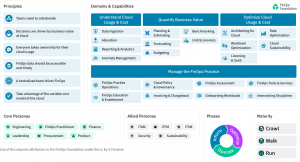
FinOps Framework. Source: FinOps Foundation 

The FinOps Framework, as illustrated above, provides a comprehensive overview of the key components and practices that drive successful Cloud Financial Management.

Beyond Cost Savings: The Real Value of Embracing FinOps

While reducing cloud costs is a significant benefit of FinOps, it’s just the tip of the iceberg. FinOps is about unlocking the true value of your cloud investments, empowering your business to achieve more with less.

This means moving beyond simply cutting costs to streamlining operations. FinOps helps you optimize your cloud operations for maximum efficiency. Imagine automating tasks, eliminating manual processes, and freeing up your team to focus on what truly matters – driving innovation and growth.

FinOps also enables you to respond with agility. In today’s dynamic business environment, agility is key. FinOps gives you the flexibility to scale your cloud resources up or down on demand, ensuring you’re always equipped to meet changing market demands without overspending.

With FinOps, you gain greater visibility and control over your cloud environment. This translates to improved governance, reduced risk, and peace of mind knowing your cloud resources are being used responsibly and securely.

Guiding You Towards Cloud Maturity and Cost Optimization

At Making Science, we understand the complexities of navigating the cloud and empower businesses to harness the full potential of the cloud, with confidence and without breaking the bank.

Our Cloud Maturity Assessment is designed to guide you through the hurdles of complex migrations, technical intricacies, and cost optimization. By identifying optimization opportunities and implementing FinOps best practices, we enable you to extract maximum value from your cloud investments without compromising the performance of your digital assets.

With our expertise, you’ll be able to achieve seamless scalability while maintaining cost-effectiveness, ensuring your cloud environment is agile, efficient, and secure. We’ll work with you to create a tailored roadmap that aligns with your unique business objectives, empowering you to redirect resources towards innovation and growth.

Ready to embark on a journey toward cloud maturity and optimized costs? Contact Making Science and take the first step towards optimizing your cloud environment for success in the digital landscape.