

Enhancing Terraform Security: The Crucial Role of TFSec

As cloud infrastructure and automation continue to evolve, Terraform has emerged as a powerful tool for provisioning and managing resources. With more organizations relying on Terraform to deploy and manage their Infrastructure as Code (IaC), it’s become essential to ensure the security of these configurations. TFSec, a specialized static analysis tool for Terraform configurations, plays a pivotal role in fortifying the security posture of cloud environments.

This article delves into the significance of incorporating TFSec into the Terraform workflow and how it contributes to a robust and secure infrastructure.

Proactive Security Measures

TFSec isn’t just a security tool—it’s a proactive security partner. It aids in identifying and addressing security vulnerabilities in Terraform configurations before deployment. By analyzing the code statically, before uploading it to the repository, TFSec can pinpoint potential misconfigurations, insecure settings, and adherence to best practices.

This proactive approach enables development and operations teams to mitigate security risks at an early stage, preventing the deployment of vulnerable infrastructures that could lead to serious consequences such as data breaches, service disruptions, or compliance violations.

Compliance and Governance

In regulated industries, compliance standards are non-negotiable. TFSec is a valuable ally in this regard, offering checks and validations against industry-specific compliance standards and best practices. Whether it’s PCI DSS, HIPAA, or CIS benchmarks, TFSec ensures that Terraform configurations align with the prescribed security guidelines.

Maintaining a secure and compliant infrastructure helps organizations avoid regulatory fines and reputational damage, and TFSec is instrumental in this process.

Customizable Security Policies

One of the standout features of TFSec is its flexibility. Organizations can tailor TFSec to enforce specific security standards and policies that align with their unique requirements. This ensures that the tool becomes an integral part of the organization’s security and compliance strategy, adapting to the dynamic nature of their infrastructure and evolving security landscape.

Collaboration and DevSecOps Integration
TFSec fosters collaboration between development, operations, and security teams by integrating seamlessly into the DevSecOps pipeline. By incorporating TFSec into the CI/CD process, security checks become an automated and integral part of the development lifecycle.

This not only accelerates the identification and remediation of security issues but also promotes a culture of shared responsibility where security is embedded throughout the development process rather than treated as an afterthought.

Continuous Improvement

TFSec contributes to the ongoing improvement of Terraform configurations by providing actionable insights into security vulnerabilities. The tool not only identifies issues but also offers guidance on remediation, empowering teams to enhance their understanding of security best practices. This continuous feedback loop fosters a culture of learning and improvement, ensuring that security remains a priority as infrastructure evolves over time.

Conclusion

In conclusion, TFSec stands as a crucial component in the arsenal of tools dedicated to ensuring the security of Terraform configurations. Its proactive approach, compliance enforcement, customizable policies, seamless integration into DevSecOps workflows, and contribution to continuous improvement make it an indispensable asset for organizations navigating the complexities of cloud infrastructure security.

As the reliance on Terraform continues to grow, the adoption of TFSec becomes not just a choice but a strategic imperative for organizations committed to building and maintaining secure and resilient cloud environments. At Making Science, we’re committed to helping our clients navigate these complexities and ensure robust security in their cloud infrastructures. Interested to learn more about how Making Science can help enhance your Terraform security with TFSec?

AR and VR in the Digital Age: Uphill Battle or Future of Opportunity?

Augmented Reality (AR) and Virtual Reality (VR) have made their mark in the digital landscape, promising to revolutionize our interactions with the world. Yet, despite their potential, these technologies are still striving to attain mainstream acceptance. Does AR/VR signal an uphill battle or do they hold a future of opportunity?

Unique UX/UI Design Principles in AR/VR

AR and VR have found success within niche applications. Google, for instance, has made impressive advancements in AR by enabling users to visualize certain products before purchase, and platforms like YouTube now use AR for innovative features like makeup trials. However, these successes are more exceptions than the norm.

Even with tech giants like Meta and Apple delving into this realm, their offerings haven’t ignited the market as expected. Meta’s AR/VR headset and Apple’s VisionPro are yet to showcase their full potential.

A key factor in the adoption of these technologies is the user experience they provide. The UX/UI design principles for AR/VR go beyond the conventional ones like user-centered design, consistency, and hierarchy. AR/VR environments, due to their three-dimensional nature, necessitate a detailed understanding of depth, proximity, and motion, thus broadening the horizon of UX/UI design principles.

Comfort: A Critical Factor in AR/VR Adoption

Comfort in AR/VR settings is a significant aspect that influences user acceptance. The immersive nature of VR can cause discomfort or even trigger motion sickness in users. To encourage user adoption, designers must explore and implement strategies to mitigate these discomforts, thereby ensuring an engaging and enjoyable experience.

Emerging Technologies: A Ray of Hope?

Despite these challenges, emerging technologies offer a glimmer of hope for AR and VR. Products like XREAL’s connected glasses and Mojo Vision’s connected lenses could potentially revolutionize the game. These devices aim to seamlessly merge the virtual and real worlds, making AR/VR more accessible and practical for everyday use.

 Envisioning the Future with AR/VR

The journey of AR and VR technologies in the digital age has been challenging, primarily due to factors like user comfort and the need for innovative UX/UI design principles. However, with the emergence of new devices and a focus on enhancing user experience, these technologies have the potential to take off in a significant way.

Whether AR and VR will become a mainstay in our everyday lives or remain a promising yet unrealized innovation is a narrative that continues to unfold. What’s clear is that these technologies are shaping our present and have the potential to significantly influence the future of digital transformation.

Integrating AR/VR technologies into digital transformation strategies is not just about keeping pace with the latest tech trends. It’s about envisioning a future where businesses can provide unprecedented value to their customers, enhance business operations, and gain a stronger competitive position in an increasingly digital market. AR and VR are not just technologies of the future—they are shaping the present and have the potential to drive significant value in the digital transformation journey. Businesses that understand this will be well-positioned to thrive in the digital age.

Leading the way in this digital era, Making Science is committed to leveraging new technologies to drive digital transformation. Our team of experts, armed with solid UX/UI design principles, is dedicated to helping businesses harness the full potential of AR/VR technologies, enhance customer experiences, and secure a competitive edge in the digital age. Ready to embark on your digital transformation journey with AR/VR? Partner with Making Science today!

Beginner’s Guide to Process Mining: Turning Spaghetti into Lasagna

Are you ready to transform your business operations from a tangle of spaghetti to a well-structured lasagna? 

This isn’t about culinary skills, but a clever metaphor used by a renowned data science professor  Wil van der Aalst in his book “Process Mining: Data Science in action” to illustrate the power of Process Mining. Welcome to the world of Process Mining, a potent tool that, much like a skilled chef, can transform the hidden tangles in your business operations into streamlined, efficient processes. But what exactly is Process Mining? And how can it turn your business from a chaotic “spaghetti” of hard-to-follow processes, into a “lasagna” – a well-structured, layered, and efficient workflow?

Unveiling Process Mining

Process Mining is a transformative technology and analytical discipline that provides a deep-dive into your business operations. At its core, it’s a form of data analysis. Still, it’s not just about the data—it’s about the fresh perspective that the data provides as it draws back the curtain on your processes, revealing areas of inefficiency, bottlenecks, and opportunities for improvement. It uses event logs to create a visual representation of a process, allowing businesses to understand and improve their workflows like never before.

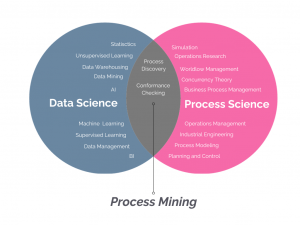
Process Mining as the Intersection Between Data Science and Process Science

There are 3 main types of process mining analysis:

  1. Discovery: This method models the as-is process from scratch, revealing ad-hoc processes and handling different types of flows. It generates a model from an event log without extra information.
  2. Conformance: Also known as compliance, this approach compares the event log of reality to a predefined normative process model, aiding businesses in enhancing compliance by checking for deviations and violations.
  3. Enhancement: This technique aims to improve the existing process model using data from the event log, aligning areas that don’t match perfectly.

Life Cycle of a Process Mining Project: The Journey from Spaghetti to Lasagna

The primary objectives of Process Mining technology are the visual representation of complex processes and the usability and ease of understanding of the obtained model. In the real world, the complexity of a process structure varies. On one end of the spectrum, we have “Lasagna” processes—highly structured workflows where the paths are well defined, with few and well-controlled variants.

Lasagna Process

While “Spaghetti” processes may seem to offer flexibility, they can lead to inefficiencies, errors, and confusion due to their lack of structure and control. The multiple, uncontrolled variants in these processes can result in inconsistencies in execution, making it difficult to identify issues and implement improvements. 

Spaghetti Process

Process Mining aims to transform your Spaghetti processes into Lasagna processes. The goal is to turn those complex, hard-to-follow workflows into structured, layered, and easy-to-understand processes. 

An excellent example of this transformation comes from the financial services industry as AIG utilized process mining to streamline their operations. Initially, they had a complex process that took 12 days to complete. With the help of process mining, they managed to reduce the cycle time to just 5 days, thereby increasing the throughput by over 30%. 

The benefits of applying process mining techniques are manifold. They not only help in identifying bottlenecks and inefficiencies in existing processes but also aid in streamlining operations, reducing cycle times, and increasing throughput. In addition, process mining can provide insights into process compliance issues, enabling organizations to enhance their regulatory adherence and decrease the risk of non-compliance. These benefits collectively lead to improved service delivery, better customer experience, and ultimately, increased business value.

Conclusion: Lasagna or Spaghetti? 

Process mining technology is not just an emerging field—it’s a game-changer with the potential to revolutionize process management. 

At Making Science, we’re not just experts—we’re your partners in transformation. From assessments to identifying optimization potential, building event data pipelines, process modeling, and monitoring, we offer comprehensive services encompassing process auditing and the implementation of recommendations.

Let’s connect and uncover the opportunities process mining could bring to your IT workflows. Choose clarity. Choose efficiency. Choose lasagna!

Strengthen Cloud Security with Governance and SSO: Protect Your Data and Improve Compliance

The digitization of companies is a phenomenon that has radically transformed the way organizations operate in the 21st century. In an increasingly interconnected and technologically advanced world, companies have been driven to adapt to an ever-evolving environment. Digitization is not simply limited to the adoption of computer technologies but encompasses a complete redefinition of business processes, organizational culture, and interaction with customers and partners.

The redefinition of business processes affects how companies organize cloud projects. One way to organize projects is through Cloud Governance (CG), which aims to balance the opposing forces of transformation and risk mitigation. Additionally, Cloud Governance ensures that cloud migration teams are aware of various guidelines on architecture, data classification, and resources governing this adoption.

One consequence of digitization is the increased use of systems, and remembering the complex passwords for each one is a daily challenge faced by many users. Single Sign-On (SSO) can be the solution to this problem, as it allows access to different applications and services with a single identity, making it easier to add and remove users from systems.

Cloud security must be a top priority for businesses in today’s digital landscape. As companies increasingly rely on cloud platforms for storing sensitive data and running critical applications, implementing robust security measures becomes essential. In this blog post, we will explore the importance of governance and Single Sign-On (SSO) in strengthening cloud security and maintaining control over access to resources.

Understanding Cloud Governance (CG)

It is created by defining, implementing, and monitoring a framework of policies and rules to guide an organization’s cloud operations and provide strategic direction. It regulates how users work in cloud environments to achieve consistent performance of cloud services and systems.

A cloud governance framework is usually built from a set of specific rules and policies for a cloud project. Since cloud systems are dynamic, involving third-party providers or different teams within a company, implementing and monitoring this framework improves oversight and control in vital areas of cloud operations, such as data management and security, risk management, cost management, and more. It ensures that everyone is working together to meet business objectives.

Creating a cloud governance framework can benefit organizations by:

  1. Maximizing performance, optimizing resources and infrastructure. With a clearer view of their entire cloud environment, organizations can improve efficiency by eliminating bottlenecks in productivity and optimizing efforts for better management of cloud resources and costs.
  2. Improving scalability and business continuity. By gaining better visibility across all business units, clearer action plans can be developed.
  3. Increasing compliance with policies and standards. Rigorous compliance monitoring contributes to organizations following governmental regulations and internal policies.
  4. Minimizing security risks by implementing a clear identity and access management strategy, along with security monitoring processes. This will enable teams to be better positioned to identify and mitigate vulnerabilities, thereby improving cloud security.

The Power of Single Sign-On (SSO)

It allows users to access multiple applications by logging in with just one account to different systems and resources. It is very useful when there are different systems that can be accessed using a single password, and it is desirable to avoid repeatedly entering passwords each time the user disconnects from the service. For users, it provides great convenience since after identifying themselves only once, the session remains valid for the rest of the applications that use SSO.

This authentication procedure facilitates access tasks for the different platforms. It is also characterized by other important features in terms of simple management, security and transparency.

  1. Simplified Management: By synchronizing passwords and user information across different systems. This streamlines the validation process and reduces administrative overhead.
  2. Enhanced Security: SSO encourages the use of strong passwords and reduces the risk of password reuse, which can lead to security breaches. SSO prevents password fatigue, encouraging users to create one strong password that can be used for multiple websites.
  3. Improved Transparency: SSO is used by cloud application providers to offer end users a seamless login experience and credential management. Users manage fewer passwords, yet can still securely access the information and applications needed to complete their daily work.

Strengthening Cloud Security: Cloud Governance & SSO

Unifying Cloud Governance and Single Sign-On services can achieve greater security in the cloud. With CG, rules, and policies are created and implemented for cloud projects. Part of the planning for these policies concerns security management, an area that can be streamlined with the use of SSO thanks to its characteristics.

SSO approach helps to reduce the number of accounts and passwords for the same user, facilitate management, and boost productivity as teams can access the applications and project resources to which they are authorized in a secure and simple way with one password they need in an easy and secure manner.

From the administration side, having a single source of truth in terms of identity management is a great advantage. Managing all accesses from an AD/LDAP and ensuring that no user is removed from any service or that no service is left with invalid accesses provides assurance.

With simpler management thanks to SSO and CG rules, greater security and efficiency can be achieved for experiencing benefits such as:

  1. Reduced Security Risks: By enforcing strong password policies and centralized identity management, SSO minimizes the risk of unauthorized access and data breaches.
  2. Streamlined Access Management: SSO simplifies access management by enabling centralized control over user permissions and access levels, aligning with CG policies.
  3. Enhanced Compliance: SSO strengthens compliance by ensuring that user access conforms to CG policies and regulatory requirements.
  4. Improved Productivity: SSO reduces the time and effort required to log in to multiple systems, enhancing user productivity and overall efficiency.

Conclusion

As cloud environments continue to evolve, ensuring robust security measures is crucial for businesses. By embracing a comprehensive approach that combines governance and SSO organizations can harness the full potential of cloud technology while safeguarding their sensitive data, maintaining compliance and control over access to resources, and mitigating security risks according to industry standards.

Additionally, leveraging Artificial Intelligence (AI) and automation can further enhance cloud security by automating tasks, detecting anomalies, and providing real-time insights.

Making Science is your partner in securing your cloud environment and achieving your business goals. Our experts can help you implement and manage effective cloud governance and SSO solutions, ensuring that your organization is well-positioned to reap the benefits of cloud computing while maintaining the highest security standards.

Want to know more?

How to Prepare Your Ecommerce Business for the Holiday Rush

The holiday season is not just about festivities and celebrations. For businesses, it’s a period of heightened activity, increased customer demand, and fierce competition. With key shopping events like Black Friday, Cyber Monday, and Christmas sales on the horizon, the success of your season depends on your preparedness.

In this guide, curated by the Making Science team, we blend various critical aspects of business operations to help equip businesses with a comprehensive, well-rounded approach to tackle the peak season rush.

1. Scalability: The Backbone of Your Online Store

We all know time is money. According to Gartner, based on industry surveys, network downtime can cost $5,600 per minute on average. This figure equates to well over $300K per hour.

Your online store’s infrastructure serves as the foundation for your digital presence. An influx of shoppers can place immense stress on your infrastructure, making it crucial to predict traffic patterns and scale your resources accordingly. Regular stress tests will help identify and rectify weak points. This proactive approach ensures your systems can handle the increased load, preventing slow loading times, crashes, or dreaded virtual queues, and keeping your digital storefront open and inviting.

2. Process Monitoring: Make checking out simple!

Don’t let a glitchy shopping cart or an overloaded payment gateway hinder your sales. Monitor the purchasing process every step of the way – from product discovery to payment confirmation for a smooth and efficient shopping experience. With the increase in traffic during peak season, your e-commerce processes, especially payment solutions, should be capable of absorbing traffic spikes so that transactions are processed without a hitch.

3. Digital Security: Protecting Your Business and Customers

Over half (56%) of Black Friday spam emails received between October 26 and November 6, 2022, were scams, according to research from Bitdefender. Furthermore, small businesses in the retail sector are 50% more likely to be targeted by cybercriminals, leading to losses of around $6.9 billion from online scams. 

The primary threats include social engineering scams, phishing attacks, fraudulent websites, unsecured financial transactions, ransomware attacks, and data breaches. Given these risks and the heightened digital activity during peak season, businesses must reinforce their digital channels by auditing their website security to safeguard their systems and customer data.

4. Inventory and Logistics: Meeting Demand Efficiently

Handling the increased demand during peak season requires efficient management of inventory and logistics. A sold-out product or delayed delivery can lead to disappointed customers. Keep a close eye on your stock levels, plan for increased shipping and delivery times, and consider liaising with third-party logistics providers to manage the increased demand.

5. Proactive Marketing Strategy: Engaging Your Customers

Stand out from your competitors with well-planned outreach to significantly increase your brand’s visibility and customer engagement. Use a mix of channels like email, targeted ads, and social media to reach your audience with impactful messages. Maximize your outreach impact with an omnichannel strategy that mixes and matches channels to deliver your message to the right audience at the right time. Most importantly, start planning at least 4 weeks in advance, allowing yourself ample time to refine and perfect your messages.

6. AI Integration: Enhancing Performance and Efficiency

Artificial Intelligence has become a game-changer in the digital space. From creating better SEO descriptions to automating repetitive processes, AI technologies can boost your business performance and efficiency. Consider integrating AI-powered tools into your operations, like Gauss AI, our proprietary technology that allows you to automate processes and improve ad performance, reaching customers more effectively.

7. Customer Experience: Prioritizing Satisfaction

A positive customer experience extends beyond a user-friendly interface and streamlined checkout process. It’s about providing timely and effective support. Incorporating FAQ and Feedback sections on your site can help customers find information quickly and share their experiences. To take it a step further, consider implementing AI-based chatbots ensuring help is just a click away, at any time.

8. Contingency Planning: Preparing for the Unexpected

Despite the best preparations, unexpected issues can occur. Having robust contingency plans helps your business respond quickly and effectively to potential system crashes, payment gateway failures, or unexpected traffic spikes, minimizing disruption and maintaining customer satisfaction.

This guide forms a solid foundation for your business as you gear up for the peak holiday season. Remember, preparation is key to turning these challenges into opportunities for growth. 

The time to start is now! As always, The Making Science team is here to guide you every step of the way. Let’s make this holiday season a resounding success together!

Creating a Greener Web: The Importance of Sustainable Websites

By now, you’ve surely heard the term “sustainability.” It’s a concept that should be applied to all human practices – including websites. The Internet has become a vital tool for economic growth and societal development, significantly impacting our daily lives. However, it’s not exactly a clean technology.

The Environmental Impact of the Internet

The Internet has a considerable impact on people’s development and daily life. To achieve sustainable development as outlined by the 2030 Agenda, we must harmonize economic growth, social inclusion, and environmental protection. These elements are interconnected and crucial for the well-being of individuals and societies.

So, what does sustainability have to do with the use of the Internet? A great deal. While the Internet is an indispensable facilitator for economic growth and human progress, it’s not as green as we might hope. With the operation of devices and the dependence on servers (the true heart of the Internet), substantial amounts of energy are used and CO2 is generated.

Here are some startling statistics:

    • The Internet represents approximately 10% of global electricity consumption.
    • If the Internet were a country, it would rank as the sixth largest consumer of electricity on the planet.
    • The Internet produces around 2% of global CO2 emissions annually, equivalent to the aviation industry.
    • An average web page produces 1.76 grams of CO2 for each page visit.
    • Streaming Netflix for one hour a week requires more electricity than the annual production of two new refrigerators.
    • Data centers alone consume approximately 200 terawatt-hours (TWh), that is, more energy than the entire country of Iran.

In addition to these, consider the excessive water consumption in data centers, necessary for their cooling systems and proper maintenance. Most of this water is potable, with non-potable water making up less than 5%. This can cause serious problems for populations and agriculture, especially in the increasingly common scenario of drought.

If this data doesn’t concern you, maybe Google’s penalty will. Google uses metrics called Core Web Vitals to score your website and index it in its search engine more or less favorably. Among these metrics are accessibility, loading speed, and now, sustainability.

How can I build a more sustainable website?

The most basic tips would be to take care of the load time, font and image optimization, js and css rendering, using clean code and simple designs. This it’s just a complement of the good practices that all companies need to apply to reduce their carbon footprint, including the use of clean and renewable energy sources.

The “Sustainable Web Manifesto” proposes certain rules that all digital products and services should follow:

  • Clean. Digital products and services must be powered by clean, renewable energy.
  • Efficient. The products and services provided digitally will use the least amount of energy possible, as well as the minimum material resources.
  • Open. Digital products and services must be accessible, allow the free exchange of information, and allow users to control their data.
  • Honest. The products and services will not deceive or exploit users in their design or content.
  • Regenerative. The products and services will support an economy that takes care of people and the planet.
  • Resilient. The products and services will work at times when people need them most.

The Role of Large Companies: Democratizing Green Websites

Do large companies really take sustainability into account? Undoubtedly, Google’s focus on sustainability is starting to influence designers, developers, and companies worldwide to do things better and apply sustainable practices. Companies like Google, Amazon, Facebook, and Apple still have to set a better example and be responsible for the high social and environmental impact they have. A good example of this is Apple’s recent campaign “2030 Status: Mother Nature“. Some see it as an aspirational, emotional, and hopeful campaign, while others see it as pure greenwashing, especially when considering the company’s blatant planned obsolescence practices and its closed ecosystem that didn’t adopt the USB-C connector until the iPhone 15 (2023). This change was forced by a European Parliament resolution that will require a unified smartphone charger by 2024 to enable reuse and reduce electronic waste.

Conclusion: Towards More Sustainable Websites

Sustainability in web design is more than an emerging trend; it’s a necessity. As the digital world continues to grow, so does its environmental impact. At Making Science, we strive to be part of the solution, not the problem.

Our team of expert back-end and front-end developers, teamed with specialized UI/UX designers, work together to create digital solutions that are not only functional and user-friendly but also sustainable. We leverage our collective expertise to reduce the digital carbon footprint, demonstrating our commitment to making the web greener, one website at a time.

Interested in building a more sustainable web presence? 

Invisible Intruders: Deciphering the World of Advanced Persistent Threats (APTs)

In the realm of cybersecurity, Advanced Persistent Threats (APTs) emerge as a hidden menace challenging digital security. These large-scale, sophisticated attacks, known for their stealth and longevity, can significantly impact organizations, including the loss of confidential data, reputational damage, and operational disruptions.

The primary goal of such attacks is to stealthily steal confidential data in a continuous and persistent manner. The perpetrators behind APTs are highly experienced teams that, backed by substantial funding, are dedicated to exploring and exploiting vulnerabilities over long periods of time, focusing their attacks on high-value organizations.

The Covert Stages of APTs

These dangerous cyber-attacks advance in secrecy through various stages, completely undercover.

  • Identification and Reconnaissance

In this stage, attackers meticulously gather information, exploring every detail. Their goal is to fully understand the infrastructure, protocols, and devices of their target.

  • Infiltration and Foothold

Equipped with the gathered information, attackers gain access to the internal network using customized malware. Sometimes, they create secret entries and backdoors to re-enter the network undetected, solidifying their position within the network.

  • Escalation and Lateral Movement

Once inside, they deepen their incursion, acquiring passwords and privileges. This ability allows them to move unrestricted through the system in search of the information they desire.

  • Exfiltration

Like true cybercriminals, they discreetly store the stolen data in a safe place within the network, patiently waiting until their collection is complete. Finally, they extract the data without leaving a trace, even blocking network personnel while they complete their operation.

The Unmistakable Signs of an APT

To quickly identify these cunning criminals, it’s essential to be alert to obvious signs that you may be a victim of their attacks:

  • Increased logins and user account activity at unusual hours.
  • Increase in database activity such as movements, creation, or transfer of massive amounts of data.
  • Receipt of fraudulent emails to carry out phishing attacks.
  • Existence of backdoors that allow access and control a computer without the user realizing.
  • Compressed data for export in suspicious places.

Protection Against Invisible Threats

However, in the digital realm, APTs are not invincible. Companies must take ongoing measures and actions to protect themselves:

  1. Awareness: It is key to inform all employees of the existence of such threats, their repercussions and share signals that may indicate an unnoticed intrusion.
  2. Up-to-Date Maintenance: Keeping software and devices updated to prevent attackers from exploiting vulnerabilities.
  3. 24/7 Monitoring and Surveillance: Implementing the use of monitoring systems that analyze internal network traffic for threats and alert of suspicious movements or unauthorized accesses. For this, AI/ML present great opportunities by being able to quickly and accurately detect suspicious activities, and generate alerts so that security teams can respond preventively.
  4. Firewalls: Isolating the organization’s network from the outside, effectively controlling what enters and leaves the network.
  5. Password Policies: Using strong passwords and changing them regularly to strengthen security.
  6. Advanced Security Solutions: Organizations can implement advanced security solutions, such as cyber intelligence, behavior analysis, and incident response, to help detect and respond to APT attacks.

Defend Your Cyber Frontline with Making Science 

In a digital world affected by APTs, staying alert and prepared becomes our main line of defense against this hidden threat. The battle continues, and only those who face this darkness with utmost caution can resist this adept tactic of cybercrime.

Making Science is a trusted partner for organizations seeking to protect their data and reputation from APT attacks. With the help of Making Science, organizations can rest assured that they are taking the necessary steps to protect themselves from this increasingly serious threat.

The future of cybersecurity requires a proactive and persistent defense. Partner with Making Science today and strengthen your frontline against the unseen threats of the digital world.

Web Security: How to protect your most valuable digital assets

The data of your company, your clients, and the infrastructure of your business/organization are some of the main assets of any company. Often, these assets are not sufficiently protected.

When we talk about protection, we refer to the implementation of security measures, technology, and tools that protect your systems from external threats. These security measures also ensure that human error does not leave the organization’s assets exposed.

Security must be present from the conceptualization of digital services and their migration to the cloud. Companies must adhere to all regulations and ensure the reliability of their environments. This way, they can avoid unpleasant situations that could result in fines, economic losses, and reputational damage.

Do companies invest in security? Not as much as they should. That is why we want to stress the importance of investing resources and budget in solutions, technology, and tools that can help you prevent disasters.

And just as important as investing in this security technology is working with the best partners to be able to implement and deploy strategies that allow us to face any attack. 

Google Cloud Platform has the capacity and tools to improve the security of your company. Some of the products that we can implement together include

  1.  Security Command Center
  2.  Zero Trust: Beyond Core Enterprise 
  3. Chronicle
  4. Virus Total
  5. Recaptcha

Security Command Center

SCC is a Google Cloud security and risk management platform. With it, you gain centralized visibility and control, can detect misconfigurations and vulnerabilities, can report violations and help with compliance, and detect threats that put your Google Cloud resources at risk.

Its main functions are: 

  • Resource discovery and inventory: Discover and query your resources in near real-time from App Engine, BigQuery, Cloud SQL, Cloud Storage, Compute Engine, Cloud Identity, and Access Management, Google Kubernetes Engine, and many more. Review the history of discovery processes to locate new, changed, or deleted resources.
  • Threat prevention: Stay informed about the security status of your Google Cloud resources. Detect the most common vulnerabilities that can put your web applications at risk, such as cross-site scripting or outdated libraries, running on App Engine, GKE, and Compute Engine. To quickly fix misconfigurations, just click directly on the affected resource and follow the steps provided.
  • Threat detection: Uses logs running on Google Cloud at scale to identify threats. Detects some of the most common container attacks, including suspect binaries, suspect libraries, and reverse shells.

Zero Trust: Beyond Core Enterprise 

A Zero Trust solution that enables secure access to applications and resources, and offers built-in threat and data protection. We recommend it because

  • It’s a scalable and reliable solution: It is based on the backbone of Google’s global infrastructure and network to offer an optimal and secure experience with integrated protection against denial of service attacks (DDoS), low latency connections, and flexible scaling.
  • It offers comprehensive and continuous protection: A layered approach to security between users, access, data, and applications that help protect every click against malware, data loss, and fraud.
  • Of its open and scalable ecosystem: Includes information and profiling signals from leading security vendors to offer a higher level of protection.

Chronicle

Google’s cloud-native SIEM, Chronicle, is designed to handle massive amounts of data and mine signals to find threats instantly.

Chronicle works by processing your data into a private container and combining it with data from Google. Everything is then aggregated, normalized, and linked into a consistent timeline, to later expose all that data through investigation, search, and discovery, as well as to other security products through APIs.

The advantages of Chronicle are

  1. It is infinitely elastic, providing an elastic container to store enterprise security telemetry
  2. It’s Cloud Native, so it’s able to ingest, normalize and index massive amounts of telemetry data. It can also correlate it with known threats.
  3. Its high storage capacity, where access to years of telemetry can mean the difference between clear answers and simply hoping for the best.

Virus Total

VirusTotal, now part of Google Cloud, provides threat context and reputation data to help analyze suspicious files, URLs, IP addresses, and domains to detect cybersecurity threats. VirusTotal reports show many crowdsourced details about why a domain, attachment, or IP address might be considered dangerous. For more information, see the VirusTotal website.

reCAPTCHA

reCAPTCHA protects your website from fraud and abuse without creating friction. 

It uses an advanced risk analysis engine and adaptive challenges to prevent malicious software from engaging in abusive activities on your website. Meanwhile, legitimate users will be able to log in, make purchases, view pages, or create accounts and fake users will be blocked.

reCAPTCHA can prevent various threats, such as

  1. Scraping: Theft of content to divert advertising revenue or competitive use.
  2. Fraudulent transactions: Purchase of goods or gift cards with stolen credit cards.
  3. Account Takeover (ATO): Credential stuffing to validate stolen accounts.
  4. Accounts being misused: Creation of new accounts for promotion value or future misuse.
  5. Fake Posts: Posting malicious links or spreading misinformation.
  6. Money laundering: Bot that generates revenue from ad clicks on fraudulent websites.

As you can see, there are many ways to better protect your digital assets. But which one should you choose? 

Are you ready to start the journey of making your users’ web experience more secure? Our cybersecurity experts can audit your site to help you pick the best solution for your particular needs. What are you waiting for?!

Get in touch