

CM360: What do we have left to cover to maximize our digital campaigns?

Have you ever wondered what we need to get the most out of CM360’s capabilities? In this post, we are going to tell you, step by step, why the CM360 optimization journey is long but exciting and what benefits you will get when you know the tool well.

Introduction

In a constantly evolving advertising environment, the question is simple: How to leverage CM360 to achieve more effective digital campaigns? This post will serve as a guide to understand where we are, what we have left to cover, and why it is key to your digital marketing strategy.

What is CM360?

Campaign Manager 360 (CM360) is Google’s platform designed to plan, manage, and measure digital campaigns globally.

Who uses it?

Agencies, advertisers, and marketers who seek to centralize their reporting and obtain unified data.

Why is it relevant now?

The evolution of the cookieless environment and new attribution models force us to rethink what to do and when to maintain advertising effectiveness.

How do we achieve it?

By analyzing what technical and strategic improvements to implement in CM360 to gain time, agility, and precision in decision-making.

Key fact: According to recent studies, companies that master CM360 increase their campaign ROI by 15% to 20%. Ready to discover where to start?

What’s happening today with CM360?
Currently, CM360 is the standard for managing large-scale digital campaigns. However, there is still much room to take advantage of it, especially when we talk about:

  • Integration with other tools in the Google stack (such as GA4, DV360, Google Ads, The Trade Desk, Netflix, or Adobe Gen Studio).

  • Improvements in advanced reporting to better understand the path to conversion.

  • Management of floodlights and audiences that respond to new data-driven models.

The key is knowing where to focus.

What do we have left to cover?

Optimization of the initial setup

Dedicating time to a well-defined structure saves headaches later.
→ Did you know that a clear taxonomy in CM360 reduces errors by 30%?

Reporting automation

A well-configured dashboard saves your team hours and gives you real-time insights.
→ Includes reports like Path to Conversion, Time Lag, or Conversion Funnels.

Implementation of cookieless strategies

With the disappearance of cookies, measurement and activation must adapt. This is where CM360 along with GA4 offers you precise data.

(This is just a visual reference of the type of dashboard you can implement)

Why is it important to keep improving in CM360?

If you want your campaigns to be more effective and your strategy to be more agile, continuing to evolve in CM360 is essential. Every small change directly impacts your ROI and, above all, gives you greater control and transparency over your advertising investment.

Think of CM360 as a treasure map: if you know how to read it well, it leads you directly to the data that will help you grow.

Conclusion: Move forward with a steady pace

In short, there is still much to cover in the world of CM360, but every step you take is an opportunity to optimize results, better understand your audience, and make your advertising investment smarter.

Do you want us to help you get the most out of the tool? Share this post with your team or leave us a comment with your questions! As someone wise said: “It’s not just the destination, it’s the journey.” 🚀
From Scroll to Impact: Collaborating with Influencers and Creators with Purpose on Every Platform🎯

Every day, thousands of brands appear on our screens. Some stay for a second ⏱️. Others stick in our minds 🤔. Very few become part of the conversation 💬.

The difference is not just how much they invest, but how they collaborate with creators within an ecosystem that is cultural, mobile, emotional, and fragmented.

Influencer marketing, when integrated with vision, can be a strategic lever at all phases of the funnel: from generating awareness in the top-funnel with content that travels naturally, to activating consideration in the mid-funnel through credible profiles ✨, or driving performance through paid media formats and well-defined attribution models 📈.

For it to work, it’s not enough to be everywhere. It’s about knowing how to collaborate with the right profiles, respecting their codes, their community, and their value at each stage of the consumer journey.

Each platform presents a distinct set of opportunities. We don’t intend to cover everything, but rather to offer a strategic vision of how to activate with purpose and direction 🧭.

TikTok: Shared Culture and Amplified Visibility 🎶

TikTok moves fast and operates primarily at the top-funnel, generating discovery and interest through cultural participation.

But for content to connect, it must feel authentic ✅. Here, working with creators implies co-creating ideas that adapt to their language and community, rather than simply transferring a prefabricated message 🗣️.

Furthermore, the use of paid media on TikTok is key to scaling content that works. Promoting organic creator pieces allows for maintaining the influencer’s voice, while amplifying its impact with advanced segmentation and performance objectives.

Brands that understand this don’t just create viral hits. They turn visibility into conversation and brand recall 🧠.

Instagram: Building Affinity with Measurable Impact 📸

Instagram remains a central platform for developing brand consideration and fostering a constant connection with the audience. Reels, Stories, and carousel collaborations allow for a continuous, visual, and emotional narrative.

Organic content is only part of the game. Today, many brands are finding in Creator Ads an effective way to amplify collaborations with creators: content created by influencers, promoted from their profile but with media control from the advertiser. This approach combines the best of two worlds: the credibility of the creator and the targeting and optimization capabilities of paid media 🎯.

On Instagram, influencer marketing can generate both branding and performance, when planned as part of a complete system 🌐.

YouTube: Deep Influence that Informs and Converts💡

YouTube is the ideal platform for working the mid-funnel and the lower-funnel, thanks to its capacity to generate trust and deepen the message 🧐.

Here, creators have space to explain, show, compare, and validate. And that generates a type of connection that goes beyond superficial recommendations.

Additionally, YouTube offers paid media formats that allow for activating creator content as part of performance campaigns 📈.

From personalized video sequences to retargeting based on visualisations, the collaboration doesn’t end when it’s published: it’s amplified when integrated with strategy.

Well-planned, content with creators on YouTube can be both an inspiration tool and a decision-making tool, depending on the format and the moment in the funnel.

Twitch: Creating Moments that Build Loyalty 🎮

Twitch offers a different dimension of audience connection: based on shared time and an active community.

It is a loyalty channel, where brands can connect with highly engaged audiences, in participatory and authentic environments.

Here, the creator is not just a broadcaster: they are an host 🎙️. Brands that understand this collaborate from within, designing activations where the presence feels organic and meaningful.

And although Twitch is essentially organic, its effect can extend by using clips and summaries in cross-channel paid media campaigns, or amplifying key moments in networks like YouTube Shorts or Instagram Reels.

What’s important is not just the live stream. It’s how it converts into useful content beyond the broadcast💡.

X (formerly Twitter): Positioning and Amplifying Narrative 🗣️

X continues to be a relevant space for brands that want to participate in the public discourse and reinforce their positioning.

Here, the value of creators lies in their ability to influence key topics, with a recognized voice and an attentive audience 👀.

Organic content can have great contextual impact, but it can also be activated as part of paid strategies, amplifying threads, collaborations, or messages aligned with cultural moments or specific junctures.

In many cases, influencer marketing on X is boosted when it aligns with causes, values, or relevant positions, especially if the goal is to participate in cultural or social conversations 🌍.

Ready to take the next step in your influencer marketing strategy?🚀

Each platform brings something distinct. Each creator has their way of influencing. But all collaborations must answer the same question:

What does this bring to my brand and business strategy? 🤔💡

At Making Science, we have been helping brands evolve in this terrain for years. We design influencer marketing strategies that integrate content, media, and measurement within the digital ecosystem, always with a business focus.

If your brand is ready to move from content to impact, and from punctual impulse to sustained strategy, let’s talk!📧

Integrating Influencer Marketing into Your Business Strategy: What No One Tells You

There’s a question that marketing teams are asking more and more often—and it’s not “Should we do influencer marketing?” It’s: How can we integrate it better? 🤔

Because it’s no longer about one-off campaigns or scattered creative collaborations throughout the year. Influencer marketing has earned its place—not as an add-on, but as a strategic growth channel that drives results on multiple fronts: attention, affinity, conversion, community, content, and insights. 📈

The difference now isn’t whether you’re doing it. It’s where you place it within your brand and business architecture. 🧠

And that requires a shift in perspective, from viewing influencers as occasional activations to understanding their cross-functional role within the brand ecosystem.

We’ve identified four key principles that are making a difference in the strategies that actually work. They’re not magic formulas, but they do define how leading brands are integrating this channel with clarity and vision. 🚀


When Content Connects, Business Grows

Leading brands don’t see creator content as a tactical boost or a nice-to-have inspirational touch. They integrate it as a core part of their communication, distribution, and audience relationship systems. Because they’ve grasped something essential: content with credibility moves people more than any brand promise can.

When a brand expresses itself through people with cultural authority, it’s not just seen. It’s felt. And what is felt is remembered. Shared. Bought. Defended.

We’re not talking about a trend or a new performance channel. We’re talking about a sharper, more genuine way to connect with people—where attention is no longer bought, but earned. And it’s earned with content that delivers value, reflects values, triggers emotion, and builds conversation. 💬

According to the 2025 Social Media Study by IAB Spain, 48% of users say they check social media before making a purchase, and 44% state that their final decision was influenced by the content they saw there. This percentage rises to 66% among Generation Z. This shows that when content truly connects with the audience, it directly impacts buying behavior. 📱🛍️


A Living Network of Influence—Not Just a Collection of Collaborations

The strongest strategies aren’t measured by the number of posts or the variety of profiles in a spreadsheet. They’re measured by the consistency of the relationship between brand, creator, and audience. 🔁

The value isn’t only in the content that gets published, but in what that content builds over time: narrative, reputation, positioning.

That’s why more brands are thinking in terms of networks of affinity, not “influencer lists.”

They’re not chasing follower counts—they’re seeking alignment. They build long-term relationships with people who share their vision, codes, and style. And that allows them to amplify their message naturally, broadly, and meaningfully across channels. 

The difference between an influencer campaign and an influence strategy is simple: One makes an impact. The other makes an impact and sustains it.

According to CreatorIQ’s 2024 Benchmark Report, brands that foster long-term partnerships with creators see up to 38% higher engagement rates compared to one-off collaborations.


Influencer Marketing Is Not Just Communication—It’s Brand Intelligence

One of the greatest strengths of creator content is that it doesn’t just create impact. It reflects, informs and measures. Every piece of content, every reaction, every comment… is a live source of cultural data. 📡

It tells us how your audience speaks. What moves them. What they share. What they question. What they reject.

That’s why a well-integrated strategy not only drives media or sales KPIs—it also enhances positioning, the funnel, and business insights. The channel works best when it’s not operating in isolation, but when it’s connected to everything else. It’s not just another puzzle piece. It’s the thread that can tie many pieces together—and give them meaning. 


Integration Isn’t Doing More—It’s Making Everything Work Together

Here’s one of the most common mistakes: confusing integration with accumulation. You don’t need more formats, more platforms, more scattered actions. You need your pieces to speak to each other. Influencer marketing should drive business, not just visibility. And your brand should show up where things are happening—not as a spectator, but as a part of the culture. 💡

The value doesn’t lie in “trying new things.” It lies in consolidating learnings, scaling what works, and sharpening what resonates. It’s not about making noise—it’s about having relevant presence. 📍

It’s not about putting your logo in more places, but about placing it in the right contexts, with the right people, in a consistent and coherent way. 


We see this every day. And if you’re reading this, you probably already know that it’s no longer about simply being present… it’s about doing it right.

Because in the end, the difference between just another campaign and a channel that reshapes your brand’s trajectory lies in how you choose to integrate it from now on.


Are you ready to make the leap and take your brand to the next level? 🚀

Unlock the Full Potential of Your Paid Media with CRO

Landing Page Optimization: The Secret to Boosting Your Paid Media ROI

Are you pouring budget into perfectly set-up paid campaigns… and still not seeing the return you expected? You’re not alone. But here’s the twist: maybe your campaign isn’t the problem—your landing page might be.

In this post, we’ll explore how Landing Page Optimization (LPO) can radically improve your Paid Media performance, help you make the most of your investment, and give you the tools to convince your clients and teams to prioritize it.

Whether you’re part of a Paid Acquisition team, a Making Science account manager, or a client trying to scale smarter, this guide is your shortcut to unlocking greater results—without touching your campaign setup.

Why CRO Is Your Paid Media’s Best Friend

Let’s be clear: Conversion Rate Optimization (CRO) isn’t just a nice-to-have. It’s the missing piece in many Paid Media strategies.

You’re likely optimizing your audiences, bidding strategies, creatives, and platforms… but what happens after someone clicks your ad?

If your landing page fails to convert, even the best campaign won’t deliver. That’s where Landing Page Optimization steps in.

Did you know?
Brands that actively run CRO tests can see up to 30% increase in conversions—without increasing ad spend.

What Is Landing Page Optimization?

Simply put, Landing Page Optimization is the process of improving the elements on your landing pages to encourage more users to take action—buy, sign up, request a demo… you name it.

It involves:

  • Aligning messaging with your ad copy
  • Improving page speed and UX
  • A/B testing layouts and CTAs
  • Removing friction and distractions

When done right, LPO doesn’t just improve conversions—it maximizes your ROAS (Return On Ad Spend) and makes every click count.

When Should You Prioritize LPO?

Let’s say your:

  • CTR is strong ✅
  • Campaign setup is solid ✅
  • CPC is competitive ✅
  • But ROAS is down ❌

That’s your cue.

If you’ve optimized your campaigns and you’re still not hitting targets, it’s time to look at your landing pages.

We often see Paid Media teams focus heavily on traffic—but forget that the true goal is conversion.

How to Sell LPO to Clients and Internal Teams

Here’s how you can pitch Landing Page Optimization with confidence:

  1. Speak in ROI:
    Explain how LPO gets more value from the same budget.
  2. Share quick wins:
    Clients love tangible results. Show A/B test examples with before/after metrics.
  3. Highlight the opportunity cost:
    A weak landing page wastes media spend. It’s like sending traffic into a leaky funnel.
  4. Align with business goals:
    Talk about revenue, leads, and growth—not just clicks or impressions.

💡 Pro tip: Ask the client, “What if we could increase your conversions by 15% without increasing your media budget?” That’s the LPO effect.

Real Impact, Real Fast

Unlike some long-term strategies, Landing Page Optimization can bring fast, measurable improvements.

Run a test. Get the data. Optimize. Repeat.

💥 Example: One Making Science client saw a 27% lift in lead volume after 3 weeks of LPO testing—with no increase in ad spend.

Conclusion: Don’t Let a Perfect Campaign Fall Flat

Landing Page Optimization is often the unsung hero of Paid Media success. When campaign setups are already tight, this is where real growth happens.

So next time your ROAS drops despite strong performance metrics, don’t panic. Think landing pages. Think CRO. Think opportunity.

Want to keep your media spend from going down the drain?
Start optimizing where it truly counts—after the click.

👉 Got a landing page in mind? Let’s test it. Let’s improve it. Let’s boost your Paid Media performance—together.

Still sending traffic to the same old page?
You might be paying for visits, not conversions. Let’s change that.

💬 Have questions or success stories? Drop them in the comments—we’d love to hear from you.

Google Analytics 4: Why you need a Data Analyst today more than ever before

Are you tapping into the full potential of your digital data or just scratching the surface? Google Analytics 4 is here to change the rules of the game… but only if you know how to play.

📍 Introduction

Since its launch, Google Analytics 4 (GA4) has positioned itself as the new standard in digital analytics. But what makes it so special? And why are so many companies looking for Data Analyst profiles specialized in GA4?

In this post, we explore what GA4 is, why it has replaced Universal Analytics, what this change implies for your company, and how an analyst can turn data into real growth. If you manage digital channels, ecommerce, paid media or UX, then read on.

💡 Fun fact: according to Google, more than 50% of companies that have migrated to GA4 are still not properly exploiting their data due to a lack of analysts or advanced configuration.

🎯 What makes GA4 different?

1. It measures people, not just sessions

GA4 focuses on the user, not on visits. This allows you to analyze the real journey of your customers across channels, devices and platforms.

It no longer matters how many users visited your site, but who they are and what they do.

2. Personalized events: you decide what matters

No more measuring only page views. In GA4 you can track specific interactions: clicks, forms, scrolls, downloads etc. And the best part: everything is flexible, without depending on your IT team at every step.

3. Predictive models within everyone’s reach

GA4 gives you predictions such as conversion or abandonment probability, so you can prioritize actions based on data, not assumptions.

🧠 What if you knew which users are about to stop shopping… before they do?

4. Goodbye cookies, hello privacy

GA4 complies with regulations such as GDPR and adapts without cookies, which is key if your company wants to continue to scale without penalties.

👨‍💻 Why do you need a Data Analyst with GA4 experience?

It is simple: because having data is not the same as understanding it. Let alone acting on it.

✔️ An analyst turns data into decisions

  • Configures relevant events and conversions
  • Detects opportunities and problems before anyone else
  • Relates data to business: sales, leads, profitability

✔️ Able to design useful dashboards for each team

A good analyst doesn’t just extract data, he translates it for Marketing, Product or C-Level. The result? Aligned teams and faster decisions.

✔️ Automate, predict and scale

With GA4 and BigQuery, your Data Analyst can build attribution models, automated reports, or identify hidden patterns that make (or lose) you money.

📌 Raw data is just noise. Advanced analytics turns it into music for your business.

🔚 Conclusion 

Google Analytics 4 has redefined how we measure and understand the digital experience.
However, to take advantage of its full potential, you need a Data Analyst who knows how to extract it, customize it and align it with your business strategy.

At Making Science, we help companies like yours turn analytics into impact. If you’re ready to transform your data into decisions, it’s time to take the next step.

🎯 Do you already have the person to turn your GA4 into a growth engine?

Did you find this article useful?
Share it, leave us a comment, or message us to show you how we work with advanced analytics at Making Science!

Because data doesn’t change your business. The decisions you make with it do.

Maximizing your Advertising Investment: The need for Measurement and the power of a Budget Optimizer like OptiPhi

Today’s media landscape is a maze. Multiple online and offline channels, fragmented audiences, multiplying touchpoints… In this complex environment, the pressure on marketing teams to demonstrate Return on Investment (ROI) and justify every dollar spent is more intense than ever. It’s no longer enough to “be present”; it’s crucial to understand what works, how it works, and, above all, where to invest the next dollar to achieve maximum impact. This is where precise measurement and intelligent budget optimization become fundamental.

Why do we need to measure accurately?

Without proper measurement, media investment decisions are based on intuition, partial data, or vanity metrics that don’t reflect the real impact on the business. The challenges are clear:

  • Fragmentation: Consumers interact with brands through numerous channels and devices. How do you understand the complete journey and the role of each touchpoint?
  • Data silos: Information is often scattered across different platforms and partners, making a unified view of performance difficult.
  • Real impact vs. correlation: Did that campaign really generate sales, or did it simply coincide with a market trend? It’s vital to distinguish causality.
  • Short-term and long-term vision: Some actions generate immediate results, while others build brand over the long term. How do you balance both needs?

The key question: Where do I allocate my budget?

Measuring is the first step, but the real challenge is translating that measurement into concrete actions, especially in budget allocation. The fundamental question every marketing manager must answer is: “Given my budget, how should I distribute it across different channels and campaigns to maximize my objectives (sales, leads, brand awareness, etc.)?”
This is where the need for a Media Budget Allocator comes into play.

Current solutions and their limitations

Currently, companies try to solve this puzzle in different ways, each with its limitations:

  • Partner reports (agencies, publishers):
    • What they provide: Detailed reports on performance within their specific platforms or channels (e.g., social media campaign results, search ad clicks, GRPs on TV).
    • Limitations: Siloed view. Each partner optimizes for their own channel, without offering a global and neutral perspective on how different media interact. They may have inherent biases towards their own solutions. They make it difficult to compare “apples to apples” between very different channels (e.g., TV vs. TikTok).
  • Other technologies (web analytics tools, isolated attribution platforms, MMM, BI): 
    • What they provide: Data on user behavior on the website, long-term insights, attribution models (often focused only on digital or last-click), dashboards with key metrics.
    • Limitations: They may lack a holistic view that robustly integrates offline and online. Digital attribution models alone don’t capture the impact of mass media or external factors (economy, seasonality, competition). MMM models focus on the long term, making short-term decision-making difficult. BI tools show the past but often lack the predictive or integrated optimization capabilities to guide future budget allocation automatically. They require complex integrations and expertise to extract actionable insights for planning.

The comprehensive solution: OptiPhi

This is where an advanced platform like OptiPhi makes a difference. It’s not just another measurement tool but a true strategic optimizer of media investment:

What does OptiPhi provide? EVERYTHING Necessary:

  • Holistic and unified vision: OptiPhi integrates data from all relevant sources: online, offline, sales, external factors (competition, seasonality, macroeconomics). It breaks down silos.
  • Robust measurement (MMM + Attribution): It combines the best of both worlds. It uses Marketing Mix Modeling (MMM) to understand the strategic impact of all channels (including offline and external factors) in the long term, and enriches it with a cookieless attribution model for tactical digital detail at the platform and strategy level on a daily basis. All within a Unified Measurement Framework.
  • Risk-free testing: Conduct experiments to validate the introduction of new platforms or strategies into your models without risk, favoring model calibration and continuous improvement.
  • Deep understanding of ROI: It measures the real impact of each marketing activity on business KPIs, separating the incremental contribution from background noise.
  • Predictive capability: It doesn’t just look at the past. OptiPhi uses advanced models to simulate future scenarios, facilitating decision-making and investment justification. You can ask: “What would happen if I increase my TV investment by 10% and reduce search by 5%?”
  • Budget optimization: This is key. Based on your objectives and constraints, OptiPhi recommends the optimal allocation of the budget across channels and campaigns to maximize return. It tells you exactly where to put each dollar.
  • Speed and agility: It provides insights and recommendations month by month, allowing for faster adaptation to market conditions.
  • Neutrality: As an independent technology platform, it offers an objective view without bias towards any specific channel or partner. Furthermore, the platform can be implemented in the client’s environment, maintaining the privacy of their data.

Conclusion: From intuition to intelligent optimization

In today’s competitive environment, managing the media budget based on partial data or intuition is too high a risk. The need for accurate measurement and, above all, for a tool that translates those insights into optimal budget allocation is critical.
Traditional solutions offer value but often in a fragmented or incomplete way. A true budget optimizer like OptiPhi provides the holistic vision, predictive capability, and optimization recommendations necessary to navigate the complexity of the media landscape and ensure that every dollar invested works as efficiently as possible to achieve your business objectives.
Are you ready to stop guessing and start optimizing your media investment strategically?
Discover more about OptiPhi here

2025 Technology Landscape: Strategic Imperatives for Business Leaders

As we approach 2025, technology leaders face a pivotal moment. The convergence of AI autonomy, quantum advancements, and human-machine collaboration isn’t just reshaping technology – it’s fundamentally transforming how businesses create and capture value. Drawing from extensive Gartner and IDC research, we explore how forward-thinking CIOs and technology leaders will navigate this new landscape.

The stakes have never been higher. With 50% of G1000 organizations facing divergent regulatory changes by 2025 and 85% implementing formal AI governance policies, technology leaders must balance innovation with responsibility. This isn’t just about adopting new technologies – it’s about architecting the future of business itself.

The New AI Paradigm

The landscape of AI is rapidly evolving, with Generative AI emerging as a powerful force. This transformative technology is not only automating tasks but also creating entirely new products, services, and business models. As Conversational AI continues to advance, organizations are increasingly leveraging AI to drive innovation, optimize operations, and enhance customer experiences.

According to recent research from Google Cloud, early adopters are seeing significant benefits, including:

  • Productivity Boost: A 45% increase in productivity.
  • Enhanced User Experience: An 85% improvement in user engagement.
  • Strengthened Security: A 56% fortification of security posture.
  • Revenue Growth: An 86% increase in revenue.

To fully realize the potential of AI, organizations must adopt a strategic approach. This includes:

  • Ethical AI Governance: Establishing guidelines to ensure responsible AI development and deployment.
  • Quantum Readiness: Preparing for the quantum computing era by implementing quantum-resistant cryptographic algorithms.
  • Human-AI Collaboration: Leveraging AI to augment human capabilities and drive innovation.

Generative AI represents a fundamental shift in how organizations approach automation and decision-making. Autonomous agents capable of planning, adapting, and executing complex strategies independently will handle 15% of daily business decisions by 2028, necessitating both vision and careful governance.

The research reveals that organizations must formalize policies and oversight to address AI risks, including ethical considerations, brand protection, and personal information security. By 2025, 85% of organizations will align AI governance with strategic business objectives, making it a cornerstone of digital transformation.

By embracing these principles and recognizing the transformative potential of Generative AI, organizations can navigate the complexities of the AI landscape and emerge as leaders in the digital age.

Key Security Trends

Two critical security trends are emerging:

  • Quantum-Ready Infrastructure: By 2027, only 50% of organizations will effectively leverage AI for incident detection and resolution. Organizations must begin transitioning to quantum-resistant algorithms now, following a structured approach from evaluation to implementation.
  • Defense Against Disinformation: By 2028, 50% of companies will invest in specialized security capabilities to combat disinformation, up from just 5% in 2024. This investment reflects the growing recognition that reputation and trust are as crucial as data protection in an AI-driven world.

The Evolution of Computing

The future of computing is neither purely cloud-based nor exclusively on-premises—it is intelligent hybrid computing. This new paradigm combines:

  • Energy-Efficient Computing: As AI workloads intensify, sustainability becomes a board-level priority. New computing architectures promise substantial efficiency gains while meeting environmental responsibilities.
  • Ambient Invisible Intelligence: Through 2028, the proliferation of low-cost sensors and IoT devices will focus on practical applications: reducing costs, improving efficiency, and enabling real-time decision-making.
  • Hybrid Architectures: Organizations must balance security with innovation, combining on-premises control with cloud scalability to optimize performance and compliance.

Human-Machine Collaboration

Perhaps most transformative is the evolution of how humans and machines work together. By 2030, 80% of humans will regularly interact with smart robots, while spatial computing creates new paradigms for collaboration and creativity.

Research predicts that by 2028, 80% of G1000 CIOs will be recruited externally, highlighting the need for leaders who can orchestrate this human-machine synergy effectively. Success will require:

  • Expertise in digital innovation
  • Strategic leadership capabilities
  • Industry versatility
  • Change management proficiency

Strategic Implications

For technology leaders, these trends converge to create both opportunities and imperatives. Success in 2025 and beyond will require:

  • A balanced approach to AI autonomy and governance
  • Proactive preparation for quantum security threats
  • Strategic investment in sustainable computing infrastructure
  • Thoughtful orchestration of human-machine collaboration

Another report predicts that by 2028, 50% of organizations will adopt cutting-edge tools to address the digital and AI skills gap, reducing dependence on specialized talent while enhancing workforce capabilities for innovation.

Conclusion

The technology landscape of 2025 demands more than technical expertise: it requires strategic vision and deep business insight. Leaders who can interpret these converging trends and focus on value creation will define the next era of digital transformation.

The future is arriving faster than we think. Is your organization ready for these transformative changes? At Making Science, we understand the implications of these trends and know how to help organizations manage change effectively. Get in touch with our experts to explore how these trends align with your business strategy and prepare for the changes ahead.

Data Exploration Reimagined: GenAI Meets Looker

Let’s face it: data is the lifeblood of modern business and extracting valuable insights from complex data sets has become crucial for organizations to maintain a competitive edge. 

But what good is a wealth of data if you can’t easily unlock its secrets? Traditional BI tools often felt like navigating a labyrinth, requiring technical expertise and time-consuming queries.

What if you could simply converse with your data?

Looker’s Explore Assistant, powered by Generative AI’s remarkable capabilities, makes this a reality by enabling conversational analytics and making data exploration more accessible and intuitive than ever before. With GenAI, interacting with data becomes as natural as having a conversation that instantly and accurately answers your business questions in plain language.

From Dashboards to Dialogue: The Evolving Landscape of Business Intelligence

Business intelligence has undergone a dramatic transformation over the years. We’ve progressed from static reports and cumbersome spreadsheets to interactive dashboards that offer a visual representation of information. However, even with these advancements, a certain level of technical proficiency and a deep understanding of data structures, SQL queries, and data manipulation techniques were still required, often posing a new set of challenges for users.

According to a report by MarketsandMarkets, “The global conversational AI market is expected to grow from USD 13.2 billion in 2024 to USD 49.9 billion by 2030, at a CAGR of 24.9%.” This rapid growth underscores the increasing demand for intuitive, conversational analytics tools that can democratize data access and empower users across all levels of an organization.

Source: MarketsandMarkets’ “Conversational AI Market by Component, Type, Application Area, Business Function, Vertical and Region – Global Forecast to 2028” (Estimated release in Q4 2023)

Looker’s Explore Assistant breaks down barriers, ushering in a new era of conversational analytics. Now, anyone in your organization, regardless of their technical background, can effortlessly ask questions and obtain instant answers from their data – no coding required!

The Benefits of Conversational Analytics

Looker’s Explore Assistant offers a multitude of advantages for businesses seeking to become truly data-driven:

  • Increased Accessibility: Empowers users across all departments and skill levels to interact with data and gain valuable insights.
  • Faster Insights: Eliminates the need for complex data manipulation, providing real-time answers to your business questions.
  • Improved Decision-Making: Enables quicker and more informed decisions based on data-driven insights.
  • Enhanced Data Governance: Fosters a data-driven culture by encouraging exploration and understanding of data.
  • Time Savings: Frees up valuable time for analysts and other team members, allowing them to focus on more strategic tasks.

By leveraging the power of conversational analytics and generative AI, businesses across different industries can uncover actionable insights, make data-driven decisions, and drive meaningful results.

Ready to Experience the Future of BI?

Join us for our exclusive event, “GenAI + BI: Accelerating Time-to-Insight with Looker,” taking place on September 19th, 2024, at Google Madrid. Together with Fabrizio Russo, Cloud BI Specialist at Google Cloud, we will delve deeper into the world of conversational analytics with live demos. Plus, you’ll hear from one of our clients, who will share their experience and success story by applying these innovative tools.

Making Science: Your Partner in Data-Driven Transformation

At Making Science, we’re passionate about helping businesses harness the power of Looker and Generative AI to achieve their goals. Our team of experts has a proven track record of successful implementations across a wide range of industries.

We understand that every business is unique, and we work closely with our clients to develop tailored solutions that address their specific needs

The future of business intelligence is conversational, and Looker’s Explore Assistant is leading the way. Partner with Making Science and embark on a journey of data-driven discovery that will transform your business.

Unlocking Business Value with Retrieval-Augmented Generation: The Future of GenAI is Contextual

The promise of Generative Artificial Intelligence (GenAI) seems limitless -from crafting compelling marketing copy to answering complex customer queries, but while large language models (LLMs) are impressive, they often lack the specific, up-to-date knowledge needed to truly deliver on their potential – especially in a business context. This is where a new technology, Retrieval-Augmented Generation, or RAG, steps in. This innovative approach is transforming how AI systems process and deliver information, bridging the gap between impressive language generation and real-world application. 

The Problem with Generic AI

Imagine deploying a chatbot trained on a general LLM to answer customer questions about your products. While it might eloquently describe the general concept of your offerings, it could falter when faced with questions about specific features, latest updates, or stock availability. This is because LLMs are trained on massive datasets that may not include your organization’s unique information or recent updates. 

The result? Inaccurate or irrelevant responses that frustrate users and erode trust in your AI implementation.

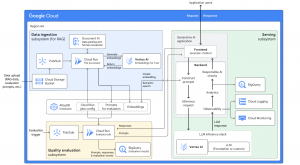
Infrastructure for a RAG-capable generative AI application using Google Cloud services

RAG: Injecting Context and Accuracy into GenAI

RAG is a technique that enhances the capabilities of Generative AI and large language models (LLMs) by combining them with external knowledge sources. Think of it as giving an AI system the ability to fact-check and update its knowledge in real time. Google’s recent Data and AI Trends 2024 report highlights the growing importance of operational data in unlocking the potential of generative AI for enterprise applications, making RAG a crucial technology for businesses looking to leverage GenAI.

How RAG Works: A Simplified View

  1. Knowledge Integration: All relevant data is transformed into a standardized format and stored in a searchable knowledge library.
  2. Vectorization: Advanced algorithms convert this information into numerical representations called vectors embeddings, enabling efficient searching and retrieval.
  3. Query Processing: When a user asks a question, RAG translates the query into a vector and searches the knowledge library for relevant information.
  4. Contextualized Response: The LLM receives both the user’s query and the retrieved contextual information, generating an accurate, specific, and up-to-date response.

Key Benefits of RAG for Your Business

Most importantly, RAG enhances the accuracy and relevance of AI-generated responses by providing users with precise answers grounded in the organization’s specific data, boosting trust and satisfaction. It also enables real-time information access, equipping AI with the latest data to ensure responses are always current and relevant—a crucial capability for dynamic fields like finance or customer service. 

Moreover, RAG can lead to significant cost savings. By indexing relevant information and retrieving only the most pertinent data to answer a question, RAG allows the use of much smaller prompts. This is particularly advantageous when dealing with large datasets, such as an entire website. New models like Gemini-1.5 can handle up to 2 million tokens, but calling such a model for every simple query would be prohibitively expensive. RAG optimizes this process, making it more cost-effective.

By delivering personalized and context-aware interactions through chatbots, virtual assistants, and other GenAI-powered applications, RAG can significantly improve the customer experience. Furthermore, RAG empowers employees with access to comprehensive and contextualized information, facilitating better-informed decisions and streamlining decision-making processes across the organization.

Examples of RAG in Action

The applications for RAG are vast, offering exciting possibilities for businesses across various sectors. Here are a few examples of how RAG is bridging the gap between powerful language generation and real-world problem-solving:

  • Elevated Customer Service with Smarter Chatbots: Imagine chatbots that go beyond generic responses. RAG empowers chatbots to tap into a wealth of knowledge, pulling up specific product details, troubleshooting guides, or even personalized order information. This means faster, more accurate resolutions for customers and reduced strain on human support teams.
  • Data-Driven Insights from Social Listening: Social media is a goldmine of customer sentiment, but sifting through the noise can be overwhelming. RAG can supercharge social listening by not only identifying brand mentions but also analyzing the context and sentiment behind them. This allows businesses to understand customer perceptions, track campaign effectiveness, and identify emerging trends with greater precision.
  • Next-Level Personalization for Loyalty Programs: Generic rewards don’t resonate with today’s discerning customers. RAG can analyze individual customer data, from purchase history to browsing behavior, to tailor loyalty program recommendations and offers. Imagine receiving a discount on a product you’ve recently viewed or being rewarded for consistent engagement with a brand you love. This level of personalization fosters stronger customer relationships and drives loyalty.

Integrating RAG into Existing Systems

While the potential of RAG is immense, integrating it into existing systems requires careful planning and execution. Businesses must consider factors such as data preprocessing, model selection, and parameter tuning to ensure optimal performance. Additionally, organizations should be prepared to address potential challenges, such as data quality issues or the need for specialized hardware to handle large-scale deployments. By working with experienced partners and allocating sufficient resources, businesses can successfully navigate these complexities and unlock the full value of RAG for their specific use cases.

Conclusion: The Future of AI is Contextual

RAG represents a significant leap forward in Generative AI, moving beyond generic language generation towards truly intelligent systems capable of understanding and responding to the nuances of your business. As RAG technology continues to evolve, we can expect to see more sophisticated applications. Future systems might not only provide information but also take actions based on that information, opening up new possibilities for automation and decision-making support.

At Making Science, we understand that the future of Generative AI lies in its ability to process and leverage information within its proper context. While RAG is still an evolving field, its potential to transform business operations is undeniable. As experts in data-driven solutions, Making Science is committed to helping our clients navigate the evolving landscape of Generative AI and unlock the power of technologies like RAG to drive business success.

RampUp 2024 Insights & Reflections by US CEO, Jason Downie

US CEO, Jason Downie attended RampUp 2024 and writes about his key insights and reflections from the event.


“At Rampup 2024, the term “data collaboration” was said MORE times than AI. That is a first! Scott Howe’s keynote focused on the dawn of this new era, ushered in by changes in user expectations for privacy and personalization, changes in regulations, and the deprecation of 3P party cookies.  

A month prior, I heard David Cohen speak at IAB ALM, and he called the upcoming years “The In-Between Years”. The messy middle between what was the standard for the last 30 years (3P cookies and precision marketing) and what will be for the next +30 years (1P data, AI-powered modeling, and collaboration).

A few weeks before IAB ALM, I heard Google’s Steve Yap speak at a US GMP Sales Partner summit. He spoke to the future of Google’s ad and martech being a “cooperative”.

Collaboration.  Cooperation.

Marketers need to figure out what their new “partner ecosystem” will look like and move quickly to build those relationships and the interconnectedness needed to achieve their goals.

In order to fully participate, marketers need:

  • 1PD collected, prepped, de-siloed and organized
  • Data Housed in a place (a cloud, or multiple clouds) where it can be made available for use across multiple partners (in a privacy-safe, secure environment)
  • Clean room tech that unlocks data collaboration across brands, data partners, and retailers in a way that also protects consumer privacy and consent
  • Platform partners that enable interoperable activation of the data where customers live (e.g. through PAIR into Google DV360)
  • A way to pull the results back down to the data warehouse for analysis and measurement

To do all this, marketers will need multiple partners.  Consulting firms, system integrators, cloud providers, clean room tech, data partners, etc..  We are trying to figure out, as an industry, how to do business for the next 30 years.

Marketers are generally not set up to do this.  They sell soft drinks.  Or soap.  Or checking accounts.  Some in-housing (or as we like to say, “right-housing”) is needed to own the data.  Testing and learning can be expensive.  But it needs to be done.  Marketers should be trying lots of different tactics in a short period of time (fail small and fast to win big!) in these in-between years, in order to arrive at more permanent solutions that will work for the new era.

Finding trusted advisors to help make sense of all the partners feels like an important step in this process.  Lots of companies have point solutions, or ad inventory, or data assets, or do media planning, buying, or measurement.  But a lot less are client-centric experts in the data collaboration value chain of the future.  Consulting plus hands-on-keyboard thingdoers to evaluate tech, collect, move, organize and activate 1PD, and enables tech connections and run POCs.  There will be an evolution towards companies becoming “ad tech system integrators for the CMO” or Data AORs as data collection and collaboration become more important.  And marketers will be better off as this evolution continues, so they can tie all this together in bespoke winning strategies.”

Get in touch with our team of experts to help your business navigate through the digital landscape.

[button color=”accent-color” hover_text_color_override=”#fff” size=”large” url=”www.makingscience.com/contact” text=”Get In Touch! ” color_override=”#ff0067″]