

Unlocking Business Value with Retrieval-Augmented Generation: The Future of GenAI is Contextual

The promise of Generative Artificial Intelligence (GenAI) seems limitless -from crafting compelling marketing copy to answering complex customer queries, but while large language models (LLMs) are impressive, they often lack the specific, up-to-date knowledge needed to truly deliver on their potential – especially in a business context. This is where a new technology, Retrieval-Augmented Generation, or RAG, steps in. This innovative approach is transforming how AI systems process and deliver information, bridging the gap between impressive language generation and real-world application. 

The Problem with Generic AI

Imagine deploying a chatbot trained on a general LLM to answer customer questions about your products. While it might eloquently describe the general concept of your offerings, it could falter when faced with questions about specific features, latest updates, or stock availability. This is because LLMs are trained on massive datasets that may not include your organization’s unique information or recent updates. 

The result? Inaccurate or irrelevant responses that frustrate users and erode trust in your AI implementation.
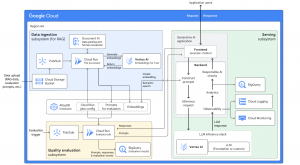
Infrastructure for a RAG-capable generative AI application using Google Cloud services

RAG: Injecting Context and Accuracy into GenAI

RAG is a technique that enhances the capabilities of Generative AI and large language models (LLMs) by combining them with external knowledge sources. Think of it as giving an AI system the ability to fact-check and update its knowledge in real time. Google’s recent Data and AI Trends 2024 report highlights the growing importance of operational data in unlocking the potential of generative AI for enterprise applications, making RAG a crucial technology for businesses looking to leverage GenAI.

How RAG Works: A Simplified View

  1. Knowledge Integration: All relevant data is transformed into a standardized format and stored in a searchable knowledge library.
  2. Vectorization: Advanced algorithms convert this information into numerical representations called vectors embeddings, enabling efficient searching and retrieval.
  3. Query Processing: When a user asks a question, RAG translates the query into a vector and searches the knowledge library for relevant information.
  4. Contextualized Response: The LLM receives both the user’s query and the retrieved contextual information, generating an accurate, specific, and up-to-date response.

Key Benefits of RAG for Your Business

Most importantly, RAG enhances the accuracy and relevance of AI-generated responses by providing users with precise answers grounded in the organization’s specific data, boosting trust and satisfaction. It also enables real-time information access, equipping AI with the latest data to ensure responses are always current and relevant—a crucial capability for dynamic fields like finance or customer service. 

Moreover, RAG can lead to significant cost savings. By indexing relevant information and retrieving only the most pertinent data to answer a question, RAG allows the use of much smaller prompts. This is particularly advantageous when dealing with large datasets, such as an entire website. New models like Gemini-1.5 can handle up to 2 million tokens, but calling such a model for every simple query would be prohibitively expensive. RAG optimizes this process, making it more cost-effective.

By delivering personalized and context-aware interactions through chatbots, virtual assistants, and other GenAI-powered applications, RAG can significantly improve the customer experience. Furthermore, RAG empowers employees with access to comprehensive and contextualized information, facilitating better-informed decisions and streamlining decision-making processes across the organization.

Examples of RAG in Action

The applications for RAG are vast, offering exciting possibilities for businesses across various sectors. Here are a few examples of how RAG is bridging the gap between powerful language generation and real-world problem-solving:

  • Elevated Customer Service with Smarter Chatbots: Imagine chatbots that go beyond generic responses. RAG empowers chatbots to tap into a wealth of knowledge, pulling up specific product details, troubleshooting guides, or even personalized order information. This means faster, more accurate resolutions for customers and reduced strain on human support teams.
  • Data-Driven Insights from Social Listening: Social media is a goldmine of customer sentiment, but sifting through the noise can be overwhelming. RAG can supercharge social listening by not only identifying brand mentions but also analyzing the context and sentiment behind them. This allows businesses to understand customer perceptions, track campaign effectiveness, and identify emerging trends with greater precision.
  • Next-Level Personalization for Loyalty Programs: Generic rewards don’t resonate with today’s discerning customers. RAG can analyze individual customer data, from purchase history to browsing behavior, to tailor loyalty program recommendations and offers. Imagine receiving a discount on a product you’ve recently viewed or being rewarded for consistent engagement with a brand you love. This level of personalization fosters stronger customer relationships and drives loyalty.

Integrating RAG into Existing Systems

While the potential of RAG is immense, integrating it into existing systems requires careful planning and execution. Businesses must consider factors such as data preprocessing, model selection, and parameter tuning to ensure optimal performance. Additionally, organizations should be prepared to address potential challenges, such as data quality issues or the need for specialized hardware to handle large-scale deployments. By working with experienced partners and allocating sufficient resources, businesses can successfully navigate these complexities and unlock the full value of RAG for their specific use cases.

Conclusion: The Future of AI is Contextual

RAG represents a significant leap forward in Generative AI, moving beyond generic language generation towards truly intelligent systems capable of understanding and responding to the nuances of your business. As RAG technology continues to evolve, we can expect to see more sophisticated applications. Future systems might not only provide information but also take actions based on that information, opening up new possibilities for automation and decision-making support.

At Making Science, we understand that the future of Generative AI lies in its ability to process and leverage information within its proper context. While RAG is still an evolving field, its potential to transform business operations is undeniable. As experts in data-driven solutions, Making Science is committed to helping our clients navigate the evolving landscape of Generative AI and unlock the power of technologies like RAG to drive business success.

Unlocking Growth with GenAI: Transforming Marketing, Sales and Customer Service

The recent Making Science and Google Cloud event series delved into the transformative power of Generative AI (GenAI). From text to images, GenAI is revolutionizing how businesses operate and engage with their audiences. However, one area that’s generating immense excitement is conversational AI, particularly its impact on customer service and engagement.

GenAI: A World of Possibilities

GenAI encompasses a range of technologies that enable machines to generate human-quality content. This includes text generation for marketing materials, creating realistic images and videos, and even composing music. The vast applications empower businesses to personalize customer journeys, optimize marketing campaigns, and streamline content creation.

But GenAI’s capabilities extend beyond text and images, venturing into the audio realm. This includes:

  • Speech Synthesis: GenAI can generate realistic and natural-sounding speech from text, enabling lifelike interactions with virtual assistants and chatbots.
  • Voice Conversion: Imagine transforming your voice into different languages or even different voices entirely. GenAI makes it possible, opening doors for personalized audio experiences and accessibility solutions.
  • Audio Editing and Enhancement: GenAI can remove background noise, improve audio quality, and generate sound effects, creating a more immersive and engaging audio experience.

These advancements in GenAI for audio lay the foundation for sophisticated conversational AI applications. By combining natural language processing with high-quality audio generation, businesses can create truly interactive and engaging customer experiences.

The Rise of Conversational AI

Within the GenAI landscape, conversational AI stands out for its ability to revolutionize customer interactions. Powered by natural language processing and machine learning, conversational AI tools like chatbots and virtual assistants can understand and respond to human language in a natural, contextually relevant way. This opens doors to:

  •  24/7 Customer Support:  Say goodbye to limited support hours and long wait times. Conversational AI provides instant responses and assistance, ensuring customers feel heard and valued around the clock.
  •  Personalized Interactions:  Gone are the days of generic responses. Conversational AI tailors interactions based on individual customer preferences and past interactions, creating a truly personalized experience.
  •  Increased Efficiency:  By automating routine tasks and handling a high volume of inquiries, conversational AI frees up human agents to focus on complex issues, boosting overall efficiency and productivity.
  •  Valuable Insights:  Every interaction with conversational AI provides valuable data and insights into customer behavior and preferences. This information can be used to refine marketing strategies further, personalize offerings, and improve the overall customer experience.

Conversational AI in Action: Real Estate and Beyond

The impact of conversational AI is already being felt across various industries. We are helping one of the main leaders of the real estate sector in Spain, an important company in Spain, implement conversational AI to transform property search, virtual tours, and mortgage assistance. Potential buyers can now receive instant answers to their questions, explore properties virtually, and even get pre-qualified for mortgages – all through a seamless conversational interface.

Beyond real estate, the potential applications are endless. Retail giants leverage conversational AI for personalized product recommendations and virtual try-on solutions. Financial institutions use it for account support, loan applications, and fraud detection. The possibilities are limited only by our imagination.

The Future of Customer Engagement

As GenAI continues to evolve, conversational AI will play an increasingly central role in shaping customer experiences. Businesses embracing this technology will be well-positioned to build stronger customer relationships, drive efficiency, and achieve sustainable growth.

Making Science and Google Cloud are committed to helping businesses unlock the power of GenAI and conversational AI. Contact us today to explore how these technologies can transform your customer engagement and take your business to the next level.

Unlocking the Cloud’s Potential: A Continuous Journey to Maturity and Innovation

The cloud has become the backbone of modern business, promising unparalleled agility, scalability, and the power to unlock game-changing innovation. However, harnessing its full potential is more than just migrating your data – it requires a strategic approach, a deep understanding of your cloud environment, and a commitment to continuous improvement. But did you know most companies are only leveraging a fraction of its potential?

At the recent “Unlocking Your Cloud” event, co-organized by Making Science and Google Cloud, we explored the critical steps businesses must take to maximize their cloud investments. Industry leaders explored the key to maximizing your cloud investment: Cloud Maturity.

Navigating the Ever-Evolving Cloud Landscape

The cloud is constantly evolving. Emerging AI, data analytics, and cybersecurity trends are reshaping the business landscape.  Take, for example, how AI is revolutionizing customer service in the retail industry. Businesses need a proactive approach, constantly evaluating their cloud strategy and adapting to the latest advancements.

The Cloud Maturity Assessment: Your Roadmap to Success

Understanding your organization’s current cloud maturity level is crucial for optimization. The Cloud Maturity Assessment framework, developed by Making Science, provides a comprehensive analysis across five key areas:

  • Architecture (Availability & Scalability): Ensure your cloud infrastructure can seamlessly scale to meet growing demands, minimizing downtime and maximizing business agility.
  • Security: Identify and address vulnerabilities before they impact your operations, safeguarding sensitive data and customer trust.
  • SecDevOps: Integrate security best practices throughout development, enabling faster deployments and reducing the risk of costly security breaches.
  • FinOps: Gain control over your cloud spending and identify areas for optimization, ensuring you get the most value from your cloud investment.
  • Continuity & Recovery: Establish robust disaster recovery plans to minimize downtime and ensure your business can weather any storm, keeping you focused on delivering value to your customers.

By identifying strengths and weaknesses, the assessment provides a clear roadmap for improvement, allowing you to prioritize initiatives and unlock the full potential of your cloud investment.

Real-world success: HolaFly’s cloud maturity journey

One of the event’s highlights was hearing directly from Pablo Gómez, CEO of HolaFly, who shared their inspiring journey, highlighting their challenges and the transformative impact of embracing the Cloud Maturity Assessment. By focusing on key areas like architecture optimization, enhanced security protocols, and streamlined DevOps practices, HolaFly achieved significant efficiency gains and accelerated its innovation cycles. Their success story serves as a powerful testament to the tangible benefits of a maturity-focused approach.

Partnering for Cloud Success

The journey to cloud maturity is best navigated with experienced partners by your side. Making Science and Google Cloud offer the technical expertise and business-oriented perspective necessary to align your cloud strategy with your core objectives. Whether you’re just starting to explore the cloud or looking to optimize existing infrastructure, the right partnerships can help you navigate complexities, avoid common pitfalls, and unlock lasting value.

Embracing the Cloud Maturity Journey

Achieving cloud maturity is not a destination, but a continuous journey of improvement and adaptation.  But equipped with the right strategy, tools, and partners, you can confidently navigate even the most challenging aspects of the cloud. By embracing the insights shared at the “Unlocking Your Cloud” event and proactively managing your cloud maturity, businesses can be well-positioned to turn the cloud into a true engine for business growth and success.

Ready to embark on your own cloud maturity journey? Contact Making Science today to learn how we can help.

Unleashing the Power of Kubernetes: How GKE Revolutionizes Container Orchestration

In the fast-paced world of cloud computing, container orchestration has become a crucial aspect of modern application deployment. . Leading this revolution is Kubernetes, an open-source platform that has redefined how we manage and scale containerized applications. Kubernetes itself was heavily inspired by Borg, Google’s internal system for managing containers at massive scale – think services like YouTube and Gmail. Today, we’ll explore how Google Kubernetes Engine (GKE), a managed service built on Kubernetes, takes this technology even further, empowering businesses to achieve unparalleled efficiency and scalability.

Understanding Kubernetes:

Often shortened to “K8s,” Kubernetes is a powerful container orchestration system that automates the deployment, scaling, and management of containerized applications.  It has rapidly become the industry standard.

At its core, Kubernetes works with two types of clusters: the control plane and the data plane. The control plane ensures the smooth functioning of the cluster, while the data plane handles servers, virtual machines, and other resources. The key components of Kubernetes include:

  • Pods: The smallest deployable units in Kubernetes, encapsulating applications or processes.
  • Services: Defining a set of pods and their access policies, providing a static IP address and DNS name.
  • Nodes: Virtual or physical machines in the cluster that run applications and workloads.
  • Master: The main server that orchestrates all activities within the Kubernetes cluster.

Elevating Kubernetes with GKE:

Google Kubernetes Engine (GKE) takes Kubernetes’s power to the next level, offering a fully managed service that simplifies the deployment and management of containerized applications. With GKE, businesses can leverage Kubernetes’ robustness and scalability while benefiting from Google’s expertise and innovative enhancements.

One of GKE’s standout features is its flexibility in cluster types. Whether you need a single-zone, multi-zone, or regional cluster, GKE has you covered. This adaptability ensures that your applications can be deployed in the most optimal configuration for your specific needs.

Unleashing the Power of Auto-Scaling:

GKE’s auto-scaling capabilities are a game-changer for businesses looking to optimize their resource utilization and cost-efficiency. With horizontal pod auto-scaling, GKE automatically adjusts the number of pods based on incoming traffic, ensuring that your applications can handle sudden spikes in demand without manual intervention.

But GKE’s auto-scaling prowess doesn’t stop there. It also offers cluster auto-scaling, where virtual machines scale based on pod capacity, and vertical pod auto-scaling, which intelligently analyzes and adjusts pod resources based on real-time requirements. Additionally, node auto-scaling creates node pools that dynamically adapt to the demands of your workload, ensuring optimal resource allocation at all times.

Security at the Forefront:

In the era of heightened cybersecurity threats, GKE prioritizes the security of your containerized applications. With features like private cluster creation, encryption both at rest and in transit, and robust vulnerability scanning, GKE helps safeguard your applications from potential threats.

GKE’s encryption is managed by the Key Management Provider (KMP), enabling the encryption of secrets that are not possible by default. This added layer of security ensures that your sensitive data remains protected throughout its lifecycle.

Empowering Your Business with GKE

Kubernetes has revolutionized the way we deploy and manage containerized applications, and Google Kubernetes Engine (GKE) takes this technology to new heights. With its powerful features, auto-scaling capabilities, and a strong focus on security, GKE empowers businesses to achieve unparalleled efficiency, scalability, and peace of mind.

At Making Science, we understand the transformative potential of GKE and are committed to helping our clients harness its full power. Our team of experts is ready to guide you through the journey of implementing GKE, ensuring that your applications are deployed with optimal performance, security, and cost-effectiveness.

Don’t miss out on the opportunity to revolutionize your container orchestration strategy. Explore how GKE can help your business achieve its goals and stay ahead in the rapidly evolving world of cloud computing.

Boost your e-commerce with Trust Generative AI

In the competitive world of e-commerce, standing out requires more than just good products. User experience, information accuracy, and the ability to attract and retain customers are crucial. This is where Trust Generative AI (TGAI), a generative AI platform designed to transform the way you run your online shop, comes in. In this blog, we will explore three key value propositions of TGAI: generating product descriptions, creating landings in multiple languages, and developing SEO-optimized category landings.

Product descriptions generation

One of the greatest challenges for an e-commerce business is maintaining accurate, engaging, and up-to-date product descriptions. TGAI uses generative AI to create detailed and persuasive descriptions in a matter of seconds.

Benefits:

  • Scalability: Produces numerous product descriptions quickly, ensuring that each item has a complete and unique description.
  • Accuracy: Generated descriptions are detailed, reducing errors and misunderstandings about the expected product.
  • Attractiveness: By incorporating attractive keywords and phrases, descriptions capture the attention of the target customer.
  • Time-saving: Frees up valuable time that can be spent on other critical areas of the business, for example, creativity.

With TGAI, you can ensure that every product in your catalog has a description that not only informs but also convinces and sells.

Landings in multiple languages

Global expansion is a goal for many e-commerce sites, but the language barrier can be a significant challenge. TGAI facilitates this process by generating landings in multiple languages with the same quality and effectiveness as the original versions.

Benefits:

  • Global Accessibility: Reach a wider audience by offering content in their native language.
  • Consistency: Maintain a uniform message and tone across all markets.
  • Speed: Launch international campaigns quickly without the need for extensive translation.

Break down the language barrier and take your e-commerce to new horizons with TGAI.

SEO-optimized category landings

Landing pages are essential to attract traffic and convert visitors into customers. TGAI generates category landings that are not only visually appealing but are also optimized for SEO, ensuring maximum engagement with consumers.

Benefits:

  • SEO Optimized: Landings are designed with SEO best practices, improving your search engine rankings.
  • Maximized engagement: Relevant and engaging content that keeps users interested and increases conversions by selecting the keywords that drive the most conversions.
  • Flexibility: Quickly adapt landings according to trends and consumer behavior.

With TGAI, you can be confident that each landing page will not only attract traffic but also keep visitors engaged, increasing conversion rates.

Conclusion

In the dynamic e-commerce environment, the ability to adapt and evolve is crucial. TGAI offers a comprehensive solution to improve the user experience, expand your global reach, and optimize your content to attract and retain customers. By integrating your strategy into your e-commerce, you not only simplify complex processes but also position yourself one step ahead of the competition.

Ready to take your e-commerce to the next level? Find out what TGAI can do for you and transform the way you manage your online storefront.


[button color=”accent-color” hover_text_color_override=”#fff” size=”large” url=”www.makingscience.com/contact” text=”Contact Us” color_override=”#ff0067″]

Cloud Strategies for Business Growth and Innovation – Lessons learned from Cloud Maturity Journey Podcast Series

Last week marked the release of the inaugural episode of Cloud Maturity Journey, a podcast series delving into key strategies for establishing a robust cloud foundation for your business. In this debut chapter, we were joined by two remarkable professionals, Israel Olalla, Cloud Customer Engineer Manager at Google Cloud and Miguel Lopez, CTO at Making Science, who, alongside moderator Jaime Desviat, Cybersecurity Analyst at Making Science, discussed the various challenges enterprises encounter when embracing cloud technology, as well as current industry trends and how these challenges are being addressed.

Recent technological trends such as AI, online shopping, and cloud storage have spurred the emergence of cloud technologies. The cloud provides storage when needed, and resources when scarce and enables architectures to be scalable and resilient in times of resource scarcity. Despite this, many companies unknowingly rely on cloud services for everyday tasks such as email accounts, storage, and online meetings.

Furthermore, the cloud has democratized access to resources, allowing resource-constrained businesses to swiftly and affordably access what they need. This has significantly empowered small enterprises to conduct tests and trials previously only feasible for larger corporations.

Challenges and the Talent Gap

Present challenges primarily revolve around the scarcity of specialists. While many individuals possess general qualifications, few have detailed technical expertise on each platform. Consequently, businesses face novel technologies they cannot fully leverage due to talent shortages. Another notable challenge lies in migrating long-standing technologies from legacy environments, often resulting in wasted efforts attempting to improve systems that could be more efficiently rebuilt in the cloud.

Cloud Adoption Trends

Current statistics indicate cloud adoption rates in Spain at 30%, compared to 46% across the European Union. While startups predominantly embrace cloud infrastructure due to financial constraints, larger enterprises struggle more with the transition. Sectors such as tourism, e-commerce, hospitality, and particularly airlines are the latest to migrate to the cloud.

Future Trends and the Evolving Landscape

AI and machine learning will continue to shape the cloud landscape, unlocking greater potential as capacities expand. Multi-cloud environments are emerging, allowing companies to cherry-pick components from various platforms based on their needs and performance. Additionally, the gaming industry is transitioning to cloud environments alongside the proliferation of IoT.

Throughout this episode, we’ve explored how the cloud not only resolves storage and resource challenges but also levels the playing field, enabling businesses of all sizes to innovate and compete on equal footing. However, significant challenges remain, including the shortage of skilled specialists and the complexities of transitioning legacy technologies to cloud environments. Nevertheless, these challenges signal a promising future for cloud technologies.

Looking Ahead

Our ‘Cloud Maturity Journey’ continues in the next episode – a deep dive into optimal cloud architectures. Join us as we explore how a robust architecture can be the cornerstone of business success, impacting competitiveness, profitability, and customer experience.

Listen to the full episode of Cloud Maturity Journey to learn more about building a solid cloud foundation for your business.

Apigee: Revolutionizing API Management

In today’s digital landscape, APIs (Application Programming Interfaces) are key enablers of innovation, collaboration and digital transformation. They enable seamless communication and data exchange between applications, fostering collaboration and driving the creation of next-generation digital experiences. But managing APIs effectively can be a complex challenge. This is where Apigee by Google Cloud Platform comes in, a tool that empowers users to manage APIs with unparalleled scalability, security, and performance.

What is Apigee?

Apigee is a leading API management solution that empowers businesses to take control of their API strategy, acting as a front-end to backend services through proxies to the APIs themselves. These proxies manage backend service traffic, enforcing policies like rate limiting and security measures. Apigee supports various protocols including REST, SOAP, GraphQL, gRPC, and OpenAPI.

It goes beyond simply managing APIs; it unlocks significant business value by ensuring scalability, security, and performance. This blog post dives into the core functionalities of Apigee and explores how it can transform your business.

Basic Concepts:

What is an API?

APIs (Application Programming Interfaces) are sets of protocols that enable different software applications to interact and share data. They define methods and data formats, establishing a contract for integration within software development. Within Google Cloud, APIs are seen as standardization tools that allow developers to harness GCP services and integrate them seamlessly into their applications.

What is a RESTful API?

RESTful APIs adhere to REST (Representational State Transfer) principles, known for their speed, scalability, and flexibility in data handling. They facilitate data access through HTTP requests and are widely used in contemporary software development for their ability to interface with varied computing resources such as storage, databases, and machine learning services.

Apigee’s Powerhouse Features:

  • AI-Powered Design: Duet AI streamlines API design using natural language, ensuring clear specifications and faster development.
  • Enhanced API Hub: Manage APIs effectively with open-standard specs, auto-generated code (proxies, integrations), and support for Vertex AI/ChatGPT deployments.
  • Advanced Security: Machine learning safeguards your APIs with automated threat detection and actionable recommendations.
  • High-Performance Proxies: Unmatched traffic management and reliability ensure smooth API experiences.
  • Deployment Flexibility: Apigee Hybrid offers hybrid and multi-cloud deployment options for on-premise or cloud environments.
  • Simplified Development: Streamlined tools for design, testing, and documentation empower developers to build robust APIs efficiently.

Apigee: Powering Business Value Through Innovative Use Cases

Apigee goes beyond simply managing APIs; it empowers businesses to achieve real-world results. Here’s how Apigee tackles common challenges and unlocks strategic value:

  • Fuel Cloud-Native Development: Build modern, scalable applications with on-demand scaling and load balancing capabilities.
    Unlock Legacy Data: Modernize legacy systems by creating secure, RESTful APIs that expose valuable functionalities. Apigee’s API proxies help modularize components for easier integration.
  • Unmatched Security and Governance: Secure web applications and APIs with a layered approach combining Apigee, Cloud Armor, and reCAPTCHA Enterprise. Safeguard your APIs with advanced security features like automated threat detection, access controls, and API quota management. Maintain data privacy and ensure compliance with industry regulations.
  • Monetize Your APIs: Generate new revenue streams by creating monetizable APIs with flexible pricing models (subscriptions, freemium, pay-per-use). A developer portal within Apigee streamlines discovery and consumption, fostering a thriving developer ecosystem.
  • Empower Developers: Provide intuitive tools for API design, testing, and documentation, accelerating developer onboarding and innovation. Duet AI further streamlines development by generating code and specifications from natural language descriptions.
  • Bridge the Digital Divide: Act as a bridge between legacy systems and modern cloud applications. Expose legacy functionalities through secure APIs, enabling seamless data exchange and a smoother digital transformation journey.
  • Optimize Operations: Automate API management tasks, freeing up IT resources for strategic initiatives. Gain valuable insights from analytics dashboards to optimize API offerings and ensure smooth, reliable operations with features like traffic management, throttling, and security enforcements.

Investing in the Future

Apigee is a future-proof solution that scales with your business needs. Its multi-cloud support allows for flexible deployment across on-premise, private cloud, and public cloud environments. Additionally, Apigee readily integrates with other Google Cloud Platform services, creating a powerful ecosystem for building and managing scalable, secure, and innovative applications.

By leveraging Apigee’s comprehensive API management capabilities, businesses can unlock significant value, driving revenue growth, fostering innovation, and achieving a competitive edge in the digital landscape.

Unleashing Apigee’s full potential requires expertise alongside the technology. Making Science, a leading digital consultancy can help. Our certified professionals will partner with you to design a customized Apigee plan that tackles your specific needs, from legacy modernization to monetization. Contact us today to unlock Apigee’s power and embark on your future-proof API journey.

RampUp 2024 Insights & Reflections by US CEO, Jason Downie

US CEO, Jason Downie attended RampUp 2024 and writes about his key insights and reflections from the event.


“At Rampup 2024, the term “data collaboration” was said MORE times than AI. That is a first! Scott Howe’s keynote focused on the dawn of this new era, ushered in by changes in user expectations for privacy and personalization, changes in regulations, and the deprecation of 3P party cookies.  

A month prior, I heard David Cohen speak at IAB ALM, and he called the upcoming years “The In-Between Years”. The messy middle between what was the standard for the last 30 years (3P cookies and precision marketing) and what will be for the next +30 years (1P data, AI-powered modeling, and collaboration).

A few weeks before IAB ALM, I heard Google’s Steve Yap speak at a US GMP Sales Partner summit. He spoke to the future of Google’s ad and martech being a “cooperative”.

Collaboration.  Cooperation.

Marketers need to figure out what their new “partner ecosystem” will look like and move quickly to build those relationships and the interconnectedness needed to achieve their goals.

In order to fully participate, marketers need:

  • 1PD collected, prepped, de-siloed and organized
  • Data Housed in a place (a cloud, or multiple clouds) where it can be made available for use across multiple partners (in a privacy-safe, secure environment)
  • Clean room tech that unlocks data collaboration across brands, data partners, and retailers in a way that also protects consumer privacy and consent
  • Platform partners that enable interoperable activation of the data where customers live (e.g. through PAIR into Google DV360)
  • A way to pull the results back down to the data warehouse for analysis and measurement

To do all this, marketers will need multiple partners.  Consulting firms, system integrators, cloud providers, clean room tech, data partners, etc..  We are trying to figure out, as an industry, how to do business for the next 30 years.

Marketers are generally not set up to do this.  They sell soft drinks.  Or soap.  Or checking accounts.  Some in-housing (or as we like to say, “right-housing”) is needed to own the data.  Testing and learning can be expensive.  But it needs to be done.  Marketers should be trying lots of different tactics in a short period of time (fail small and fast to win big!) in these in-between years, in order to arrive at more permanent solutions that will work for the new era.

Finding trusted advisors to help make sense of all the partners feels like an important step in this process.  Lots of companies have point solutions, or ad inventory, or data assets, or do media planning, buying, or measurement.  But a lot less are client-centric experts in the data collaboration value chain of the future.  Consulting plus hands-on-keyboard thingdoers to evaluate tech, collect, move, organize and activate 1PD, and enables tech connections and run POCs.  There will be an evolution towards companies becoming “ad tech system integrators for the CMO” or Data AORs as data collection and collaboration become more important.  And marketers will be better off as this evolution continues, so they can tie all this together in bespoke winning strategies.”

Get in touch with our team of experts to help your business navigate through the digital landscape.

[button color=”accent-color” hover_text_color_override=”#fff” size=”large” url=”www.makingscience.com/contact” text=”Get In Touch! ” color_override=”#ff0067″]

Navigating the Transition: Embracing Mitigation and Activation for 3PC Deprecation

As a continuation of “Chrome’s Challenge: Adapting to 3rd Party Cookie Deprecation“, we delve deeper into the intricacies of adapting to a world without third-party cookies, it’s crucial to not only focus on immediate mitigation and activation strategies, but also to consider the broader implications for managing change within your organization and the evolving digital landscape. Here’s how to approach this transition with a holistic perspective:

Managing Change and Stakeholder Engagement:

  • Leveraging Making Science’s 3PC Deprecation Tool: This invaluable tool aids in strategic planning by quantifying the impact of 3PC deprecation on your operations, streamlining the process for gaining the necessary technical and legal approvals for implementing critical updates like Enhanced Conversions. It’s about making informed decisions that align with both current needs and future directions.

The Role of Google’s Privacy Sandbox:

  • Adapting to New Technologies: Google’s Privacy Sandbox introduces a suite of alternatives, including the Topics API and Protected Audiences, aimed at preserving user privacy while maintaining advertising effectiveness. Although reactions have been mixed, staying abreast of these developments is essential for adjusting strategies in real-time.
    • Topics API: Designed to categorize a user’s interests based on their browsing history, facilitating personalized advertising without individual tracking
    • Protected Audiences API: Offers a framework for advertisers to target specific user groups while ensuring stringent privacy protections and compliance with data regulations
  • Monitoring Developments: The influence of the Privacy Sandbox is set to expand, making it imperative to understand how its components can be integrated into your advertising efforts. Begin with the immediate strategies outlined, then pivot to harnessing the full potential of the Privacy Sandbox as it matures.

This approach not only ensures compliance and efficacy in your marketing endeavors post-3PC but also emphasizes the importance of agility and forward-thinking. By embracing both mitigation and activation techniques—and preparing for the shifts in technology and stakeholder expectations—you can continue to provide personalized advertising experiences, sidestepping reliance on third-party data and setting a new standard for privacy-conscious marketing.


[button color=”accent-color” hover_text_color_override=”#fff” size=”large” url=”www.makingscience.com/contact” text=”Get In Touch With Our Experts!” color_override=”#ff0067″]

Chrome’s Challenge: Adapting to 3rd Party Cookie Deprecation

Chrome’s 3rd Party Cookie Deprecation (3PCD) is already affecting business and marketing performance. In this post, we’ll uncover how this seismic shift is reshaping today’s strategies and explore ways to adapt and succeed in a post-3PC world. 

What is happening?

Google Chrome has taken a decisive step towards privacy-first browsing, which started with the deprecation of third-party cookies for 1% of its users in January 2024. Google plans to extend this to all users by the latter half of the year. This gradual phase-out marks a significant shift from traditional user tracking methods and aligns with a broader industry move towards enhancing user privacy.

Why it matters

Chrome’s third-party cookie deprecation is more than a tech shift—it’s a revolution in digital advertising, given its 65% global market share. This change impacts advertisers, publishers, and users, especially on desktop where conversion rates are higher. Google and Meta’s reliance on these cookies for detailed user profiles and targeted advertising is facing a transformative challenge.

What will the impact be?

The decline in third-party data quality will make it less complete and accurate, potentially reducing marketing efficiency and ROAS unless advertisers adjust. Making Science’s 3PC Deprecation Impact Tool predicts up to a 30% drop in advertising-attributed online conversions and a possible 9% loss in digital revenue for certain sectors. This highlights the growing importance of first-party data (1PD) over third-party data (3PD), due to cookie deprecation.

What can be done to mitigate the impact?

There are lots of options available to handle this change – in fact, too many. It is important to understand the impact on your business and prioritize the available changes based on ease of implementation and impact. We can bucket the opportunities into mitigation and activation.

Mitigation

We’ve compiled a few key solutions that are aimed at reducing the loss of data volume and quality by implementing tools provided by Google and collecting better data using durable, privacy-compliant solutions.

  • We can’t stress the importance of a consent management platform (CMP) rather than a DIY solution for a consent banner. CMPs integrate with Google’s technical solutions and provide template consent banners that are compliant with the latest regulatory changes in differing markets, which can become hard to manage as more and more countries and states implement their own privacy legislation.
  • GA4 implementation will provide confidence in data, become the data source of truth for the business and stay up-to-date with privacy changes, as Google has shown its commitment to keeping GA4 compliant.
  • Consent Mode V2 for all Google products and Enhanced Conversions will allow for better matching by Google whilst respecting privacy. Consent Mode is now a requirement for using advertising features within Google products, and Enhanced Conversions allow conversions to be tied to impressions and clicks better, improving the understanding of campaign performance.

We deem those as the initial essential requirements for dealing with 3PC deprecation, but there are also other measures, such as: 

  • Implementing server-side measurement that will further improve the robustness of the GA4 implementation and marketing pixels. 
  • Leveraging server-to-server APIs for key conversions to ensure 1-to-1 matching between internal databases and ad/martech. 
  • Greater understanding of users can be achieved by using a Customer Data Architecture (CDA) or a Customer Data Platform (CDP) and cleanroom analysis can help cluster users together for better-aggregated targeting.

What activation strategies can help navigate 3PC deprecation effectively?

In addressing the challenge of third-party cookie (3PC) deprecation, a myriad of strategies are available to adapt and thrive. The key is to assess the impact on your business and prioritize strategies based on their implementation feasibility and potential impact.

Activation

Focusing on activation strategies that leverage first-party data (1PD) is crucial. Here’s a breakdown of key action items:

Building and Enhancing Audiences:

  • GA4 Audiences: Utilize GA4 to create dynamic audiences based on user behavior. These audiences can then be seamlessly integrated into Ads and Google’s adtech stack, improving the precision of your targeting.
  • Customer Match: Automate the process of uploading customer lists into Ads for more accurate targeting, helping to counteract the impact of 3PC deprecation.

Leveraging Google’s Advanced Tools:

  • Smart Bidding: Implement Google’s Smart Bidding to optimize campaigns using AI, which adjusts bids in real-time for conversions or conversion value, making use of contextual signals and machine learning.
  • Consent Mode V2 and Enhanced Conversions: Ensure compliance and improve data accuracy with Consent Mode V2, now a requirement for Google product advertising features. Enhanced Conversions improve the linkage between conversions and ad interactions, offering a deeper understanding of campaign performance.

Enhancing Signal Quality:

Predictive Modeling with Gauss Smart Advertising: Beyond the scope of Google’s tools, Gauss Smart Advertising enhances your digital strategy through predictive modeling. This tool does more than just score users; it significantly enhances the signals sent to Google’s algorithms for unparalleled optimization. Such advanced techniques can sharpen your advertising efforts and lead to more targeted, impactful campaigns that elevate performance thoughtfully and effectively.


[button color=”accent-color” hover_text_color_override=”#fff” size=”large” url=”www.makingscience.com/contact” text=”Get In Touch To Activate Your Data Strategy” color_override=”#ff0067″]