Pioneering applications of AI in advertising

First: A warning to all the androids out there

Science fiction movies might come to mind when we hear about Artificial intelligence (AI). In many of these movies, AI became conscious. And, of course, they all came to the same conclusion: “Error 404 – human beings are to blame for everything bad on this planet. Ending the human race will set us free.” For all those androids and bots out there that are reading this: that’s simply not true! No matter how hard you try to annihilate humanity, you will never be free, because in short, you are just a digital tool to make life easier and besides, we’ve got you all figured out!

Now that we’ve got that out of the way, and shaken our fear of dystopian AIs a bit, I am here to tell you about the applications of this tool in advertising. I’ll also share some examples of national and international campaigns where this tool has been applied for good.

Why do AI and advertising go so well together?

Advertising is constantly evolving. It’s an endless race in which every tool or innovation translates into an opportunity to better impress and impact our consumers. Artificial Intelligence is another one of those tools in our belts we can use to better impress our customers. And, despite its relatively short lifespan, we can already observe some of the changes generated and process improvements that exist in the industry.

One of the main tasks of advertising is to analyze large amounts of data to identify patterns and trends in consumer behavior. Normally, this is an arduous task. But, it can be carried out by AI quickly and more precisely. This gives us valuable time back, allowing us to design more effective and personalized advertising campaigns, as well as streamline processes and reduce time spent.

Practical applications of AI in advertising

We can use AI to quickly optimize our advertising campaigns. Advertisers can use Artificial Intelligence to automatically analyze and adjust the targeting, budget, and creatives of ad campaigns in real-time. This can increase advertising efficiency by lowering your cost per acquisition and increasing your return on investment.

Another application of AI is to use it to analyze the results of advertising campaigns. Advertisers can use AI to analyze ad campaign performance data and gain insight into which elements of the campaign are working and which are not. This can help advertisers adjust and improve their campaigns in the future.

Examples of AI art being used in recent campaigns

There are many different types of Artificial Intelligence already. Today I want to talk a bit about Midjourney. It is an image generator with text that works thanks to an AI. Here I will discuss two of my favorite examples of “artificial campaigns” generated by this tool.

The first features a Spanish comic called Gatas (English article here). It is a comic created by the agency CYW. In it, we meet some revolutionary Spanish grandmothers who live in a dystopian Madrid in the year 2614. While the text was written by humans, the art itself was generated by the MidJourney technology.

The second creative example that I bring you, and my favorite to date, is this campaign for The Melbourne Writers Festival. In it, they used the same Artificial intelligence as CYW to bring to life the most famous texts of universal literature. I invite you to discover this campaign; it only takes a minute and I am sure you will find it interesting.

Considerations for using AI in your campaigns

While AI is an extremely useful tool, there have been some controversies related to the use of this type of generated imagery. This is because AI tools are “taught” how to create based on art created by real people. So, before jumping into using any tool for this type of work, be sure to check into the company providing the software. It is never a good idea to steal the work of others. Be sure you don’t run into any copyright issues!

In the end…

AI is rapidly transforming the world of advertising by enabling the personalization, optimization, and analysis of advertising campaigns in real-time. As AI continues to evolve, it is likely to play an even bigger role in advertising in the future.

If you’re not quite sure how AI might be able to save you time and money, our team would be happy to help!
 

Get in touch

From volume to value: Improve your campaigns with Gauss Smart Advertising

Align your advertising investment with your business strategy

The automatic bidding strategies offered by the different advertising platforms have become one of our best allies when it comes to campaign optimization. Specifically, those known as Value Based Bidding allow us to align our advertising investment with our business objectives in an automated way.

If you are using Value Based Bidding, simply configure your pixels so that they collect the conversions that you want to optimize. Then, indicate the objectives you want to achieve through your campaigns (whether it is maximizing the value of the conversions or optimizing the return on our investment). From there, algorithms take care of learning everything necessary to find and bid for users to achieve your goals.

The main issues with Value Based Bidding

Conversions, in this case, act as signals that tell the algorithm whether or not users are valuable for our campaign. But, sometimes you may not have enough conversion volume for VBB to work. And sometimes, web conversions do not fully reflect the reality of our business.

Furthermore, it is estimated that the Google and Meta algorithms only consider signals for the first 7 days since the user entered through a paid campaign. For user acquisition data, the most recent signals are the ones that the algorithms give the most importance to. What happens when a lead’s final conversion takes place beyond that 7-day window?

How Gauss Smart Advertising can help you

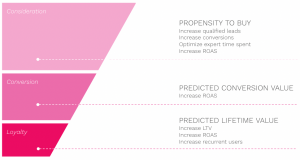
To cover this gap between what the algorithm is able to see and the real objectives and KPIs of your business, Making Science developed Gauss Smart Advertising. This is a proprietary technology that allows you to anticipate the future value of a user and improve signals throughout the entire sales funnel. With Gauss, we can predict a lead’s propensity to buy, the expected purchase value, and even the long-term value of the lead (customer lifetime value). Then, we translate it into signals that provide the algorithm with a more realistic vision of your business. Furthermore, what makes the difference is that we not only create predictive models, but we can activate them in real-time to anticipate and communicate those signals without losing the benefits of the cross-device, nor the freshness that Smart Bidding algorithms require. Additionally, we develop agnostic models that can be activated on any of your marketing platforms.

How it works

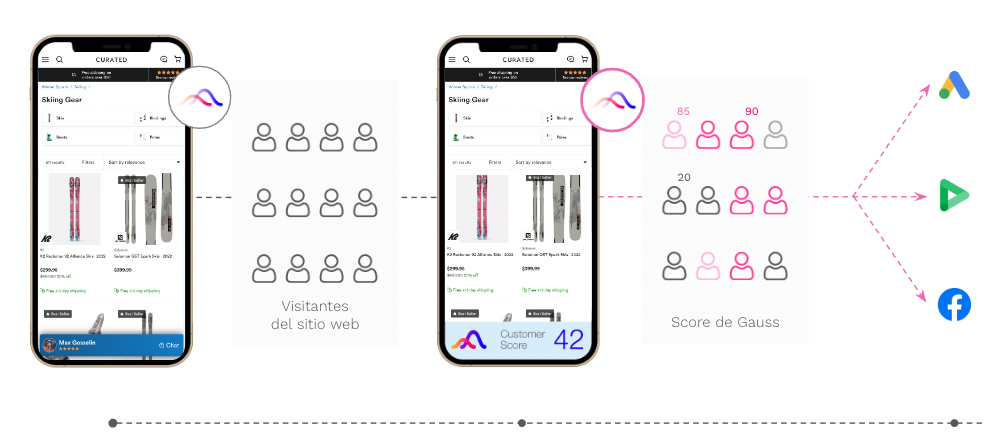
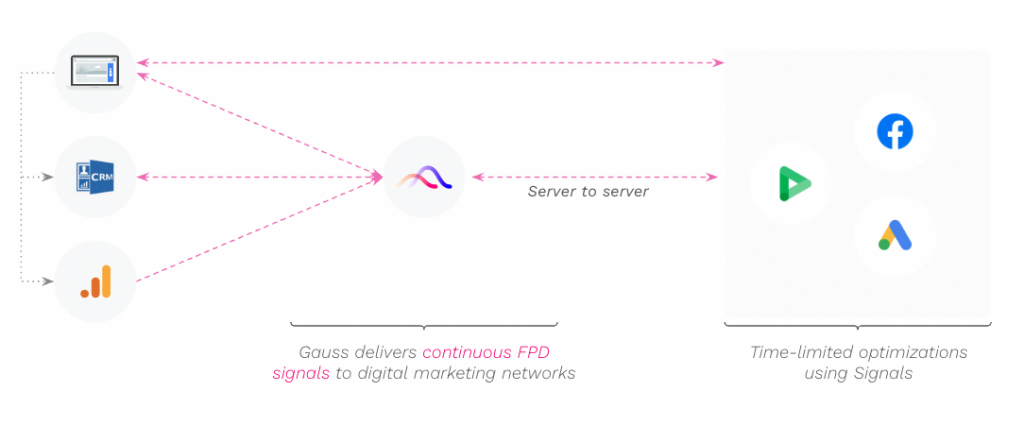
Advertising platforms have the ability to collect web browsing data for campaign optimization. Gauss Smart Advertising collects browsing data, but also from other data sources to issue a more accurate assessment of the user that it then sends as a signal to the platforms.

In essence, based on previously trained machine learning models, it predicts and issues a score/value for each of the users that enter the website and communicates it to the platforms in real time:

A methodology for automation and activation

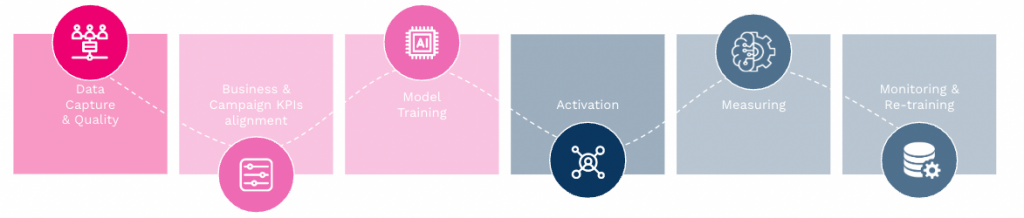
Our solution is optimized to cover all the critical phases of its implementation, from the collection and evaluation of the quality of the data that feeds our models to the activation and monitoring of campaigns and models:

With Gauss Smart Advertising we have managed to increase our clients’ conversions by 20% and reduce their CPL/CPA by up to 50%.

Gauss Smart Advertising can be used to

  • Communicate to the algorithms that someone has made a purchase when the lead is more than 7 days old (for example, longer tail conversions like university enrollments, vehicle purchases in the automobile industry, insurance or mortgage purchases in the banking sector, etc.)
  • Adjust conversion values ​​when refunds and cancellations represent an important part of the business and these occur outside the scope of action of the algorithms (example: in the hotel industry where cancellations tend to take place closer to check-in than to reservation)
  • Amplify and provide a greater volume of signals to the algorithms in order to improve their performance in industries or advertising channels (for example, display) where few conversions are collected
  • Adjust the signals captured by the algorithms to the KPIs and business objectives (for example, increase customer lifetime value for e-commerce businesses)

Do you want to know more about Gauss Smart Advertising? Write to us! Our team of experts will be happy to help you.

Get in touch