

Three GA4 Data Loss Solutions

On July 1, 2023, Universal Analytics will be officially replaced by Google Analytics 4 (GA4) (read more here). This transition will bring significant changes to the platform, including a refreshed interface, a new data model, and the incorporation of machine learning capabilities.

GA4’s ability to merge both observed and modeled (unobserved) data is crucial due to evolving browser cookie policies and GDPR regulations. These changes increasingly restrict traditional tracking and analysis methods, making GA4 data loss solutions essential.

To adapt, analytics tools must address missing data. With three key GA4 data loss solutions— data-driven attribution, predictive metrics, and modeled behavioral data— users can effectively compensate for this loss of information.

Data-Driven Attribution

The Data-driven attribution model employs a statistical approach to assess the significance of a channel’s contribution to a conversion. For instance, GA4’s top acquisition reports might attribute 5,000 purchases to the SEO channel, but prior touchpoints from channels like Paid Search could have influenced the user’s decision to buy.

Hence, the statistical model analyzes user behavior and conversion paths to determine the appropriate weight for various touchpoints. Instead of attributing the entire conversion to the SEO channel, the model assigns percentages to all contributing channels based on their impact on the user’s transaction. 

Predictive Metrics

Currently, this feature is exclusively applicable to e-commerce and revenue metrics, which may include purchase probability, cancellation likelihood, projected income, and the chance of users revisiting the website or app in the near future. GA4 relies on historical user activity for its predictive data, which can be utilized beyond Analytics. By creating audiences and segments to distinguish between potential or improbable buyers, this data can be leveraged in Google Ads for remarketing purposes.

Modeled behavioral data

This feature involves integrating GA4 with a cookie consent management tool, allowing Google Analytics to gather anonymous data from users who have not granted tracking consent. This information is not linked to a cookie or any user identifier.

The behavior of observed users (those who have opted out of tracking) is utilized to train a machine-learning model, which then estimates the behavior of users who have chosen not to be tracked.

By harnessing these three innovative GA4 data loss solutions, you can improve your analytics and optimize campaigns to boost your business KPIs significantly. If you need assistance with Analytics and GA4, our expert team is ready to help. Don’t hesitate to contact us!
Get in touch

Data and AdTech Trends: 2023

As we kick off 2023, there’s no better time to reflect on our digital activity from last year. 

Attribution, activation, and respect for user privacy have been key issues for companies with regard to data. Meanwhile, new tools, technologies, and platforms like CDPs have emerged to help pool data in one place and avoid silos.

2023 is full of many opportunities and trends. Let’s dig into those we’ve identified as being most impactful. 

Data & AdTech Essentials for 2023

Let’s start with some of the less obvious recommendations:

  • Predictive Models: Consumers are offering up less and less of their data these days. Predictive models will help us to have better conversions. For example, through Google Ads’ Value-Based Bidding, we have the opportunity to improve campaign profitability by increasing Customer Lifetime Value.
  • BigQuery: This Google tool offers more enhanced analytics capabilities – all right in the Cloud. Google Cloud now offers the use of BigQuery, a serverless, multi-cloud enterprise data warehouse so you can continue to improve your data-driven strategy. BigQuery integrates Machine Learning for advanced analytics, allows you to share valuable information across your organization, and helps you make business decisions based on data.
  • Server-Side Tagging: We recommend moving measurement and advertising tags from your website to a secure server container. This helps protect your customers by restricting access to their information and increasing conversion rates on your site by reducing page load times. Server-side tagging is now supported in products from Google Ads and Google Marketing Platform, including Campaign Manager 360, Display & Video 360 y Search Ads 360.
  • Marketing Mix Modeling (MMM): Start distributing your budgets based on more advanced models. MMM for example is a statistical modeling technique that identifies the relationship between marketing spending in each channel and the results obtained by it. This allows you to discover what is the optimal investment in each channel to maximize your sales.
  • Connected TV: Otherwise known as the evolution of digital advertising. Connected TV is any television connected to the Internet where users stream video content. This technology provides advertisers with a new means to deliver measurable and personalized advertising. According to a study about Connected TV carried out by IAB Spain in 2022, 82% of Internet users between the ages of 16 and 75 internet streaming services. Connected TV allows for cross-device strategies. It also allows us to identify and impact users with our ads through different devices, thus measuring their effectiveness and how they have influenced the conversion process of said user. Another benefit of Connected TV campaigns is the possibility of being able to segment audiences and control frequencies, which can help lower costs.

And, a few solutions that you’ve surely heard of before:

  • Privacy planning: Having a privacy plan for your company is essential (it has been now for many years). Privacy protection regulations and the demand for greater transparency from users about how companies use their data continue to increase. If we build a privacy-centric strategy, we can continue developing our advertising activity with total normality. At Making Science we opted for the implementation of solutions such as Consent Mode, Enhanced Conversions, GA4, and Facebook CAPI, which allow us to “catch up” in the privacy race. We are also committed to the use and activation of First-Party Data, an option that is increasingly accepted by organizations due to the disappearance of third-party cookies.
  • GA4: All data capture, measurement, and activation technologies are becoming privacy-first. So, it’s a no-brainer to implement them. One excellent technology is Google Analytics 4 (GA4). It is a tool that will be crucial for measuring our results. It offers many new functionalities, with which we will be able to extract greater insights from our data. It will also make our measurement much more reliable.
  • Hyper-personalization and AI projects: Users are demanding better and better experiences that are adapted to their reality and needs. In short, personalization was essential in 2022, but in 2023 we will have to work even harder to continue surprising them. We should look to implement AI based on the activity of our users, so that we can design and develop better products, services, messages, and, ultimately, better ways to reach our audiences.
  • First-Party Data Activation: In a cookieless environment, how can we continue to impact our users in the same way as in the past? Thanks to First-Party Data, we can nurture our campaigns without putting our activity at risk. First-party data is an optimal, reliable, scalable data strategy. This activation and exploitation can be done either by CDPs or any platform that helps to manage data.

These are just some of the trends that will mark 2023 and will undoubtedly influence the digital ecosystem. What will happen in the world of digital marketing and technology this 2023? Find out by following the Making Science blog, where you will find articles on the latest trends, tools, and technologies.

If you want to start a project related to these trends, Making Science can help. We have a team of experts who can help you in your specific case. Get in touch!

Contact us

Increase your sales by up to 20% by activating AI in your digital advertising campaigns

Data collected without a purpose and without proper processing is virtually useless and becomes an expense that quickly escalates. It is not until we enrich it intelligently that we can truly consider it an investment. This helps us uncover the (often surprising) stories it holds.

Considering our data as one of our most critical corporate assets is imperative. Monitoring customer interactions provides a wealth of knowledge to guide our marketing, sales, and product development efforts while monitoring internal processes generates valuable information to optimize operations and improve productivity.

This knowledge value chain is composed of technical and non-technical components. It includes business processes and understanding that a systematic approach allows us to put data-driven predictive models into production through a strategy tailored to each business objective.

Once we have extracted the relevant insights from the predictive models, the next crucial step begins: turning this information into action to generate measurable business impact. 

This requires three key aspects: 

  1. Understanding the business environment we operate, our acquisition, sales, and loyalty processes.
  2. In-depth knowledge of the different profiles and purchase drivers of each customer segment to which we direct our advertising campaigns.
  3. The creation of tools that automate or facilitate decision-making.

At Making Science, we have been innovating in this context for years with ad-machina and Gauss Smart Advertising. These machine-learning solutions optimize your advertising campaigns on digital platforms (Google Ads, DV360, Campaign Manager, and Meta, among others), making the most of First Party Data (from CRMs, call centers, or other available data sources) and managing to improve sales ratios by up to 20%.

Making Science brings you technology geared towards automation and activation.

Interested in learning more about how we can help you do more with less? Get in touch today!

Contact us

Personalize your ads and reduce costs with Gauss Dynamic Creatives

We live in a world where people have become accustomed to receiving hundreds of advertising impacts every day. One of the main problems that users mention is that many of the ads they see are not related to their interests. This generates fatigue and frustration. Relatedly, most advertisers state that it’s difficult to personalize each of their advertising impacts due to the creative cost and the management time involved in generating personalized ads that help them overcome the aforementioned barriers.

Dynamic ads can be an effective solution that allows advertisers to generate more personalized ads and offer customers what they demand, improving brand perception, reducing advertising fatigue, and improving the conversion rates of their campaigns.

How does it work?

Dynamic ads build on previous customer interactions to deliver an ad tailored to one’s needs and interests. Based on these interests, a personalized final piece is composed for each user, generating an authentic user-centric strategy and activating the first-party data that we have about the user. That allows us to fine-tune commercial opportunities, appearing at the right time with the right product.

Building dynamic ads in Meta

Meta’s advertising tool offers us a native solution for generating dynamic ads thanks to product catalogs that we link to user activity. We use the data collected by pixels on the same platform. However, this tool has a limitation at a creative level, since the final creativity is made up exclusively of the image of the product for which they have shown interest, without the possibility of adding dynamic creative elements such as prices, descriptions, logos, or CTAs.

Go a step further with our solution: Gauss Dynamic Creatives

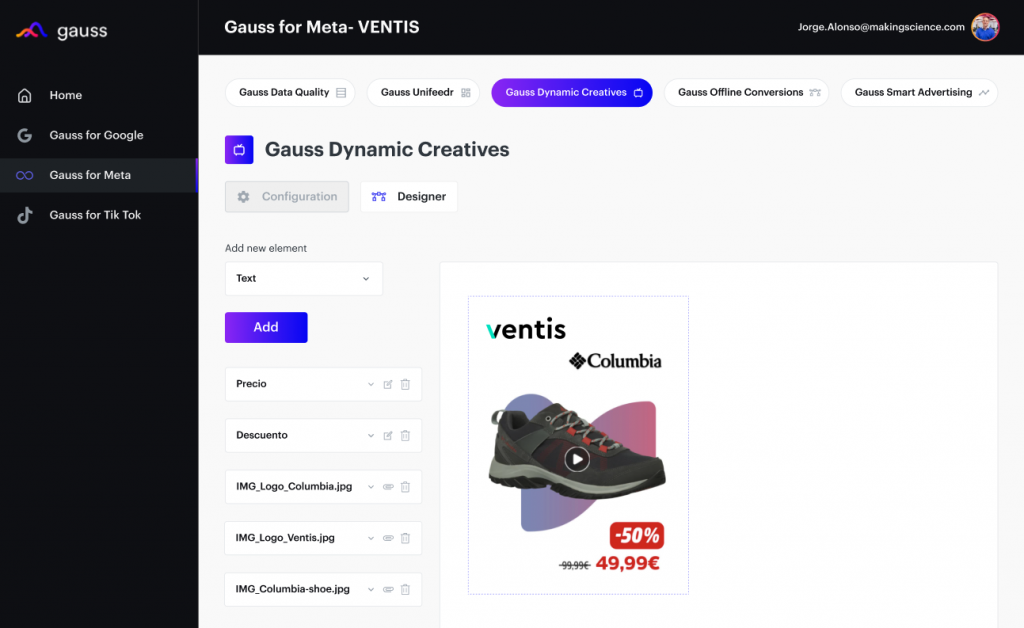
At Making Science, we offer a solution that allows us to customize all aspects of our final creative dynamically. Adding the specific price of the product visited, a description, a logo, or any dynamic or static element to the final creative to improve its performance, taking into consideration branding boosts that are generated with impressions that do not end in conversion.

You just need to connect your product feed to our platform. From there, you can generate a template defining which elements will be dynamic or static and select the feed column from which we will take the value for the dynamic elements. 

Activating it is as easy as uploading the catalog to your Business Manager and selecting it when creating a campaign, either remarketing with catalog sales or prospecting with dynamic ads for wide audiences. Once that’s done, a dynamic creative is automatically generated for each user based on their behavior.

The main benefits of using dynamic ads are:

  • Higher CTRs
  • Higher conversion rates
  • Improved brand perception
  • Reduced creative costs
  • Improved user experience

Now that you know how dynamic ads work, let us help you get started!

Get in touch