DV360: Delivering Results While Respecting User Privacy

We are in the era with digital marketing on top of the world, and looking for the right tools & solutions to excel in your company’s presence is essential. With Google’s Display & Video 360, businesses can reach their target audience with compelling and intriguing still image and video content that drives positive events such as conversions, subscriptions, or whatever your team is reaching to achieve. Let’s look closer into DV360 and the rising question of user privacy within this impactful tool.

So, what is DV360?

Display & Video 360 is Google’s integrated tool for managing programmatic ad campaigns. It’s part of the Google Marketing Platform and offers comprehensive features for planning, executing, and optimizing display and video advertising across various channels. It offers robust analytics and real-time optimization features, making it a powerful choice for advertisers looking to maximize their reach and performance. The impactful feature of enhanced automation helps maintain performance using an advanced AI prediction model to curate an advanced optimization algorithm for your campaigns. Enhanced automation has led to a 60% median decrease in cost per acquisition* in most cases. When it comes to successful verticals, retail, travel, and automotive sectors often see strong performance with DV360 due to its precise targeting and rich media capabilities. What’s unique about DV360, however, is its versatility. DV360’s flexible formatting and diverse content inventory makes it an effective tool across many verticals.

Protecting User Data with DV360

In the year 2024, everyone has seen some case and situation of user data being exposed, which is why 4 of every 5 online users** are worried about their privacy and how easily their data can be stolen. At the same time, 66% of the general population** is still expecting to have a unique, personalized ad experience, which leads to the complications of exposing their data. So, how does DV360 & Google come into the picture and please both parties?

Google continuously updates its practices to ensure user data is protected while maintaining ad effectiveness. Their efforts to continue to preserve user privacy while maintaining a personalized ad experience has been labeled the Privacy Sandbox Initiative. The Privacy Sandbox is Google’s initiative to develop new web standards that prioritize user privacy while allowing targeted advertising. For DV360, this means evolving to use these new technologies, like Federated Learning of Cohorts (FLoC), which should positively impact its ability to deliver personalized ads while respecting privacy. Overall, the changes brought by the Privacy Sandbox should positively impact DV360. While there will be an adjustment period, the move towards more privacy-focused advertising will ultimately build greater trust with users and ensure long-term sustainability for the platform.

DV360 will stay on top

Google’s Display & Video 360 tool is here to stay atop of the digital marketing landscape when it comes to video and image campaigns. Their expansive inventory and capabilities to be activated on almost any platform thanks to Google makes it a top choice for advertisers.

As Google Marketing Platform resellers at Making Science, we are prepared to help deliver the best results for businesses to grow to their fullest potential. Reach out to us today to learn more about our services regarding DV360 and other GMP tools.

[button color=”accent-color” hover_text_color_override=”#fff” size=”large” url=”www.makingscience.com/contact” text=”Get in Touch” color_override=”#ff0067″]


*Source: Google, DV360 & CM360 3P Cookie Deprecation Holistic Readiness Guide, 2023

**Source: Google, DV360: Level Up Webinar, 2024

AI comes to Google: The future of SEO with SGE

SGE (Search Generative Experience) will be a major change in the search experience and the way results are displayed in the SERPs.

But first of all, what exactly is SGE? It’s a radical update from Google, which will start using AI to generate contextual answers to complex questions.

AI in search engines

The impact of ChatGPT since the end of 2022 and its very rapid integration into the digital status quo, especially among young people, has led tech giants (such as Google) to further accelerate the deployment of their AI-related technologies.

Within the search engine market, Microsoft has moved ahead with the integration of ChatGPT into Bing as early as 2023 and Google has responded quickly with the announcement of SGE, based on Gemini, its LLM that promises to be more powerful than GPT-4.

The common formula is the integration of an AI module on top of the search engine that not only directly answers complex queries accurately, but also enables deeper searches through a conversational interface.

What do we know so far about the impact of SGE on SEO?

SGE will bring about an evolution in the way we search for information on the Internet, as ChatGPT has already done.

SGE is being tested in the USA, and the SEO team at Making Science has already been testing this new experience to draw some preliminary conclusions before its final international roll-out:

Several sources of information

This new AI module draws from many sources to offer more complete information:

  • Media: Very relevant, especially in information searches. Media attention, through PR teams, is essential to manage the conversation around brands.
  • Shopping feeds: PDPs everywhere in searches closer to conversion. A good product feed is essential to appear here. It seems that achieving a more complete shopping experience is one of SGE’s main objectives.
  • Reviews: Google knows that reviews are powerful conversion triggers, and integrates them into SGE for searches close to conversion. The focus should be on optimal Schema markup and online reputation management.
  • Social media: Social media conversation is especially relevant for topical or trending searches. Inspirational approach.
  • Google Maps / Business Profile: Many of the searches, even when not explicitly geolocated from the query, return local SEO results.
  • Multimedia: Text, images, video, FAQs, social media… what seems evident is that covering searches with multiple formats is going to be essential to capture the key terms in SGE

SEO strategies impact

There are a few things that seem to be clear, and that don’t really change the ‘traditional’ approaches to SEO strategies that much:

  • The classic Google Top 3 will determine what comes out of this block.
  • There will still be ads (as they are Google’s main revenue stream), but to a lesser extent. At least at launch.
  • SEO-optimized elements or content will continue to be relevant in order to match users’ searches

And what will the SEO performance be like?

Organic traffic is expected to decrease because it is assumed that the traditional SEO results will show even lower in the SERPs (with the consequent drop in CTR): Google as a “media” in its own right, which means a drop in overall SEO CTR.

However, the user has the opportunity to become more qualified in conversational mode before clicking on a link, which could benefit SEO conversion.

In addition, users could make even more intensive use of Google, especially younger audiences, who now turn to platforms such as TikTok. In any case, it remains to be seen if this hypothesis is true and, if so, if it will compensate in terms of traffic for the drop in positions of traditional organic results.

Types of content that could be most affected by SGE

We predict that the impact of SGE will be even greater for some types of content:

  • General informational content: Direct answers to factual questions, definitions of concepts, general explanations of a topic, etc. SGE could directly answer many general information queries without the need to take the user to another website.
  • Comparative content: Such as product comparisons, rankings of best options, pros and cons reviews. SGE could generate this comparative content in an automated way.
  • Simplified content: Such as summaries, simplified guides, step-by-step explanations of a process. SGE could extract and synthesize the most relevant information.
  • Repetitive content: Such as similar listings on a topic, frequently asked questions, duplicate content. SGE would reduce the need for multiple pages of redundant information.
  • Local content: Location-specific answers, such as business hours, local business addresses, geolocated recommendations.

Websites that rely on this type of content for their organic visibility should rethink their SEO strategy with the arrival of SGE if they don’t want to be negatively affected.

Conclusion

Essentially, Google’s SGE marks a revolutionary development in SEO. With AI shaping the digital realm, it’s vital to keep pace with these shifts and comprehend their significance to uphold an advantage in online presence

Making Science expands US service offerings with new Google Marketing Platform Sales Partner Certification

Certified to deliver all 11 Google Marketing Platform (GMP) services, Making Science is now a GMP Sales Partner licensed to resell contracts for the full suite of GMP products

Chicago, January 30, 2024 – Making Science, a global digital marketing company, today announced its official status as a Google Marketing Platform (GMP) Sales Partner in the United States. This strategic partnership empowers Making Science to resell contracts for the full suite of GMP products, providing brands and agencies with platform access to help navigate the evolving digital marketing landscape.

“We couldn’t be more excited about our newly minted status as a Google Marketing Platform Sales Partner,” commented Jason Downie, the US CEO of Making Science. “By delivering GMP services over the years, we observed the transformative power of GMP to connect brands with audiences. Our elevated partnership formalizes our commitment to democratizing access to these cutting-edge tools, allowing Making Science to resell GMP products and help US brands and agencies unlock the full potential of Google and accelerate their digital transformation.”

As a new GMP Sales Partner, Making Science continues to offer unparalleled expertise and comprehensive services, which include:

  • Data + Activation: Making Science helps brands develop strategies to collect, analyze, and transform first-party data from site analytics, CRM, and Cloud platforms into assets for media activation.
  • Performance Enhancing Technology: Making Science has built award-winning automation and AI technologies that supercharge Google Ads and GMP media performance. With 400+ engineers, they are the rare marketing consultancy backed by proven IT and developer horsepower.
  • Privacy-Forward Solutions: Making Science helps brands prepare for third-party cookie deprecation and navigate a rapidly evolving digital marketing landscape with proprietary reporting technology, audits, privacy-preserving consultation, and mitigation plans.
  • Strategic Partnership Development: The US leadership team has 30+ years of combined experience at Google and across the broader AdTech industry. They have an unmatched understanding of multi-partner collaboration with Google, agencies, and industry-leading data and technology providers. 
  • Delivery at Scale: Making Science offers agile, on-demand service teams dedicated to US customers with the ability to scale globally.

“As one of only a few certified GMP resellers in the US, our unmatched expertise offers clients a competitive edge as they navigate cookie deprecation and bolster their first-party data assets,” commented Founder and Chairman of Making Science, José Antonio Martínez Aguilar. “This is an exciting step in our growth and enables us to truly collaborate with and support our clients in every aspect of their digital marketing initiatives.”  

This alliance marks a significant milestone for Making Science and the company’s global expansion while further solidifying its position as a trusted global guide for brands seeking to unlock the full potential of their digital marketing efforts. Organizations can gain a competitive edge, achieve measurable results, and drive sustainable growth by leveraging the power of GMP and Making Science’s expert guidance.

[button color=”accent-color” hover_text_color_override=”#fff” size=”large” url=”www.makingscience.com/contact” text=”Get In Touch To Accelerate Your Buisness with GMP” color_override=”#f0067f”]

About Making Science 

Making Science is a global digital acceleration company with a dynamic team of over 1,200 experts across 15 markets, including Spain, Portugal, Mexico, Colombia, France, Italy, the UK, Ireland, Sweden, Denmark, Norway, Finland, Germany, Georgia, and the USA. As a proud consulting partner of Local Planet — the world’s premier network of independent media agencies — we deliver a suite of digital, technology, and performance marketing services to a global clientele. Our expertise spans digital marketing and MarTech, software and cloud solutions, artificial intelligence, and SaaS, all underscored by a relentless pursuit of innovation.

As part of its commitment to innovation, Making Science offers its clients end-to-end capabilities required for consulting, developing, integrating, and maintaining advanced IT solutions. Our global network of delivery hubs not only fosters job growth but also serves as an incubator for cultivating top-tier tech talent, fueling projects that accelerate transformation and modernization.

Committed to making a positive impact, Making Science actively engages in various ESG initiatives. We’ve joined forces with the Climate Pledge, the United Nations Global Compact, and Pledge1%, dedicating resources and efforts to support non-profit organizations. Through these endeavors, we are committed to driving meaningful change for a brighter, more sustainable future.

Revolutionize Your Hotel Advertising with Tripmax

In the ever-evolving landscape of digital marketing, staying ahead of the competition is imperative, especially in the hotel industry. Google Ads has long been a powerful tool for advertisers, but there’s a game-changer on the horizon – Tripmax. In this article, we will provide an exploration of this innovative Google Ads product to help you understand how Tripmax can revolutionize hotel advertising campaigns; and we will conclude by mentioning some tips and best practices that Making Science has implemented with one of our clients.

Simplifying Hotel Advertising

Tripmax is part of the Performance Max for travel goals campaigns, tailor-made for hotel performance advertisers. It offers a streamlined approach to reaching your target audience across all Google properties, simplifying the process and driving more direct bookings. With a single, user-friendly setup, Tripmax empowers advertisers to create property-specific asset groups, enhancing the overall performance of their Google Ads campaigns.

Getting Started with Tripmax

Before you embark on your journey, there are essential prerequisites to consider. Let’s explore the steps to set the stage for a successful Tripmax campaign:

  1. Link to Hotel Center or Google Ads: To initiate the campaign, you must first link your account to either Hotel Center or Google Ads. This link serves as the foundation for your campaign setup, streamlining the process and enhancing efficiency. The choice between Hotel Center and Google Ads largely depends on the number of properties you have. If your account has no more than 100 hotels, linking to Hotel Center is the ideal choice. For those with over 100 properties, creating a hotel properties feed is the recommended path.
  2. Creating a Hotel Properties Feed: To maximize the benefits of Tripmax, it’s crucial to establish a hotel properties feed within your Google Ads account. You can achieve this in two ways: using the hotel picker or Google Maps URLs. Each method simplifies the creation of property lists and the management of assets, contributing to a more efficient campaign setup.
  3. Creating the campaign & asset groups: Once you have completed these tasks, you can create your Tripmax campaign by creating a new campaign as you would normally do. With “Sales” as the objective, choose “Hotels” under “What are you advertising?” and select your Hotel Property feed source. All other steps are the usual: specify budget, bidding, target, assets, etc; and publish! You can then create Asset Groups and link them to specific hotels. Google will automatically suggest headlines, descriptions, images and other assets, simplifying the process of setting them up – but they are 100% customizable.
  4.  Let the ads run! Once everything is ready, it is possible to activate the asset groups and start reaching your potential clients through Search, Gmail, Maps, YouTube, Display, Video & Discover.

Best practices & Other tips

  • Tripmax campaigns were originally designed to cover the Upper Funnel, increasing brand awareness. The more images (max 20) and videos (max 5) we include in the asset groups, the more options Google will have to show our ads in different networks. This is the reason why the recommended practice is to exclude the brand (through the creation of a brand list), preventing our ads from showing in searches that include the name of our brand. Apart from this, in settings of the campaign, you should select “Only bid for new customers”.
    • However! Since this is a tool that covers so many placements (even Search!), at Making Science we have started an experiment with one of our clients. For locations where the budget is limited and having different campaigns is not optimal, we have tried leaving only a Tripmax campaign, without excluding the brand. This way, we can cover all levels of the funnel while reducing costs – and it is working great. Even though this is not the ideal option, it is a very good solution for when resources are scarce. 
  • The best practice for promotions is to create a new asset group that is not linked to any hotel, and that will work as a normal PMAX asset group. In it, we will include all the headlines, descriptions and creativities of the promotion, and we will activate it only during this period of time (until the next promo!). Given that we cannot decide how the budget is distributed among asset groups, to make sure that the message is reaching our potential customers, with our client we add a couple promo titles and descriptions -as well as images and videos- to the Hotel Asset Groups, to maximize the possibility of Google showing the discount to users.
  • Adding audience signals to Asset Groups is recommended, because the platform will learn from these users and look for others that behave similarly. If you have a list of clients for each specific hotel, this will work even better!
  • We understand that sometimes, our ads reach users that we never wanted to impress, and it is inconvenient. If you see this happening to your campaign, there is a solution. Even though it is not possible to exclude certain terms or topics from Tripmax, you can always ask Google to create a “negative list” for you, where you include all terms that should be avoided by your ads.

All in all, Tripmax is a great tool for the Hotel industry, especially for investing in the upper funnel level. Google will recognize when users are interested in hotels that are similar to yours, and will impact them with your property – increasing your brand awareness and helping your business grow.

Get ready for the new SA360 interface: Key migration details and new features

Google has announced that at the beginning of 2024, the Search Ads 360 (SA360) interface that we all know (one of the most popular tools of the Google Marketing Platform [GMP] marketing suite) will cease to exist for good and be replaced by a new SA360 interface. Google created the new interface to improve the experience for advertisers and to help achieve better results with better management of search campaigns across multiple channels.

While it may seem straightforward, not migrating to the new interface can negatively affect advertisers. Keep reading to find out how to avoid potential conflicts.

What conflicts can arise from not migrating to the new SA360 interface?

If advertisers do not migrate, there are several issues that will arise:

  • Disconnection of the SA360 API with reporting platforms
  • The loss of custom columns
  • Misconfiguration of conversion goals and Smart Bidding
  • Involuntary synchronization issues with search engines

What are the differences between the current and new SA360 interface?

With a modern infrastructure, the new Search Ads 360 offers better support across multiple advertising channels and search engines, including third-party partners. This means advertisers can access more features from other search engines.

  • Current Search Ads 360 has limited search engine functionality, conversion goal setting at the bid strategy level, and automatic daily search engine synchronization with manual forcing for instant updating.
  • The new Search Ads 360 interface offers expanded coverage of other search engine features, campaign/account level conversion targeting and actions, and the ability to create rules to adjust the value of conversions. In addition, it will allow us to differentiate between campaign conversion targeting, bidding strategies, and budgeting strategies and automatically synchronize real-time changes to search engines.

Additionally, there are new user roles in SA360, allowing for more granular control of access.

When should you migrate to the new interface?

Before you consider this migration, we recommend that you take a look at Google’s timeline:

  • Up until January 2024, we recommend scheduling the migration of your bidding and budget management strategies to the new Search Ads 360 experience.
  • During February 2024, we recommend to proceed with the migration to ensure continuity of service.
  • Between February and April 2024, the old Search Ads 360 interface will no longer be available to all users. Google will notify all advertisers at least 60 days in advance.

Ready to move forward?

Making Science is uniquely poised to assist you in planning your migration to the new SA360 interface. As a Google Marketing Platform partner, we’ve helped over 100 companies across a variety of industries with GMP-related projects. Don’t hesitate to reach out! Or, click here for additional details about the change.

 Get in touch

Grow your search strategy with Search Ads 360

Google is known for creating products that help companies keep up with consumers’ wishes. That’s why it is also constantly improving its Google Marketing Platform products, such as Search Ads 360.

Nowadays, users are impatient and want immediate results that reflect their search queries, hence the need for personalized, timely advertisements.

The purpose SA360 is to equip businesses for the future. This is made possible through innovative features that make the platform more user-friendly and intuitive. With improved search engine and campaign support, marketers can accomplish more tasks from one central location, boosting efficiency and improving outcomes.

So, what do we like best about the SA360 platform?

  1. Streamline Campaign Management: Centralize the setup, adjustment, and management of your search campaigns across various search engines, all within one platform. Experience the power of automation in bidding, budget allocation, structural modifications, event-induced changes, and much more. Unleash the potential of an all-encompassing solution that enhances campaign management at scale.
  2. Advanced Business Innovations: The platform focuses on account granularity and flexibility. The main interface supports multi-advertiser workflows, allowing users to report and manage account activity across various levels. It also enables features like sharing tags, setting rules, creating campaigns, and groups, along with comparing and reporting on multiple accounts and advertisers. The Performance Center merges the functions of Budget Management and Performance Planner to allow planning, executing, and managing budgets and performance. Customizable overview dashboards provide quick access to metrics and high-performing areas at different levels. The report editor enables tailored graphs, charts, and tables, with options to schedule and download them. Also, the interface supports GA4 (Google Analytics 4).
  3. User Interface Designed for Rapid Navigation: The main interface integrates views from Google Ads and Microsoft Advertising, offering a fresh yet familiar user experience. The intuitive design fosters effective and straightforward navigation.
  4. Great Search Engine Support: The interface enhances support for search engines, paid advertising platforms, and third-party partners, resulting in a richer feature set for Search Ads users. For instance, expect improvements in Google Ads’ support for Local, Discovery, and Performance Max campaigns. In the case of Microsoft Advertising, anticipate enhanced support for responsive ads and shopping campaigns. Yahoo will offer improved use and measurement of dynamic ads.

Google is always introducing new features to make their products better and more user-friendly. To stay ahead of the game and learn about the newest features being released by Google, subscribe to our GMP newsletter by clicking the button below!

Subscribe


Paying (in) Attention? A guide to thriving in the attention economy of 2023

A lack of attention has superseded a lack of information as the bottleneck of our human capacity. What is called the “attention economy” has long been the centerpiece in the development of digital media, and rightfully so. But what lessons can marketers take going into 2023? And how does the attention economy manifest itself in the upcoming year?

Information today is abundant, even oversaturated. A Google search for “sewing on a button” yields 57,000,000 sites, when, in the past, our parents called grandparents for such advice. Meanwhile, our world is filled with ads, all featuring bright colors and lively animations. According to Red Crow Marketing, it is estimated that a person is exposed to approximately 4,000 to 10,000 ads every day. However, few remember even a fraction of them. That’s because, although our access to information has increased exponentially in the digital age, our capacity to process this information has remained unchanged. In essence, all content in the digital sphere is competing for the one scarce good left: our time and attention. 

So why should this worry digital marketers? Simply put, an ad not seen is a message not received. And that is money thrown out the window. So in a world where clients demand increased transparency and value for their money, and customers increasingly value their digital integrity and privacy, attention should be in every marketer’s toolbox, ready to be employed.

Consumers are reclaiming their time

It seems as though humans are at a pivotal moment in their internet journey. Daily online screen time has decreased by 13 minutes in 2022 to pre-pandemic levels, according to GWI (2023). That is over 3 full days a year of less online time. Apps that are designed to be non-addictive (and maybe more crucial, ad-free), such as Wordle and BeReal, have seen incredible popularity in 2022 (Bloomberg, 2022). Audio formats are loved for their screenless form of entertainment, and a mostly lockdown-free world means people can enjoy each other’s company in real-life again (Dagens Media, 2022). All these signs point towards a customer that is more aware of their online behavior and actively takes steps towards balance and well-being.

To make matters worse for advertisers, people are great at avoiding ads and distractions when on the internet. Whether it is physical avoidance by leaving the TV for the ad break or mentally blocking out anything resembling a banner on a website, these are just two of many techniques that many use to avoid spending time watching ads. In short, advertisers find themselves now in the perfect storm of these trends coming together at the same time in 2023. Marketers need a data-driven approach to effective advertising to create ads that people want to give their attention to.

Care for your customer and make your customer care

It is easier said than done. But, the most important factor to get customers’ attention is to get them to care about what the ad has to say. This requires a customer-first approach to identify a benefit that the customer can obtain from interacting with your ad. By utilizing contextual and native advertising, marketers can ensure that the content is relevant, usable, and correctly targeted to their target audience. Research suggests that contextual advertising drives interest and information-sharing more so than interest-based or demographic-based advertising. Perhaps more importantly, respondents feel less annoyed when seeing the ad (Seedtag, 2023). 

And annoyance is precisely the feeling you do not want customers to link to your brand. Your products or services have already been designed to alleviate a customer pain point, so why should your advertisement not do the same? Furthermore, the unavoidable cookieless world makes a great case for contextual and native advertising and provides a future-proof way of reaching your target audience with great ads. In short, contextual and native advertising is a great way to capture your customer’s attention and deliver value through advertising. 

Make AI your #1 companion

AI has been a hot topic for a while. Recent months have shown that advancements can come fast and from unexpected corners. New tools like chatbot ChatGPT and image-generator Dall.E have proven the immense value of AI-based technologies and the wide-reaching consequences that these can have on all types of businesses. Anyone who thinks that human attention is not predictable by AI is sorely mistaken.

In the field of attention-based advertising, eye-tracking measurements of ads have become increasingly precise in tracking human attention. Thus, they have become a popular way to quantify attention to data-driven actions. The downside is that they require an extensive setup, a panel of customers to sit in front of a computer, and they take a long time to complete. However, AI-based eye-tracking models have proven to show up to 95% accuracy in predicting where customers will look at any given ad, whether it is digital ads, out-of-home, or videos (Neurons, 2023).

AI-based eye-tracking delivers the advantages of real-life eye-tracking at reduced cost and time. This enables companies to make rapid, informed, and data-driven decisions on creative materials pre-, mid-, or post-campaign. The technology will surely evolve, but it already yields impressive results, helping marketers invest in attention directed to the right place.

What to take with you this year

The field of advertising has grown more competitive, but marketers can still capitalize on human attention to create impactful ads. By employing contextual and native advertising, companies can deliver genuine value. Artificial Intelligence, a powerful tool for predicting attention, enables swift ad optimization to grab customers’ focus. Though attention is challenging to quantify, Making Science’s team provides exceptional expertise and experience, optimizing your campaigns and ads for success in 2023.

At Making Science we have worked extensively with AI-based eye tracking solutions to efficiently obtain data-driven recommendations on creative materials. Get in touch with us to learn more!

Pioneering applications of AI in advertising

First: A warning to all the androids out there

Science fiction movies might come to mind when we hear about Artificial intelligence (AI). In many of these movies, AI became conscious. And, of course, they all came to the same conclusion: “Error 404 – human beings are to blame for everything bad on this planet. Ending the human race will set us free.” For all those androids and bots out there that are reading this: that’s simply not true! No matter how hard you try to annihilate humanity, you will never be free, because in short, you are just a digital tool to make life easier and besides, we’ve got you all figured out!

Now that we’ve got that out of the way, and shaken our fear of dystopian AIs a bit, I am here to tell you about the applications of this tool in advertising. I’ll also share some examples of national and international campaigns where this tool has been applied for good.

Why do AI and advertising go so well together?

Advertising is constantly evolving. It’s an endless race in which every tool or innovation translates into an opportunity to better impress and impact our consumers. Artificial Intelligence is another one of those tools in our belts we can use to better impress our customers. And, despite its relatively short lifespan, we can already observe some of the changes generated and process improvements that exist in the industry.

One of the main tasks of advertising is to analyze large amounts of data to identify patterns and trends in consumer behavior. Normally, this is an arduous task. But, it can be carried out by AI quickly and more precisely. This gives us valuable time back, allowing us to design more effective and personalized advertising campaigns, as well as streamline processes and reduce time spent.

Practical applications of AI in advertising

We can use AI to quickly optimize our advertising campaigns. Advertisers can use Artificial Intelligence to automatically analyze and adjust the targeting, budget, and creatives of ad campaigns in real-time. This can increase advertising efficiency by lowering your cost per acquisition and increasing your return on investment.

Another application of AI is to use it to analyze the results of advertising campaigns. Advertisers can use AI to analyze ad campaign performance data and gain insight into which elements of the campaign are working and which are not. This can help advertisers adjust and improve their campaigns in the future.

Examples of AI art being used in recent campaigns

There are many different types of Artificial Intelligence already. Today I want to talk a bit about Midjourney. It is an image generator with text that works thanks to an AI. Here I will discuss two of my favorite examples of “artificial campaigns” generated by this tool.

The first features a Spanish comic called Gatas (English article here). It is a comic created by the agency CYW. In it, we meet some revolutionary Spanish grandmothers who live in a dystopian Madrid in the year 2614. While the text was written by humans, the art itself was generated by the MidJourney technology.

The second creative example that I bring you, and my favorite to date, is this campaign for The Melbourne Writers Festival. In it, they used the same Artificial intelligence as CYW to bring to life the most famous texts of universal literature. I invite you to discover this campaign; it only takes a minute and I am sure you will find it interesting.

Considerations for using AI in your campaigns

While AI is an extremely useful tool, there have been some controversies related to the use of this type of generated imagery. This is because AI tools are “taught” how to create based on art created by real people. So, before jumping into using any tool for this type of work, be sure to check into the company providing the software. It is never a good idea to steal the work of others. Be sure you don’t run into any copyright issues!

In the end…

AI is rapidly transforming the world of advertising by enabling the personalization, optimization, and analysis of advertising campaigns in real-time. As AI continues to evolve, it is likely to play an even bigger role in advertising in the future.

If you’re not quite sure how AI might be able to save you time and money, our team would be happy to help!


Get in touch

From volume to value: Improve your campaigns with Gauss Smart Advertising

Align your advertising investment with your business strategy

The automatic bidding strategies offered by the different advertising platforms have become one of our best allies when it comes to campaign optimization. Specifically, those known as Value Based Bidding allow us to align our advertising investment with our business objectives in an automated way.

If you are using Value Based Bidding, simply configure your pixels so that they collect the conversions that you want to optimize. Then, indicate the objectives you want to achieve through your campaigns (whether it is maximizing the value of the conversions or optimizing the return on our investment). From there, algorithms take care of learning everything necessary to find and bid for users to achieve your goals.

The main issues with Value Based Bidding

Conversions, in this case, act as signals that tell the algorithm whether or not users are valuable for our campaign. But, sometimes you may not have enough conversion volume for VBB to work. And sometimes, web conversions do not fully reflect the reality of our business.

Furthermore, it is estimated that the Google and Meta algorithms only consider signals for the first 7 days since the user entered through a paid campaign. For user acquisition data, the most recent signals are the ones that the algorithms give the most importance to. What happens when a lead’s final conversion takes place beyond that 7-day window?

How Gauss Smart Advertising can help you

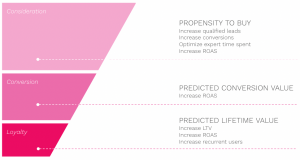
To cover this gap between what the algorithm is able to see and the real objectives and KPIs of your business, Making Science developed Gauss Smart Advertising. This is a proprietary technology that allows you to anticipate the future value of a user and improve signals throughout the entire sales funnel. With Gauss, we can predict a lead’s propensity to buy, the expected purchase value, and even the long-term value of the lead (customer lifetime value). Then, we translate it into signals that provide the algorithm with a more realistic vision of your business. Furthermore, what makes the difference is that we not only create predictive models, but we can activate them in real-time to anticipate and communicate those signals without losing the benefits of the cross-device, nor the freshness that Smart Bidding algorithms require. Additionally, we develop agnostic models that can be activated on any of your marketing platforms.

How it works

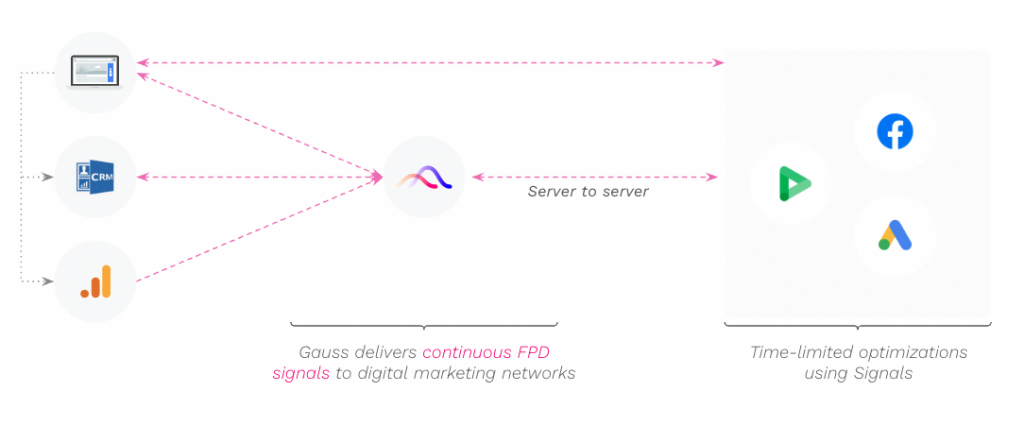
Advertising platforms have the ability to collect web browsing data for campaign optimization. Gauss Smart Advertising collects browsing data, but also from other data sources to issue a more accurate assessment of the user that it then sends as a signal to the platforms.

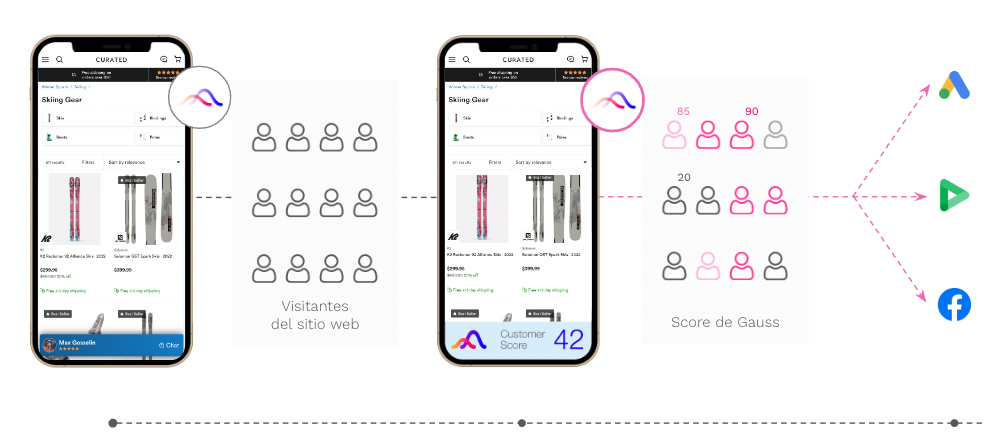
In essence, based on previously trained machine learning models, it predicts and issues a score/value for each of the users that enter the website and communicates it to the platforms in real time:

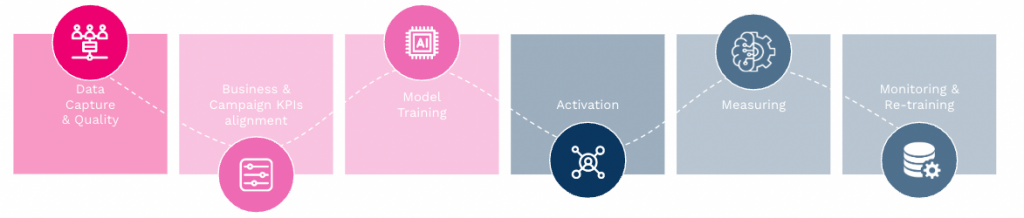
A methodology for automation and activation

Our solution is optimized to cover all the critical phases of its implementation, from the collection and evaluation of the quality of the data that feeds our models to the activation and monitoring of campaigns and models:

With Gauss Smart Advertising we have managed to increase our clients’ conversions by 20% and reduce their CPL/CPA by up to 50%.

Gauss Smart Advertising can be used to

  • Communicate to the algorithms that someone has made a purchase when the lead is more than 7 days old (for example, longer tail conversions like university enrollments, vehicle purchases in the automobile industry, insurance or mortgage purchases in the banking sector, etc.)
  • Adjust conversion values ​​when refunds and cancellations represent an important part of the business and these occur outside the scope of action of the algorithms (example: in the hotel industry where cancellations tend to take place closer to check-in than to reservation)
  • Amplify and provide a greater volume of signals to the algorithms in order to improve their performance in industries or advertising channels (for example, display) where few conversions are collected
  • Adjust the signals captured by the algorithms to the KPIs and business objectives (for example, increase customer lifetime value for e-commerce businesses)

Do you want to know more about Gauss Smart Advertising? Write to us! Our team of experts will be happy to help you.

Get in touch

Trends of a new era: Contextual Cookieless Targeting

Regulatory and technological changes are affecting the ways we reach potential customers. User expectations are evolving. These days, people demand more transparency, choice, and control over the use of their data online. The industry must change, too, to meet these user demands. 

The elimination of cookies has already changed digital marketing in many ways: 

  • Targeting: segmentation is limited due to the rapid decrease in the use of cookies.
  • Measurement and attribution: the current trend of measuring post-click campaigns means there is a significant loss of conversion data which leads to attribution issues for each channel. 
  • Bidding: the algorithms are fed by the data. But, if this data is limited by the absence of cookies, the full potential of the automatic bidding algorithms is not used.

Programmatic Success in a Cookieless World

For these reasons, we need to find ways to continue impacting our users in the same skilled ways of the past. 

The main objective that each marketing manager or paid media marketer should have is to maintain and increase the segments that can be activated after the limitation of cookies, with the following main objectives: 

  • Increase the performance of campaigns with powerful results 
  • Obtain real-time insights
  • Promote and maintain brand awareness and growth
  • Maximize profitability and boost ROI

A few months ago, Making Science formalized a joint venture with the British group that developed 4D technology, a cookie-free solution based on contextual segmentation. This combines programmatic segmentation with Artificial Intelligence along with the most advanced machine learning to offer accurate, actionable, and scalable information and recommendations in real-time.

Technological Features

With 4D, we can obtain at least a 30% increase in sessions compared to campaigns that do not use this technology, to a 58% increase in unique users. These are some of the features that we can implement thanks to technology:  

  1. 4D Tag: implementation of the 4D tag in campaigns to collect data (privacy compliant) to obtain contextual insights and learnings, and activate them later.
  2. Scanning of video and YouTube ads: 4D offers the possibility of scanning creatives in video format, taking into account various elements to obtain insights and topics that can be activated in your programmatic campaigns.

  1. Advanced reporting based on topics to analyze in depth the performance of each of your campaigns and reactivate those insights, improving the response rate of users.

Get ready to enter the world of post-cookie privacy with the most advanced Machine Learning together with the technology to reach customers in the right place and at the right time. It’s the future of digital marketing: it’s contextual targeting redefined.

Do you want to know more about 4D technology and the cookie-free solution based on contextual segmentation? Do not hesitate to contact us so that we can analyze your specific case and offer you the best solution. We look forward to hearing from you!

Get in touch