Predictive SEO: Your Brand in AI’s Answers

For years, SEO professionals treated monthly search volume as the compass that guided every strategy. We picked topics, set priorities, and measured the potential of a keyword almost exclusively by that number.

But by 2025, that approach feels outdated. Google isn’t just showing blue links in the SERPs anymore. It now presents results through features like AI Overviews and AI Mode (already live in some regions), delivering direct, AI-generated summaries instead of a list of links.

Meanwhile, users are shifting their behavior. Increasingly, they’re asking questions directly to ChatGPT, Gemini, Claude, or Perplexity rather than typing into a search bar. In this context, searches aren’t keywords anymore, they’re conversational prompts. And right now, there’s no reliable public data to tell us the “volume” of those queries.

If you’re waiting for your SEO tool to catch up with the trend… you’re already behind.

Why Predictive SEO Matters

Predictive SEO doesn’t sit around waiting for data to confirm a trend. It takes the lead.

  • It spots early signals using tools like Google Trends or AnswerThePublic.
  • It creates content before the metrics are visible, by tapping into Reddit, X, Quora, Feedly, niche forums, or Google News.
  • It’s optimized for conversations, thinking about how a user would phrase a question to a chatbot — or how Google might condense an answer in AI Overviews.

The First-Mover Advantage

In this new world of conversational search, being the first source cited by an AI model is a huge competitive edge.
Once a chatbot or Google references your content in its responses, dislodging it becomes extremely difficult.


How to Adapt Today

  1. Keep an eye on forums and social platforms to spot weak signals early.
  2. Write answers to complex questions that are clear, structured, and genuinely helpful, the way an AI assistant would.
  3. Shift your focus to intent, not exact keywords: create content that solves problems, not just content that ranks.

Conclusion

Predictive SEO is the strategy that ensures your brand shows up in AI-driven answers.

It’s no longer just about hitting Google’s front page. It’s about becoming the trusted source that AI models cite when users ask questions. That’s the real visibility frontier in 2025.

At Making Science, our SEO & Content team has already made this approach to the foundation of how we create and optimize content.

👉 So let me ask you: are you making sure your brand — or your clients’ brands — appears in AI’s answers?

Google Cloud NEXT ’25: Accelerating Software and Application Modernization with AI

At Google Cloud NEXT ’25, we witnessed a significant transformation in how modern applications are built, deployed, and maintained. As a Google Cloud Premier Partner, Making Science was there to see how Google is reimagining the software development lifecycle with AI at its core. This blog post explores the key innovations in software and application modernization that will enable organizations to build and deploy applications faster, more reliably, and with greater intelligence than ever before.

The AI-Powered Application Development Landscape

Google’s vision for application modernization centers around integrating AI throughout the entire software development lifecycle. The company revealed that internally, more than 25% of new code at Google is already generated by AI and reviewed by Google engineers—a testament to AI’s transformative impact on software development.

Gemini Code Assist: The AI-Powered Development Partner

Gemini Code Assist has evolved into a comprehensive solution for developers with several new capabilities:

  • Kanban Board: Developers can now interact with AI agents on a Kanban board, tracking agent assistance across common developer tasks such as code migration, new feature implementation, code review, test generation, model testing, and documentation.
  • Enhanced Partner Integration: Gemini Code Assist now integrates with tools from partners such as Atlassian, Sentry, Snyk, and others, providing a more connected development experience.
  • Android Studio Integration: Gemini Code Assist is now available in Android Studio for professional developers who want AI coding assistance with enterprise security and privacy features.
  • App Prototyping Agent: A new agent in preview for Gemini Code Assist within Firebase Studio can turn app ideas into fully functional prototypes, including UI, backend code, and AI flows.

Application Design and Management Reinvented

Google introduced several new tools to simplify application design and management:

  • Application Design Center (in preview): Provides a visual, canvas-style approach to designing and modifying application templates, allowing developers to configure application templates for deployment, view infrastructure as code in-line, and collaborate with teammates on designs.
  • Cloud Hub (in preview): A central command center for the entire application landscape, providing insights into deployments, health and troubleshooting, resource optimization, maintenance, quotas and reservations, and support cases.
  • App Hub: Now integrated with over 20 Google Cloud products, this service models applications as interconnected services and workloads for an application-centric view.
  • Application Monitoring (in public preview): Supports automatically tagging telemetry (logs, metrics, and traces) with application context, application-aware alerts, and out-of-the-box application dashboards.
  • Cost Explorer (in private preview): Provides visibility into granular application costs and utilization metrics, allowing teams to identify efficiency opportunities.

Gemini Cloud Assist: AI for Infrastructure and Operations

Beyond coding, Google is extending AI assistance to cloud operations with Gemini Cloud Assist:

  • Integration with Application Design Center: Accelerates application infrastructure design and deployment.
  • Investigations: Leverages data in your cloud environment to accelerate troubleshooting and issue resolution.
  • Cross-Service Integration: Now integrated across Google Cloud services including Storage Insights, Cloud Observability, Firebase, Database Center, Flow Analyzer, and FinOps Hub, as well as security and compliance-related services.
  • FinOps Hub 2.0: Now includes waste insights and cost optimization opportunities from Gemini Cloud Assist.

Container and Kubernetes Innovations for AI Workloads

Google Kubernetes Engine (GKE) has been enhanced to better support AI workloads:

  • GKE Inference Gateway: Offers intelligent scaling and load-balancing capabilities, helping handle request scheduling and routing with gen AI model-aware scaling and load-balancing techniques.
  • GKE Inference Quickstart: Allows developers to choose an AI model and desired performance, with GKE automatically configuring the right infrastructure, accelerators, and Kubernetes resources.
  • RayTurbo on GKE: In partnership with Anyscale, Google announced an optimized version of open-source Ray that delivers 4.5x faster data processing and requires 50% fewer nodes for serving.
  • Cluster Director for GKE (formerly Hypercompute Cluster, now GA): Lets developers deploy and manage large clusters of accelerated VMs with compute, storage, and networking — all operating as a single unit.
  • GKE Autopilot Improvements: Including faster pod scheduling, scaling reaction time, and capacity right-sizing.

Firebase: The Full-Stack AI App Development Platform

Firebase has evolved into a comprehensive platform for building AI-powered applications:

  • Firebase Studio (in preview): A cloud-based, agentic development environment powered by Gemini that includes everything developers need to create and publish production-quality full-stack AI apps quickly, all in one place.
  • Genkit: An open-source framework for building AI-powered applications using your preferred language, now with early support for Python and expanded support for Go.
  • Vertex AI in Firebase: Now includes support for the Live API for Gemini models, enabling more conversational interactions in apps, such as allowing customers to ask audio questions and get responses.
  • Firebase Data Connect (now GA): Offering the reliability of Cloud SQL for PostgreSQL with instant GraphQL APIs and type-safe SDKs.
  • Firebase App Hosting (now GA): Providing an opinionated, git-centric hosting solution for modern, full-stack web apps.
  • App Testing Agent (in preview): Prepares mobile apps for production by generating, managing, and executing end-to-end tests.

Real-World Impact: Customer Success Stories

Google’s application modernization innovations are already delivering significant impact across industries:

  • Deutsche Bank: Built DB Lumina, a new Gemini-powered tool that can synthesize financial data and research, turning hundreds of pages into a one-page brief in seconds for traders and wealth managers.
  • Nokia: Built a coding tool to speed up app development with Gemini, enabling developers to create 5G applications faster.
  • Reddit: Using Gemini on Vertex AI to power “Reddit Answers,” its AI-powered conversation platform, and Enterprise Search to improve its homepage experience.
  • Samsung: Integrating Gemini on Google Cloud into Ballie, its newest AI home companion robot, enabling more personalized and intelligent interactions.
  • The Sphere: Created an immersive “Wizard of Oz” experience reconceptualized through AI, bringing the classic film to life on the 160,000-square-foot domed screen at The Sphere in Las Vegas.

Developer Program Enhancements

To support the developer community, Google introduced:

  • Enterprise Tier of the Google Developer Program (in limited preview): Providing a safe and affordable way to explore Google Cloud and its AI products for a set monthly cost of $75/month per seat.

Making Science Perspective

As a Google Cloud Premier Partner, Making Science sees these software and application modernization innovations as game-changing for development teams. The integration of AI throughout the development lifecycle—from ideation and design to coding, testing, deployment, and operations—represents a fundamental shift in how applications are built and maintained.

For technical decision-makers, the most significant takeaways are:

  1. AI-augmented development: Gemini Code Assist is evolving from a coding assistant to a comprehensive development partner, handling increasingly complex aspects of the development lifecycle.
  2. Simplified application management: New tools like Application Design Center and Cloud Hub provide a more visual, intuitive approach to application design and management.
  3. Kubernetes optimized for AI: GKE enhancements make it the platform of choice for deploying AI workloads at scale with optimal performance and cost.
  4. Full-stack AI development: Firebase Studio provides an end-to-end environment for building AI-powered applications quickly.

Organizations that leverage these capabilities can expect:

  • Accelerated development cycles
  • Improved code quality and security
  • More efficient resource utilization
  • Faster deployment of AI-powered applications

The companies that embrace these innovations will be better positioned to respond to market changes, deliver better customer experiences, and maintain a competitive edge in an increasingly AI-driven world.

Looking to modernize your application development practices or build AI-powered applications? Contact our team at Making Science to discover how we can help accelerate your organization’s application modernization journey.

[button open_new_tab=”true” color=”accent-color” hover_text_color_override=”#fff” size=”medium” url=”https://www.makingscience.com/contact/” text=”Contact Us” color_override=”#f0076f”]

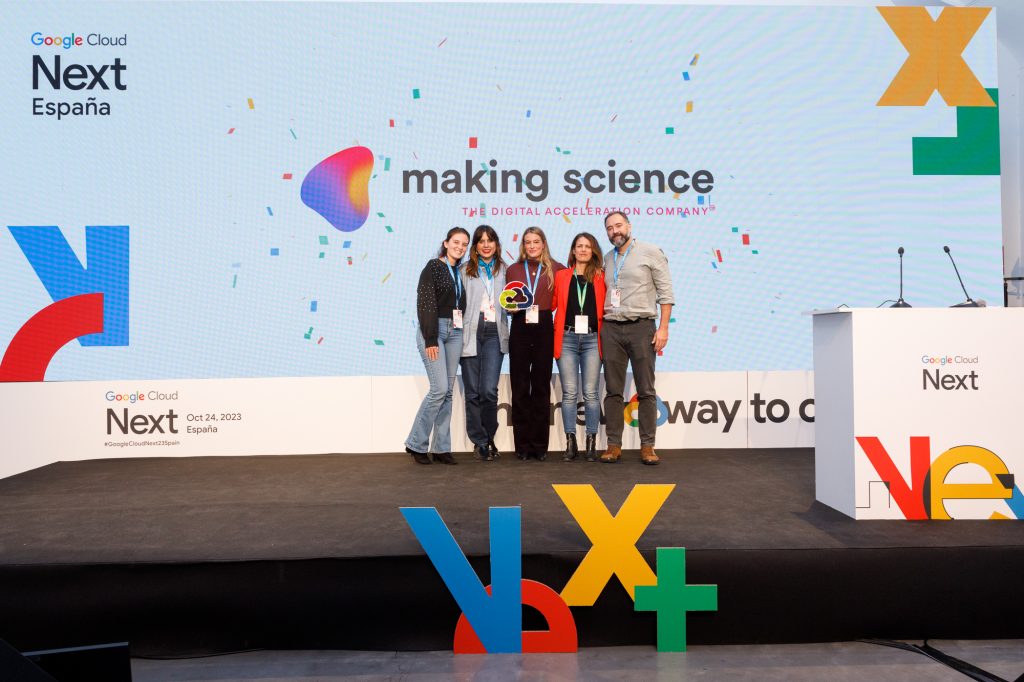
Making Science, a leader in Data Analytics and BI, awarded the “The Data Magicians” prize at Google Cloud Next ’23

On Tuesday, October 24th, Making Science was awarded “The Data Magicians” for leadership in Data Analytics and BI, an accolade from Google Cloud during Google Cloud Next ’23 in Madrid. With this award, we position ourselves as one of the essential partners for the business development of Google Cloud.

Data Analytics and BI have been one of Making Science’s strongest commitments globally within the Cloud ecosystem. Over the past couple of years, we have grown and expanded our expertise to position ourselves as one of the leaders in managing the entire data lifecycle, from ingestion, collection, processing, normalization, and storage to the development of solutions and strategies for activation that allow maximum value to be extracted from them.

For over five years, Making Science has invested in cloud technology (both proprietary and for its clients), and we advise and offer Cloud services and expertise in the countries where we operate and collaborate with Google Cloud. Together, we’ve created innovative strategies designed to drive company growth, with the development of Composable Customer Data Platforms, which combine data from multiple sources and tools to obtain a 360° customer profile in real time.

Receiving recognition like this further underlines our work in Cloud, data, and AI, which is now a fundamental part of our international business, as well as the development of the best Data Analytics and Business Intelligence solutions for our clients on Google Cloud.

Want to start a cloud-based data project? Our team of experts can assist you. Don’t hesitate to write to us. We’re waiting for you!

Get in touch

Google Cloud Next ’23: Unveiling the AI Revolution | Part 2

In our previous blog post, we navigated the announcements from Google Cloud Next ’23, spotlighting Google Cloud AI advancements in infrastructure and the Vertex AI Platform. Today, let’s journey further into the AI domain, examining how artificial intelligence is reshaping Google Workspace, Google Cloud Platform, and cybersecurity. Let’s delve deeper!

Duet AI: Powering Productivity and Collaboration in Workspace and Google Cloud

Duet AI, a dynamic GenAI collaborator introduced at Google I/O in May, is at the heart of Google’s AI revolution. Duet AI seamlessly integrates with a wide range of products and services, promising to enhance productivity, foster collaboration, and uphold the highest standards of security and privacy.

Workspace features have been significantly upgraded, including content creation in Gmail and Google Docs and image generation in Google Slides. As a result of integrating Duet AI with Google Meet, meeting notes and summaries are now available in 18 languages, allowing everyone to be heard, seen, and understood during video calls. Meanwhile, Google Chat takes on the role of a Chatbot, assisting with content-related queries, document summaries, and more, all within a redesigned user interface with enhanced search functionality.

However, Duet AI’s capabilities aren’t confined to Workspace alone. It extends its support across a plethora of Google Cloud products and services:

  • Software Development: Duet AI serves as a coding assistant, expediting development and aiding in code refactoring throughout the software development lifecycle. Thanks to Apigee integration, developers can now build APIs using natural language prompts.
  • Application and Infrastructure Operations: Operators can directly interact with Duet AI within the Google Cloud Console, receiving guidance on infrastructure configurations, deployment best practices, and recommendations for optimizing costs and performance.
  • Data Analytics: BigQuery now boasts enhanced AI features, providing contextual assistance for SQL queries and Python code, code generation, and schema-based recommendations. This empowers data teams to focus on achieving their business objectives.
  • Database Modernization: Duet AI generates code for data management using natural language, covering Cloud Spanner, AlloyDB, Cloud SQL, and Database Migration Service (DMS), streamlining the conversion of database code.
  • Security Operations: In the security realm, Duet AI integrates with a suite of security products, empowering professionals to proactively prevent threats, streamline workflows, and fortify overall organizational protection.

Unifying Data and AI for Limitless Insights

Efficiency and productivity are paramount when unlocking new insights with data at the core of GenAI. Google Cloud is committed to simplifying analytics at scale by expanding its ecosystem of partnerships with various data providers. Key innovations in this domain include:

  • BigQuery Studio: A unified solution for data engineering, analytics, and predictive analysis, seamlessly integrated with Vertex AI foundation models. Implementing AI capabilities into data lakehouses enhances cross-cloud analytics, strengthens governance, and facilitates secure data sharing.
  • AlloyDB AI: Offering a comprehensive set of capabilities for building high-performance GenAI apps, whether on-premises, within the Google Cloud ecosystem, AWS, Azure, or through the versatile Google Distributed Cloud infrastructure.

AI: Your Ultimate Security Guardian

In today’s ever-evolving digital landscape, staying one step ahead of cyber threats is non-negotiable. Google Cloud recognizes this imperative, introducing Mandiant Hunt for Chronicle alongside the groundbreaking Duet AI. This addition provides the latest insights into attacker behavior by seamlessly integrating Mandiant’s frontline expertise with Chronicle Security Operations’ robust data analysis and search capabilities. It’s elite-level support without the burdens of hiring, tooling, or training.

Security is not solely about protection; it’s about equipping yourself with the right tools to respond effectively. Google Cloud’s modern SecOps platform, fortified by GenAI, brings you Chronicle Security Operations and Security Command Center, offering a comprehensive solution to centralize security data, detect threats, and coordinate a unified response.

Join us on this transformative journey as we anticipate even more groundbreaking developments in cloud computing and GenAI. With our strong partnership with Google Cloud, a pioneer in shaping the future of technology, we are thrilled to offer our support across a spectrum of technology expertise, including cloud infrastructure, data analytics, GenAI, Predictive AI, cybersecurity, and much more.

We eagerly await more Google Cloud AI Advancements at Google Cloud Next ’24!

Save the date: April 9-11, 2024 in Las Vegas, NV

Interview with José Antonio Martinez Aguilar: How Generative AI is reshaping the marketing landscape

How do you see generative AI transforming marketing?

Generative AI technology has boomed this year, primarily due to the expansion of Chat GPT and other platforms that enable content creation. The previous AI was predictive AI, which essentially allows you to make predictions based on historical data about the probability of an event happening in the future. This is very positive because it will enable you to understand what will happen in the future. For example, predictive AI predicts whether you like a movie in a product recommender, such as Spotify or Netflix. From an efficiency point of view, it brings a lot of value.

Generative AI creates content. It can create text, audio, and images. If we think about what marketing is: sound, sight, and motion, and what creativity is: communication through text, audio, photos, and videos, we are in an environment where you can create all these kinds of content to help communication. It is a new tool for creating content for creatives, agencies, and companies.

The key benefits of Generative AI are cost savings and variety. It allows the generation of content at a cost that is a fraction of the cost of human content generation, and the combination allows multiple variations of the same content to be generated. We, for example, have published some cases where we generate tens of thousands of product descriptions at a cost of one-thousandth of the cost of production by one person. It will undoubtedly transform marketing from the perspective of diversity and efficiency in content creation.

How does Making Science address the challenges this poses for the sector?

At Making Science, we have two sides: On the one hand, we are an agency, and on the other hand, we are a technology company. From an agency point of view, we are reviewing how to use generative AI in all our processes. We generate campaigns for our clients and are starting to use generative AI in different parts of the value chain of our business process: ad and content generation.

As a technology company, we have developed a platform called Trust Generative AI, which allows us to apply generative AI to the business cases that are most relevant and that allow us to scale globally. For example, it will enable us to generate product descriptions, blogs, web content, and copy generation for ads and images, and we are working on video generation for the near future.

At Making Science, we are taking a very proactive approach. We believe in embracing technology and maximizing it for your business.

What impact, both positive and negative, can its use have?

Every technology has a positive and negative effect depending on how you use it. For example, you can use iron or steel to build a bridge, a machine gun, or a tank. On the positive side, generative AI can generate much more variety of content at a much lower cost. In other words, we must see artificial intelligence as a tool that helps us improve. 

An MIT study analyzes how, in generating content, an internal memo, an article, or a communication, using ChatGPT, it is possible to improve by 20% times and improve the quality of the content by 30%. Therefore, it should be seen as an opportunity for Human Augmentation, which turns us into humans with more capabilities, as has happened in the past.

The downside is that it can generate virtual spaces that can be used for impersonation, generating your voice or false images, and generating fake content and information. As with any new technology, there are positive and negative uses. It’s a question of taking advantage of all the positive benefits and fighting against the negative ones.

Where does generative AI leave marketers in this new era?

Technology has changed marketing over the last 50 years, and marketers have had to adapt. Advertising at the beginning of the century, in the 1920s, was mainly text in newspapers or outdoor billboards. Then came radio, television, the internet, and now digital; we must adapt to every advertising landscape evolution.

In general, technology allows many lower value-added activities to be done in a scalable way, and marketers need to adapt. A similar example is what has happened in media buying through technology platforms such as Google or Meta, where techniques such as automatic bidding or other automation do tasks that only 20 years ago were done by consultants. Marketers, therefore, have to evolve their roles.

Similarly, let’s think about how creatives were made 100 years ago, where an illustrator was the one who drew, and how later video and audio editing tools appeared that allowed to evolve towards professionals with editing capabilities. Likewise, generative AI is an opportunity, and marketers must embrace it and evolve towards a technology that will enable them to do much more varied things at a lower cost.

How should the risks associated with their use be dealt with, and is there a way to avoid them?

You have to be cautious. From an agency or end-client point of view, communication always has communication guidelines defining how the brand expresses itself at text, audio, and image levels. The risk of generative AI is that the content needs a sufficient level of control or compliance and results in content that is not appropriate or does not express the brand identity.

Controls must be implemented to ensure the generated content is valid, relevant, and aligned with brand standards. At Making Science, we have developed our platform, Trust Generative AI, which incorporates algorithms that help users control how close or far their content is from the company’s standards and allows them to incorporate Human-In-The-Loop, which are processes in which there is a person who is validating the final content before publication.

How should brands integrate generative AI into their strategies to get the most out of it?

Fundamentally, from two points, taking advantage of the creativity capacity of platforms such as ChatGPT Dall.e or Google’s Vertex AI, which are platforms that have been trained with hundreds of millions of images, videos, and texts to allow interaction with them, generating a lot of information in the divergent phase of the creative method. For example, when you are brainstorming, that is, in the phase of generating new ideas. 

The second important application is the scalability and personalization of content. Generative AI develops a lot of variations of content, and you have to take advantage of this strength. For example, when you create a website, the text of the descriptions is unique. With generative AI, you can create many variations of content and context with a different tone of voice depending on the business target. It differs from how you would address millennials as you address Generation X, with hyper-personalizing communication.

Generative AI is one of the tech trends of 2023. How do you think it will evolve? Is it here to stay, or will nobody remember it in a few years?

Generative AI is the big hit of 2023, mainly due to the tools such as ChatGPT that have democratized the use of this technology. Previously, everyone used artificial intelligence with Google, Amazon, or Spotify’s product recommender that presented videos, products, or content relevant to the user. Still, it was not visible to them due to the artificial intelligence working in the background. Now, however, with ChatGPT, we are experiencing, in a very personal way, a 1-to-1 with the use of artificial intelligence, and we know that we are talking to a machine.

So, the significant change is that it’s consumed at the mass market level. Everybody understands generative artificial intelligence and its possibilities, and many people are thinking about used cases and opportunities. I think it’s a technology that is here to stay and will have a revolutionary impact on society and all sectors.

To learn more about AI, download our AI e-book or get in touch with our team of experts to begin your AI journey!


[button color=”accent-color” hover_text_color_override=”#fff” size=”large” url=”www.makingscience.co.uk/contact” text=”Get in touch” color_override=”#f0076f”]


Google Next ’23: Unveiling the AI Revolution | Part 1

Google Next ’23, the annual event that brings together tech enthusiasts, industry leaders, and innovators, was a remarkable showcase of Google’s commitment to revolutionizing technology across Google Cloud’s extensive portfolio spanning Infrastructure, Data and AI, Workspace Collaboration, and Cybersecurity solutions.

Given our longstanding relationship as a Google Cloud Premier Partner, the Making Science team attended the event to get a first glance at the main innovations and gain insights that will shape the future of our work and value to our customers. 

At the heart of the event, one theme was the main character approaching the future of technology: Artificial Intelligence. The event unfolded as a dynamic showcase of AI’s transformative power across industries and its pivotal role in shaping the future of technology. 

In this Blog Post, we dive into the different dimensions of AI that took center stage at Google Next ’23.

AI-Optimized Infrastructure

Google Cloud is committed to providing cutting-edge AI-optimized infrastructure that empowers businesses to train and deploy AI models efficiently. This infrastructure is available across Google’s global cloud regions, on customer premises through Google Distributed Cloud, and at the edge. Notably, over 70% of “gen AI unicorns” are Google Cloud customers, emphasizing the platform’s dominance in this transformative field. Key infrastructure advancements announced at the event include:

  • Cloud TPU v5e: This state-of-the-art AI accelerator platform is cost-efficient, versatile, and scalable. It enables customers to perform large-scale AI training and inference on a single platform, offering significant improvements in training and inference performance per dollar compared to its predecessor.
  • A3 VMs with NVIDIA H100 GPU: Powered by NVIDIA’s H100 GPU, these virtual machines offer superior performance, high-speed networking, and advancements to support demanding gen AI and large language model (LLM) applications.
  • GKE Enterprise: Enabling multi-cluster horizontal scaling, GKE Enterprise enhances productivity while reducing software deployment times, catering to mission-critical AI and ML workloads.
  • Cross-Cloud Network: This global networking platform simplifies application connectivity and security across multiple cloud environments, offering reduced network latency and improved accessibility to Google services.
  • Google Distributed Cloud: Designed for organizations running workloads at the edge or in their data centers. Google Distributed Cloud is being enhanced to bring AI capabilities to the edge.

Vertex AI: Building, Deploying, and Scaling ML Models

Vertex AI is Google Cloud’s comprehensive AI platform, empowering customers to build, deploy, and scale machine learning (ML) models effectively. The platform’s usage has grown substantially, with the number of gen AI customer projects surging over 150 times quickly. Main updates on this platform include:

  • Vertex AI Search and Conversation: These tools enable organizations to quickly create Search and Chat applications using their data, with minimal coding and robust enterprise-grade management and security features.
  • New Models and Tooling: Updates to PaLM 2 for processing large documents efficiently, extended support for new languages available in Codey, and increased capabilities for Imagen regarding visual appeal and new tuning methods to create images aligned to specific requirements with a few references.
  • Vertex AI Extensions: Developers can now access, build, and manage extensions that provide real-time information and actions, enabling gen AI applications to interact with enterprise systems and third-party platforms.
  • Digital Watermarking: Leveraging Google DeepMind SynthID technology, digital watermarking is now available for AI-generated images, offering scalability and security in image generation.
  • Colab Enterprise: A service for Data Scientists to accelerate AI workflows, access the whole Vertex AI platform, integrate with BigQuery and benefit from code completion and advanced generation features.

If you’re a cloud or data expert, we encourage you to learn more about these new features and capabilities so you can start using them to build and deploy innovative solutions. 

These are just a few of the many announcements made at Google Cloud Next 2023. Stay in touch for an upcoming post on how AI is shaping Cloud, Data and Security.

Contact us

Making Science reinforces the purpose of its brand and moves toward “digital acceleration”

  • The company commits to digital acceleration by combining its strong capabilities in technological development with its digital strategy acumen.
  • The new tagline on the logo coincides with the final integration of the brands Omniaweb in Italy, Celsius in France, and Nara Media in the UK under the brand “Making Science.”

Making Science, a technology and digital marketing consultancy specializing in e-commerce and digital acceleration, has announced a change to its logo to reinforce the meaning of its brand and make its value proposition more tangible. In this way, the company consolidates its commitment to digital acceleration, combining its strong capabilities in technological development with its digital strategy acumen.

The main reason behind the change has to do with the evolving needs of its customers and the market in general. These days, nearly every company has been transformed into a digital business, so the phrasing is becoming obsolete. With the introduction of the new tagline “The digital acceleration company,” the consultancy illustrates its commitment to optimizing and activating digital channels, with a strong focus on digital strategy and digital business capabilities.

“More and more companies are embracing the processes of the future and taking their businesses a step further. Most organizations already understand the importance of going digital. At Making Science, we want to help them accelerate and optimize their technology efforts,” explains José Antonio Martínez Aguilar, Chairman & CEO of Making Science. Digital transformation is not enough, and companies need to understand the importance of moving faster because the world is accelerating thanks to technology and communications.  Companies that are not able to move faster in their decision making and processes will be left behind.

This change coincides with the definitive integration of the brands Omniaweb in Italy, Celsius in France, and Nara Media in the UK. From now on, these three companies will become part of the “Making Science” umbrella. As the companies unite, the company shows its strength and the ability to operate across the European continent (and beyond).

The consultancy firm acquired the Italian company, Omniaweb, in October 2020 to strengthen its presence in the country, where it had already been present since 2019. At the beginning of 2021, the company entered the United Kingdom with the purchase of Nara Media, a market in which it has always placed great confidence due to its size and global relevance. In France, it purchased Celsius and Loyal to consolidate its position in programmatic and provide services locally to French clients with whom it operates from Spain.

Making Science at Quantum LEAP 2022

This year, Making Science US will be participating in the Quantum LEAP Conference on February 8th and 9th, along with our partner, Quantum Metric. The event is 100% virtual, and also totally free of charge. It’s not too late to sign up!

At the conference, we’ll be discussing Digital Ultra-Optimization, which is how we combine:

  • Personalization in Advertising
  • Leveraging your First-Party Data

Read on to get a quick preview about our keynote session, Ultra-optimized programmatic: The next step for your tech stack.

Personalization in Advertising

In our last blog post of 2020, Why Personalization in Digital Marketing is Key in 2021, we suggested that personalization would be key in 2021. Not only were we correct, the term has evolved to “hyper-” or “ultra-personalization.” But what does ultra-personalization even mean?

At Making Science, we aim for creating a relevant experience (not a creepy one). To give one example, our team at ad-machina can create 1,000s of personalized ads and landing pages in seconds. If a traveler is searching for a kid-friendly hotel that accepts pets, first they will be presented with a Google text Ad with language specific to their search. Once they click on that ad link, they will reach a landing page with information about the kid/pet friendliness of the hotel, alongside imagery related to that search. In addition to landing pages, Ad-machina can also work on the homepage to adapt it to the search made by the traveler, adding another layer of relevance.

Another tool in our tech stack is Gauss Dynamic Creatives. This technology allows you to drive performance at scale and engage your audiences by delivering data-driven ads. These ads display the most appropriate product for the specific interests that each user has shown on your website.

This is how we achieve ultra-personalization.

Leveraging your First-Party Data

2021 was all about “first-party data” – searches for this term climbed measurably in 2021 months compared to the previous 12-month period. 

Europe’s General Data Protection Regulation (GDPR) was created in 2018 to protect the data and online privacy of its citizens. In 2020/2021, California, Colorado, and Virginia have all enacted laws which essentially provide the same protections as GDPR. 

Similar laws have only been proposed in many other states. However, if you have potential customers that live in Europe, or other states with laws currently signed it’s important to start thinking about Data Protection (and your own First-Party Data) yesterday.

You can learn more about other states’ laws and proposals in this NY Times article.

Tune in!

To learn more about how we’re revolutionizing personalization and first-party data, we definitely recommend registering for the event. You can do so here.

If you’re not able to make it, you can still get in touch. Send us an email to info@makingscience.com and we’ll be happy to help. We know the rapidly evolving digital landscape can be a bit intimidating to manage on your own. That’s why we have a team of experts dedicated to managing your digital strategy.

Making Science US’ Travel Predictions for 2022

The last few years have been undoubtedly tough on the travel industry. Review these tips (ensuring safety, prioritizing flexibility, and relevance) to ensure your strategy for the future takes unpredictability into account!

Pent-up demand due to safety concerns

This may seem obvious but we wanted to give it a special mention anyway.

Seasonality is out of whack. But one thing is for sure, there is pent up demand in 2022 that’s all about making up for lost time, seizing the moment and making every day matter. What were high/low/shoulder seasons have now drastically changed, and this situation is still evolving. 

Many destinations are filling up on this high demand and will need to look to other revenue streams/upselling techniques to optimize sales. Yet, it could all come to a grinding halt if travel restrictions get heightened or a new wave of COVID is introduced (looking at you omicron). But generally speaking, more demand means higher rates, greater revenue and hence deeper pockets.

We expect that hospitality brands will stretch budgets to invest in their products and try to differentiate themselves for today’s new demanding traveler, with added bonuses which are accessible by integrated and comprehensive mobile apps. For example: 

  • online vacation planners
  • Itinerary-builders
  • on-property COVID testing facilities, and 
  • smart-room technology – all accessible by integrated and comprehensive mobile apps.

Prioritizing Flexibility

According to booking.com, the travel industry will continue to prioritize flexibility. Travelers rank reassurance that they won’t lose money (38%), the ability to cancel (33%), and ability to reschedule free of charge (34%) as the top three most important priorities. So, websites need to pivot and be geared towards driving bookings and rebooking. 

Though this flexibility does pose a risk for planning purposes, we prefer to bet on sure revenue by guaranteeing a flexible booking (rather than never getting that booking at all!).

Relevance, relevance, relevance

Few things are more important than creating an ultra-personalized, relevant experience for your customers in this highly competitive industry.

But what does ultra-personalization even mean?

The goal is to create a relevant experience (not a creepy one). To give one example, our team at ad-machina can create 1,000s of personalized ads and landing pages in seconds. If a traveler is searching for a kid-friendly hotel that accepts pets, first they will be presented with a Google text Ad with language specific to their search. Once they click on that ad link, they will reach a landing page with information about the kid/pet friendliness of the hotel, alongside imagery related to that search. 

This is how we achieve ultra-personalization (and relevance). You can learn more about it by checking out this video.

How to react?

Take a moment to reflect on how your travel preferences have evolved over the last two years. Surely there are some notable differences. Just remember that if you want to continue to attract travelers to your hotel, cruiseline, or rental car agency you must be flexible, ensure safety, and be relevant.

If you’re not exactly sure how to boost your travel sales in 2022 given all of the unpredictability, get in touch with our team. We’ll be glad to help!

Making Science US at Quantum LEAP Conference

It’s official! ?

Making Science will be participating in the Quantum LEAP Con virtually on February 8-9, 2022. Since the event is 100% virtual, it’s completely FREE to register.

Each year, Quantum Metric holds this conference to “share lessons learned, forecast lasting trends, and hear how to build customer-centric products and processes with Continuous Product Design.” You’ll hear from industry experts and get to “level-up your platform knowledge and see best practices from tenured instructors.”

At the conference, we will be presenting about how we combine technology to bring you Ultra-Optimized Programmatic to create relevant experiences for your consumers. We’ll also be available for questions throughout the event ?

“From c-suite to practitioner, in-person or virtual, LEAP 2022 holds something for everyone.”

This will be Making Science’s first year participating.

Don’t miss out!