Data Exploration Reimagined: GenAI Meets Looker

Let’s face it: data is the lifeblood of modern business and extracting valuable insights from complex data sets has become crucial for organizations to maintain a competitive edge. 

But what good is a wealth of data if you can’t easily unlock its secrets? Traditional BI tools often felt like navigating a labyrinth, requiring technical expertise and time-consuming queries.

What if you could simply converse with your data?

Looker’s Explore Assistant, powered by Generative AI’s remarkable capabilities, makes this a reality by enabling conversational analytics and making data exploration more accessible and intuitive than ever before. With GenAI, interacting with data becomes as natural as having a conversation that instantly and accurately answers your business questions in plain language.

From Dashboards to Dialogue: The Evolving Landscape of Business Intelligence

Business intelligence has undergone a dramatic transformation over the years. We’ve progressed from static reports and cumbersome spreadsheets to interactive dashboards that offer a visual representation of information. However, even with these advancements, a certain level of technical proficiency and a deep understanding of data structures, SQL queries, and data manipulation techniques were still required, often posing a new set of challenges for users.

According to a report by MarketsandMarkets, “The global conversational AI market is expected to grow from USD 13.2 billion in 2024 to USD 49.9 billion by 2030, at a CAGR of 24.9%.” This rapid growth underscores the increasing demand for intuitive, conversational analytics tools that can democratize data access and empower users across all levels of an organization.

Source: MarketsandMarkets’ “Conversational AI Market by Component, Type, Application Area, Business Function, Vertical and Region – Global Forecast to 2028” (Estimated release in Q4 2023)

Looker’s Explore Assistant breaks down barriers, ushering in a new era of conversational analytics. Now, anyone in your organization, regardless of their technical background, can effortlessly ask questions and obtain instant answers from their data – no coding required!

The Benefits of Conversational Analytics

Looker’s Explore Assistant offers a multitude of advantages for businesses seeking to become truly data-driven:

  • Increased Accessibility: Empowers users across all departments and skill levels to interact with data and gain valuable insights.
  • Faster Insights: Eliminates the need for complex data manipulation, providing real-time answers to your business questions.
  • Improved Decision-Making: Enables quicker and more informed decisions based on data-driven insights.
  • Enhanced Data Governance: Fosters a data-driven culture by encouraging exploration and understanding of data.
  • Time Savings: Frees up valuable time for analysts and other team members, allowing them to focus on more strategic tasks.

By leveraging the power of conversational analytics and generative AI, businesses across different industries can uncover actionable insights, make data-driven decisions, and drive meaningful results.

Ready to Experience the Future of BI?

Join us for our exclusive event, “GenAI + BI: Accelerating Time-to-Insight with Looker,” taking place on September 19th, 2024, at Google Madrid. Together with Fabrizio Russo, Cloud BI Specialist at Google Cloud, we will delve deeper into the world of conversational analytics with live demos. Plus, you’ll hear from one of our clients, who will share their experience and success story by applying these innovative tools.

Making Science: Your Partner in Data-Driven Transformation

At Making Science, we’re passionate about helping businesses harness the power of Looker and Generative AI to achieve their goals. Our team of experts has a proven track record of successful implementations across a wide range of industries.

We understand that every business is unique, and we work closely with our clients to develop tailored solutions that address their specific needs

The future of business intelligence is conversational, and Looker’s Explore Assistant is leading the way. Partner with Making Science and embark on a journey of data-driven discovery that will transform your business.

Protecting Customer Privacy: How to Remove PII from Call Center Transcripts

In our previous blog note, we discussed a methodical approach to converting call center audio recordings into text on an industrial scale. This capability is a game changer for companies in many different industries since it allows them to obtain relevant customer data (customer satisfaction, churn reason, etc.) that only a few years ago was inaccessible and used to take a lot of human effort and resources to unlock.

One of the key points to be compliant with current regulations is the importance of removing sensitive information about the users from the datasets used with analytical proposes. This sensitive information is what we call PII (Personal Identifiable Information). If this data is not properly handled or removed from the datasets used to extract users’ insights, it may result in costly lawsuits against businesses. This article will discuss different techniques to remove PII data from audio conversations previously converted to text “dialogs.”

Different techniques to remove PII information

Plenty of tools are available on the market to remove PII information. All these tools perform the same function but with different techniques under the hood, varied results, and varied costs. The core functionality is to take a text input that “contains” sensitive information and return an anonymized text. These tools also allow the user to define which PII attributes should be considered in the scope for anonymization (first names, surnames, phone numbers, emails, IP, etc.). Figure 1 shows a graphical representation of how a PII removal tool should work.

Figure 1: an example of how a PII removal tool works.

Until recently the best practice was to utilize a rules-based system to look for PII attributes, tag/treat those attributes as early as possible in the data ingestion processes that moved data into the Enterprise for processing. All of this is to protect customers’ confidentiality and reduce other types of business risks. 

Before modern machine learning systems, rule-based systems were the standard way to anonymize data. These systems use a set of rules to define if a word belongs to a certain entity type (in this case, these entities can be names, email addresses, phone numbers, etc.) and mask the input text based on these rules. However, this kind of solution implementation has limitations and maintenance costs as new attributes come into the business:

  1. Rigidness: the rule-based systems will catch only the entities’ values that the rules defined by the user comprehend. In other words, they are rigid. Because of that, if a new entity value doesn’t fulfill one of the predefined rules it won’t be caught by the system. For example, if the user tries to catch names by using a rule (a fixed list of names), if an example with a name that isn’t included in the rule’s list, then the system won’t mask that new value as a name.
  2. Contextual limitations: some names can have another meaning (being a noun or an adjective) depending on the context. For example, Rose is cleaning the vase. Depending on the context, a Rose can be a name or a noun (the flower). These kinds of cases take a lot of work to catch for rule-based systems.

As Large Language Models are becoming more widely available and affordable to use, modern AI-based PII systems tackle these problems by taking into account the labels that may accompany the PII attribute and even the context where the PII attribute(s) are embedded. Because of that, their accuracy in finding and mapping these PII entities is much more accurate than the old-fashioned systems.

In this article, we will evaluate two different approaches to finding PII fields: classic entity recognition systems and LLM-based systems. The entity recognition systems look at a word context to define whether that world is a PII field or not. In this case, the tool used was Google DLP (Data Loss Prevention). This tool has an entity recognition model that recognizes up to 150 different types of fields with sensitive information. On the other hand, the LLM-based systems use an LLM and a prompt designed for the PII recognition task and mask the PII values detected in the piece of text given as input. One of the key advantages of this approach is that it allows the user to define custom PII fields to be masked (outside, for example, the 150 default ones available in Google DLP) by simply modifying the prompt used for this task. Customization is the key advantage of this approach.

The benchmark

For this benchmark, we used the pii-masking-200k dataset. This is a public dataset that contains 200,000 pieces of text with PII data labeled. This dataset contains up to 54 different PII categories and the pieces of text are in four different languages (English, French, German, and Italian). It provides a comprehensive source of truth for model comparison since it contains many different PII categories in many languages.

For this particular benchmark, we focused on five PII categories: first name, last name, email address, phone number, and address. This constraint reduced the sample size to 3826 elements. For each estimator and each PII category, we quantified the number of times when that category was correctly and incorrectly found. We considered that a piece of text is incorrectly labeled when the model doesn’t assign the expected label and when the model assigns an incorrect label (i.e.: an estimator masks Mouriño Street as [LAST_NAME] Street).

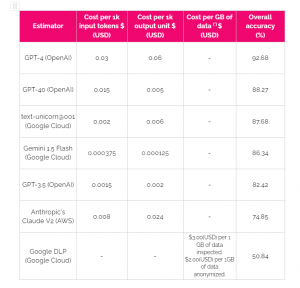
As we mentioned before, we used Google DLP, Data Loss Prevention, to represent the classical entity recognition models. For the LLM-based approach, we tested many different models using the same prompt. These models are GPT 3.5, GPT 4, GPT 4o (OpenAI), Anthropic Claude v2 (AWS), Gemini 1.5 Flash, and text-unicorn@001 (Google Cloud). Since some improvement can be obtained by customizing the prompt for each model, the idea behind this experiment is to separate the poor-performing LLMs from the high-performers. The obtained results are displayed in Table 1. The detailed results by each category can be found in Table 2 to Table 8 (see the appendix).

Table 1 – benchmark results summary. The cost data was updated on 2024-06-26. OpenAI and AWS models’ costs are expressed per 1K tokens whereas for Google models are per 1K characters

The main takeaways from this benchmark are:

  1. The estimator with the best performance is the GPT-4-based system, and the one with the worst performance is Google DLP.
  2. If we take into account the price, the system with the best price-performance trade-off is the Gemini 1.5 Flash-based system. This is because it costs 10 times less than the GPT-4-based one and it has a performance only 6% lower if we consider the overall accuracy.
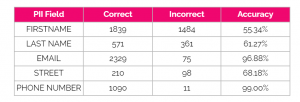
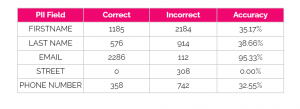
  3. For Google DLP, it’s particularly surprising that it is unable to catch any address value. By doing a deep dive into the examples, we found out that it tends to confuse surnames as addresses (i.e.: Johnson Street is anonymized as [SURNAME] Street).
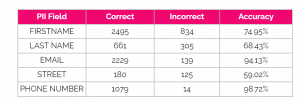
  4. All the systems have a great performance for email address (the model with the worst performance, GPT-3.5, has a 94.13% accuracy for this label) recognition.

Choosing the Right PII Removal Method

In this article, we compared several estimators to find PII attributes in text and to remove them. This is a crucial step in any call center analytics system (and, in general, in any system that works with text data with sensitive information) since it allows the removal of users’ personal information.

We observed an important variability in the performance of the two solution approaches and across the different LLMs.

If we look only at the overall accuracy, the best performer estimator is the GPT-4-based system (OpenAI), and the worst performer is Google DLP (Google Cloud). However, if we include the cost in the equation, the best option by far is the Gemini 1.5 Flash-based system (Google Cloud Platform). This anonymization system has an overall accuracy comparable to the GPT-4-based system but for a fraction of the cost (10 times less).

PII identification, tagging, and treatment performance should not be forgotten about. Cloud and service accounts require that quotas be adjusted according to performance demands for the given use cases and volumetrics being targeted.

For each particular use case, it is important to take into account the specific requirements for it. Because of that, it is important to assess the required accuracy to be compliant with the product requirements, the cost that this accuracy implies, and accepted latency (if the system will be a stream system, then the latency will be an important factor in choosing the best-suited estimator for the use case).

The latest relevant aspect to point out is that there is no perfect model. This idea is crucial for PII remotion use cases because, in some situations, very demanding standards regarding data anonymization must be fulfilled. Because of that, to be fully sure that the system does its trick in the way it should, from Making Science we always recommend keeping the human in the loop. The presence of human validation of the output generated by the LLM-based system will ensure that the solution fulfills the minimum requirements regarding PII entities’ remotion.

Accuracy by label by model appendix

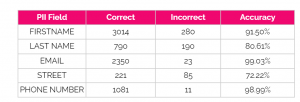
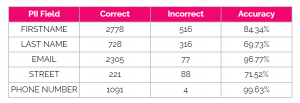
Table 2 – GPT-4 accuracy by PII field

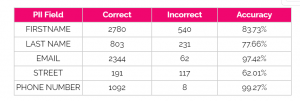
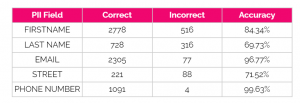
Table 3 – GPT-4o accuracy by PII field

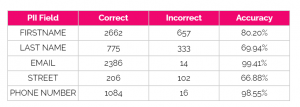
Table 4 – GPT-3.5 accuracy by PII field

Table 5 – Anthropics’s Claude v2 accuracy by PII field

Table 6 – text-unicorn@001 accuracy by PII field

Table 7 – Gemini Flash 1.5 accuracy by PII field

Table 8 – test-unicorn@001 accuracy by PII field

Table 9 – Google DLP accuracy by PII field

Conclusion

This exploration into PII removal from call center transcripts reveals a critical takeaway for businesses: achieving both accuracy and cost-efficiency is possible. While the advanced capabilities of GPT-4 delivered accuracy, the cost factor cannot be ignored. This is where Gemini 1.5 Flash shines, providing top-notch performance at a significantly lower cost, making it a compelling solution for organizations of all sizes.

At Making Science, we understand the importance of balancing powerful AI solutions with robust security measures. We are committed to helping businesses unlock the full potential of their call center data while upholding the highest ethical and security standards. Our team of experts can help you develop and implement a tailored PII removal strategy that leverages the latest technologies, including Gemini 1.5 Flash, while ensuring complete and reliable data anonymization. Contact us to learn how we can tailor a solution to your specific needs.


CDP: Beyond Customer Data, a holistic view of the business

Customer Data Platforms (CDPs) have undergone significant evolution in recent years, expanding their scope and capabilities beyond customer data management. Today, companies are looking for more comprehensive solutions that integrate data from various areas to obtain a holistic view of the business and make more strategic decisions. In this context, the concept of Central Data Platform (CDP) emerges, a centralized platform that unifies data from customers, products, finances, operations, and other areas, allowing for comprehensive information management.

The event “Optimizing CDP with Google Cloud”, held on March 5th at Google’s offices in Madrid, addressed this evolution and the keys to making the most of the capabilities of CDPs in the cloud. Here are the 6 most relevant lessons from the event:

1. Focus on activation:

  • Prioritize obtaining immediate value: It is not necessary to start with a large-scale CDP project. It is advisable to start with an MVP that focuses on data activation, that is, on its use to make decisions and execute actions immediately.
  • Efficiency from the start: With just two relevant data sources, it is already possible to obtain results and value from the CDP. Two data sources, one activation.

2.Flexibility and adaptability:

  • Composable CDP: Starting with the focus on activation, the necessary pieces and data should be gradually incorporated without overloading the platform. Each company has unique needs, so the CDP must be flexible and adaptable to these needs.

3.Long-term vision:

  • Digital transformation strategy: The implementation of a CDP is not a one-time project, but a long-term strategy that requires a clear vision and a sustained commitment from the company.
  • Durable technologies and data: Technologies and data types should be selected that can last over time and adapt to market and business changes.

4. Beyond Customer Data:

  • Expanding the scope: A CDP is not limited to customer data, but can integrate financial, product, personnel, marketing and other information relevant to the company.
  • Advanced personalization: The integration of diverse data allows us to move from general targeting to individualized personalization and, finally, to hyper-personalization using technologies such as Generative AI (GenAI).
  • Unique experiences: The CDP can use this data to create personalized experiences for each customer, increasing satisfaction and loyalty.

5. Benefits for the entire company:

  • Interdepartmental collaboration: Although CDP projects are often led by marketing and sales departments, over time and with the accumulation of data, they can be very useful for other teams such as finance, product, customer service, operations, and more.
  • Internal efficiency: The CDP can boost collaboration between different departments and improve the efficiency of internal processes.

6. Evolution towards the Central Data Platform:

  • Integration and comprehensive management: Companies are looking for more comprehensive solutions that integrate data from various areas into a single centralized platform.
  • Strategic decision making: The Central Data Platform allows for comprehensive information management, facilitating strategic decision making and predictive analysis.

At Making Science, we are convinced that the CDPs and Central Data Platforms are key tools for the digital transformation of companies.

If you want to know more about how we can help you implement a CDP or a centralized Central Data Platform in your company, do not hesitate to contact us.

Save the date:

Our next event in Google Cloud’s Madrid offices will take place on the 24th of April. We will soon share more details about the topic, speakers and surprises that we have prepared.

What is the Best Speech-to-Text foundational model ?

A Benchmark of Models for a Call Center Analytics use case

Call centers are one of the main communication channels between customers and companies. The calls to/from the call center contain a gold-mine of valuable information about the customer and its relationship with the companies. At Making Science we are helping customers leverage this value in the business delivering significant ROI on conversational analytics projects.

Before the advent of the modern speech-to-text models, it was almost impossible to process these calls on an industrial scale, since it was a manual process. A very resource-intensive one.

Modern speech-to-text models allow companies to convert call audio records into text, and analyze them to extract valuable insights. With this technology, transcribing a single call can take as little as 4 seconds. However, in-production systems have many challenges:

  1. PII(personally identifying information) data in call center audios: these calls may contain several pieces of sensitive information (names, addresses, credit card numbers, etc.). If the transcripted calls are stored without PII remotion, this may lead to a potential data leakage.
  2. Audio records caveats: depending on the call center setup, the records may be stored as mono or stereo audio files. In terms of this particular use case, this has a deep impact. If the audio is stored as a mono file, the recording from the call center operator and the recording from the caller are in the same audio channel; they aren’t separated. In this case, besides the speech-to-text model, an additional diarization step must be included to separate the parts of the audio that belong to each speaker.

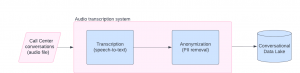
From the previous discussion, it is possible to conclude that an in-production audio transcription system must have two core components: the transcription module itself (the one that converts the audio into text) and an anonymization module (to remove all the sensitive data from the transcripts). The following image shows a high-level architecture for this solution.

Figure 1. High-level architecture for an audio transcription module.

Implementing an end-to-end speech-to-text system for call center records is the first step required to extract value for the transcripts by adding other features on top of it. Some of these features are:

  1. Topic modeling. To know which are the topics discussed in every single conversation.
  2. Sentiment analysis. To know the client’s sentiment regarding the brand and/or about the outcome of the call.
  3. Script monitoring. To validate if the call center operator is following the script and analyze the impact of script variations in the communication output.

From audio to text on an industrial scale – the current landscape

To convert audio to text, there are many different speech-to-text models. At Making Science, we compared several models to see which one performs better. The benchmark dataset we used is the Gridspace-Stanford Harper Valley speech dataset, which contains 1446 call center conversations manually transcribed. These recordings are divided into two audio files, one for the call center operator and the other for the caller. Because of that, no diarization is required.

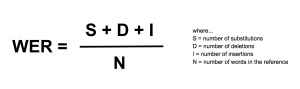
The metric used to evaluate the model’s performance is WER (Word Error Rate). This metric quantifies the mistakes made by the model, taking into account the substitutions, the mistaken insertions, and the deletions done by it. The lower the WER is, the better the model performance is. Since the WER can be greater than one, it isn’t a transcription accuracy percentage. The WER metric is defined as:

Besides how the WER is, there are also other relevant metrics to evaluate which model is the best one for an industrial-scale application. For example, a few relevant dimensions to take into account for this decision are:
  • How much does it cost to translate a minute of audio?
  • The latency if your use case requires rapid translation and analytics; how long does it take for the model to transcribe audio?
  • Parallelism if your use case has a large number of users waiting for “intelligence”; how many API requests per unit of time can the model provider handle?
  • The Privacy; How does the model provider handle our data? Is it possible to deploy a private instance of the model?

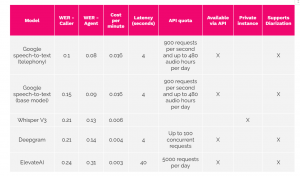
For this benchmark, we considered several models from different providers. Also, we tried models that allow the user to deploy a private instance of it and models that are available via a public API. The results we obtained are available in Table 1.

Table 1: benchmark results for speech-to-text task.

Key takeaways:

  1. Google speech-to-text models are the best-performing models at the time of this benchmark(lower WER) for both agent and caller transcriptions.
  2. In general, the models tend to transcribe better the agent audio than the caller audio. This is an expected behavior because, in general, the audio quality for the agent audio is better.
  3. Whisper V3 has quite good performance, especially for the caller audio. However, the Whisper model doesn’t support diarization. Because of that, to use it in a production environment when audios can be mono audios, a diarization module should be developed (using, for example, pyannote).

Keeping Pace with Speech-to-Text Advancements

In the fast-paced world of speech-to-text technology, it’s crucial to keep pace with innovation. The performance benchmarks we rely on today may shift as advancements continue.

At Making Science, we understand the importance of adaptability and regularly update our approach to ensure we harness the best tools for unlocking customer insights. Stay informed, stay agile, and stay ahead with us as your analytics ally.