

Server Side and Facebook CAPI: Data Governance and Accuracy of Collected Data

Accurate data is essential for precise marketing strategy decisions. Server Side tracking and the Facebook Conversion API (CAPI) offer many advantages that can significantly enhance your marketing performance. Yet, there are nuances between these two methods…

What is Server Side Tracking?

Server Side is a data collection method that sends tracking information from your website’s server to advertising platforms, instead of directly from the user’s browser. This ensures more accurate data collection and sidesteps issues like ad-blockers and browser restrictions.
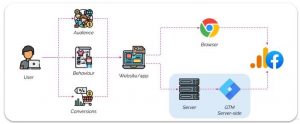
Server side tracking in a nutshell

Benefits of Server Side Tracking

  • Data Accuracy: Up to 30% more accurate data as ad-blockers and ITP/ETP technologies can’t block server-side tracking. When combined with CAPI, you get more comprehensive and reliable data, guiding smarter marketing decisions.
  • Load Time: Improved website load times.
  • Security: Enhanced security via the GTM server within cloud projects.
  • Data Privacy: Strengthened user data protection. Direct data transfer from your server gives you more control over processing and storage.
  • Data Governance: Better data control and management. Data is collected on the Google Cloud platform and distributed from there.
  • Real-Time: Enhanced real-time data activation using the GTM cloud server.
  • Quick Implementation: Utilizes the existing dataLayer, eliminating the need for new code.

What is the Facebook Conversion API (CAPI)?

Facebook’s CAPI is a powerful tool that sends conversion events directly from your server to Facebook. It complements the traditional Facebook pixel, capturing data when the pixel can’t, like mobile app purchases or conversions by users with cookies turned off. CAPI ensures more robust data collection, providing a clearer view of your Facebook ad performance.

When Facebook gets a server event, it checks for a corresponding browser event. If the browser event is blocked (e.g., by ad-blockers), the server event is used instead.

CAPI supports various event types and parameters, giving businesses flexibility in tracking many conversion actions and customizing the data they send to Facebook.
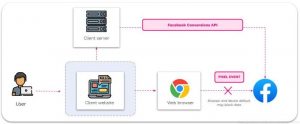
Facebook CAPI in a nutshell

Benefits of FB CAPI

  • Data Control & Measurement: Greater control over data sharing and enhanced performance measurement throughout the customer journey.
  • Full Path Visibility: CAPI sends more detailed information than the pixel, such as CRM data or lower funnel events, targeting ads to those more likely to take desired actions.
  • Stronger Data Flow: CAPI data is less affected by browser loading errors, connectivity issues, and ad blockers.

Ready to harness the power of Server Side and Facebook CAPI?

Our expert team can tailor solutions to your needs. Don’t hesitate to get in touch!
Contact us


Deep Links in GA4

The digital world is constantly evolving, leading to new forms of navigation and mobile app use. Today, users access different sections and specific content of apps and websites through deep links. So, we will tell you what deep links are and how they can be measured in our new favorite analytics tool: GA4.

What are Deep Links?

Deep links are links that allow users to directly access a specific section of an app (or website) instead of landing on the app’s main page. This lets users quickly and easily reach the information they need.

One example might be a link in a web article that directs us to a product within an e-commerce app.

Why are Deep Links Important?

Deep links enhance the user experience by providing direct access to needed content. They can also improve app visibility and rankings in search results, potentially increasing download numbers and traffic.

How Are Deep Links Measured in GA4?

First, set up a custom event for the deep link and then a custom parameter for the deep link URL.

Once the custom events and parameters are set, deep links can be measured through GA4’s event reports. These reports show how many times a deep link has been clicked and provide information about traffic sources and user behavior.

How Can They Be Improved?

Improving deep links involves optimizing them for both users and search engines. This means including relevant keywords in the deep link URL, as well as in the description and title of the page accessed.

Ensure deep links work properly and are not broken. A non-functional deep link can negatively impact user experience and reduce app visibility.

Deep links can be an effective tool in a mobile marketing strategy. They can direct users to particular offers or promotions within an app, which can increase conversion rates and sales. They can also be used in mobile ads to guide users directly to a specific section of an app, enhancing ad effectiveness and user experience.

Our Vision

Deep links are crucial for improving user experience and increasing app visibility and rankings in search results. Implementing deep linking in GA4 involves configuring the landing page, adding deep link parameters, and setting up a custom event.

Learn more by contacting our team today!

Get in touch

Or, check out some related posts:

4 attribution tools to resolve web-app tracking and attribution discrepancies

With the growing use of mobile apps and increased web traffic, attribution and tracking have become crucial factors for businesses.

Here, we explore how to address common web-app tracking and attribution discrepancies in Google Analytics 4 and Firebase using tools like Adjust, Appflyers, Singular, and Branch.

What types of discrepancies are most common?

  • Different attribution models: Google Analytics 4 and Firebase use different default attribution models, which can cause data discrepancies.
  • Incorrect tracking setup: Event and conversion tracking may not be correctly set up on Google Analytics 4 and/or Firebase, leading to data discrepancies.
  • Different user identifiers: Using different user identifiers on the app and web can make it challenging to match data across channels, causing attribution data discrepancies.
  • Varying processing times: Google Analytics 4 and Firebase process data differently and at different speeds, which can lead to discrepancies if compared at different times.
  • Data synchronization issues: If app and web data aren’t properly synced, it can cause attribution data discrepancies.

When should you use Adjust, Appflyers, Singular, and Branch to improve your app and website performance?

These third-party attribution tools help with:

  • Multichannel attribution tracking: They can track and correctly attribute app installs and conversions from various channels, such as Facebook, Google, and Twitter.
  • Precise user identification: They can help address issues related to identifying unique users on mobile apps and websites, allowing for more accurate performance measurement.
  • Custom event and conversion tracking: They provide more flexibility in tracking custom events and conversions, useful for monitoring specific events on websites and mobile apps.

In conclusion, external attribution tools like Adjust, AppFlyer, Singular, and Branch offer greater flexibility and accuracy in conversion and event attribution, as well as advanced analytics and data security features. Depending on a business’s specific needs, incorporating these tools can improve ad campaign effectiveness and data-driven decision-making.

Have you noticed web-app tracking and attribution discrepancies? Our team of experts can help. Don’t hesitate to write to us, we’re waiting for you!

Get in touch


Three GA4 Data Loss Solutions

On July 1, 2023, Universal Analytics will be officially replaced by Google Analytics 4 (GA4) (read more here). This transition will bring significant changes to the platform, including a refreshed interface, a new data model, and the incorporation of machine learning capabilities.

GA4’s ability to merge both observed and modeled (unobserved) data is crucial due to evolving browser cookie policies and GDPR regulations. These changes increasingly restrict traditional tracking and analysis methods, making GA4 data loss solutions essential.

To adapt, analytics tools must address missing data. With three key GA4 data loss solutions— data-driven attribution, predictive metrics, and modeled behavioral data— users can effectively compensate for this loss of information.

Data-Driven Attribution

The Data-driven attribution model employs a statistical approach to assess the significance of a channel’s contribution to a conversion. For instance, GA4’s top acquisition reports might attribute 5,000 purchases to the SEO channel, but prior touchpoints from channels like Paid Search could have influenced the user’s decision to buy.

Hence, the statistical model analyzes user behavior and conversion paths to determine the appropriate weight for various touchpoints. Instead of attributing the entire conversion to the SEO channel, the model assigns percentages to all contributing channels based on their impact on the user’s transaction. 

Predictive Metrics

Currently, this feature is exclusively applicable to e-commerce and revenue metrics, which may include purchase probability, cancellation likelihood, projected income, and the chance of users revisiting the website or app in the near future. GA4 relies on historical user activity for its predictive data, which can be utilized beyond Analytics. By creating audiences and segments to distinguish between potential or improbable buyers, this data can be leveraged in Google Ads for remarketing purposes.

Modeled behavioral data

This feature involves integrating GA4 with a cookie consent management tool, allowing Google Analytics to gather anonymous data from users who have not granted tracking consent. This information is not linked to a cookie or any user identifier.

The behavior of observed users (those who have opted out of tracking) is utilized to train a machine-learning model, which then estimates the behavior of users who have chosen not to be tracked.

By harnessing these three innovative GA4 data loss solutions, you can improve your analytics and optimize campaigns to boost your business KPIs significantly. If you need assistance with Analytics and GA4, our expert team is ready to help. Don’t hesitate to contact us!

Get in touch

Data and AdTech Trends: 2023

As we kick off 2023, there’s no better time to reflect on our digital activity from last year. 

Attribution, activation, and respect for user privacy have been key issues for companies with regard to data. Meanwhile, new tools, technologies, and platforms like CDPs have emerged to help pool data in one place and avoid silos.

2023 is full of many opportunities and trends. Let’s dig into those we’ve identified as being most impactful. 

Data & AdTech Essentials for 2023

Let’s start with some of the less obvious recommendations:

  • Predictive Models: Consumers are offering up less and less of their data these days. Predictive models will help us to have better conversions. For example, through Google Ads’ Value-Based Bidding, we have the opportunity to improve campaign profitability by increasing Customer Lifetime Value.
  • BigQuery: This Google tool offers more enhanced analytics capabilities – all right in the Cloud. Google Cloud now offers the use of BigQuery, a serverless, multi-cloud enterprise data warehouse so you can continue to improve your data-driven strategy. BigQuery integrates Machine Learning for advanced analytics, allows you to share valuable information across your organization, and helps you make business decisions based on data.
  • Server-Side Tagging: We recommend moving measurement and advertising tags from your website to a secure server container. This helps protect your customers by restricting access to their information and increasing conversion rates on your site by reducing page load times. Server-side tagging is now supported in products from Google Ads and Google Marketing Platform, including Campaign Manager 360, Display & Video 360 y Search Ads 360.
  • Marketing Mix Modeling (MMM): Start distributing your budgets based on more advanced models. MMM for example is a statistical modeling technique that identifies the relationship between marketing spending in each channel and the results obtained by it. This allows you to discover what is the optimal investment in each channel to maximize your sales.
  • Connected TV: Otherwise known as the evolution of digital advertising. Connected TV is any television connected to the Internet where users stream video content. This technology provides advertisers with a new means to deliver measurable and personalized advertising. According to a study about Connected TV carried out by IAB Spain in 2022, 82% of Internet users between the ages of 16 and 75 internet streaming services. Connected TV allows for cross-device strategies. It also allows us to identify and impact users with our ads through different devices, thus measuring their effectiveness and how they have influenced the conversion process of said user. Another benefit of Connected TV campaigns is the possibility of being able to segment audiences and control frequencies, which can help lower costs.

And, a few solutions that you’ve surely heard of before:

  • Privacy planning: Having a privacy plan for your company is essential (it has been now for many years). Privacy protection regulations and the demand for greater transparency from users about how companies use their data continue to increase. If we build a privacy-centric strategy, we can continue developing our advertising activity with total normality. At Making Science we opted for the implementation of solutions such as Consent Mode, Enhanced Conversions, GA4, and Facebook CAPI, which allow us to “catch up” in the privacy race. We are also committed to the use and activation of First-Party Data, an option that is increasingly accepted by organizations due to the disappearance of third-party cookies.
  • GA4: All data capture, measurement, and activation technologies are becoming privacy-first. So, it’s a no-brainer to implement them. One excellent technology is Google Analytics 4 (GA4). It is a tool that will be crucial for measuring our results. It offers many new functionalities, with which we will be able to extract greater insights from our data. It will also make our measurement much more reliable.
  • Hyper-personalization and AI projects: Users are demanding better and better experiences that are adapted to their reality and needs. In short, personalization was essential in 2022, but in 2023 we will have to work even harder to continue surprising them. We should look to implement AI based on the activity of our users, so that we can design and develop better products, services, messages, and, ultimately, better ways to reach our audiences.
  • First-Party Data Activation: In a cookieless environment, how can we continue to impact our users in the same way as in the past? Thanks to First-Party Data, we can nurture our campaigns without putting our activity at risk. First-party data is an optimal, reliable, scalable data strategy. This activation and exploitation can be done either by CDPs or any platform that helps to manage data.

These are just some of the trends that will mark 2023 and will undoubtedly influence the digital ecosystem. What will happen in the world of digital marketing and technology this 2023? Find out by following the Making Science blog, where you will find articles on the latest trends, tools, and technologies.

If you want to start a project related to these trends, Making Science can help. We have a team of experts who can help you in your specific case. Get in touch!

Contact us

Increase your sales by up to 20% by activating AI in your digital advertising campaigns

Data collected without a purpose and without proper processing is virtually useless and becomes an expense that quickly escalates. It is not until we enrich it intelligently that we can truly consider it an investment. This helps us uncover the (often surprising) stories it holds.

Considering our data as one of our most critical corporate assets is imperative. Monitoring customer interactions provides a wealth of knowledge to guide our marketing, sales, and product development efforts while monitoring internal processes generates valuable information to optimize operations and improve productivity.

This knowledge value chain is composed of technical and non-technical components. It includes business processes and understanding that a systematic approach allows us to put data-driven predictive models into production through a strategy tailored to each business objective.

Once we have extracted the relevant insights from the predictive models, the next crucial step begins: turning this information into action to generate measurable business impact. 

This requires three key aspects: 

  1. Understanding the business environment we operate, our acquisition, sales, and loyalty processes.
  2. In-depth knowledge of the different profiles and purchase drivers of each customer segment to which we direct our advertising campaigns.
  3. The creation of tools that automate or facilitate decision-making.

At Making Science, we have been innovating in this context for years with ad-machina and Gauss Smart Advertising. These machine-learning solutions optimize your advertising campaigns on digital platforms (Google Ads, DV360, Campaign Manager, and Meta, among others), making the most of First Party Data (from CRMs, call centers, or other available data sources) and managing to improve sales ratios by up to 20%.

Making Science brings you technology geared towards automation and activation.

Interested in learning more about how we can help you do more with less? Get in touch today!

Contact us

Personalize your ads and reduce costs with Gauss Dynamic Creatives

We live in a world where people have become accustomed to receiving hundreds of advertising impacts every day. One of the main problems that users mention is that many of the ads they see are not related to their interests. This generates fatigue and frustration. Relatedly, most advertisers state that it’s difficult to personalize each of their advertising impacts due to the creative cost and the management time involved in generating personalized ads that help them overcome the aforementioned barriers.

Dynamic ads can be an effective solution that allows advertisers to generate more personalized ads and offer customers what they demand, improving brand perception, reducing advertising fatigue, and improving the conversion rates of their campaigns.

How does it work?

Dynamic ads build on previous customer interactions to deliver an ad tailored to one’s needs and interests. Based on these interests, a personalized final piece is composed for each user, generating an authentic user-centric strategy and activating the first-party data that we have about the user. That allows us to fine-tune commercial opportunities, appearing at the right time with the right product.

Building dynamic ads in Meta

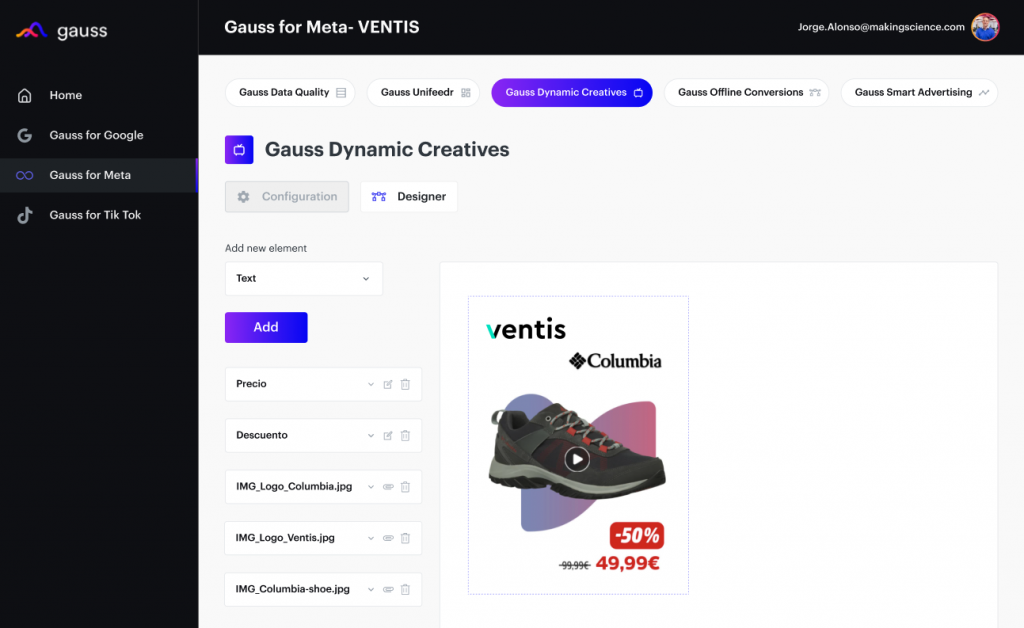
Meta’s advertising tool offers us a native solution for generating dynamic ads thanks to product catalogs that we link to user activity. We use the data collected by pixels on the same platform. However, this tool has a limitation at a creative level, since the final creativity is made up exclusively of the image of the product for which they have shown interest, without the possibility of adding dynamic creative elements such as prices, descriptions, logos, or CTAs.

Go a step further with our solution: Gauss Dynamic Creatives

At Making Science, we offer a solution that allows us to customize all aspects of our final creative dynamically. Adding the specific price of the product visited, a description, a logo, or any dynamic or static element to the final creative to improve its performance, taking into consideration branding boosts that are generated with impressions that do not end in conversion.

You just need to connect your product feed to our platform. From there, you can generate a template defining which elements will be dynamic or static and select the feed column from which we will take the value for the dynamic elements. 

Activating it is as easy as uploading the catalog to your Business Manager and selecting it when creating a campaign, either remarketing with catalog sales or prospecting with dynamic ads for wide audiences. Once that’s done, a dynamic creative is automatically generated for each user based on their behavior.

The main benefits of using dynamic ads are:

  • Higher CTRs
  • Higher conversion rates
  • Improved brand perception
  • Reduced creative costs
  • Improved user experience

Now that you know how dynamic ads work, let us help you get started!

Get in touch

Trends of a new era: Contextual Cookieless Targeting

Regulatory and technological changes are affecting the ways we reach potential customers. User expectations are evolving. These days, people demand more transparency, choice, and control over the use of their data online. The industry must change, too, to meet these user demands. 

The elimination of cookies has already changed digital marketing in many ways: 

  • Targeting: segmentation is limited due to the rapid decrease in the use of cookies.
  • Measurement and attribution: the current trend of measuring post-click campaigns means there is a significant loss of conversion data which leads to attribution issues for each channel. 
  • Bidding: the algorithms are fed by the data. But, if this data is limited by the absence of cookies, the full potential of the automatic bidding algorithms is not used.

Programmatic Success in a Cookieless World

For these reasons, we need to find ways to continue impacting our users in the same skilled ways of the past. 

The main objective that each marketing manager or paid media marketer should have is to maintain and increase the segments that can be activated after the limitation of cookies, with the following main objectives: 

  • Increase the performance of campaigns with powerful results 
  • Obtain real-time insights
  • Promote and maintain brand awareness and growth
  • Maximize profitability and boost ROI

A few months ago, Making Science formalized a joint venture with the British group that developed 4D technology, a cookie-free solution based on contextual segmentation. This combines programmatic segmentation with Artificial Intelligence along with the most advanced machine learning to offer accurate, actionable, and scalable information and recommendations in real-time.

Technological Features

With 4D, we can obtain at least a 30% increase in sessions compared to campaigns that do not use this technology, to a 58% increase in unique users. These are some of the features that we can implement thanks to technology:  

  1. 4D Tag: implementation of the 4D tag in campaigns to collect data (privacy compliant) to obtain contextual insights and learnings, and activate them later.
  2. Scanning of video and YouTube ads: 4D offers the possibility of scanning creatives in video format, taking into account various elements to obtain insights and topics that can be activated in your programmatic campaigns.

  1. Advanced reporting based on topics to analyze in depth the performance of each of your campaigns and reactivate those insights, improving the response rate of users.

Get ready to enter the world of post-cookie privacy with the most advanced Machine Learning together with the technology to reach customers in the right place and at the right time. It’s the future of digital marketing: it’s contextual targeting redefined.

Do you want to know more about 4D technology and the cookie-free solution based on contextual segmentation? Do not hesitate to contact us so that we can analyze your specific case and offer you the best solution. We look forward to hearing from you!

Get in touch

Boost Campaigns with CAPI: Unlock High-Value Audiences via Offline Conversion Data

Are you wasting your data?

We live in a time of major change in the world of advertising due to the imminent disappearance of third-party cookies, as announced by Google almost two years ago. This new context is characterized by a shift in the strategy of how we use data. Before, using third-party data was pervasive, and practically a given. Now, strategies must revolve around first-party data and have a customer-centric orientation. Today, our capacity for data collection and activation determines our competitiveness as advertisers.

Using this first-party data to feed our campaigns and audience generation is essential if you want to succeed on advertising platforms like META, where AI is key in optimizing your results. It’s more important than ever to understand and integrate your offline conversion data because that’s where the most valuable information is actually generated. 

The current challenge: Moving from a third-party to a first-party data strategy

One of the main challenges marketers face is being able to measure all the steps of our funnel, both those that occur in our online environment and those that occur offline. Another optimization cornerstone is to correctly attribute conversions and understand the journeys users take to convert. 

The trend is clear: every day, there are fewer third-party options in the market. Facebook is no exception, with its latest updates. Many of its former segmentation options have been limited to give greater weight to the automatic optimization of the AI itself in addition to the activation of customer data (first-party data).

Take the plunge: Implement a secure Server-to-Server connection across your funnel

In the race to be a profitable and successful advertiser, you must include offline business data in your calculations. By using Meta’s Conversions API, you can upload your offline data and thus monitor campaigns through actual conversions. In this way, we can generate high-value audiences based on users who complete the process and reach the desired conversion phase of our funnel.

The difficulty here is the need to update this data in real-time so that Facebook’s AI can learn from this information throughout our campaigns. Manual upload can be an operational challenge for most businesses that have to pull data from different sources and sort it for activation. For this reason, Facebook’s API can generate a direct connection with the different data sources such as your CRM, so that the information about your offline conversions is automatically updated with the Meta platform. In this way, Meta is optimized with the information of your actual clients and will allow you to:

  • Optimize lower funnel events.
  • Create audiences of real conversions that we can use to generate lookalike audiences
  • Create audiences with high lifetime value to activate cross- and up-selling campaigns
  • Improve the attribution capacity of our campaigns on Social

At Making Science, we offer multiple solutions for integrating your offline data into your digital marketing strategy. Discover our proprietary technology, Gauss Offline Conversions, or our direct Server-to-Server integration with CAPI. Write us at info@makingscience.com to learn more

Google sets July 2023 as the end date for Universal Analytics

Recently, Google announced in their that Universal Analytics will stop working as of July 2023, as it will be replaced by Google Analytics 4 (GA4). This new version was designed to adapt to a digital ecosystem that is more respectful of user privacy – cross-platform and cross-device.

In a recent post on the company blog, Russell Ketchum, director of product management for Google Analytics, explained:

“Universal Analytics was designed for a generation of online measurement anchored in desktop websites, separate sessions, and data tracking via cookies. But this form of measurement has become obsolete. Google Analytics 4 operates across platforms, does not rely exclusively on cookies, and uses event-based data models for user-centric measurement.”

Here are the main changes and advantages provided by GA4 compared to the current Universal Analytics:

  • New privacy controls to minimize data collection at the user level.
  • More integrations and metrics.
  • A complete view of the customer lifecycle, with an event-based measurement model that is not divided by platform.
  • Use of machine learning to generate predictive insights on user behavior and conversions. Audiences can be created of users who are likely to buy or abandon.
  • Default data-driven attribution model and the option to obtain predictive insights on user behavior and conversions.
  • GA4 will no longer store user IP addresses; instead, it will switch to using anonymized IP addresses.

It’s time (as it has been for a few months!) to configure Google Analytics 4 as soon as possible. In this way, you can generate the necessary historical data before Universal Analytics stops processing new hits.

Don’t get left behind! If you still haven’t migrated to Google Analytics 4, our team of experts can help. Get in touch with us at info@makingscience.com or by visiting makingscience.com/contact. We’ll be waiting to hear from you! ?