ChatGPT for SEO experts

There has recently been a growing interest in AI technology and, more specifically, OpenAI’s ChatGPT product. In this week’s blog post we will learn what ChatGPT is and how to use it in SEO.

What is ChatGPT?

ChatGPT is a language model developed by OpenAI, a leading research organization in the field of artificial intelligence. It is a type of AI technology that uses deep learning algorithms to generate human-like text based on a large corpus of training data.

ChatGPT has been trained on a massive amount of diverse text data, making it capable of generating text in various styles and on a wide range of topics. This makes it a versatile tool that can be used for different applications, such as language translation, text summarization, question answering, and content generation. It has become a popular instrument for building conversational AI systems, such as chatbots, as it can generate coherent and contextually appropriate responses to different questions. Overall, ChatGPT is a powerful and sophisticated AI technology that has the potential to revolutionize the way we interact with computers and automate many language-related tasks.

Is ChatGPT good for SEO?

ChatGPT has the potential to be a useful tool for SEO (Search Engine Optimization), but it is not a silver bullet and has some limitations. ChatGPT can be used to generate optimized content for websites, such as product descriptions or blog articles. It can also assist with keyword research by generating suggestions for relevant keywords and phrases.

However, it is essential to remember that the generated content may not always be accurate or high-quality. It may lack the creativity and originality that is often necessary for effective SEO. Additionally, there may be ethical considerations to using AI to manipulate search engines, such as the impact on content creators and the overall quality of online content. It is also worth noting that search engines are constantly updating their algorithms to detect better and penalize manipulation, and they may be able to detect content generated by AI.

In conclusion, while ChatGPT has the potential to be a useful tool for SEO, it is not a guaranteed solution and should be used with caution and in conjunction with other SEO best practices.

How are SEO experts using ChatGPT?

SEO experts are using ChatGPT in various ways to improve their search engine optimization efforts. Some typical applications of ChatGPT in SEO include:

  • Content Generation: ChatGPT can be used to generate high-quality, optimized content for websites, such as product descriptions, blog articles, and meta descriptions. The generated content is designed to be SEO-friendly, with a focus on incorporating relevant keywords and phrases.
  • Keyword Research: ChatGPT can assist with keyword research by generating suggestions for relevant keywords and phrases. This can help SEO experts identify keywords they may not have considered and improve their content’s visibility in search results.
  • Competitor Analysis: ChatGPT can be used to analyze competitor websites, identifying their strengths and weaknesses, and helping SEO experts to stay ahead of the competition.
  • Chatbots: ChatGPT can be used to build chatbots for websites, which can help to improve the user experience and increase engagement. Chatbots can answer customer questions and provide information, reducing the workload for human customer service representatives.

It’s worth noting that ChatGPT is just one tool in an SEO expert’s arsenal and should be used in conjunction with other best practices and techniques. Additionally, as search engines continually update their algorithms, it’s important to stay up-to-date on the latest SEO trends.

 What are the drawbacks of Chat GPT and potential ethical considerations?

 There are several limitations to using ChatGPT for SEO:

  • Accuracy: While ChatGPT is a very advanced language model, it is not perfect and may generate incorrect or unreliable information. This can be a concern when using it for SEO, as the accuracy of the information used to optimize websites and content is critical.
  • Scalability: Depending on the model’s size, using ChatGPT for SEO on a large scale may require significant computational resources and be expensive.
  • Lack of creativity: Although ChatGPT can generate human-like text, it may lack the creativity and originality that is often necessary for effective SEO.

In terms of ethical considerations, it is important to consider the potential consequences of using AI to generate optimized content and manipulate search engines. Some may argue that this practice undermines the integrity of search engines and could lead to the dissemination of inaccurate or misleading information. Additionally, there may be concerns about the impact on content creators and the overall quality of online content.

It is essential to carefully weigh the potential benefits and risks of using ChatGPT for SEO and ensure that it is used responsibly and ethically.

How to think about ChatGPT as an SEO expert

As an SEO expert, it is crucial to approach ChatGPT as just one tool among many in your arsenal, and to use it thoughtfully and strategically.

Here are some key considerations when thinking about using ChatGPT for SEO:

  • Quality over Quantity: While ChatGPT can generate a large amount of content quickly, the quality of that content may not always be up to the standards you require. It is important to prioritize quality over quantity and carefully review the content generated by ChatGPT to ensure it meets your standards and is SEO-friendly.
  • Context Matters: ChatGPT has been trained on a large corpus of text data, but it may not always understand the nuances and context of specific topics. It is essential to be mindful of this and to provide clear, detailed instructions when using ChatGPT for content generation or keyword research.
  • Ethical Considerations: There may be ethical considerations to using AI to manipulate search engines, such as the impact on content creators and the overall quality of online content. It is important to be mindful of these considerations and to ensure that your use of ChatGPT aligns with your ethical standards and values.
  • Algorithm Updates: Search engines are constantly updating their algorithms to detect better and penalize manipulation, and they may be able to detect content generated by AI. It is vital to stay up-to-date on the latest developments and trends in SEO, and to continually evaluate your use of ChatGPT in light of these changes.
  • Integrating with Other Tools and Techniques: While ChatGPT can be a valuable tool for SEO, it should be used in conjunction with other best practices and techniques. This may include conducting keyword research, analyzing competitor websites, and building high-quality backlinks, among other things.

In conclusion, as an SEO expert, it is important to approach ChatGPT with a strategic and thoughtful mindset, and to use it as just one tool among many in your toolkit. Get in touch with our SEO experts to utilise AI effectively in your SEO campaign. 

PS: This article was written exclusively with the help of ChatGPT. A human reviewer corrected discrepancies and structured the content.
From volume to value: Improve your campaigns with Gauss Smart Advertising

Align your advertising investment with your business strategy

The automatic bidding strategies offered by the different advertising platforms have become one of our best allies when it comes to campaign optimization. Specifically, those known as Value Based Bidding allow us to align our advertising investment with our business objectives in an automated way.

If you are using Value Based Bidding, simply configure your pixels so that they collect the conversions that you want to optimize. Then, indicate the objectives you want to achieve through your campaigns (whether it is maximizing the value of the conversions or optimizing the return on our investment). From there, algorithms take care of learning everything necessary to find and bid for users to achieve your goals.

The main issues with Value Based Bidding

Conversions, in this case, act as signals that tell the algorithm whether or not users are valuable for our campaign. But, sometimes you may not have enough conversion volume for VBB to work. And sometimes, web conversions do not fully reflect the reality of our business.

Furthermore, it is estimated that the Google and Meta algorithms only consider signals for the first 7 days since the user entered through a paid campaign. For user acquisition data, the most recent signals are the ones that the algorithms give the most importance to. What happens when a lead’s final conversion takes place beyond that 7-day window?

How Gauss Smart Advertising can help you

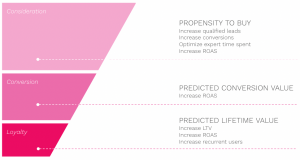
To cover this gap between what the algorithm is able to see and the real objectives and KPIs of your business, Making Science developed Gauss Smart Advertising. This is a proprietary technology that allows you to anticipate the future value of a user and improve signals throughout the entire sales funnel. With Gauss, we can predict a lead’s propensity to buy, the expected purchase value, and even the long-term value of the lead (customer lifetime value). Then, we translate it into signals that provide the algorithm with a more realistic vision of your business. Furthermore, what makes the difference is that we not only create predictive models, but we can activate them in real-time to anticipate and communicate those signals without losing the benefits of the cross-device, nor the freshness that Smart Bidding algorithms require. Additionally, we develop agnostic models that can be activated on any of your marketing platforms.

How it works

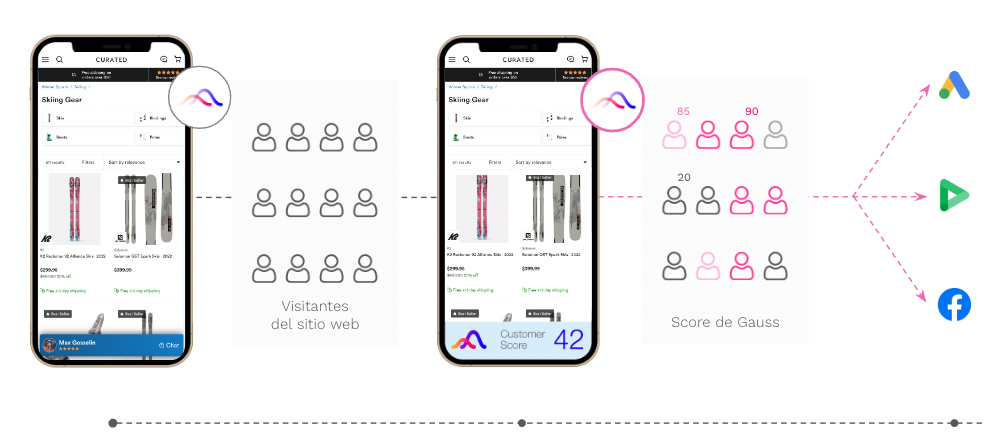
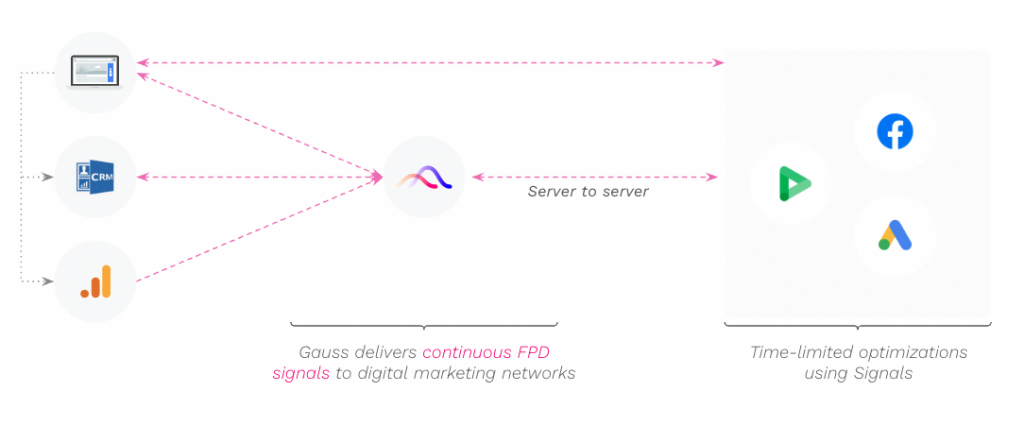
Advertising platforms have the ability to collect web browsing data for campaign optimization. Gauss Smart Advertising collects browsing data, but also from other data sources to issue a more accurate assessment of the user that it then sends as a signal to the platforms.

In essence, based on previously trained machine learning models, it predicts and issues a score/value for each of the users that enter the website and communicates it to the platforms in real time:

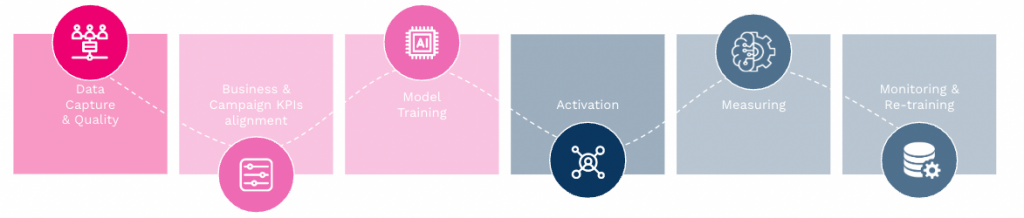
A methodology for automation and activation

Our solution is optimized to cover all the critical phases of its implementation, from the collection and evaluation of the quality of the data that feeds our models to the activation and monitoring of campaigns and models:

With Gauss Smart Advertising we have managed to increase our clients’ conversions by 20% and reduce their CPL/CPA by up to 50%.

Gauss Smart Advertising can be used to

  • Communicate to the algorithms that someone has made a purchase when the lead is more than 7 days old (for example, longer tail conversions like university enrollments, vehicle purchases in the automobile industry, insurance or mortgage purchases in the banking sector, etc.)
  • Adjust conversion values ​​when refunds and cancellations represent an important part of the business and these occur outside the scope of action of the algorithms (example: in the hotel industry where cancellations tend to take place closer to check-in than to reservation)
  • Amplify and provide a greater volume of signals to the algorithms in order to improve their performance in industries or advertising channels (for example, display) where few conversions are collected
  • Adjust the signals captured by the algorithms to the KPIs and business objectives (for example, increase customer lifetime value for e-commerce businesses)

Do you want to know more about Gauss Smart Advertising? Write to us! Our team of experts will be happy to help you.

Get in touch

Increase your sales by up to 20% by activating AI in your digital advertising campaigns

Data collected without a purpose and without proper processing is virtually useless and becomes an expense that quickly escalates. It is not until we enrich it intelligently that we can truly consider it an investment. This helps us uncover the (often surprising) stories it holds.

Considering our data as one of our most critical corporate assets is imperative. Monitoring customer interactions provides a wealth of knowledge to guide our marketing, sales, and product development efforts while monitoring internal processes generates valuable information to optimize operations and improve productivity.

This knowledge value chain is composed of technical and non-technical components. It includes business processes and understanding that a systematic approach allows us to put data-driven predictive models into production through a strategy tailored to each business objective.

Once we have extracted the relevant insights from the predictive models, the next crucial step begins: turning this information into action to generate measurable business impact. 

This requires three key aspects: 

  1. Understanding the business environment we operate, our acquisition, sales, and loyalty processes.
  2. In-depth knowledge of the different profiles and purchase drivers of each customer segment to which we direct our advertising campaigns.
  3. The creation of tools that automate or facilitate decision-making.

At Making Science, we have been innovating in this context for years with ad-machina and Gauss Smart Advertising. These machine-learning solutions optimize your advertising campaigns on digital platforms (Google Ads, DV360, Campaign Manager, and Meta, among others), making the most of First Party Data (from CRMs, call centers, or other available data sources) and managing to improve sales ratios by up to 20%.

Making Science brings you technology geared towards automation and activation.

Interested in learning more about how we can help you do more with less? Get in touch today!

Contact us

Maximize your sales with Marketing Mix Modeling

What is Marketing Mix Modeling?

According to the paper “Challenges and Opportunities in Media Mix Modeling” by Chan, D., & Perry, M. (2017),

Marketing Mix Modeling (MMM) refers to statistical models used by advertisers to measure the effectiveness of their advertising investments and have existed in various forms since the 1960s. MMMs, as we will call them from now on, use aggregated historical time series data to model sales outcomes based on advertising variables, other marketing variables, and control variables such as weather, seasonality, and market competition.

Metrics like the return on ad spend (ROAS) and optimized advertising budget allocations are derived from these models, relying on the assumption that they provide valid causal results.

In other words, MMMs attempt to answer causal questions for advertisers. For example:

  • What was my ROAS on television last year?
  • What would my sales be if more or less money were spent next year?
  • How should my media budgets be allocated to maximize sales?

What does Marketing Mix Modeling bring to our business?

With MMM, we will achieve two different things:

  1. Attribution: We will obtain an analysis of all variables that influence the client’s business results, and we will know which are the most relevant to enhance them. The advantage over user-level models is that this model doesn’t only talk about digital data, but by using aggregated data, it can incorporate offline investment data, types of offers, seasonality, and more.
  2. Predictions: We will be able to discover the most relevant variables in the analyzed period; an MMM will indicate how to enhance each variable and predict how the results will change in each proposed scenario.

We can only carry out high-value activations for decision-making, and for this, an analyst will be needed to interpret the data. However, since aggregated data is used, users are not identified, so an MMM cannot be used to activate audiences or optimize campaign algorithms.

Choosing the best model for our business

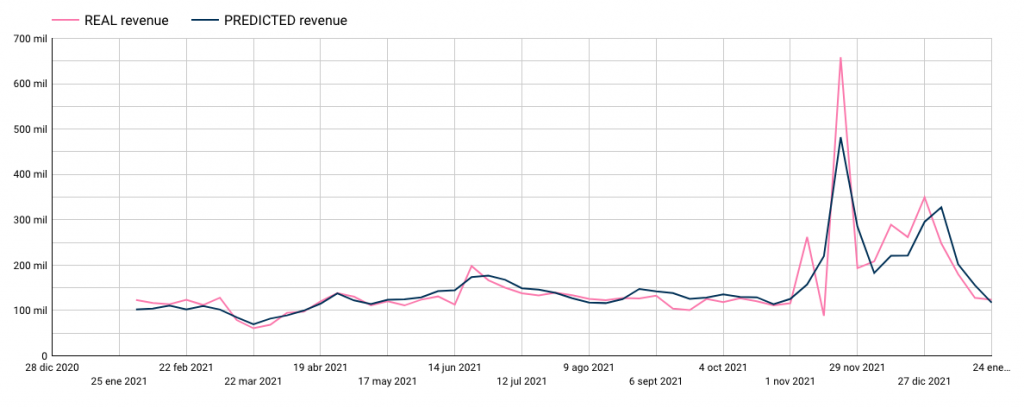
In an MMM project, we will work on and create different types of models, and the initial goal will be to choose the one that best suits our business:

Below, we can see the client’s actual sales history (pink line) and how this model has predicted that period (blue line).

In the end, we will choose the model that best fits the client’s sales trend and peaks.

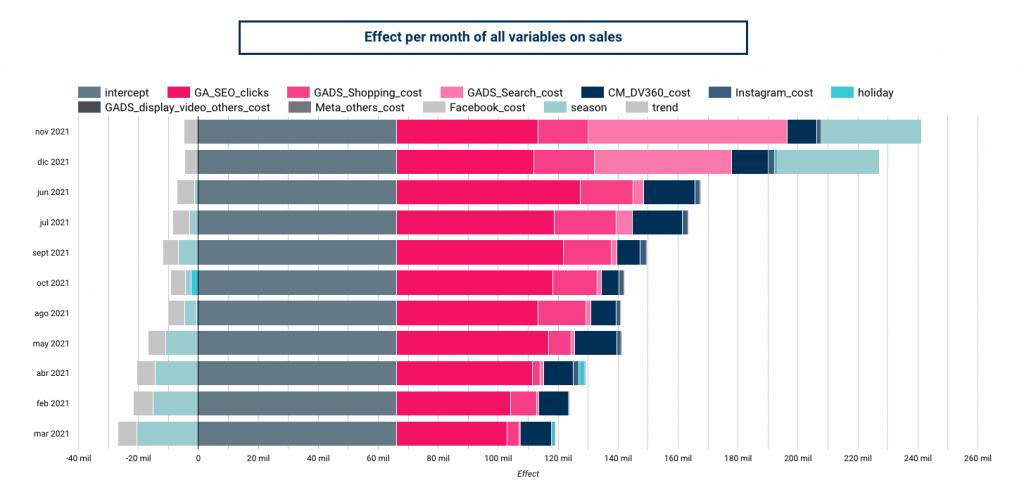
What insights can we extract from our MMM?

horizontal bar graph which demonstrates effect per month of all variables on sales to show how much each making channel contributes to sales

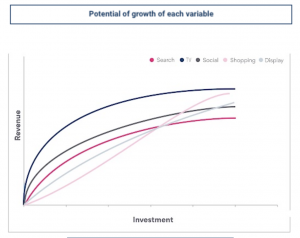
  • Prediction of potential sales increase:  This graph shows all campaigns or actions included in the model. The dots represent the investment and actual sales of that campaign, and thanks to the trend lines, we can see the sales potential of each campaign as we increase the investment.

  • ROI of campaigns and variables: In the graph, we can see in dark blue the percentage weight of total sales that a campaign or action has had (calculated by the model). In light blue, we can see the weight that action has had on the total investment (data we give to the model). Lastly, the orange dots show us the ROI of each action, identifying which are the most profitable for our business.

Do you want to know more about what Marketing Mix Modeling can bring to your business? Don’t hesitate to contact our team of experts. We are waiting for you! 🚀

Get in touch

Personalize your ads and reduce costs with Gauss Dynamic Creatives

We live in a world where people have become accustomed to receiving hundreds of advertising impacts every day. One of the main problems that users mention is that many of the ads they see are not related to their interests. This generates fatigue and frustration. Relatedly, most advertisers state that it’s difficult to personalize each of their advertising impacts due to the creative cost and the management time involved in generating personalized ads that help them overcome the aforementioned barriers.

Dynamic ads can be an effective solution that allows advertisers to generate more personalized ads and offer customers what they demand, improving brand perception, reducing advertising fatigue, and improving the conversion rates of their campaigns.

How does it work?

Dynamic ads build on previous customer interactions to deliver an ad tailored to one’s needs and interests. Based on these interests, a personalized final piece is composed for each user, generating an authentic user-centric strategy and activating the first-party data that we have about the user. That allows us to fine-tune commercial opportunities, appearing at the right time with the right product.

Building dynamic ads in Meta

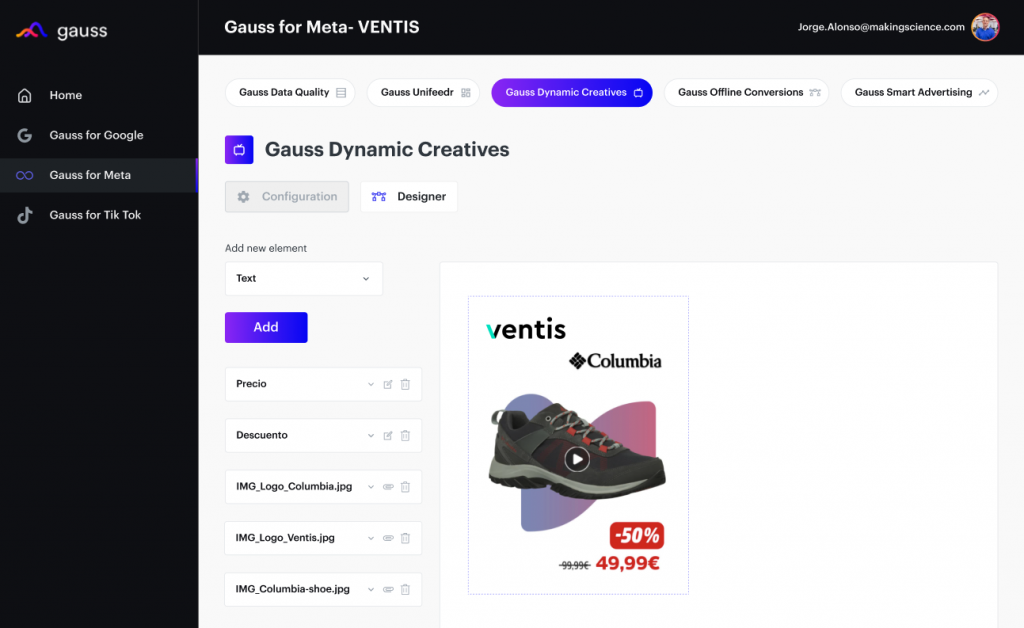
Meta’s advertising tool offers us a native solution for generating dynamic ads thanks to product catalogs that we link to user activity. We use the data collected by pixels on the same platform. However, this tool has a limitation at a creative level, since the final creativity is made up exclusively of the image of the product for which they have shown interest, without the possibility of adding dynamic creative elements such as prices, descriptions, logos, or CTAs.

Go a step further with our solution: Gauss Dynamic Creatives

At Making Science, we offer a solution that allows us to customize all aspects of our final creative dynamically. Adding the specific price of the product visited, a description, a logo, or any dynamic or static element to the final creative to improve its performance, taking into consideration branding boosts that are generated with impressions that do not end in conversion.

You just need to connect your product feed to our platform. From there, you can generate a template defining which elements will be dynamic or static and select the feed column from which we will take the value for the dynamic elements. 

Activating it is as easy as uploading the catalog to your Business Manager and selecting it when creating a campaign, either remarketing with catalog sales or prospecting with dynamic ads for wide audiences. Once that’s done, a dynamic creative is automatically generated for each user based on their behavior.

The main benefits of using dynamic ads are:

  • Higher CTRs
  • Higher conversion rates
  • Improved brand perception
  • Reduced creative costs
  • Improved user experience

Now that you know how dynamic ads work, let us help you get started!

Get in touch

Trends that are (already) revolutionizing interaction with mobile devices

Due to the current, constant technological evolution, there are significant challenges for user experience and user interface designers in the immediate future. There is a clear tendency to simplify traditional graphical interfaces more and more. With this commitment to a simple design, there has come a point where we cannot simplify things any further. 

On the other hand, with today’s fast pace of life, there is a tendency to make interaction with devices more organic, without the need to take your phone out of your pocket. 

Although some of these technologies have already been around for some time, today I will tell you about the trends in mobile interaction that will explode in the coming years. 

Voice interaction 

It is the most widely known and applied and is currently the primary trend because it allows users to interact while performing other tasks, thus improving productivity. Voice interaction will enable us to search and obtain information, make notes, and even play audiovisual content through interfaces such as Siri, Cortana, and Alexa. However, there are still many options to explore! 

Most smartphones and new generation devices include the technology necessary for their use. It becomes a unique challenge for UX designers because it is essential to design a user-friendly, intuitive, and practical experience that is not based on “classic” visual and touch interfaces. 

The adoption rate of this technology is expected to reach 80% of users in the next five years. 

Gesture recognition 

Anyone who watches futuristic action or science fiction films can find characters interacting through gestures with holographic devices, operating interfaces, and interactive futuristic devices. Perhaps it’s not as eye-catching yet, but this technology is already on its way. 

Gesture recognition technology can achieve much more natural interactions than classic text and touchscreen interaction. It can be very intuitive, with reduced hardware requirements (one integrated video camera) and fully customizable to associate actions or tasks with static and dynamic gestures. 

Gaze recognition 

This technology is also based on recognizing movements, in this case, and opens the door to interfaces outside a conventional screen, moving into virtual reality (VR) or augmented reality (AR). 

Although this change will not happen rapidly (the transition will be more gradual), interface designers need to be familiar with new 3D imaging techniques to increasingly drive the evolution toward augmented and virtual reality. It shares excellent advantages with voice interaction, as it is also customizable, user-friendly, convenient in situations where hands are busy, and highly useful for users with specific disabilities. 

This technology will be available “on the street” in the medium term. However, these interactions require additional hardware, such as head-mounted devices like Oculus and HoloLens, glasses, or even contact lenses. “Smart” lenses, such as Mojo Vision lenses, can recognize all eye movements required for interaction, using movement patterns pre-set customizations. Still, they may face limitations for the time being. 

Wearables 

These devices, whose implementation is advancing by leaps and bounds, offer an increasing variety of types of interaction without the need to take your phone out of your pocket. In the coming years, these devices will become cheaper, more functional, and more independent of the smartphone so that they will multiply. 

According to reports from Statista, between 2019 and 2022, the number of these devices is expected to triple to one billion. These devices will base their interaction on all the technologies we have just discussed. 

The trends focused on interaction with CONTACTLESS interfaces, to which users will be very attracted; in which it seems that mobile devices will be relegated to the pocket,  and designers and developers have to be attentive and adapt to these new needs. 

Undoubtedly, brands betting on these trends will be vital in defining and delivering better experiences for their users. Do you want to know more about these trends and how to use them for your users? Email us at  info@makingscience.com, and we will help you in your specific case.

How Consent Mode adds value to your analytics in GA4

Due to recent changes in privacy regulations and user consent requirements in force, data modeling is a great way to help ensure we are not missing out on valuable data insights in a world where online signals are becoming increasingly scarce. Otherwise, we will not be able to completely measure site interactions, nor answer questions like:

  • How many daily active users are on my site?
  • How many new users have I attracted with my last campaign?
  • What journey do users take, from landing on the web to making a purchase (or other type of conversion)?

With the implementation of Consent Mode, you can have a much more realistic understanding of how your business is operating because you can model the behavior of users who reject cookies, based on the behavior of those who accept them.

As you can see in the image below, for a few days we started tracking the modeled data of users who rejected cookies in Google Analytics 4. The data quality is clearly enhanced when using Consent Mode. 

Moving forward, we will be able to obtain higher quality insights since we will not only have the results of the users who consent to cookie tracking, but also modeled information of those who do not, and therefore, our volume of measurable users grows.

Usually, around 20-30% of users do not accept cookies. So, we can expect to see the volume of data gathered by around 20%.

Reference image:

What are the requirements to be able to see the conversions modeled in GA4?

In short, Consent Mode and GA4 can help us continue to add value to our business, even in a cookieless environment.

If you want to implement Consent Mode in your business, or even migrate to the new GA4, our team of experts can help you with a custom solution. We can’t wait to hear from you!🚀

Get in touch

6 tips to future-proof your travel business

During our most recent webinar, we had the chance to speak with 2 key industry stakeholders about the biggest challengers digital marketers are facing in the travel industry. Read on to learn about Costanza Ghelfi (Co-founder and COO of ad-machina, a Making Science company) and Miquel Trias (Sr. Data Industry Manager at Google) had to say about the top 3 things they’d recommend any travel organization focus on. 

Costanza’s recommendations

1. Personalization

I see it every day, it really makes an enormous difference. If you go with a customized message to the user, you can connect with the user much better than with a generic message.

2. Data Activation – using all the data

These days, a company’s competitive advantage is data. You need to capture as much data as possible but you must do so intelligently. Data that is not activated correctly is a huge opportunity lost.

Personalization and data are very related. You can learn from the data of your existing clients and apply it to prospective clients. And, more importantly, you can personalize better with all the data you collect.

3. Mindset

Marketings teams need to adapt to win in this new context… They should lean into a mindset of letting go, of losing control. We are so used to controlling everything in digital marketing, down to the specific message that we showed each user at a particular time of day. But machine learning and automation have shown us that this doesn’t work anymore. It is inefficient – so we have to trust the technology. We have to give the technology all the information about our business & target that are relevant and let the technology do the magic. This doesn’t mean that the marketing team doesn’t have anything to do! Quite the opposite – it gives us the time/opportunity to strategically differentiate ourselves from our competitors. 

It is about feeding the technology with the best resources, best assets… Regarding search campaigns specifically: you should feed Google Search Ads with the best copy you can generate about your hotels.

Miquel’s recommendations

1. Be privacy ready

We mentioned the new privacy regulations (like GDPR and the CCPA) – and if we don’t have the privacy basics right, the rest of our efforts will fail. We need to be able to track the conversions and the actions that happen on our site properly. This means doing it legally for people who accept to have their data collected, and extrapolating data for the ones that don’t.

2. Set clear objectives

It might seem obvious, but you should establish clear business objectives that you want to maximize. Then, given a budget, what is the KPI that you want to maximize? In this way, you can enable your company to have the data available to calculate those KPIs… You need to know what is important for the business, and be able to measure and track it.

3. Embrace automation

If you have the basics right (privacy ready with clear business objectives), there is no way that a manual strategy can beat a target ROAS straegy. There is no way that an old-fashioned, complex campaign structure works better than one using responsive Search Ads. Companies must embrace automation. 

We’ve tested it with over 100 customers in our office, and I have not sen a single classic campaign work better… if you are running a non-automated campaign, you are losing money every day. Quite simply, it’s an unfair battle – that’s why I can say who will win. Smart bidding offers a number of signals that manual campaigns can’t collect. Sure, you can put a bid modifier for device, but these are very big segments compared to auction time bidding. They are not able to put bid modifiers that Target ROAS puts on modifiers… In my experience, smart bidding always wins. 

Conclusions

When it comes to digital marketing in the travel sector, you really can’t beat insights from Google and ad-machina. Whether you’re looking to personalize your campaigns, activate your data, be privacy ready, or even set (or modify) business objectives, Making Science can help bring you the best of all worlds. 

Follow us on LinkedIn to keep up with our latest viewpoints. Or, get in touch with our team today by visiting makingscience.com/contact.

NFTs: Future or Flop?

We have all heard about NFTs and the digital art marketing market. There’s been news of all kinds: from large investments to projects that fail. That leads us to ask, is it worth investing in the creation of exclusive content for certain users? Does this have some kind of added value for the brand?

What are NFTs?

First, let’s define what NFT is and what it is used for. An NFT is a Non-Fungible Token. It is a collectible piece that, as its name suggests, is not material. In other words, it is a digital item with a subjective value generated by its use and exclusivity. That translates into a price created by the same community that buys and markets it.

Now, what is so special about NFTs? We could say, “I can download an image like the one from the NFT with the same quality, the same signature, and for free.” While that is true, these items are so special because they are collectible and there is only one original. There may be many adaptations of the Mona Lisa, but the real one will always be found in the Louvre. Exclusivity is what users are looking for, as well as being the owner of an original piece.

Having an NFT is like having a unique Pokémon: a special gold edition that was only produced once. It may not have true economic value, and there may be hundreds of replicas, but the original has a value that no copy will have. That’s how Non-Fungible Tokens work.

Should your brand invest in NFTs?

Now that we understand what an NFT is, we can discuss whether it’s worth it for companies to invest in the creation of NFTs. Let’s start with the obvious: first, with NFTs, it is no longer necessary to offer products or services to customers in person. In addition, NFTs allow a new link to be created between the fanbase and the brand. Customers can show their brand love by purchasing original products directly. For example, a musician can sell their songs directly to a fan through an NFT, without going through streaming platforms.

It’s clear that an NFT is not a product, it is a brand itself. Pringles exemplifies this concept. They created a digital flavor called CryptoCrisp with 50 originals for sale. The GIFs started at $2 each (the price of an actual can of Pringles) and quickly jumped to $600 an item. Another notable example is the invention of Nike’s CryptoKicks in 2019. Nike created assets to manufacture digital shoes on the blockchain, which can be customized and manufactured.

Not all users want to simply collect NFTs. This is why some brands have chosen to add benefits to their items. For example, Adidas grants access to exclusive garments and access to the launch of future collections.

To have a real impact on the Crypto-market, we must show the world what makes our tokens special. According to Forbes magazine, there are 3 ways to give added value:

  • Give access to an exclusive online community together with the NFT.
  • Tickets to future events, online or in-person
  • Opportunities for personalized forums with senior company officials such as the CEO or founder.

Also, you need to add a great deal of trust to the equation. Users won’t buy just any product. They have to be sure that it will be useful. They need to know they are betting on an item that will be more valuable in the future. Additionally, it must be a serious offer, with good foundations and business credibility. Consider the case of Lana Rhoades who created “CryptoSis,” and scammed investors for 1.5 million Euros worth of Ethereum cryptocurrency.

The future of NFTs

This situation could pan out two ways; On one hand,  NFTs could succeed. Or, things could go tragically wrong.

Case 1: NFTs can be exhibited and popularized in the metaverse if all goes well. They will become a kind of CryptoCurrency with a lot of movement and will be considered a collectible just like valuable modern art paintings or sculptures. There will also be a new market where brands will be able to develop a fanbase, based on branding (not just the product).

Case 2: The world begins to reject NFTs because they are considered useless. They cannot be implemented in the metaverse environment and those who already have them keep them due to the impossibility of selling them at a decent price. They are lost in the future due to the imminent fall and disconnection of servers (which, by many, are considered harmful to the environment). Those who managed to take advantage of the boom in this market accumulate their wealth, while others regret not having thought better of it.

So, there are two options in the market for non-fungible tokens. On the one hand, you could decide to enter the market, assume the risks, and invest in positioning and marketing campaigns aimed at a specific population with these interests. It could result in the exponential growth of branding and customer loyalty, in addition to gains related to the public interest in products. Though, this could also result in a loss of investment in the medium term… Or, you could let the opportunity pass, and see its growth or decline from afar while focusing on what already works (and pay the opportunity cost by being left behind with what might work).

Conclusion

Whether you’re determined to start investing in creating NFTs or just need support with a more traditional marketing strategy, Making Science is here to help. Get in touch by visiting www.makingscience.com/contact

Gauss Framework: Machine Learning Solutions to Optimize your Advertising Sales Strategies

Today, data is one of our main corporate assets. Monitoring customer interactions provides a wealth of knowledge to guide our marketing, sales, and product development efforts. Meanwhile, monitoring internal processes generates information useful for optimizing operations and improving productivity.

By understanding both the sales cycle and the sales processes, we can create relevant, data-driven predictive models through a strategy tailored to each business objective.

Once we have extracted the main insights from models, we can begin turning this information into actions to generate a measurable impact for the business. This requires three considerations: 

  1. Understanding of the business scope in which we operate: our acquisition, sales, and loyalty processes 
  2. In-depth knowledge about the different profiles and purchase drivers of each customer segment targeted within our advertising campaigns
  3. Creation of tools that automate or allow us to easily make decisions

This has been our focus for years at Making Science with our innovative GAUSS FRAMEWORK. Within the Gauss Framework, we can apply machine learning and dedicated scorecards. With this, we have achieved improved productivity to optimize campaigns in the advertising platforms (Google Ads, DV360, Campaign Manager, and Facebook, among others). In this way, we make the most of First-Party Data from CRMs, call centers, or other available data sources.


A methodology focused on automation and activation

What is the Gauss Framework?

First, we collect and integrate key data points

The backbone requires integrating different data sources through the use of matching IDs. Then, by analyzing the browsing history or by incorporating a pixel, we can integrate the data of all user sessions that interact with the company’s digital assets.

Then, we enrich it through data modeling 

We have vast experience in feature engineering, which allows us to provide discriminant variables to the system. After several stages of pattern analysis and fine-tuning of the models, we can obtain the most relevant metrics to enrich Lead Scoring and Customer LifeTimeValue.

Finally, we can activate and optimize

Once we have selected the best model and identified targeted users for prospecting or marketing, we activate audiences in real-time to obtain maximum impact. Furthermore, we actively supervise the performance model to ensure efficiency over time. 


Gauss Solutions

In the next blog articles, we will go deeper into the main solutions we offer. We will also provide case studies to demonstrate what it all looks like in practice. For now, let us introduce you to the four main solutions.

Gauss Data Quality

This allows your company to compare data in real-time from different measurement platforms, to proactively detect discrepancies in the main business KPIs. We can visualize the evolution of the most relevant metrics in dashboards that are customized to the necessities of each department or company. Likewise, it provides real-time alerts that will help you resolve incidents, thus minimizing the impact on your business.

Gauss Smart Advertising

It aims to optimize your investment in search, display, social, and video ads. It allows advertisers to provide additional signals that Smart Bidding algorithms cannot collect on time or in sufficient volume. As such, you can prioritize audiences through value-based bidding strategies. 

Thanks to these Lead Scores or Customer Value predictions, we have helped our clients increase conversions by more than 20% and reduce their CPA by around 15%.

Gauss Attribution

We design and select the best attribution model adapted to your business objectives. In this way, your advertising investment stays aligned with those specific actions that have generated the best results: from impressions to conversions to sales. 

Gauss Attribution allows for the weighting of the signals sent to Google Ads. This considerably increases the volume of conversions provided to the algorithm, to each one of the campaigns involved in the client’s strategy. 

Gauss Offline Conversions

This is a solution that integrates First-Party Data, as well as data from the CRM & call center among others. You can add data related to sales, returns, or offline cancellations, and integrate them with the user’s online behavior. This enriches audiences in real-time, allowing the marketing platform to optimize your activation campaigns. 

With our Gauss Offline Conversions, one of our clients achieved a 50% decrease in the CPA without losing volume in Google Ads.  


The bottom line

Certainly, the biggest players in the advertising market (Google, Facebook, and Amazon to name a few) have incredible offerings to better understand your key audiences. Since these companies are constantly processing enormous quantities of data, you may be missing out on additional insights. Consider:

  • The tracking windows are relatively short with these advertisers, but it is possible to extend that date range
  • With these larger companies, it’s not possible to natively integrate offline conversion data
  • Integrating improved and customized algorithms into your campaigns can help you optimize ad spending.

If you want to take your advertising investment to the next level, don’t hesitate to get in touch with our team by visiting www.makingscience.com/contact.