

Apigee: Revolutionizing API Management

In today’s digital landscape, APIs (Application Programming Interfaces) are key enablers of innovation, collaboration and digital transformation. They enable seamless communication and data exchange between applications, fostering collaboration and driving the creation of next-generation digital experiences. But managing APIs effectively can be a complex challenge. This is where Apigee by Google Cloud Platform comes in, a tool that empowers users to manage APIs with unparalleled scalability, security, and performance.

What is Apigee?

Apigee is a leading API management solution that empowers businesses to take control of their API strategy, acting as a front-end to backend services through proxies to the APIs themselves. These proxies manage backend service traffic, enforcing policies like rate limiting and security measures. Apigee supports various protocols including REST, SOAP, GraphQL, gRPC, and OpenAPI.

It goes beyond simply managing APIs; it unlocks significant business value by ensuring scalability, security, and performance. This blog post dives into the core functionalities of Apigee and explores how it can transform your business.

Basic Concepts:

What is an API?

APIs (Application Programming Interfaces) are sets of protocols that enable different software applications to interact and share data. They define methods and data formats, establishing a contract for integration within software development. Within Google Cloud, APIs are seen as standardization tools that allow developers to harness GCP services and integrate them seamlessly into their applications.

What is a RESTful API?

RESTful APIs adhere to REST (Representational State Transfer) principles, known for their speed, scalability, and flexibility in data handling. They facilitate data access through HTTP requests and are widely used in contemporary software development for their ability to interface with varied computing resources such as storage, databases, and machine learning services.

Apigee’s Powerhouse Features:

  • AI-Powered Design: Duet AI streamlines API design using natural language, ensuring clear specifications and faster development.
  • Enhanced API Hub: Manage APIs effectively with open-standard specs, auto-generated code (proxies, integrations), and support for Vertex AI/ChatGPT deployments.
  • Advanced Security: Machine learning safeguards your APIs with automated threat detection and actionable recommendations.
  • High-Performance Proxies: Unmatched traffic management and reliability ensure smooth API experiences.
  • Deployment Flexibility: Apigee Hybrid offers hybrid and multi-cloud deployment options for on-premise or cloud environments.
  • Simplified Development: Streamlined tools for design, testing, and documentation empower developers to build robust APIs efficiently.

Apigee: Powering Business Value Through Innovative Use Cases

Apigee goes beyond simply managing APIs; it empowers businesses to achieve real-world results. Here’s how Apigee tackles common challenges and unlocks strategic value:

  • Fuel Cloud-Native Development: Build modern, scalable applications with on-demand scaling and load balancing capabilities.
    Unlock Legacy Data: Modernize legacy systems by creating secure, RESTful APIs that expose valuable functionalities. Apigee’s API proxies help modularize components for easier integration.
  • Unmatched Security and Governance: Secure web applications and APIs with a layered approach combining Apigee, Cloud Armor, and reCAPTCHA Enterprise. Safeguard your APIs with advanced security features like automated threat detection, access controls, and API quota management. Maintain data privacy and ensure compliance with industry regulations.
  • Monetize Your APIs: Generate new revenue streams by creating monetizable APIs with flexible pricing models (subscriptions, freemium, pay-per-use). A developer portal within Apigee streamlines discovery and consumption, fostering a thriving developer ecosystem.
  • Empower Developers: Provide intuitive tools for API design, testing, and documentation, accelerating developer onboarding and innovation. Duet AI further streamlines development by generating code and specifications from natural language descriptions.
  • Bridge the Digital Divide: Act as a bridge between legacy systems and modern cloud applications. Expose legacy functionalities through secure APIs, enabling seamless data exchange and a smoother digital transformation journey.
  • Optimize Operations: Automate API management tasks, freeing up IT resources for strategic initiatives. Gain valuable insights from analytics dashboards to optimize API offerings and ensure smooth, reliable operations with features like traffic management, throttling, and security enforcements.

Investing in the Future

Apigee is a future-proof solution that scales with your business needs. Its multi-cloud support allows for flexible deployment across on-premise, private cloud, and public cloud environments. Additionally, Apigee readily integrates with other Google Cloud Platform services, creating a powerful ecosystem for building and managing scalable, secure, and innovative applications.

By leveraging Apigee’s comprehensive API management capabilities, businesses can unlock significant value, driving revenue growth, fostering innovation, and achieving a competitive edge in the digital landscape.

Unleashing Apigee’s full potential requires expertise alongside the technology. Making Science, a leading digital consultancy can help. Our certified professionals will partner with you to design a customized Apigee plan that tackles your specific needs, from legacy modernization to monetization. Contact us today to unlock Apigee’s power and embark on your future-proof API journey.
Unlocking Agility and Efficiency: A Guide to Serverless Computing with Google Cloud Platform

Cloud computing has revolutionized application development, and serverless computing is emerging as a powerful force within this landscape. This approach streamlines the process by offloading server management to cloud providers, allowing developers to focus solely on core functionalities.

While the term implies an absence of servers, serverless computing  refers to a development model where server provisioning and management become the responsibility of the cloud provider. Developers write code and define triggers (events) that initiate code execution. This frees them from the burden of infrastructure maintenance,  enabling:

  • Faster development cycles: Focus on core functionalities instead of server management.
  • Improved scalability: Automatic scaling based on traffic fluctuations ensures smooth operation.
  • Reduced costs: Pay only for the resources used, eliminating fixed server costs.

Why serverless computing?

With the exponential growth in cloud computing, an increasing number of companies are opting for Serverless solutions. This style of developing and deploying applications continues to transform the tech industry due to its capacity to accelerate development processes, scalability, and efficiency.

Serverless architecture allows developers to focus on application logic without having to manage the underlying infrastructure. Therefore, they are only responsible for programming functions and trigger events. Meanwhile, cloud service providers are in charge of managing the infrastructure, ensuring automatic scaling and billing only for the resources used.

It is worth noting that serverless does not mean there are no servers involved but rather that by adopting this solution, the team gets rid of the responsibility of managing and maintaining the infrastructure, delegating that responsibility to the service provider.

Serverless Tools provided by Google Cloud

Google Cloud stands out as a leader in serverless solutions, offering a robust suite of tools and features for developing and deploying highly scalable web and mobile applications without the necessity of managing servers.

The Google Cloud serverless model scales servers automatically according to traffic and with a pay-as-you-go model: 

  • Cloud Functions: It is a function service that allows you to execute code in response to events (such as HTTP requests, Pub/Sub notifications, or changes in Cloud Storage). You only pay for the runtime of the code, making it a cost-effective solution for short-duration workloads or traffic spikes.
  • Cloud Run: It is a serverless service that allows you to run containers on an infrastructure managed by Google. It is similar to Kubernetes but without the complexity of cluster management. It also adjusts automatically to traffic, billing for the resources used.

Additional Google Cloud Serverless Services:

  • Cloud Storage: Secure and scalable data storage, working in along with Cloud Functions.
  • Cloud SQL: Managed relational database integrated easily with Cloud Functions.
  • Cloud Spanner: Globally distributed database for applications with high availability and scalability requirements.

Benefits of using Serverless Solutions powered by Google Cloud

Among the main advantages provided by Serverless solutions, we can highlight the way in which it allows its clients to save money and accelerate the development of applications.

Google Cloud Serverless clients deploy their applications 95% faster and reduce infrastructure costs by 75%. That is why at Making Science, we use and continue to train with the latest technologies, thus taking advantage of the underlying benefits.

The main advantages provided by this technology include the following:

  • Development in any language: Developers can write code in any language or framework, such as Python, Java, JavaScript, Node.js…
  • Enhanced Developer Productivity: With this architecture, the service provider is responsible for the automatic scaling, updating the operating system, and provisioning the infrastructure. This allows the development teams to focus on innovation and not infrastructure, thereby increasing the company’s productivity.
  • Pay-per-use model: Serverless platforms, such as Cloud Run or Cloud Functions scale automatically based on the number of running instances needed to handle incoming requests. So, when there is no traffic, the service automatically scales down to zero. Therefore, customers only pay for the resources they are using, unlike servers that are constantly running.
  • Usage visibility: The Serverless Model provides visibility into system and usage information, including user times.

Conclusion

In recent years, there has been a significant increase in the adoption of serverless technologies. According to a serverless technology survey by O’Reilly in 2019, over 40% of organizations have adopted this serverless technology.

Making Science champions innovation through serverless computing with Google Cloud Platform. This approach streamlines development by offloading server management, allowing our team to focus on core functionalities.  Leveraging Google’s robust infrastructure ensures exceptional quality and performance.  Furthermore, the pay-per-use model optimizes costs, fostering sustainable growth as Making Science stays at the forefront of technological advancements.

CDP: Beyond Customer Data, a holistic view of the business

Customer Data Platforms (CDPs) have undergone significant evolution in recent years, expanding their scope and capabilities beyond customer data management. Today, companies are looking for more comprehensive solutions that integrate data from various areas to obtain a holistic view of the business and make more strategic decisions. In this context, the concept of Central Data Platform (CDP) emerges, a centralized platform that unifies data from customers, products, finances, operations, and other areas, allowing for comprehensive information management.

The event “Optimizing CDP with Google Cloud”, held on March 5th at Google’s offices in Madrid, addressed this evolution and the keys to making the most of the capabilities of CDPs in the cloud. Here are the 6 most relevant lessons from the event:

1. Focus on activation:

  • Prioritize obtaining immediate value: It is not necessary to start with a large-scale CDP project. It is advisable to start with an MVP that focuses on data activation, that is, on its use to make decisions and execute actions immediately.
  • Efficiency from the start: With just two relevant data sources, it is already possible to obtain results and value from the CDP. Two data sources, one activation.

2.Flexibility and adaptability:

  • Composable CDP: Starting with the focus on activation, the necessary pieces and data should be gradually incorporated without overloading the platform. Each company has unique needs, so the CDP must be flexible and adaptable to these needs.

3.Long-term vision:

  • Digital transformation strategy: The implementation of a CDP is not a one-time project, but a long-term strategy that requires a clear vision and a sustained commitment from the company.
  • Durable technologies and data: Technologies and data types should be selected that can last over time and adapt to market and business changes.

4. Beyond Customer Data:

  • Expanding the scope: A CDP is not limited to customer data, but can integrate financial, product, personnel, marketing and other information relevant to the company.
  • Advanced personalization: The integration of diverse data allows us to move from general targeting to individualized personalization and, finally, to hyper-personalization using technologies such as Generative AI (GenAI).
  • Unique experiences: The CDP can use this data to create personalized experiences for each customer, increasing satisfaction and loyalty.

5. Benefits for the entire company:

  • Interdepartmental collaboration: Although CDP projects are often led by marketing and sales departments, over time and with the accumulation of data, they can be very useful for other teams such as finance, product, customer service, operations, and more.
  • Internal efficiency: The CDP can boost collaboration between different departments and improve the efficiency of internal processes.

6. Evolution towards the Central Data Platform:

  • Integration and comprehensive management: Companies are looking for more comprehensive solutions that integrate data from various areas into a single centralized platform.
  • Strategic decision making: The Central Data Platform allows for comprehensive information management, facilitating strategic decision making and predictive analysis.

At Making Science, we are convinced that the CDPs and Central Data Platforms are key tools for the digital transformation of companies.

If you want to know more about how we can help you implement a CDP or a centralized Central Data Platform in your company, do not hesitate to contact us.

Save the date:

Our next event in Google Cloud’s Madrid offices will take place on the 24th of April. We will soon share more details about the topic, speakers and surprises that we have prepared.

Understanding Phishing in 2024: Strategies and Defenses against Advanced Threats

It is very common to hear the word phishing in our day-to-day life, sometimes we are even able to use it without really knowing what the meaning of this word is. The purpose of this Blog Post is to provide a deeper understanding of the most prevalent and dangerous cyber-attack technique: phishing.

Exploring the world of phishing

Phishing is a type of cyberattack designed to target individuals through emails, text messages, phone calls or other forms of communication. Its primary goal is to trick the recipient into performing actions desired by the attacker, such as revealing financial information or login credentials to corporate systems or other sensitive information.

As a form of social engineering, phishing involves psychological manipulation and deception, where threat actors pose as trusted entities to induce users to perform specific actions, such as clicking on malicious links, downloading and installing malicious files, or disclosing private information such as bank account numbers or credit card details.

What distinguishes phishing and makes it especially dangerous is that its success depends on human action. Even if advanced security measures are implemented, a simple user error can compromise an entire company.

The Impact on the Organization

Phishing attacks can have a variety of consequences, the most common of which are:

  • Data loss
  • Compromise of accounts and login credentials
  • Ransomware and/or malware infections
  • Financial losses and fraud from banking transactions

Advanced phishing strategies

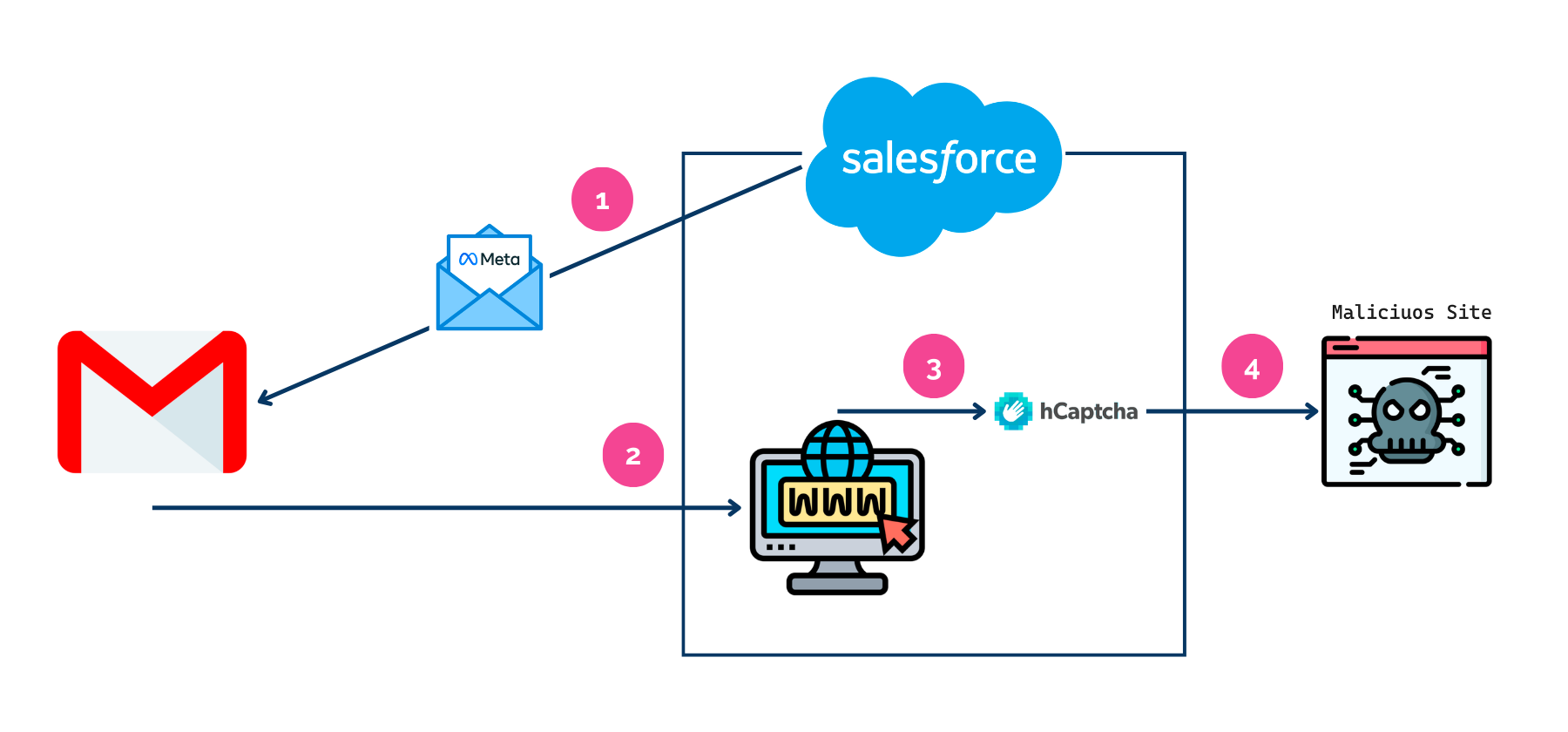
As all technologies evolve, so do phishing campaigns. Attackers learn from their mistakes and improve their strategies, making them more difficult to identify. Recently, a new strategy has been discovered that we want to address in this article. It involves phishing that spoofs Meta for Business, using a Salesforce website as a bridge to direct the user to a seemingly secure target.


It starts with an email pretending to be from Meta for Business, informing the user of a violation of the community rules that involve account deletion (1). This type of campaign is targeted, as it addresses the user by name. Although the sender of the email is noreply@salesforce.com, which is suspicious, it is a trusted domain that avoids detection by conventional filters and generates fewer doubts in the user. The email includes a button to send an appeal.
If the user clicks the button, he is directed to a Salesforce-hosted website (2), requesting an identity verification via hCaptcha (3). Once the verification is completed, the user is left vulnerable to the attack (4). 

In this case, the page was hosted by Salesforce, but any other platform can act as a bridge. This pattern is persistent and, despite technical efforts, many sites manage to go undetected. By contacting the Salesforce team, it has been possible to remove the intermediate page and block the mailing from Salesforce.

How to identify the threat?

As we have seen, phishing is a type of attack that is characterized by its versatility, so there is no exact method to identify it. However, there are signs that will give us a clearer picture of whether the email we have in front of us is legitimate or not:

  1. Pay attention to the sender: Verify that the sender is consistent with the content of the email. In the case mentioned above, the email pretended to be from Meta for Business but came from a Salesforce address, a clear indicator that it was not legitimate.
  2. Review images and links: By hovering the mouse over images, buttons, or links, you can view the address to which they redirect. It is crucial to verify that the domain matches the owner of the client or partner. Platforms such as VirusTotal can help to check the legitimacy of domains.
  3. Check typography and special characters: Legitimate emails follow specific typography standards. Atypical elements may indicate a phishing attempt.
  4. Verify through regular channels: If the sender claims to be part of your organization, use regular communication channels to confirm their identity. The CEO fraud case is also a very common attack.

Protecting ourselves in the digital world.

In summary, phishing is a persistent threat that is continually adapting. Awareness, education, and the use of security technologies are essential to be protected. Being informed and vigilant helps build a safer and more resilient digital environment against this growing threat. In a world where cybersecurity is crucial, prevention and attention to detail are critical to avoid falling into phishing traps.

Web3: The Next Wave of the Internet

From the very heart of blockchain technology, a quiet revolution is stirring the foundations of the web as we know it. A new era is upon us, where digital pioneers rise to reclaim the throne of digital sovereignty, and decentralization takes center stage. Web3 beckons us back to the protocols that birthed the internet, offering transparency, freer systems, and a renewed online interaction structure that removes intermediaries.

The Promise of Web3: A Shift Towards Decentralization

Let’s focus on what Web3 brings to the table: a transformative network that combines the advanced functionality and user interfaces of Web2 with the neutrality of Web1’s protocols. Unlike the centralized databases of tech giants, Web3 allows us to store information across distributed public databases, harnessing blockchain technology, and potentially resolving issues of trust and transparency.

Imagine extending community-based domain protocols, creating an internet layer free from corporate governance. This enables direct connections between audiences and platforms without algorithms or ads, akin to using email, but with the added capability to develop functionalities atop the protocol—ushering in decentralized finance and autonomous organizations that challenge traditional structures.

Learning from the Past and Navigating the New Web

The battle between Encarta and Wikipedia in the early 2000s is a telling historical parallel. Encarta’s centralized model was supplanted by Wikipedia’s decentralized, community-driven content control. This shift indicates how a decentralized approach can be more aligned with user needs and preferences, foretelling the potential advantages of Web3.

In Web3, we use wallets and tokens on various blockchains, interacting with Smart Contracts. While this may seem daunting, it’s a learning curve comparable to the advent of the internet or smartphones. Web3 introduces new concepts like NFTs and DAOs, and paradigm shifts that demand a deeper understanding, yet the innovation potential is as vast as the challenges we face.

Cryptographic Ownership and Exchange

Tokens symbolize ownership in this new web. They’re cryptographic units of value created by entities, and they come in different types, such as NFTs, which follow the ERC-721 standard. Wallets are programs that allow us to autonomously transact with our tokens. They serve as our interface with the blockchain, the decentralized database that records token ownership, and smart contracts are the self-executing agreements that facilitate this trustless exchange.

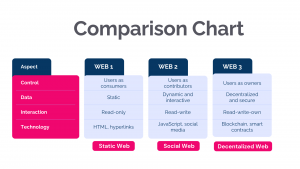
Comparative Analysis Between Web1, Web2, and Web3:

Before we delve further into the implications of Web3, let’s take a moment to compare the three generations of the web:

Use Cases: Web3 in Action

Web3’s potential is not limited to theoretical discussions; it’s already causing ripples across various industries. Let’s delve into some tangible applications that illustrate the power of Web3 in the real world:

  • Supply Chain Management:  Utilizing blockchain technology, Web3 enhances supply chain transparency, allowing us to track the journey of products from manufacturer to consumer. This not only ensures authenticity but also greatly improves the efficiency of tracking items in real-time, a crucial factor for recalls or verifying the supply chain’s integrity.
  • Insurance: Smart contracts in Web3 are set to revolutionize the insurance industry. By automating claims processing, these contracts execute when predefined conditions are met, minimizing the possibility of fraudulent claims and ensuring that genuine claims are paid out more quickly and efficiently.
  • Telecom: Web3 technologies are reinventing the telecom sector with NFT-based mobile identities. These digital identities are secure and portable across services, offering a new level of control and personalization for users while also opening up possibilities for cross-service integration and loyalty programs without compromising privacy.

Conclusion and the Road Ahead

In conclusion, as we stand at the dawn of an internet revolution that lays a new conceptual framework for the future, we must also acknowledge the accompanying challenges, such as an increased risk of scams and the steep learning curve for new users. History shows that once technology solves a problem, it becomes a staple in our lives—like fire, airplanes, and the internet. Innovations may evolve, but the solutions they offer create lasting impact. The shift from Web2 to Web3 is underway; it’s not a question of if, but when it will become mainstream. The time to educate ourselves and safely navigate this new frontier is now.

If you’re ready to unlock the potential of Web3 and transform your business operations, Making Science is here to guide you every step of the way.

Navigating 2024: Top 10 Strategic Technology Trends You Need to Know

As we wave goodbye to 2023 and prepare to embrace the opportunities of the coming year, it’s a perfect time to look ahead toward the future. What innovations and technological advancements await us in the new year and beyond?

From evolutionary to revolutionary changes, thoughtful consideration of how new technologies might affect your business could provide strategic advantages. With this in mind, let’s explore the top tech trends Gartner predicts will play a significant role in 2024 and beyond.

What trends will shape 2024?

1. AI Trust, Risk and Security Management (AI TRiSM)

As the adoption of Artificial Intelligence (AI) continues to accelerate, organizations are increasingly seeking frameworks to manage the associated risks and ensure responsible AI development. AI Trust, Risk, and Security Management (AI TRiSM) is emerging as a prominent approach, offering a comprehensive approach to governance, trustworthiness, fairness, reliability, robustness, transparency, and data protection for AI models.

This framework is gaining traction due to its demonstrated ability to enhance the success of AI projects, increase model precision, and promote fairness in AI-driven applications. Additionally, it emphasizes the importance of continuous model monitoring to ensure that interpretability and explanations remain consistent throughout the AI lifecycle. Organizations that embrace AI TRiSM are laying the foundation for responsible and trustworthy AI deployments that deliver real business value.

2. Continuous Threat Exposure Management (CTEM)

Cybersecurity remains a top priority. organizations seek pragmatic and systemic approaches to optimize their risk mitigation strategies. CTEM, emerges as a forward-thinking approach that aligns exposure assessment cycles with business projects and threat vectors, ensuring security efforts align with organizational objectives.

Beyond traditional vulnerability management, CTEM addresses both patchable and unpatchable exposures, recognizing the need for comprehensive risk mitigation. To validate security controls and prioritization decisions, it incorporates an attacker’s perspective, simulating real-world attacks to test the resilience of defenses. This evidence-based approach shifts focus from tactical responses to informed decisions based on threat analysis, enabling organizations to effectively address emerging threats and enhance overall cybersecurity posture.

3. Sustainable Technology

As the world confronts pressing environmental, social, and governance (ESG) issues, Sustainable Technology stands as a compelling framework for digital solutions to foster positive change: environmental technologies that safeguard the natural world, social technologies that promote human rights and well-being, and governance technologies that strengthen ethical business practices.

Effective implementation of Sustainable Technology hinges on selecting relevant technologies aligned with industry priorities and stakeholder expectations. Cloud services, AI, and other innovative tools can play a transformative role in driving sustainability initiatives.

4. Developer-Driven Self-Service: Platform Engineering

In the pursuit of rapid software delivery and enhanced developer productivity, Platform Engineering focuses on constructing and maintaining self-service internal platforms as layers of abstraction for streamlining the development process and easing the cognitive burden for developers.
By carefully curating reusable, composable, and configurable platform components, knowledge, and services empowers developers to independently manage and develop applications while guaranteeing reliability and security.

This approach not only optimizes the developer experience but also expedites time to market and augments business value. To effectively implement Platform Engineering, organizations should treat the platform as a product, actively engaging with end users to identify and prioritize their requirements. Additionally, fostering a product management culture promotes open communication and collaboration between platform engineers and end users, enabling continuous improvement and feedback loops.

5. AI-Augmented Development

This approach leverages AI technologies like GenAI and Machine Learning (ML) to aid software engineers across the development lifecycle. These tools seamlessly integrate into developers’ environments, helping generate application code, convert legacy code to modern languages, facilitate design-to-code transformation, and improve application testing. 

By automating routine tasks and offering intelligent guidance, AI-augmented development significantly boosts developer productivity, allowing them to concentrate on higher-level tasks like crafting innovative business applications. This not only streamlines the development process but also empowers developers to efficiently deliver software solutions, keeping pace with the escalating needs of today’s businesses.

6. Industry Cloud Platforms

In the dynamic landscape of modern business, Industry Cloud Platforms (ICPs) can revolutionize the way organizations approach IT infrastructure and solutions. These platforms seamlessly integrate underlying SaaS (Software as a Service), PaaS (Platform as a Service), and IaaS (Infrastructure as a Service) services into a unified offering crafted specifically for distinct industries. This tailored approach addresses the unique challenges and requirements of each industry, providing a comprehensive solution that optimizes IT capabilities and drives business success.

At the heart of ICPs lies composability, a key feature that empowers organizations to flexibly combine and customize platform functionalities to align with their specific needs. This agility enables businesses to swiftly adapt to evolving market trends and business requirements, fostering innovation and resilience. Moreover, ICPs are designed with industry-specific outcomes in mind, ensuring that the platform’s features and capabilities are tailored to address the mission-critical priorities of each vertical segment. This focus on industry-specific value ensures that organizations maximize the return on their cloud investments and gain a competitive edge.

7. Intelligent Applications

Intelligent Applications, infused with AI capabilities and diverse data sources, are revolutionizing organizational interactions with users. They offer real-time insights, personalized experiences, and predictive features beyond traditional functionalities. By analyzing user behavior and external trends, these applications proactively cater to user needs, enhancing experiences and driving superior outcomes. This data-centric approach empowers informed decision-making, operational optimization, and competitive advantage.

This paradigm shift in business interactions is driven by Intelligent Applications, leveraging AI and data to transform customer experiences, streamline operations, and foster innovation. They position organizations to flourish in the dynamic digital landscape.

8. Democratized Generative AI

Democratized Generative AI (DGAI) is revolutionizing how organizations operate and engage with stakeholders in the digital realm. By democratizing content creation, it boosts productivity through automation, cuts costs, and empowers a wider workforce with new skills and opportunities. Its personalized content capabilities enhance customer experiences, while unified data access aids decision-making and workflow efficiency. 

As DGAI evolves, its impact promises to transform industries, streamlining processes, elevating customer interactions, and transform how virtually all enterprises compete by empowering users across roles.

9. Augmented Connected Workforce

As remote work persists, Augmented Connected Workforce (ACW) seamlessly integrates intelligent technologies and analytics to empower employees with the tools and insights crucial for success. This approach bridges human expertise with technological capabilities, enabling better decision-making, heightened productivity, and a more adaptable workforce ready to tackle the demands of the digital age.

Beyond individual empowerment, it drives organizational agility by rapidly acquiring new skills and adapting to market shifts. It fosters a motivated workforce, enhancing retention and reducing turnover costs. As workplaces embrace automation and AI, it prepares employees to thrive in this intelligent setting.

10. Machine Customers

Businesses will cater not only to human customers but also to machines. Proliferating connected products with purchasing autonomy in 2024 and beyond will disrupt trillions in sales as non-human economic actors impact business models. Innovatively serving algorithmic customers presents new opportunities for those adapting early.

These non-human economic players, enabled by connected devices, signify a paradigm shift in commerce. With an estimated 15 billion connected devices by 2028, poised to engage in transactions independently. Their impact extends across business realms, offering expanded consumer markets, personalized experiences, streamlined operations through automation, and invaluable data insights for market research and product development.

Conclusion

The opportunities and challenges these emerging technologies present are complex to navigate.  By carefully considering strategic implications and staying informed about the evolving landscape, technology leaders can position their organizations to capitalize on promising innovations while mitigating risks.

As we venture into the future, we’re committed to being your trusted partner, staying ahead of the curve, and delivering value through responsible innovation. At Making Science, we’re ready to ride the wave of these technological advancements, guiding you on your journey from insight to actionable strategy. 

Understand emerging influences, equip yourself to seize opportunities, and safeguard your organization’s future success!

Enhancing Terraform Security: The Crucial Role of TFSec

As cloud infrastructure and automation continue to evolve, Terraform has emerged as a powerful tool for provisioning and managing resources. With more organizations relying on Terraform to deploy and manage their Infrastructure as Code (IaC), it’s become essential to ensure the security of these configurations. TFSec, a specialized static analysis tool for Terraform configurations, plays a pivotal role in fortifying the security posture of cloud environments.

This article delves into the significance of incorporating TFSec into the Terraform workflow and how it contributes to a robust and secure infrastructure.

Proactive Security Measures

TFSec isn’t just a security tool—it’s a proactive security partner. It aids in identifying and addressing security vulnerabilities in Terraform configurations before deployment. By analyzing the code statically, before uploading it to the repository, TFSec can pinpoint potential misconfigurations, insecure settings, and adherence to best practices.

This proactive approach enables development and operations teams to mitigate security risks at an early stage, preventing the deployment of vulnerable infrastructures that could lead to serious consequences such as data breaches, service disruptions, or compliance violations.

Compliance and Governance

In regulated industries, compliance standards are non-negotiable. TFSec is a valuable ally in this regard, offering checks and validations against industry-specific compliance standards and best practices. Whether it’s PCI DSS, HIPAA, or CIS benchmarks, TFSec ensures that Terraform configurations align with the prescribed security guidelines.

Maintaining a secure and compliant infrastructure helps organizations avoid regulatory fines and reputational damage, and TFSec is instrumental in this process.

Customizable Security Policies

One of the standout features of TFSec is its flexibility. Organizations can tailor TFSec to enforce specific security standards and policies that align with their unique requirements. This ensures that the tool becomes an integral part of the organization’s security and compliance strategy, adapting to the dynamic nature of their infrastructure and evolving security landscape.

Collaboration and DevSecOps Integration
TFSec fosters collaboration between development, operations, and security teams by integrating seamlessly into the DevSecOps pipeline. By incorporating TFSec into the CI/CD process, security checks become an automated and integral part of the development lifecycle.

This not only accelerates the identification and remediation of security issues but also promotes a culture of shared responsibility where security is embedded throughout the development process rather than treated as an afterthought.

Continuous Improvement

TFSec contributes to the ongoing improvement of Terraform configurations by providing actionable insights into security vulnerabilities. The tool not only identifies issues but also offers guidance on remediation, empowering teams to enhance their understanding of security best practices. This continuous feedback loop fosters a culture of learning and improvement, ensuring that security remains a priority as infrastructure evolves over time.

Conclusion

In conclusion, TFSec stands as a crucial component in the arsenal of tools dedicated to ensuring the security of Terraform configurations. Its proactive approach, compliance enforcement, customizable policies, seamless integration into DevSecOps workflows, and contribution to continuous improvement make it an indispensable asset for organizations navigating the complexities of cloud infrastructure security.

As the reliance on Terraform continues to grow, the adoption of TFSec becomes not just a choice but a strategic imperative for organizations committed to building and maintaining secure and resilient cloud environments. At Making Science, we’re committed to helping our clients navigate these complexities and ensure robust security in their cloud infrastructures. Interested to learn more about how Making Science can help enhance your Terraform security with TFSec?

Strengthen Cloud Security with Governance and SSO: Protect Your Data and Improve Compliance

The digitization of companies is a phenomenon that has radically transformed the way organizations operate in the 21st century. In an increasingly interconnected and technologically advanced world, companies have been driven to adapt to an ever-evolving environment. Digitization is not simply limited to the adoption of computer technologies but encompasses a complete redefinition of business processes, organizational culture, and interaction with customers and partners.

The redefinition of business processes affects how companies organize cloud projects. One way to organize projects is through Cloud Governance (CG), which aims to balance the opposing forces of transformation and risk mitigation. Additionally, Cloud Governance ensures that cloud migration teams are aware of various guidelines on architecture, data classification, and resources governing this adoption.

One consequence of digitization is the increased use of systems, and remembering the complex passwords for each one is a daily challenge faced by many users. Single Sign-On (SSO) can be the solution to this problem, as it allows access to different applications and services with a single identity, making it easier to add and remove users from systems.

Cloud security must be a top priority for businesses in today’s digital landscape. As companies increasingly rely on cloud platforms for storing sensitive data and running critical applications, implementing robust security measures becomes essential. In this blog post, we will explore the importance of governance and Single Sign-On (SSO) in strengthening cloud security and maintaining control over access to resources.

Understanding Cloud Governance (CG)

It is created by defining, implementing, and monitoring a framework of policies and rules to guide an organization’s cloud operations and provide strategic direction. It regulates how users work in cloud environments to achieve consistent performance of cloud services and systems.

A cloud governance framework is usually built from a set of specific rules and policies for a cloud project. Since cloud systems are dynamic, involving third-party providers or different teams within a company, implementing and monitoring this framework improves oversight and control in vital areas of cloud operations, such as data management and security, risk management, cost management, and more. It ensures that everyone is working together to meet business objectives.

Creating a cloud governance framework can benefit organizations by:

  1. Maximizing performance, optimizing resources and infrastructure. With a clearer view of their entire cloud environment, organizations can improve efficiency by eliminating bottlenecks in productivity and optimizing efforts for better management of cloud resources and costs.
  2. Improving scalability and business continuity. By gaining better visibility across all business units, clearer action plans can be developed.
  3. Increasing compliance with policies and standards. Rigorous compliance monitoring contributes to organizations following governmental regulations and internal policies.
  4. Minimizing security risks by implementing a clear identity and access management strategy, along with security monitoring processes. This will enable teams to be better positioned to identify and mitigate vulnerabilities, thereby improving cloud security.

The Power of Single Sign-On (SSO)

It allows users to access multiple applications by logging in with just one account to different systems and resources. It is very useful when there are different systems that can be accessed using a single password, and it is desirable to avoid repeatedly entering passwords each time the user disconnects from the service. For users, it provides great convenience since after identifying themselves only once, the session remains valid for the rest of the applications that use SSO.

This authentication procedure facilitates access tasks for the different platforms. It is also characterized by other important features in terms of simple management, security and transparency.

  1. Simplified Management: By synchronizing passwords and user information across different systems. This streamlines the validation process and reduces administrative overhead.
  2. Enhanced Security: SSO encourages the use of strong passwords and reduces the risk of password reuse, which can lead to security breaches. SSO prevents password fatigue, encouraging users to create one strong password that can be used for multiple websites.
  3. Improved Transparency: SSO is used by cloud application providers to offer end users a seamless login experience and credential management. Users manage fewer passwords, yet can still securely access the information and applications needed to complete their daily work.

Strengthening Cloud Security: Cloud Governance & SSO

Unifying Cloud Governance and Single Sign-On services can achieve greater security in the cloud. With CG, rules, and policies are created and implemented for cloud projects. Part of the planning for these policies concerns security management, an area that can be streamlined with the use of SSO thanks to its characteristics.

SSO approach helps to reduce the number of accounts and passwords for the same user, facilitate management, and boost productivity as teams can access the applications and project resources to which they are authorized in a secure and simple way with one password they need in an easy and secure manner.

From the administration side, having a single source of truth in terms of identity management is a great advantage. Managing all accesses from an AD/LDAP and ensuring that no user is removed from any service or that no service is left with invalid accesses provides assurance.

With simpler management thanks to SSO and CG rules, greater security and efficiency can be achieved for experiencing benefits such as:

  1. Reduced Security Risks: By enforcing strong password policies and centralized identity management, SSO minimizes the risk of unauthorized access and data breaches.
  2. Streamlined Access Management: SSO simplifies access management by enabling centralized control over user permissions and access levels, aligning with CG policies.
  3. Enhanced Compliance: SSO strengthens compliance by ensuring that user access conforms to CG policies and regulatory requirements.
  4. Improved Productivity: SSO reduces the time and effort required to log in to multiple systems, enhancing user productivity and overall efficiency.

Conclusion

As cloud environments continue to evolve, ensuring robust security measures is crucial for businesses. By embracing a comprehensive approach that combines governance and SSO organizations can harness the full potential of cloud technology while safeguarding their sensitive data, maintaining compliance and control over access to resources, and mitigating security risks according to industry standards.

Additionally, leveraging Artificial Intelligence (AI) and automation can further enhance cloud security by automating tasks, detecting anomalies, and providing real-time insights.

Making Science is your partner in securing your cloud environment and achieving your business goals. Our experts can help you implement and manage effective cloud governance and SSO solutions, ensuring that your organization is well-positioned to reap the benefits of cloud computing while maintaining the highest security standards.

Want to know more?

Invisible Intruders: Deciphering the World of Advanced Persistent Threats (APTs)

In the realm of cybersecurity, Advanced Persistent Threats (APTs) emerge as a hidden menace challenging digital security. These large-scale, sophisticated attacks, known for their stealth and longevity, can significantly impact organizations, including the loss of confidential data, reputational damage, and operational disruptions.

The primary goal of such attacks is to stealthily steal confidential data in a continuous and persistent manner. The perpetrators behind APTs are highly experienced teams that, backed by substantial funding, are dedicated to exploring and exploiting vulnerabilities over long periods of time, focusing their attacks on high-value organizations.

The Covert Stages of APTs

These dangerous cyber-attacks advance in secrecy through various stages, completely undercover.

  • Identification and Reconnaissance

In this stage, attackers meticulously gather information, exploring every detail. Their goal is to fully understand the infrastructure, protocols, and devices of their target.

  • Infiltration and Foothold

Equipped with the gathered information, attackers gain access to the internal network using customized malware. Sometimes, they create secret entries and backdoors to re-enter the network undetected, solidifying their position within the network.

  • Escalation and Lateral Movement

Once inside, they deepen their incursion, acquiring passwords and privileges. This ability allows them to move unrestricted through the system in search of the information they desire.

  • Exfiltration

Like true cybercriminals, they discreetly store the stolen data in a safe place within the network, patiently waiting until their collection is complete. Finally, they extract the data without leaving a trace, even blocking network personnel while they complete their operation.

The Unmistakable Signs of an APT

To quickly identify these cunning criminals, it’s essential to be alert to obvious signs that you may be a victim of their attacks:

  • Increased logins and user account activity at unusual hours.
  • Increase in database activity such as movements, creation, or transfer of massive amounts of data.
  • Receipt of fraudulent emails to carry out phishing attacks.
  • Existence of backdoors that allow access and control a computer without the user realizing.
  • Compressed data for export in suspicious places.

Protection Against Invisible Threats

However, in the digital realm, APTs are not invincible. Companies must take ongoing measures and actions to protect themselves:

  1. Awareness: It is key to inform all employees of the existence of such threats, their repercussions and share signals that may indicate an unnoticed intrusion.
  2. Up-to-Date Maintenance: Keeping software and devices updated to prevent attackers from exploiting vulnerabilities.
  3. 24/7 Monitoring and Surveillance: Implementing the use of monitoring systems that analyze internal network traffic for threats and alert of suspicious movements or unauthorized accesses. For this, AI/ML present great opportunities by being able to quickly and accurately detect suspicious activities, and generate alerts so that security teams can respond preventively.
  4. Firewalls: Isolating the organization’s network from the outside, effectively controlling what enters and leaves the network.
  5. Password Policies: Using strong passwords and changing them regularly to strengthen security.
  6. Advanced Security Solutions: Organizations can implement advanced security solutions, such as cyber intelligence, behavior analysis, and incident response, to help detect and respond to APT attacks.

Defend Your Cyber Frontline with Making Science 

In a digital world affected by APTs, staying alert and prepared becomes our main line of defense against this hidden threat. The battle continues, and only those who face this darkness with utmost caution can resist this adept tactic of cybercrime.

Making Science is a trusted partner for organizations seeking to protect their data and reputation from APT attacks. With the help of Making Science, organizations can rest assured that they are taking the necessary steps to protect themselves from this increasingly serious threat.

The future of cybersecurity requires a proactive and persistent defense. Partner with Making Science today and strengthen your frontline against the unseen threats of the digital world.

Making Science, a leader in Data Analytics and BI, awarded the “The Data Magicians” prize at Google Cloud Next ’23

On Tuesday, October 24th, Making Science was awarded “The Data Magicians” for leadership in Data Analytics and BI, an accolade from Google Cloud during Google Cloud Next ’23 in Madrid. With this award, we position ourselves as one of the essential partners for the business development of Google Cloud.

Data Analytics and BI have been one of Making Science’s strongest commitments globally within the Cloud ecosystem. Over the past couple of years, we have grown and expanded our expertise to position ourselves as one of the leaders in managing the entire data lifecycle, from ingestion, collection, processing, normalization, and storage to the development of solutions and strategies for activation that allow maximum value to be extracted from them.

For over five years, Making Science has invested in cloud technology (both proprietary and for its clients), and we advise and offer Cloud services and expertise in the countries where we operate and collaborate with Google Cloud. Together, we’ve created innovative strategies designed to drive company growth, with the development of Composable Customer Data Platforms, which combine data from multiple sources and tools to obtain a 360° customer profile in real time.

Receiving recognition like this further underlines our work in Cloud, data, and AI, which is now a fundamental part of our international business, as well as the development of the best Data Analytics and Business Intelligence solutions for our clients on Google Cloud.

Want to start a cloud-based data project? Our team of experts can assist you. Don’t hesitate to write to us. We’re waiting for you!

Get in touch