

From volume to value: Improve your campaigns with Gauss Smart Advertising

Align your advertising investment with your business strategy

The automatic bidding strategies offered by the different advertising platforms have become one of our best allies regarding campaign optimisation. Specifically, those known as Value Based Bidding allow us to align our advertising investment with our business objectives in an automated way.

If you are using Value Based Bidding, configure your pixels to collect the conversions you want to optimise. Then, indicate the objectives you want to achieve through your campaigns (whether it is maximising the value of the conversions or optimising the return on our investment). From there, algorithms learn everything necessary to find and bid for users to achieve your goals.

The main issues with Value-Based Bidding

Conversions, in this case, act as signals that tell the algorithm whether or not users are valuable for our campaign. But, sometimes, you may not have enough conversion volume for VBB to work. And sometimes, web conversions do not fully reflect the reality of our business.

Furthermore, it is estimated that the Google and Meta algorithms only consider signals for the first seven days since the user entered through a paid campaign. For user acquisition data, the most recent signals are the ones that the algorithms give the most importance to. What happens when a lead’s final conversion occurs beyond that 7-day window?

How Gauss Smart Advertising can help you

To cover this gap between what the algorithm can see and your business’s fundamental objectives and KPIs, Making Science developed Gauss Smart Advertising. This proprietary technology allows you to anticipate the future value of a user and improve signals throughout the entire sales funnel. With Gauss, we can predict a lead’s propensity to buy, the expected purchase value, and even the long-term value of the lead (customer lifetime value). Then, we translate it into signals that give the algorithm a more realistic vision of your business. Furthermore, what makes the difference is that we not only create predictive models but can activate them in real-time to anticipate and communicate those signals without losing the benefits of the cross-device nor the freshness that Smart Bidding algorithms require. Additionally, we develop agnostic models that can be activated on any of your marketing platforms.
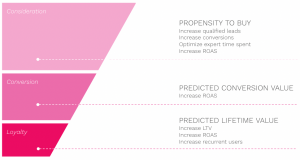
How it works

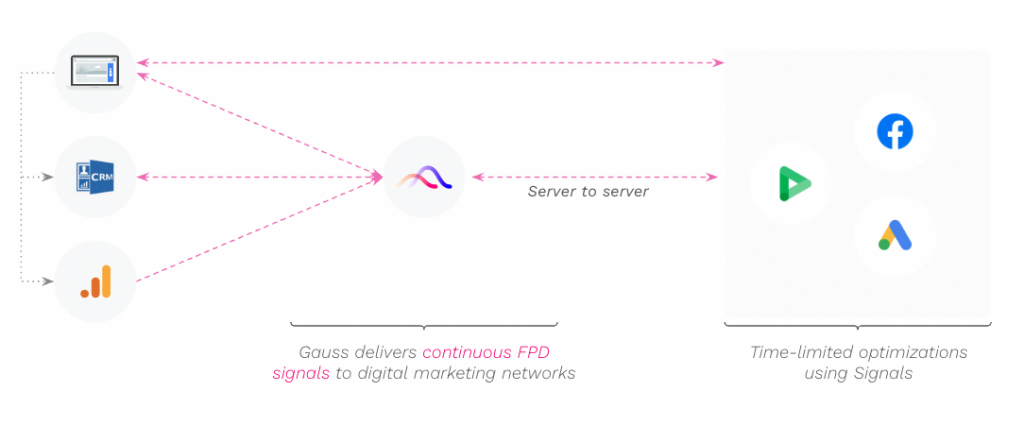
Advertising platforms have the ability to collect web browsing data for campaign optimisation. Gauss Smart Advertising collects browsing data from other data sources to issue a more accurate assessment of the user that it then sends as a signal to the platforms.
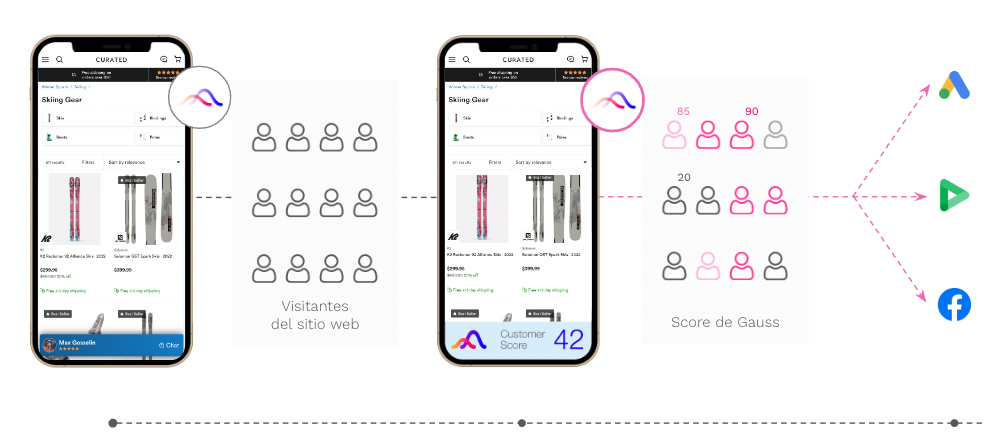
In essence, based on previously trained machine learning models, it predicts and issues a score/value for each of the users that enter the website and communicates it to the platforms in real-time:
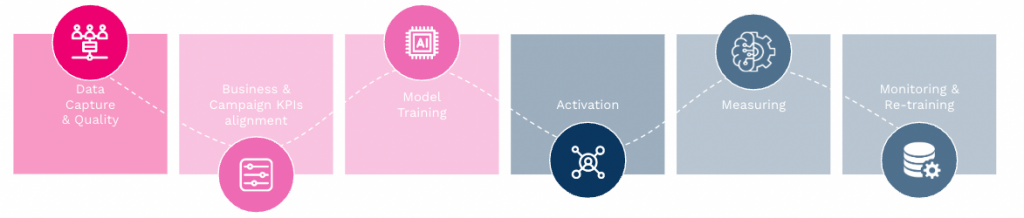
A methodology for automation and activation

Our solution is optimised to cover all the critical phases of its implementation, from the collection and evaluation of the quality of the data that feeds our models to the activation and monitoring of campaigns and models:
With Gauss Smart Advertising, we have increased our clients’ conversions by 20% and reduced their CPL/CPA by up to 50%.

Gauss Smart Advertising can be used to

  • Communicate to the algorithms that someone has made a purchase when the lead is more than seven days old (for example, longer tail conversions like university enrollments, vehicle purchases in the automobile industry, insurance or mortgage purchases in the banking sector, etc.)
  • Adjust conversion values ​​when refunds and cancellations represent an essential part of the business, and these occur outside the scope of action of the algorithms (for example: in the hotel industry where cancellations tend to take place closer to check-in than to reservation)
  • Amplify and provide a greater volume of signals to the algorithms to improve their performance in industries or advertising channels (for example, display) where few conversions are collected
  • Adjust the signals captured by the algorithms to the KPIs and business objectives (for example, increase customer lifetime value for e-commerce businesses)

Do you want to know more about Gauss Smart Advertising? Write to us! Our team of experts will be happy to help you.
 

Get in touch


How is AI Changing the Game?

AI-generated content is transforming how marketers produce and share digital content. AI can provide compelling written and visual content that is highly tailored, utilising cutting-edge algorithms and machine learning approaches. Understanding the potential of AI-generated content and knowing how to use it well in your campaigns will help you as a marketer remains on top of trends and get better outcomes.

The potential of AI-generated content to produce highly tailored material for specific clients is one of its main advantages. AI may produce content that is customised to the interests and preferences of particular parts of your audience by examining consumer data and behaviour. This can enhance the entire client experience and aid in boosting engagement and conversion rates.

AI-generated content can also save time and resources, which is a benefit. AI can assist marketers in producing more content in less time without losing quality by automating the content development process. Small firms or marketing teams with minimal resources may find this to be extremely helpful.

Utilising AI-generated content

Writing product descriptions and other sorts of written material is one approach to use it. Without the need for human writing, AI-powered solutions, for instance, can assist you in creating accurate and enticing product descriptions. AI can also be employed to produce visually pleasing photos and videos that can be utilised in social media campaigns and other kinds of digital advertising.

A/B testing and optimisation

Using AI-generated material for A/B testing and optimisation is another approach, and Making Science is leading the way in this field with its innovative GAUSS framework.

The Gauss Framework utilises AI-generated content for A/B testing and optimization. With the ability to quickly determine the most effective parts of your content through evaluating consumer data and behaviour, you can refine your campaigns with the insights provided. This leads to improved productivity and the optimisation of advertising platforms such as Google Ads, DV360, Campaign Manager, and Facebook, among others. 

Set your objectives

Having specific objectives in place, such as:

  • Increasing engagement and conversion rates
  • Enhancing the customer experience
  • Producing more content in less time

Can help you make the most of AI-generated content.

Once you have identified your goals, developing a strategy for how to achieve them is essential. This should include a detailed plan for how you will use AI-generated content in your campaigns, what types of content you will generate, and how you will measure the success of your efforts.

Additionally, working closely with your team and any external partners is important to ensure that your AI-generated content aligns with your overall marketing strategy. This includes collaborating with your design, development, and data teams to ensure that your AI-generated content meets your technical and branding requirements. Also, working with a data science team, if you don’t have one, ensures that the data used to train the AI model is diverse and representative of your target audience.


Finally, it’s essential to continuously monitor and evaluate your AI-generated content efforts to ensure that they meet your goals and positively impact your business. This includes regularly analysing metrics such as engagement rates, conversion rates, and customer feedback to identify areas for improvement and make adjustments as needed. 

Using AI-generated content comes with numerous advantages and opportunities. By carefully selecting the data used to train the AI model, you can ensure that the content produced is diverse and representative of your target audience, minimising the possibility of bias. Furthermore, incorporating AI-generated content into your campaigns opens the door to new possibilities and allows you to enhance human creativity and uniqueness, rather than stifle it.


To ensure the success of using AI, it is key to have a clear strategy and to be aware of potential challenges. Reach out to our team of experts to create a clear strategy with AI and to learn more about GAUSS!

Increase your sales by 20% by activating AI in your digital advertising campaigns

Data collected without a purpose and without proper processing is virtually useless and becomes an expense that quickly escalates. It is not until we give it a sense and enrich it intelligently that we can truly consider it an investment; and discover the often surprising stories it holds.

Considering our data as one of our most critical corporate assets is imperative. Monitoring customer interactions provides a wealth of knowledge to guide our marketing, sales and product development efforts, while monitoring internal processes generates valuable information to optimise operations and improve productivity.

This knowledge value chain is composed of technical and non-technical components. It includes business processes and understanding that a systematic approach allows us to put data-driven predictive models into production through a strategy tailored to each business objective.

Once we have extracted the relevant insights from the predictive models, the next crucial step begins: turning this information into action to generate measurable business impact. 

This requires three key aspects: 

  1. Understanding the business environment we operate, our acquisition, sales and loyalty processes.
  2. In-depth knowledge of the different profiles and purchase drivers of each customer segment to which we direct our advertising campaigns.
  3. The creation of tools that automate or facilitate decision-making.

At Making Science, we have been innovating in this context for years with Gauss Smart Advertising. This machine-learning solution optimises your advertising campaigns on digital platforms (Google Ads, DV360, Campaign Manager and Meta, among others), making the most of First Party Data (from CRMs, call centres or other available data sources) and managing to improve sales ratios by 20%.

Technology geared towards automation and activation


Discover the state of data maturity of UK companies in the latest Making Science research and our recommendations for getting the most out of your data and marketing efforts.