Making Science launches three innovative solutions from the Gauss AI Suite on Google Cloud Marketplace

In the upper funnel GaussTV, BrandMax and Data Quality combine to optimise the strategies of the consultancy’s clients and ensure quality data.

Madrid, 27 June 2024 – Making Science, a leading digital marketing and technology company, announces the availability of three new solutions from its renowned Gauss AI Suite on Google Cloud Marketplace: GaussTV, BrandMax and Data Quality. These solutions are designed to help customers overcome upper funnel challenges, optimise their marketing strategies, and ensure data quality at every step of the conversion process.

GaussTV is a solution that enables clients to effectively plan, optimise, and measure their media campaigns. By integrating linear and connected TV into a single console, GaussTV facilitates incremental reach measurement and optimisation of advertising investments, ensuring that campaigns reach the right audiences with personalised messages.

Along these lines of ad hoc planning, BrandMax enables companies to target their branding campaigns by personalising bidding strategies based on user value. Using advanced algorithms, the tool identifies buyer personas and converts business objectives into complex bidding algorithms, maximising the impact of campaigns and reaching the highest-value audiences.

The Data Quality solution helps clients maintain the quality of their data throughout the conversion funnel. By implementing key indicators, real-time alerts, and customised dashboards, Data Quality ensures accuracy in campaign attribution and minimises the negative impacts of data inconsistencies, enabling more effective and well-targeted marketing actions.

“We are very excited to launch these three new solutions on Google Cloud Marketplace and to continue to provide access to our value proposition of innovative technologies. Through these three solutions, Gauss AI helps our customers maximise their advertising impact and achieve their business goals with greater accuracy and efficiency,” said Jorge Alonso, COO SaaS at Making Science.

“Bringing Making Science to Google Cloud Marketplace will help customers quickly deploy, manage, and grow the digital marketing solutions on Google Cloud’s trusted, global infrastructure,” said Dai Vu, Managing Director, Marketplace & ISV GTM Programs at Google Cloud. “Making Science can now securely scale and support customers on their digital transformation journeys.”

In this way, Making Science will continue its collaboration with Google Cloud to provide advanced technology that facilitates digital transformation and delivers leading solutions to companies.

About Making Science

Making Science is a digital acceleration company that currently has more than 1200 employees,  with a presence and technological development in 15 markets: Spain, Portugal, Mexico, Colombia, France, Italy, UK, Ireland, Sweden, Denmark, Norway, Finland, Germany, Georgia and the USA. As a consulting partner of Local Planet – the world’s premier network of independent media agencies – we deliver a suite of digital marketing, Adtech, Martech, software and cloud solutions, and cybersecurity services globally, through delivery hubs that foster job creation and the availability of highly skilled technology talent. 

Making Science is composed of four business lines: the Global Digital Agency and Technology, with 360 digital advertising services that integrate strategic planning, creative, data, and technology; the Cloud, Software and Cybersecurity business, with cloud-based solutions that deploy data intelligence and a specialised cybersecurity team; the Artificial Intelligence and SaaS division, with more than 400 engineers and data scientists for the development of platforms and digital solutions with AI technology applied to marketing; the Making Science Investment area, with Ventis and TMQ, as a line of business diversification and implementation of all of Making Science business capabilities.

In addition, the company participates in various ESG initiatives, including the Climate Pledge, the United Nations Global Compact and the Pledge1% initiative, supporting non-profit organisations in its community with a strong commitment to making a positive impact on the future.

Maximising your content across channels with Google PMax campaigns? ad-machina makes it easier

Unlocking the Potential of Performance Max: ad-machina for PMax is here

In the current competitive and unpredictable landscape, there is the challenge of connecting with customers at the right time and place. To effectively address this challenge with the right message, it is imperative to automate campaigns and optimise performance cost-effectively. The new Google Ads campaign type, Performance Max, offers the opportunity to establish an omnichannel and automated presence. Are you prepared for the amount of content generation required for this type of campaign? Can you afford to manually update all the assets of your company constantly? ad-machina makes it easier.

But first, what is Google Performance Max? 

Google Performance Max represents a paradigm shift in digital advertising, offering businesses an unprecedented level of control and optimisation. Leveraging advanced machine learning algorithms, Performance Max enables advertisers to maximise their reach across all Google channels, including YouTube, Display, Search, Discover, Gmail, and Maps. But, it’s not as straightforward as it may seem. PMax campaigns demand a significant amount of content generation, which can prove to be overly demanding for the marketing department. For example, a key challenge in setting up a Performance Max campaign isn’t just about deciding on the bidding strategy or targeting the audience. It’s also about ensuring there’s a diverse range of assets available for each channel and an updated database. This is where ad-machina comes into play, enabling businesses to leverage PMax effectively while efficiently optimising the team’s time. 

What is ad-machina for PMax?

ad-machina arrives to help you optimise all your Performance Max campaigns. We provide substantial benefits such as streamlining the process of optimising PMax campaigns, enabling companies to customise their ads with text, image and video based on search terms, and automating the adaptation of ads to changes in the business landscape. As a result, it’s crucial to synchronise Performance Max campaigns with these daily tactical and strategic decisions.

It offers three key enhancements:

  • Enhanced assets
  • Adaptive listing groups
  • Fine-tuned search themes and audiences

Enhanced assets

ad-machina for PMax optimises asset creation through automated processes, minimising dependence on the creative team. By producing textual and audiovisual content for Performance Max campaigns, the platform incorporates essential details like offers, maximum discounts, minimum prices, and flagship products. Moreover, ad-machina strategically integrates the brand into visual assets, boosting brand visibility. This approach not only guarantees maximum impact but also facilitates precise measurement and optimisation of visual creative templates, representing a significant advancement in campaign effectiveness and efficiency.

Adaptive listing groups

ad-machina for PMax transforms listing group management by integrating various data sources. By seamlessly connecting with Google Merchant feed and first-party data such as offer calendars, category manager recommendations, and insights from competitiveness monitoring tools, ad-machina for PMax establishes a strong basis for dynamic product grouping. This fusion of information facilitates agile decision-making, enabling precise adjustment of listings based on factors like price competitiveness, product margins, offer schedules, and category manager priorities. The outcome is a flexible and strategically aligned product lineup, poised for optimal profitability. This pioneering approach offers a substantial competitive advantage in the online marketplace.

Fine-tuned search themes and audiences

ad-machina for PMax employs sophisticated analysis of account search term history to curate the most impactful search themes for each listing group. This process guarantees peak performance by eliminating redundancy among asset groups. Furthermore, ad-machina doesn’t stop at search themes; it also crafts custom audiences. This innovative feature is designed to equip the Google Ads algorithm with the most refined signals available. These signals are characterised by their specificity and coherence, ensuring a targeted approach that maximises campaign effectiveness. This strategic combination of search themes and custom audiences sets the stage for optimal results in online advertising efforts.

Conclusion

We know that having Google PMax is essential to maximise the performance of your campaigns, however having ad-machina for PMax is taking it a step further. You’ll still be able to communicate with your target audience through the appropriate channels, but with ad-machina, we make it easier for you to find the right message.

AI comes to Google: The future of SEO with SGE

SGE (Search Generative Experience) will be a major change in the search experience and the way results are displayed in the SERPs.

But first of all, what exactly is SGE? It’s a radical update from Google, which will start using AI to generate contextual answers to complex questions.

AI in search engines

The impact of ChatGPT since the end of 2022 and its very rapid integration into the digital status quo, especially among young people, has led tech giants (such as Google) to further accelerate the deployment of their AI-related technologies.

Within the search engine market, Microsoft has moved ahead with the integration of ChatGPT into Bing as early as 2023 and Google has responded quickly with the announcement of SGE, based on Gemini, its LLM that promises to be more powerful than GPT-4.

The common formula is the integration of an AI module on top of the search engine that not only directly answers complex queries accurately, but also enables deeper searches through a conversational interface.

What do we know so far about the impact of SGE on SEO?

SGE will bring about an evolution in the way we search for information on the Internet, as ChatGPT has already done.

SGE is being tested in the USA, and the SEO team at Making Science has already been testing this new experience to draw some preliminary conclusions before its final international roll-out:

Several sources of information

This new AI module draws from many sources to offer more complete information:

  • Media: Very relevant, especially in information searches. Media attention, through PR teams, is essential to manage the conversation around brands.
  • Shopping feeds: PDPs everywhere in searches closer to conversion. A good product feed is essential to appear here. It seems that achieving a more complete shopping experience is one of SGE’s main objectives.
  • Reviews: Google knows that reviews are powerful conversion triggers, and integrates them into SGE for searches close to conversion. The focus should be on optimal Schema markup and online reputation management.
  • Social media: Social media conversation is especially relevant for topical or trending searches. Inspirational approach.
  • Google Maps / Business Profile: Many of the searches, even when not explicitly geolocated from the query, return local SEO results.
  • Multimedia: Text, images, video, FAQs, social media… what seems evident is that covering searches with multiple formats is going to be essential to capture the key terms in SGE

SEO strategies impact

There are a few things that seem to be clear, and that don’t really change the ‘traditional’ approaches to SEO strategies that much:

  • The classic Google Top 3 will determine what comes out of this block.
  • There will still be ads (as they are Google’s main revenue stream), but to a lesser extent. At least at launch.
  • SEO-optimised elements or content will continue to be relevant in order to match users’ searches

And what will the SEO performance be like?

Organic traffic is expected to decrease because it is assumed that the traditional SEO results will show even lower in the SERPs (with the consequent drop in CTR): Google as a “media” in its own right, which means a drop in overall SEO CTR.

However, the user has the opportunity to become more qualified in conversational mode before clicking on a link, which could benefit SEO conversion.

In addition, users could make even more intensive use of Google, especially younger audiences, who now turn to platforms such as TikTok. In any case, it remains to be seen if this hypothesis is true and, if so, if it will compensate in terms of traffic for the drop in positions of traditional organic results.

Types of content that could be most affected by SGE

We predict that the impact of SGE will be even greater for some types of content:

  • General informational content: Direct answers to factual questions, definitions of concepts, general explanations of a topic, etc. SGE could directly answer many general information queries without the need to take the user to another website.
  • Comparative content: Such as product comparisons, rankings of best options, pros and cons reviews. SGE could generate this comparative content in an automated way.
  • Simplified content: Such as summaries, simplified guides, step-by-step explanations of a process. SGE could extract and synthesise the most relevant information.
  • Repetitive content: Such as similar listings on a topic, frequently asked questions, duplicate content. SGE would reduce the need for multiple pages of redundant information.
  • Local content: Location-specific answers, such as business hours, local business addresses, geolocated recommendations.

Websites that rely on this type of content for their organic visibility should rethink their SEO strategy with the arrival of SGE if they don’t want to be negatively affected.

Conclusion

Essentially, Google’s SGE marks a revolutionary development in SEO. With AI shaping the digital realm, it’s vital to keep pace with these shifts and comprehend their significance to uphold an advantage in online presence

Demystifying Google’s Enhanced Conversions

In an era where digital footprints are becoming increasingly elusive, understanding the nuances of conversion tracking is critical for marketers. Conversion modeling stands at the forefront of this change, providing an innovative way to capture data without infringing on user privacy. Today, we explore the depths of Google’s Enhanced Conversions and the crucial role of conversion modeling.

Understanding Conversion Modeling

Conversion modeling is a method that uses aggregated and anonymised data to predict conversions that aren’t directly observable. Instead of relying solely on the decreasing pool of observable data due to privacy changes, it fills in the gaps, offering a more comprehensive view of campaign performance. Google’s approach to modeling ensures that reported conversions present a complete picture, not just a snapshot.

Introducing Enhanced Conversions

In a world where traditional tracking cookies are crumbling, Google’s Enhanced Conversions emerge as a beacon for accurate conversion measurement. This feature utilises conversion modeling to ensure that advertisers can gauge the efficacy of their campaigns, even as third-party cookies become obsolete.

The Necessity of Enhanced Conversions

As reliance on third-party cookies fades, the risk of digital media performance measurement becoming less reliable grows. Enhanced Conversions serve as the necessary bridge to a future where privacy concerns and marketing analytics can coexist harmoniously.

How Enhanced Conversions Work

  1. A logged-in Google user clicks on your ad.
  2. They make a conversion on your website.
  3. The conversion tag on your site captures a predefined piece of user data (like an email), hashes it, and securely transmits it to Google.
  4. Google then matches this hashed data against its own, noting a conversion in your account, thereby preserving the integrity of your ad performance data.

You can learn more about how Enhanced Conversions work by clicking here.

The Advantages of Enhanced Conversions

Adopting Enhanced Conversions isn’t just about keeping up with privacy standards—it’s about achieving tangible benefits:

  • 5% Increase in Search Conversions: On average, brands adopting Enhanced Conversions for search campaigns see a 5% uptick in conversions.
  • 17% Rise in YouTube Conversions: Similarly, a notable 17% average increase in conversions is observed for YouTube campaigns.
  • 10%+ Boost for Real Estate: In the real estate sector, one of our clients experienced over a 10% increase in total measured conversions after implementing Enhanced Conversions.

What We’ve Learned from Implementing Enhanced Conversions

  • Stakeholder Alignment: It’s crucial to get marketing, legal, privacy, and IT on the same page early in the process to streamline implementation and address compliance concerns proactively.
  • Start Small & Scale: Beginning with a single site allows for benchmarking results and a more manageable scale-up process. However, if there’s consistency across brands or sub-brands, a more comprehensive rollout may be feasible.
  • Defining Success: It’s important to establish what success looks like upfront, considering the balance between implementation costs and the anticipated lift in conversion tracking.

Unlock the Full Potential of Your Campaigns

Understanding and leveraging foundational data is critical in harnessing the full potential of Enhanced Conversions. The “Foundational Data” section of our AI Essentials Playbook provides you with a deep dive into strategies for creating a strong data strategy, designed for marketers aiming to refine their digital approach in line with Google’s AI Essentials checklist.

Ready to elevate your conversion tracking and embrace the next level of digital marketing maturity?

📘 Download the “Foundational Data” section of our AI Essentials Playbook and begin your journey toward a sophisticated, AI-accelerated marketing strategy today.

[button color=”accent-color” hover_text_color_override=”#fff” size=”large” url=”https://www.makingscience.com/ai-essentials-foundational-data/” text=”Read now” color_override=”#ff0067″]

Why are iGaming brands still using sub-optimal CPA bidding strategies?

With a particularly skewed customer value curves – a broad industry benchmark is that the top 5% of users will deliver roughly 95% of revenue – iGaming brands stand to gain a significant improvement in ROI from adopting a value-based bidding strategy. However, the vertical also faces more challenges than most in doing so.

Here are the top 4 challenges limiting Gaming brands to inefficient CPA bidding strategies (and their solutions).

1. Long LTV Curves

LTV matures over time as players deposit and play on-site, fluctuating based on wins, losses and subsequent deposits. Most operators don’t see a positive return on players until months after acquisition, while typical pixel-based attribution windows are around 7 days. This disconnect means many advertisers rely on optimisation towards a first deposit or deposit value, which holds a limited correlation with customer LTV.

In this case, prediction is the solution, because it allows the modeler to accurately predict future value in accordance with early journey indicators.

2. LTV Customers are Tricky to Predict

Prediction itself is challenging when the business’ revenue model is built on outcomes of games of chance. Additionally, players rarely monetise in a linear fashion, they follow Eric Bradlow’s model of ‘clumpiness’. It can be hard for marketers and data analysts to spot causations between customer behaviours and LTV. Machine learning models will allow causation to be found and exploited.

3. Customer Value Distribution

Bidding algorithms work best when fed with high volumes of high-quality data at a consistent rate. Unfortunately, iGaming customer value patterns rarely follow this model. For example, the very highest-value customers are few in number, but these make up a high share of total revenue. A bidding algorithm with insufficient learning data inevitably ends up over and under-valuing customers at the extreme ends of the value distribution.

Modelling against large, historical datasets provides the volumes needed for reliability. Bidding against early journey proxy events provides the volumes needed for effective algorithmic bidding.

4. Slow Signals

The most effective VBB occurs when activated against real-time signals. Most LTV prediction takes weeks or months, and even immediately available predictions are not typically accessible as real-time bidding signals. These predictions need to be accurate, fast, and easily available for bidding activation in marketing platforms – and that requires technology. Real-time prediction and passback of a value signal are crucial to an optimised data and media strategy. In VBB, fast prediction trumps absolute precision.

VBB can have its challenges, but it’s a hugely valuable tool for performance marketers looking to optimise their bottom line. Making Science’s Gauss Smart Advertising solution is an AI-driven, predictive value modelling tool. It allows advertisers to bid in real time on predicted LTV value. It’s channel and vertical-agnostic and proven to drive 10-30% stronger ROI in activation.

To reach better bidding, reach out to our team of experts to learn more about effective bidding strategies or to kick-off your campaign!

[button color=”accent-color” hover_text_color_override=”#fff” size=”large” url=”www.makingscience.co.uk/contact” text=”Get in touch! ” color_override=”#ff0067″]

The power [and problems] of value-based bidding

In an increasingly competitive and complex digital marketing landscape, it’s now more important than ever to ensure optimisation of both data and media to achieve marketing ROI. The best decisions are the ones informed by data and AI.

Across the two performance marketing behemoths, there are over 4 billion monthly active users worldwide on Google, and over 3 billion on Meta. Of course, not all users are created equal, far from it. Value-based bidding (VBB) gives advertisers the ability to adjust their marketing bids for their most and least valuable users. It combines the power of an advertising platform’s rich user data and AI smart bidding algorithms with a brand’s first-party conversion value data. In short, VBB drives stronger efficiencies and increased revenue for businesses by aligning the bidding goal with business outcomes.

It’s a powerful tool; Google’s study on its internal data in 2021 showed a 14% uplift in conversion value moving from tCPA to tROAS, Meta has quoted up to 35% improvement in ROI from their value bidding strategy and Making Science’s proprietary predictive VBB solution – Gauss Smart Advertising – drives 10-30% uplift in lifetime value ROI.

So why would an advertiser not harness the power of VBB? Well, it’s not always easy.

To start, advertisers need to understand clearly what value means to them – revenue, lead quality, customer lifetime value, new vs returning customer ratio, conversion propensity (and countless more) are all applicable value metrics, requiring distinct optimisation strategies.

Below the surface, advertisers need robust measurement solutions in place to track customer value in online and offline environments. This data needs to be accurate and accessible. Bidding experts are required to steer VBB algorithms through a volume, efficiency and efficacy balancing act. The necessity for predictive modelling arises when advertisers want to make quick decisions on bidding and investment.

All of this is to say that effective VBB is far from a flick of a switch. Durable VBB is best viewed as a journey to maturity, on which accuracy, speed and actionability are the guiding stars.

If you’re interested in understanding how better bidding can deliver you more ROI, please reach out.


[button color=”accent-color” hover_text_color_override=”#fff” size=”large” url=”www.makingscience.co.uk/contact” text=”Get in touch!” color_override=”#ff0067″]

Interview with José Antonio Martinez Aguilar: How Generative AI is reshaping the marketing landscape

How do you see generative AI transforming marketing?

Generative AI technology has boomed this year, primarily due to the expansion of Chat GPT and other platforms that enable content creation. The previous AI was predictive AI, which essentially allows you to make predictions based on historical data about the probability of an event happening in the future. This is very positive because it will enable you to understand what will happen in the future. For example, predictive AI predicts whether you like a movie in a product recommender, such as Spotify or Netflix. From an efficiency point of view, it brings a lot of value.

Generative AI creates content. It can create text, audio and images. If we think about what marketing is: sound, sight and motion, and what creativity is: communication through text, audio, photos and videos, we are in an environment where you can create all these kinds of content to help communication. It is a new tool for creating content for creatives, agencies and companies.

The key benefits of Generative AI are cost and variety. It allows the generation of content at a cost that is a fraction of the cost of human content generation, and the combination allows multiple variations of the same content to be generated. We, for example, have published some cases where we generate tens of thousands of product descriptions at a cost of one-thousandth of the cost of production by one person. It will undoubtedly transform marketing from the perspective of diversity and efficiency in content creation.

How does Making Science address the challenges this poses for the sector?

At Making Science, we have two sides: On the one hand, we are an agency, and on the other hand, we are a technology company. From an agency point of view, we are reviewing how to use generative AI in all our processes. We generate campaigns for our clients and are starting to use generative AI in different parts of the value chain of our business process: ad and content generation.

As a technology company, we have developed a platform called Trust Generative AI, which allows us to apply generative AI to the business cases that are most relevant and that allow us to scale globally. For example, it will enable us to generate product descriptions, blogs, web content, and copy generation for ads and images, and we are working on video generation for the near future.

At Making Science, we are taking a very proactive approach. We believe in embracing technology and maximising it for your business.

What impact, both positive and negative, can its use have?

Every technology has a positive and negative effect depending on how you use it. For example, you can use iron or steel to build a bridge, a machine gun, or a tank. On the positive side, generative AI can generate much more variety of content at a much lower cost. In other words, we must see artificial intelligence as a tool that helps us improve. 

An MIT study analyses how, in generating content, an internal memo, an article or a communication, using ChatGPT, it is possible to improve by 20% times and improve the quality of the content by 30%. Therefore, it should be seen as an opportunity for Human Augmentation, which turns us into humans with more capabilities, as has happened in the past.

The downside is that it can generate virtual spaces that can be used for impersonation, generating your voice or false images, and generating fake content and information. As with any new technology, there are positive and negative uses. Instead, it’s a question of taking advantage of all the positive benefits and fighting against the negative ones.

Where does generative AI leave marketers in this new era?

Technology has changed marketing over the last 50 years, and marketers have had to adapt. Advertising at the beginning of the century, in the 1920s, was mainly text in newspapers or outdoor billboards. Then came radio, television, the internet, and now digital; we must adapt to every advertising landscape evolution.

In general, technology allows many lower value-added activities to be done in a scalable way, and marketers need to adapt. A similar example is what has happened in media buying through technology platforms such as Google or Meta, where techniques such as automatic bidding or other automation do tasks that only 20 years ago were done by consultants. Marketers, therefore, have to evolve their roles.

Similarly, let’s think about how creatives were made 100 years ago, where an illustrator was the one who drew, and how later video and audio editing tools appeared that allowed to evolve towards professionals with editing capabilities. Likewise, generative AI is an opportunity, and marketers must embrace it and evolve towards a technology that will enable them to do much more varied things at a lower cost.

How should the risks associated with their use be dealt with, and is there a way to avoid them?

You have to be cautious. From an agency or end-client point of view, communication always has communication guidelines defining how the brand expresses itself at text, audio and image levels. The risk of generative AI is that the content needs a sufficient level of control or compliance and results in content that is not appropriate or does not express the brand identity.

Controls must be implemented to ensure the generated content is valid, relevant and aligned with brand standards. At Making Science, we have developed our platform, Trust Generative AI, which incorporates algorithms that help users control how close or far their content is from the company’s standards and allows them to incorporate Human-In_The-Loop, which are processes in which there is a person who is validating the final content before publication.

How should brands integrate generative AI into their strategies to get the most out of it?

Fundamentally, from two points, taking advantage of the creativity capacity of platforms such as ChatGPT Dall. e or Google’s Vertex AI, which are platforms that have been trained with hundreds of millions of images, videos and texts to allow interaction with them, generating a lot of information in the divergent phase of the creative method. For example, when you are brainstorming, that is, in the phase of generating new ideas. 

The second important application is the scalability and personalisation of content. Generative AI develops a lot of variations of content, and you have to take advantage of this strength. For example, when you create a website, the text of the descriptions is unique. With generative AI, you can create many variations of content and context with a different tone of voice depending on the business target. It differs from how you would address millennials as you address Generation X, with hyper-personalising communication.

Generative AI is one of the tech trends of 2023. How do you think it will evolve? Is it here to stay, or will nobody remember it in a few years?

Generative AI is the big hit of 2023, mainly due to the tools such as ChatGPT that have democratised the use of this technology. Previously, everyone used artificial intelligence with Google, Amazon or Spotify’s product recommender that presented videos, products or content relevant to the user. Still, it was not visible to them due to the artificial intelligence working in the background. Now, however, with ChatGPT, we are experiencing, in a very personal way, a 1-to-1 with the use of artificial intelligence, and we know that we are talking to a machine.

So, the significant change is that it’s consumed at the mass market level. Everybody understands generative artificial intelligence and its possibilities, and many people are thinking about used cases and opportunities. I think it’s a technology that is here to stay and will have a revolutionary impact on society and all sectors.

To learn more about AI, download our AI e-book or get in touch with our team of experts to begin you AI journey!


[button color=”accent-color” hover_text_color_override=”#fff” size=”large” url=”www.makingscience.co.uk/contact” text=”Get in touch” color_override=”#f0076f”]

Real-time Anomaly Detection on Your Website’s Sales Funnel with Gauss Data Quality

Today’s marketing and business intelligence teams demand tools that allow them to understand what’s happening in their business environments; insights into aspects like web traffic, the number of customers, and user behaviours, among others.

Thus, this no longer serves as a comparative advantage against your competitors since they, too, will possess systems capable of generating these business insights, thanks to analytics tools and the like. A potential distinguishing feature that emerges is the immediacy of data.

Immediate access to data is becoming a highly sought-after characteristic for companies. It allows them to preemptively address potential business issues, providing quick and accurate responses to challenges like webpage downtimes or significant drops in page visits.

The closer in time this information is received, the more valuable it becomes. That’s why there’s a growing need to use more proactive tools than traditional dashboards when dealing with critical business information.

To address these needs, Making Science has developed Gauss Data Quality and its alert functionality, a solution that sends real-time notifications if the predefined conditions are met.

Gauss Data Quality and its alert system offer a fully customisable solution. Clients decide which metrics they want to set alarms for, under which specific conditions, and at what intervals.

Used cases for this solution

  • Website Metric Anomalies: Set alerts to detect unusual trends in website visits, like decreased page views, changes in visitor browsers, or any other site navigation metrics.
  • Data Consistency or Quality: Establishing alerts to measure metric calculations’ consistency and reporting from various analysis tools (e.g., analytics systems, CRMs). This way, you can identify discrepancies in these platforms’ measurements.
  • Tracking Business Metrics: Setting alerts to actively and promptly detect any unusual trends in the sales funnel regarding visits, conversions, changes in ROPO patterns, etc.

Thanks to these alert configurations, you’ll better understand your business. The real-time data that powers these alerts can clarify if the measurements from various platforms are consistent and if the crucial business metrics follow the expected trend.

In today’s fast-paced digital landscape, staying ahead requires not just data but real-time, actionable insights. Gauss Data Quality alerts empower businesses with timely notifications, ensuring no critical anomaly goes unnoticed.

Don’t let unexpected changes disrupt your business flow. To truly harness the power of real-time data and keep a vigilant eye on your web sales funnel, reach out to us. Discover how our advanced solutions can transform your decision-making processes.


[button color=”accent-color” hover_text_color_override=”#fff” size=”large” url=”www.makingscience.co.uk/contact” text=”GET IN TOUCH TO LEARN MORE ABOUT GAUSS DATA QUALITY” color_override=”#f0076f”]


AI and Technology: 5 Reasons to invest

In the ever-evolving business world, one truth is clear: adopting cutting-edge technologies and solutions based on Artificial Intelligence (AI) is no longer an option but an absolute necessity. AI is transforming how companies perform, interact, and compete in the digital landscape, opening up a range of unprecedented opportunities. This blog will explore why businesses should seriously consider investing in technology and AI in their digital strategies.

1. Efficiency Translates to Profit

AI can automate complex and repetitive processes, often leading to errors, enabling individuals to focus on high-value activities. This results in a significant increase in operational efficiency and reduced wastage of valuable resources. A more efficient company can deliver services more swiftly, shorten delivery times, and enhance customer satisfaction.

2. Large-Scale Personalisation

AI can swiftly analyse vast amounts of data and automatically understand customer behaviours and preferences. This empowers businesses to provide highly personalised experiences that can lead to increased loyalty and higher conversion rates. Customers expect tailored experiences, and AI enables this large-scale personalisation.

3. Accurate Forecasts and Informed Decisions

Advanced analytics and machine learning allow businesses to obtain more precise forecasts and in-depth insights into market trends, consumer behaviour, and company performance. This assists executives in making more informed decisions based on real data rather than conjecture.

4. Market Competitiveness

Companies embracing AI and technology position themselves advantageously in the market. They can swiftly adapt to new challenges and opportunities, staying ahead of competitors who aren’t fully harnessing the potential of technology.

5. Continuous Innovation

AI fuels innovation through new applications and creative solutions. Businesses investing in AI develop an innovation culture as they constantly seek better ways to utilise cutting-edge technologies to meet customer needs and exceed their expectations.

In an era where technology is revolutionising every aspect of business operations, adopting AI and technology-based solutions isn’t just a wise choice but a necessary move to ensure long-term success. Companies embracing technological innovation can offer exceptional customer experiences, make decisions based on accurate data, and maintain a significant competitive advantage.

So, why wait? The time to invest in the future is now.

[button color=”accent-color” hover_text_color_override=”#fff” size=”large” url=”www.makingscience.co.uk/contact” text=”GET IN TOUCH TO LEARN MORE ” color_override=”#f0076f”]


Making Science launches Trust Generative AI built on Google Cloud Platform and OpenAI (ChatGPT-3.5 Turbo)

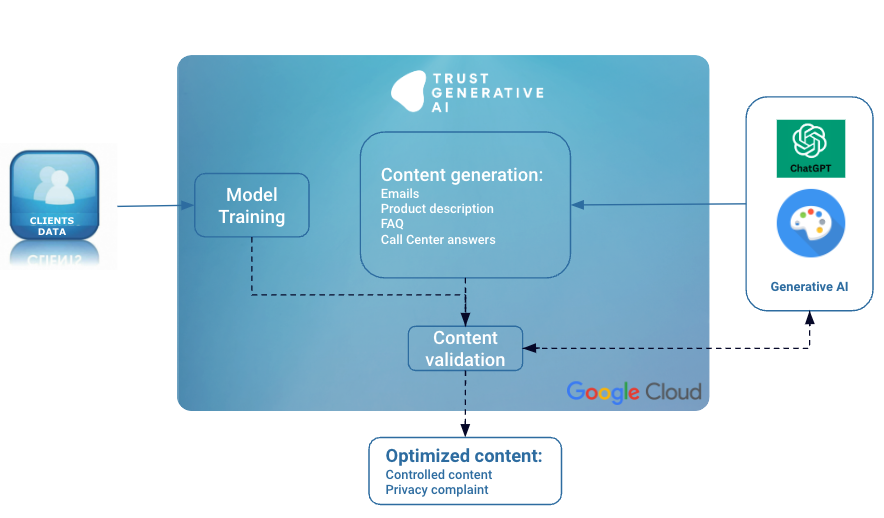
Making Science, the digital acceleration company, launches Trust Generative AI, a Generative Artificial Intelligence platform that solves two main problems on systems such as OpenAI: the difficulty of accessing non-public company data and the absence of updated information in generative models.

The launch comes as generative artificial intelligence, based on large language models such as GPT and Bard, aims to transform the way people work, taking companies to a higher level of automation and efficiency. A recent MIT study in which different professionals were asked to use Chat GPT to write reports, press releases and other business documents achieved savings of around 50% in report writing and improve report quality. 

However, large language models such as GPT-3 cannot access non-public company information and do not have recent information stored. The GPT-4 language model was trained with data up to September 2021 and didn’t update information after that date. “The availability of large language models and generative artificial intelligence opens up a world of possibilities unthinkable just two years ago. In this sense, Trust Generative AI is a solution that creates a bridge between private and recent company data and large models generated with public information. This will undoubtedly facilitate the adoption of Generative AI,” explains José Antonio Martínez Aguilar, CEO of Making Science.

The platform (developed on Google Cloud Platform and OpenAI) optimises both data cycles and the training of artificial intelligence models. It validates the answers obtained using models developed on Google Cloud Platform on private customer data and more recent data that does not exist in models such as GPT-3 and GPT-4.

Therefore, companies maintain complete control over their data and can generate less generic content, more aligned with their policies, and style guides optimised with up-to-date information. 

An example of the efficiency of Generative AI is how Trust Generative AI generated 100,000 product descriptions for the Ventis.it website in minutes and at a cost more than 10,000 times lower than traditional means of generation. The generated descriptions were more than 95% aligned with other descriptions generated by the editorial department and were produced using prompts optimised by Trust Generative AI. 

Trust Generative AI can also generate all types of content, such as call centre conversations, FAQs or emails, images and other entities, connecting to services such as Google Cloud’s Vertex Generative AI, DALL-E2 and Stable Diffusion.

In an environment of rapid technological change and uncertainty about the use of technology, it is crucial to develop tools that help build trust in the use of technology. Trust Generative AI aims to play this role.