Succeeding in the AI-Powered Search Era (SEO-GEO)

The search ecosystem is undergoing a significant transformation, driven by Generative AI and Large Language Models (LLMs). This new paradigm, the SEO-GEO Era (Search Engine Optimisation – Generative Engine Optimisation), signals that search is no longer a linear journey and that providing machine-readable, verified context is more critical than ever.

To thrive in this AI-first world, your content strategy must adapt to prioritise citation and trust over traditional ranking alone.

Key Strategies for AI Search Visibility

  • Focus on Unique, Valuable Content: Create content that fulfills users’ needs by being unique and helpful. Address longer, more specific questions that users are now asking in AI search experiences. Creating helpful, reliable, people-first content is critical.
  • Empower your brand: Everything starts with understanding the business and placing the brand at its core. Build brand authority through consistent assets (content, EEAT, structured data). Strengthen visibility via strategic collaborations and PR link building. Amplify presence through social platforms and cross-channel synergies.
  • Own your AI narrative: Create content for every layer of discovery, from users and search engines to AI models. Prioritise personalised content that can be easily indexed, referenced, and recognised by AI models.
  • Ensure Accessibility: Meet Google Search’s technical requirements, making sure Google can find, crawl, and index your pages. Verify that Googlebot isn’t blocked, your page works with an HTTP 200 (success) status, and the content is indexable.
  • Lead AI with AI: The perfect balance between human expertise and technological innovation. With our solutions like ad-machina and Trust Generative AI, we create content optimised for both users and AI models, personalised for audiences and designed for a multimodal ecosystem — all within a private and secure environment.
  • Go Multimodal: Enhance textual content with high-quality images and videos. Keep your Merchant Center and Business Profile information current to succeed with multimodal searches.
  • Understand the Full Value of Visits: Focus on the overall value of visits from Search, rather than just clicks. AI results may provide more context and relevant links, leading to a more engaged audience. Consider indicators like sales, signups, audience engagement, and information lookups to measure success.

By focusing on these strategies, you can create content that performs well in both classic and AI-powered search results, ensuring your site remains competitive and visible.

Brighton SEO 2025: My Key Takeaways

This April, I had the chance to attend Brighton SEO. It was my first visit since 2017 — and once again, it didn’t disappoint. The recurring headline? AI is no longer a buzzword; it’s redefining how we search, strategise, and create content. With dozens of talks happening at once, I’ve pulled together the ones that stuck with me most.

AI Meets Search

Josh Blyksal – What 10M AI Searches Reveal
Josh shared an eye-opening analysis of AI-based search behavior using data from ChatGPT, Perplexity, and others.

  • AI tools return results radically different from traditional engines—ChatGPT only overlaps with Google 12% of the time.
  • Each tool favors distinct content formats—listicles, comparisons, and direct answers often win.
  • Visibility in AI search still depends on being indexed by Bing (especially for ChatGPT).

Veronika Höller – Optimising for AI Search
Veronika reminded us that it’s not enough to write for Google anymore.

  • AI tools crave concise, clear, and regularly updated content.
  • She encouraged testing your content in AI platforms and analysing where they pull data from.
  • Optimisation now means creating multi-platform-ready content.

Smarter Content Strategies

Carl Poxon – Clusters with Purpose
Carl reexamined the idea of topic clusters. The challenge isn’t building them—it’s getting internal buy-in and making sure they reflect real user intent.

Oluwatobi Folasade Balogun – Sustainable SEO
Oluwatobi made a compelling case for content sustainability.

  • With most pages generating zero traffic, it’s time to stop publishing just for the sake of it.
  • Focus on fewer, higher-quality pages that genuinely serve user needs.
  • She also advocated for updating, reusing, and refining content to reduce digital waste.

Sarah Pokorna – Mindset-Based Marketing
Forget demographics—Sarah urged us to think psychographics instead.

  • Tailoring content to users’ mindsets (growth vs. fixed) leads to deeper engagement.
  • It’s a subtle but powerful shift in how we approach messaging and targeting.

Search Beyond the SERP

Ashley Liddell – The Rise of Social Search
Ashley argued that search isn’t just a Google-shaped box anymore—it’s a behavior.

  • TikTok, Instagram, and Pinterest are now key discovery tools, especially for younger audiences.
  • She highlighted the democratisation of search, where community engagement can outperform big budgets.
  • Winning on social search means being present, responsive, and genuinely helpful in your niche.

Alex Ighalo – Influencer Strategies for Underdogs
Alex showed how smaller brands can punch above their weight using data and automation.

  • Plan with AI, but leave creativity and relationships to real people.
  • Influencer marketing is now an SEO tactic in its own right.

Ray Saddiq – Multi-Channel Authority Building
Ray closed with a powerful message: real SEO strength comes from cross-platform presence.

  • Letting experts speak in forums, podcasts, and publications helps build both brand trust and E-E-A-T (Experience, Expertise, Authoritativeness, and Trustworthiness).
  • Visibility isn’t just about links—it’s about being recognised everywhere.

Final Thoughts
This year’s Brighton SEO was a clear signal: the game is changing.

 Success in search now means:

  • Thinking beyond the SERP.
  • Writing for both AI and human users.
  • Focusing on quality over quantity.
  • Meeting users where they really are.

Brighton, you’ve done it again. See you next time!

AI comes to Google: The future of SEO with SGE

SGE (Search Generative Experience) will be a major change in the search experience and the way results are displayed in the SERPs.

But first of all, what exactly is SGE? It’s a radical update from Google, which will start using AI to generate contextual answers to complex questions.

AI in search engines

The impact of ChatGPT since the end of 2022 and its very rapid integration into the digital status quo, especially among young people, has led tech giants (such as Google) to further accelerate the deployment of their AI-related technologies.

Within the search engine market, Microsoft has moved ahead with the integration of ChatGPT into Bing as early as 2023 and Google has responded quickly with the announcement of SGE, based on Gemini, its LLM that promises to be more powerful than GPT-4.

The common formula is the integration of an AI module on top of the search engine that not only directly answers complex queries accurately, but also enables deeper searches through a conversational interface.

What do we know so far about the impact of SGE on SEO?

SGE will bring about an evolution in the way we search for information on the Internet, as ChatGPT has already done.

SGE is being tested in the USA, and the SEO team at Making Science has already been testing this new experience to draw some preliminary conclusions before its final international roll-out:

Several sources of information

This new AI module draws from many sources to offer more complete information:

  • Media: Very relevant, especially in information searches. Media attention, through PR teams, is essential to manage the conversation around brands.
  • Shopping feeds: PDPs everywhere in searches closer to conversion. A good product feed is essential to appear here. It seems that achieving a more complete shopping experience is one of SGE’s main objectives.
  • Reviews: Google knows that reviews are powerful conversion triggers, and integrates them into SGE for searches close to conversion. The focus should be on optimal Schema markup and online reputation management.
  • Social media: Social media conversation is especially relevant for topical or trending searches. Inspirational approach.
  • Google Maps / Business Profile: Many of the searches, even when not explicitly geolocated from the query, return local SEO results.
  • Multimedia: Text, images, video, FAQs, social media… what seems evident is that covering searches with multiple formats is going to be essential to capture the key terms in SGE

SEO strategies impact

There are a few things that seem to be clear, and that don’t really change the ‘traditional’ approaches to SEO strategies that much:

  • The classic Google Top 3 will determine what comes out of this block.
  • There will still be ads (as they are Google’s main revenue stream), but to a lesser extent. At least at launch.
  • SEO-optimised elements or content will continue to be relevant in order to match users’ searches

And what will the SEO performance be like?

Organic traffic is expected to decrease because it is assumed that the traditional SEO results will show even lower in the SERPs (with the consequent drop in CTR): Google as a “media” in its own right, which means a drop in overall SEO CTR.

However, the user has the opportunity to become more qualified in conversational mode before clicking on a link, which could benefit SEO conversion.

In addition, users could make even more intensive use of Google, especially younger audiences, who now turn to platforms such as TikTok. In any case, it remains to be seen if this hypothesis is true and, if so, if it will compensate in terms of traffic for the drop in positions of traditional organic results.

Types of content that could be most affected by SGE

We predict that the impact of SGE will be even greater for some types of content:

  • General informational content: Direct answers to factual questions, definitions of concepts, general explanations of a topic, etc. SGE could directly answer many general information queries without the need to take the user to another website.
  • Comparative content: Such as product comparisons, rankings of best options, pros and cons reviews. SGE could generate this comparative content in an automated way.
  • Simplified content: Such as summaries, simplified guides, step-by-step explanations of a process. SGE could extract and synthesise the most relevant information.
  • Repetitive content: Such as similar listings on a topic, frequently asked questions, duplicate content. SGE would reduce the need for multiple pages of redundant information.
  • Local content: Location-specific answers, such as business hours, local business addresses, geolocated recommendations.

Websites that rely on this type of content for their organic visibility should rethink their SEO strategy with the arrival of SGE if they don’t want to be negatively affected.

Conclusion

Essentially, Google’s SGE marks a revolutionary development in SEO. With AI shaping the digital realm, it’s vital to keep pace with these shifts and comprehend their significance to uphold an advantage in online presence

Top 5 Black Friday and Black Week 2023 SEO Tips for Boosting your Visibility

The countdown to one of the season’s largest shopping holidays and the biggest sale of the year, Black Friday 2023 and Black Week, has officially begun. In 2023, Black Friday falls on Friday 24 November and Black Week also extends over the days before this date. The holiday marks the start of the Christmas shopping season and is an opportunity for people to shop digitally as well as in physical stores at favourable prices.

Although it may seem relatively far away, it is not too early to start optimising your website, quite the opposite. In order to see results in time, it is important that you work on your digital marketing and SEO strategy as soon as possible to boost performance and maximise Black Friday sales. SEO is more important than ever when it comes to improving your visibility and competition is high during Black Friday. If it’s not already part of your long-term strategy, it’s a good idea to implement as soon as possible, it’s not a quick fix but a strategic measure that drives valuable traffic.

Make 2023 your Black Friday year with the help of Making Science’s top 5 tips!

What is SEO?

SEO stands for Search Engine Optimisation, and is a method that uses technical measures and content optimisation to increase organic traffic and rank higher on the results page of search engines such as Google, Bing and more.

  • Website Performance: During Black Friday, customers are flooded with adverts and offers from thousands of merchants. To succeed with your Black Friday sales, you need to stick out. But sticking out only with special deals is not enough if your website does not load fast or has technical issues. A slow website that performs poorly could lead to losing  potential customers, which is not desirable during the biggest shopping holiday of the year. This applies to both mobile and desktop performance, it’s important that the two are in sync and perform seamlessly. Review your website’s performance well in advance and make any technical changes necessary to keep it running at peak performance. A common misconception is that SEO strategy is only about optimising texts and adding keywords, which is not true at all. The technical SEO aspect is important as well for ranking higher in search results and it is common practice for SEO professionals to work closely with developers.
  • Optimise Landing Pages: To improve your visibility for searches related to Black Friday and Black Week, it is recommended to create optimised landing pages dedicated to this specific occasion. Don’t wait too long to create them, as search engines need some time to start crawling and indexing the pages. The landing pages for Black Friday, Black Week and Cyber Monday can remain the same and be reused every year. The important thing to remember is to keep them “evergreen”, which is used to describe content that is relevant and fresh all year round. In addition to creating new pages, it’s a good idea to optimise any existing landing pages you have around the topic, freshen them up and make them relevant so you can easily see results in your traffic. Be thorough and update things like Meta Titles, Meta Descriptions, H1 titles and image tags. See below for an example of how a company selling electric toothbrushes can optimise their site.
    • URL:  company.com/black-friday
    • Meta Title: 40+ Black Friday Electric Toothbrush Deals 2023! Best in test & Black Week prices!
    • Meta Description: Black Week & Black Friday electric toothbrush deals 2023! Discount on electric toothbrushes online, big savings. Rechargeable, efficient & affordable!
    • H1 Title: Best Black Week & Black Friday Electric Toothbrush deals 2023.
  • Write text for humans. And for robots: As previously mentioned, SEO is something that, when implemented in existing routines, is hard to forget when it comes to working with texts and other content on a website. One example is how you choose to formulate and structure texts. Writing for Google’s robots is about being clear, correct and using important keywords. If your goal is to gain organic traffic, writing for bots is important as they help drive more traffic to your site. However, it’s equally important that you write for humans as they are ultimately the ones who make the choice to shop on your site. Therefore, write texts with your human audience in mind, sprinkling your keywords in a natural way and writing in ways that appeal to your target audience. It’s that balancing act of writing in an SEO-friendly way for both humans and robots that is important to get a feel for. It’s something that’s not just important for Black Friday, but all year round.
  • Collect positive reviews: The search engines value pages with high authority which can be earned in a variety of ways. Product reviews are one way to gain authority as both positive and negative reviews are considered by search engines as signals and could affect organic rankings. Unsure what volume of positive reviews is needed to raise or decline your organic rankings, but do not forget the manual graders that will analyse the SERPS* in order to decide which result is relevant and needs to be prioritised. Besides being favoured by search engines (and Google!), reviews are important as they can help convince hesitant customers to go through and finalise their purchase. Working on your reviews and customer satisfaction is important all year round, but especially important to focus on, in order to win new customers by integrating them into your pages for Black Friday and Black Week 2023.*Search Engine Result Pages
  • Keyword strategy for Black Friday: A well-thought-out keyword strategy is what takes you from start to finish and there are certain things that are particularly important to consider when it comes to SEO for Black Friday. One of these is to work with long-tail keywords, which are keyword combinations consisting of two or more important keywords. The goal of long-tail keywords is to lead the customer in the right direction and give them what they are looking for. Black Friday and Black Week are already identified as two of the most important words to optimise for. Keyword combinations such as Black Friday Deal, Black Friday Offer 2023 and Black Friday savings together with product-related words thus provide niche and specific search results. See examples below:
    • Black Friday Electric toothbrush Deal
    • Black Friday Offer Airpods
    • Black Friday savings Trainers

Cyber Monday

Black Friday always falls on the Friday after Thanksgiving, which in 2023 is 24 November, but it’s not the only day to watch. The following Monday, 27 November, is what is known as Cyber Monday. Initially, Cyber Monday was the Black Friday of e-commerce, but in today’s climate, Black Friday discounts in physical stores have also moved online. When optimising for Cyber Monday, it is important to identify keywords, keyword combinations and phrases that are specific to that day. Black Friday and Cyber Monday are close together, but that doesn’t necessarily mean that search behaviour is exactly the same between the two. When in doubt, it’s a good idea to use Google Keyword Planner, Google Trends or tools like SEMrush etc, to analyse search trends and relevant keywords.

Black Friday is an incredible opportunity for all e-commerce businesses to boost their sales. Investing in SEO for the festive season is a simple, cost-effective measure that continues to deliver results. 

Making Science is a full-service media agency with extensive experience in SEO optimisation on different platforms. Contact us if you want to know more about how you can create a strategy to improve your Black Friday 2023 SEO!

[button color=”accent-color” hover_text_color_override=”#fff” size=”large” url=”www.makingscience.co.uk/contact” text=”GET IN TOUCH TO LEARN MORE” color_override=”#f0076f”]

TikTok SEO – Does your company have an SEO strategy for TikTok today?

TikTok is a relatively new platform that is rarely prioritised or part of SEO strategies. However, recent research into young people’s online search behaviour has shown that marketers may need to rethink their approach to implementing SEO on TikTok. For Gen Z, is TikTok the new Search Engine.

Studies conducted by Google show that about 40% of young people today prefer Instagram and TikTok’s search function over Google’s e.g. Google Maps, to find what they are looking for. The studies show that young people prefer visual content and therefore prefer to use platforms such as TikTok, Pinterest or Instagram with a strong focus on visual content in various forms. This can range from suggestions for beauty products to recipes or hotel and restaurant tips.

Google’s vice president Prabhakar Raghavan, has pointed out that few of today’s youth have used physical maps, meaning that map products on various devices do not meet the expectations young people have of a map. There seems to be a gap between the features that tech devices present and the reality that today’s youth want to see represented digitally.

If a person wants to find a recipe for a particular ingredient, for example a salmon dish, they may choose to do a Google search using the keywords salmon + recipe. They will then go through the results that look most appealing, perhaps based on its title or the time it will take to cook. The time taken to go through 2-5 recipes is likely to be between 3-5 minutes.

What TikTok does is to give its users an opportunity to view short video clips summarising the preparation of 3-4 salmon recipes in 1 minute. Video snippets of the ingredients included in the recipe and a short recipe description in the form of recorded audio allow users to quickly get an idea of the level of difficulty and time required without having to read text. TikTok has also launched a function to play the clips at double speed, so that the user can form an opinion even faster.

How do I optimise TikTok for SEO and make my TikTok searchable?

SEO can help TikTok content climb higher in the search results, driving more traffic and making it easier to reach a large number of people. Creating an SEO strategy for TikTok is not complicated or time-consuming, read on to find out Making Science’s top 4 tips for creating an SEO strategy for TikTok.

Keyword analysis – How do I find SEO Keywords for TikTok?

The first step in working with SEO at TikTok is to have a keyword analysis to identify which keywords you should focus on ranking higher for. The analysis can be used to identify words that is important for a company to rank for, both those that you currently rank for but that you want to perform even better on, as well as those that the company should rank for but does not. 

An example of how keyword analysis can be used in your social media strategy is for hashtags. It is common for users interested in a certain type of content, product or brand to click through hashtags in order to find more related videos. By including your most important keywords as hashtags and in your video title and description as well, you optimise the content for users and for TikTok as a search engine. The use of hashtags in advertising is still limited on Tiktok, but as long as you publish it organically and then pull it up as a spark ad, the hashtags will follow.

Video Descriptions – important for your TikTok SEO

The maximum number of characters in the video description was recently increased from 300 to 2200 characters, increasing the possibility to include important keywords and a more accurate SEO description. It is important to be aware that it is not the number of words that makes a video or an account rank higher, but the use of the right words and relevance. This is why it is so important to use a keyword analysis to point you in the right direction when it comes to choosing search terms rather than creating a spammy description. 

Microblogging – Embed your TikTok videos in other platforms

When it comes to SEO strategies for TikTok, microblogging is another option. It involves writing and optimising a text on an external platform for your important keywords and including a link to a TikTok video. When users later search for content related to your keywords on other platforms, you can gain traffic to your TikTok account. Platforms that can be used for microblogging include Twitter, Facebook and Linkedin or your website where you can embed your TikTok videos in pages or blog content.

Engagement – Reaching a wider audience

Something that the majority of all social media platforms have in common is that engagement is the key to success. One of the ranking factors that TikTok uses is engagement: accounts and videos with high engagement will appear higher in the search results compared to those with lower engagement. Engagement means how users interact with your account as well as how your account interacts with others, your followers as well as other accounts and users. Interact by liking and commenting on content relevant to your brand to potentially improve your TikTok SEO.

One suggestion is to select a variety of suitable creators and brands in your niche and engage with what they post on TikTok. Be inspired by competitors and other creators on the platform to create relevant content that your audience might be interested in!

Making Science is a full-service media agency with extensive experience in SEO optimisation on different platforms. Contact us if you want to know more about how you can create an SEO strategy to improve your TikTok SEO!

[button open_new_tab=”true” color=”accent-color” hover_text_color_override=”#fff” size=”medium” url=”www.makingscience.co.uk/contact” text=”Contact Us” color_override=”#f0076f”]

What is ChatGPT and how can SEO experts use it?

There has recently been a growing interest in AI technology and, more specifically, OpenAI’s ChatGPT product. In this week’s blog post we will learn what ChatGPT is and how to use it in SEO.


What is ChatGPT?

ChatGPT is a language model developed by OpenAI, a leading research organization in the field of artificial intelligence. It is a type of AI technology that uses deep learning algorithms to generate human-like text based on a large corpus of training data.

ChatGPT has been trained on a massive amount of diverse text data, making it capable of generating text in various styles and on a wide range of topics. This makes it a versatile tool that can be used for different applications, such as language translation, text summarization, question answering, and content generation. It has become a popular instrument for building conversational AI systems, such as chatbots, as it can generate coherent and contextually appropriate responses to different questions. Overall, ChatGPT is a powerful and sophisticated AI technology that has the potential to revolutionize the way we interact with computers and automate many language-related tasks.

Is ChatGPT good for SEO?

ChatGPT has the potential to be a useful tool for SEO (Search Engine Optimization), but it is not a silver bullet and has some limitations. ChatGPT can be used to generate optimized content for websites, such as product descriptions or blog articles. It can also assist with keyword research by generating suggestions for relevant keywords and phrases.

However, it is essential to remember that the generated content may not always be accurate or high-quality. It may lack the creativity and originality that is often necessary for effective SEO. Additionally, there may be ethical considerations to using AI to manipulate search engines, such as the impact on content creators and the overall quality of online content. It is also worth noting that search engines are constantly updating their algorithms to detect better and penalize manipulation, and they may be able to detect content generated by AI.

In conclusion, while ChatGPT has the potential to be a useful tool for SEO, it is not a guaranteed solution and should be used with caution and in conjunction with other SEO best practices.

How are SEO experts using ChatGPT?

SEO experts are using ChatGPT in various ways to improve their search engine optimization efforts. Some typical applications of ChatGPT in SEO include:

  • Content Generation: ChatGPT can be used to generate high-quality, optimized content for websites, such as product descriptions, blog articles, and meta descriptions. The generated content is designed to be SEO-friendly, with a focus on incorporating relevant keywords and phrases.
  • Keyword Research: ChatGPT can assist with keyword research by generating suggestions for relevant keywords and phrases. This can help SEO experts identify keywords they may not have considered and improve their content’s visibility in search results.
  • Competitor Analysis: ChatGPT can be used to analyze competitor websites, identifying their strengths and weaknesses, and helping SEO experts to stay ahead of the competition.
  • Chatbots: ChatGPT can be used to build chatbots for websites, which can help to improve the user experience and increase engagement. Chatbots can answer customer questions and provide information, reducing the workload for human customer service representatives.

It’s worth noting that ChatGPT is just one tool in an SEO expert’s arsenal and should be used in conjunction with other best practices and techniques. Additionally, as search engines continually update their algorithms, it’s important to stay up-to-date on the latest SEO trends.

 What are the drawbacks of Chat GPT and potential ethical considerations?

 There are several limitations to using ChatGPT for SEO:

  • Accuracy: While ChatGPT is a very advanced language model, it is not perfect and may generate incorrect or unreliable information. This can be a concern when using it for SEO, as the accuracy of the information used to optimize websites and content is critical.
  • Scalability: Depending on the model’s size, using ChatGPT for SEO on a large scale may require significant computational resources and be expensive.
  • Lack of creativity: Although ChatGPT can generate human-like text, it may lack the creativity and originality that is often necessary for effective SEO.

In terms of ethical considerations, it is important to consider the potential consequences of using AI to generate optimized content and manipulate search engines. Some may argue that this practice undermines the integrity of search engines and could lead to the dissemination of inaccurate or misleading information. Additionally, there may be concerns about the impact on content creators and the overall quality of online content.

It is essential to carefully weigh the potential benefits and risks of using ChatGPT for SEO and ensure that it is used responsibly and ethically.

How to think about ChatGPT as an SEO expert

As an SEO expert, it is crucial to approach ChatGPT as just one tool among many in your arsenal, and to use it thoughtfully and strategically.

Here are some key considerations when thinking about using ChatGPT for SEO:

  • Quality over Quantity: While ChatGPT can generate a large amount of content quickly, the quality of that content may not always be up to the standards you require. It is important to prioritize quality over quantity and carefully review the content generated by ChatGPT to ensure it meets your standards and is SEO-friendly.
  • Context Matters: ChatGPT has been trained on a large corpus of text data, but it may not always understand the nuances and context of specific topics. It is essential to be mindful of this and to provide clear, detailed instructions when using ChatGPT for content generation or keyword research.
  • Ethical Considerations: There may be ethical considerations to using AI to manipulate search engines, such as the impact on content creators and the overall quality of online content. It is important to be mindful of these considerations and to ensure that your use of ChatGPT aligns with your ethical standards and values.
  • Algorithm Updates: Search engines are constantly updating their algorithms to detect better and penalize manipulation, and they may be able to detect content generated by AI. It is vital to stay up-to-date on the latest developments and trends in SEO, and to continually evaluate your use of ChatGPT in light of these changes.
  • Integrating with Other Tools and Techniques: While ChatGPT can be a valuable tool for SEO, it should be used in conjunction with other best practices and techniques. This may include conducting keyword research, analyzing competitor websites, and building high-quality backlinks, among other things.

In conclusion, as an SEO expert, it is important to approach ChatGPT with a strategic and thoughtful mindset, and to use it as just one tool among many in your toolkit. Get in touch with our SEO experts to utilise AI effectively in your SEO campaign. 

PS: This article was written exclusively with the help of ChatGPT. A human reviewer corrected discrepancies and structured the content.

How to Dramatically Increase the Reach of Your Blog Posts with Google Discover

How to Dramatically Increase the Reach of Your Blog Posts with Google Discover

What is Google Discover?

Officially, Google Discover is what used to be known previously as Google Feed. In short, it is a Google function that is based on offering content to the user without asking for it (that is, it does not rely on any search intention) based on different sources. Google Discover is only available on mobile devices and does not collect defined themes. However, in my opinion, Discover has ended up turning into something else. Basically it is Google’s “official clickbaiting platform”. As we have indicated, it is not based directly on search intent, so the best way to get traffic is to attract the attention of mobile users through eye-catching headlines and current content. “Discover is not SEO, but nevertheless we have managed to use the platform to our advantage to boost the traffic of informational content on client blogs with a minimal investment. Do you want to know how?”

How to integrate Discover into an SEO strategy?

To carry out an action of this type you only have to memorize three simple steps:

  1. Post a blog post.
  2. Post an organic tweet with a link to this blog post.
  3. Boost your tweet through a paid campaign to maximize its reach.

We will delve into each point separately to execute the strategy without errors.  

Post a blog post

To do it correctly, the following steps must be followed:

  1. Choose the theme: It is very important to know the trends of Google Discover during the days surrounding the publication to be able to target the content (remember that the content is not for SEO, it is for Discover).
  2. Define an eye-catching headline: The goal should always be capturing the attention of a user who is not looking for your content.
  3. Find an attractive image: The image must be 1200px wide.
  4. Write the post and do not publish it yet: The blog post should include interlinking to the main pages of the project (either informational or conversion) to take advantage of referral traffic.

Before continuing with step 2, you should coordinate with the Paid Social department. A good time to get old friends back!  

Post an organic tweet with a link to this blog post

This second step is divided into three phases:

  1. Define an attractive copy: As in the blog post itself, the goal is to capture the attention of as many users as possible, in this case through Twitter.
  2. Keep the link to the entry handy: The tweet should include the exact URL of the post, without using URL shorteners like Bit.ly
  3. Post the tweet right after the entry has been published on the blog: There is no time to waste, which is why coordination between departments is so important.


Boost your tweet through a paid campaign to maximize its reach

In turn, this last step is also divided into 3 phases:

  1. Set the budget for the outreach campaign: In our experience, a budget of around 500 euros is more than enough to achieve the goal.
  2. Launch a paid campaign with micro influencers right after the organic tweet is published: Between 500 and 10,000 followers per influencer is more than enough. They should concentrate the revitalization of the publication in a short period of time, no more than 4-5 hours. To contact influencers and facilitate the management of the campaign, you can trust online platforms such as Social Publi.
  3. Wait for the post to appear organically in the Discover feed: And don’t forget to follow the performance in the search console.


Summary of some key aspects

If you want the action to go really well, you must focus on two basic objectives:

  • Maximize reach.
  • Concentrate all social investment in the shortest possible time.

Once Google detects these signs of interaction and engagement, it will show our post in the Discover news feed, being able to reach a large number of potentially interested users. As far as we know, if a CTR of 10% is exceeded in Discover, the post can stay for several days and get even more traffic. Go for it! To give you an idea, we have achieved with just one post about 360,000 impressions (only in Google Discover, discarding the rest of channels) with just 500 euros of investment. Do you know a better offer?

What is Google Bert?

What is Google Bert?
Google has spent years making big changes and small adjustments in its search engine to gradually improve its algorithm, in order to always be able to offer the user the answers to everything in an easier, simpler and faster way.  

What is Google Bert?

Google Bert is a new artificial intelligence system devised by Google to improve its search engine, since it has the purpose of being able to better understand the queries made by users in order to offer a more appropriate answer, thus better understanding the language that we use on a day-to-day basis. In short, what you are trying to do is not rely so much on the KWs that we use when searching, but rather try to understand the context in which we use those KWs. Therefore, Bert is not as such a factor by which you can rank or by which it can be measured if your page is good or not for this algorithm, but this update has brought enough changes in the positioning because it tries to teach the user exactly what he is looking for. For example, if you do a Google search for “places where there is no beach”; Google collects the important KWs as “sites” or “beach”, and ignores the context of the “no” in that sentence, so the first result that appears is: “The 10 best rated beach destinations in Spain” something that it does not respond to what we are looking for. For this reason, Bert wants to help us achieve everything we are looking for in order to offer exactly the result we wanted to find at all times.  

What implication does it have for SEO and how to improve it?

Obviously, this update is going to be a headache for many SEOs since it will provide us with many changes of positions in different projects without the need for it to be a penalty, just for the fact of adapting the result to the user’s intention. The example that Google gives us in this case is that of a traveler who wants to know if a Visa is needed to travel from Brazil to the USA, but Google, by not reading prepositions or determiners before, and only keeping the KWs for “traveling” , “Brazil” or “USA”, the first results it shows us is “How to travel from the USA to Brazil”. With Bert now it will offer us the appropriate result, so, to improve web positioning, the key will be to apply some changes in the way of writing both the text and the goals. In summary, the advice that Google gives us is to get away from everything aseptic that is in Google’s goals and try to approach it in a less cordial tone, resembling what the user is really looking for. We have to move away from all goals that omit words such as prepositions or determiners because they don’t fit in the characters, and move closer to naturalness with a more conversational tone. Therefore, from now on and for the future, all the content that we create on the Internet must be made even more focused on the user and not focused on the KWs that we want to position; perhaps in the future, Google will completely ignore the KWs of the goals and may come to understand all the content that is written, to give the best response to the user according to the context and intentionality they have.

Screaming Frog Version 13.0 Basic Guide

Screaming Frog Version 13.0 Basic Guide
Screaming Frog presented us on July 1 its new release Spider version 13.0 or as they call it “Lockdown”. This new update of the famous SEO tool promised great surprises and it has been so, it has new features that will help SEO professionals who are dedicated to improving web pages a lot. Let’s find out what this new version offers us!  

Duplicate content detection

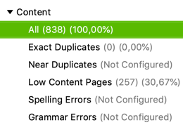
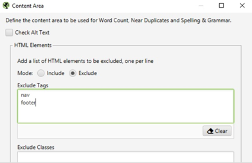
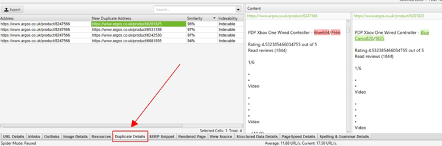
As you see it! Now with the version of Screaming Frog 13.0 it is possible to detect duplicate or very similar content in the domain that is analyzed in the tool. This will help to improve the content of our website avoiding cannibalizations and possible penalties from Google. In order to see this functionality, it is as simple as going to the right section of the tool, selecting “Overview” we will find a “Content” section at the end: Within “Content” the tool allows us to differentiate between “Exact duplicate content” that will show us which pages have exactly the same content and which can cause cannibalizations and errors in the positioning of the page. But the tool goes further, because it can also provide us with pages that have very similar content and that it would be positive to improve to attack keywords that are not being worked on. These two filters are very interesting, since they allow us to see at a glance an action that in other circumstances could take a long time to detect, depending on the volume of URLs on the web that we analyze. The tool also allows you to further refine your search with filters in which HTML elements are added: Finally, in order to easily view the “Almost similar content”, the tool has added a “Duplicate content” tab at the bottom where it will display the content fragment that has been detected as the same or as very similar: Within the content analysis we can also know which pages have little content in order to expand it.  

Spelling and grammar check

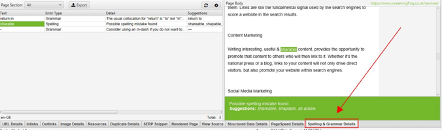
This is another of the new features of version 13.0, and as they already mentioned, this functionality escapes a little from its main SEO analysis functionalities, but they also understand that controlling and improving the quality of the site is vital for the user and we they want to help easily detect these errors that can sometimes be easily overlooked.  

Link position on the page

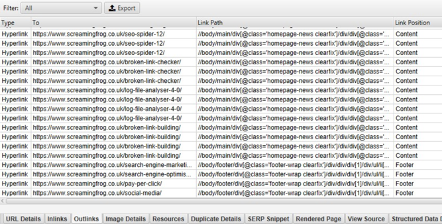
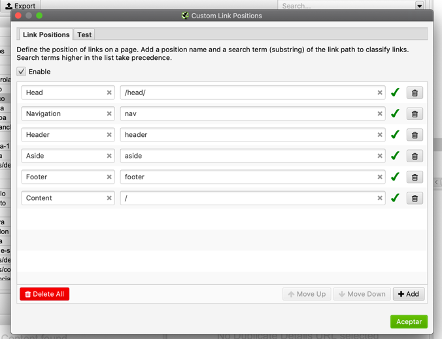
The Screaming Frog team tells us in the presentation of the new version 13.0, that they had many requests related to links from professionals and have decided to improve this section, so that all of us who are dedicated to SEO can make the best decisions. They have heard our prayers and created new link attributes!   Now you can see the position of the link within the page, such as if it is in the header, in the content or in the footer: The position in which the tool shows you where the link is located on the page is based on HTML5, but not all websites will respond to this language, so they also give us the option to configure the “Position of the links ”to make the tool as accurate as possible.  

Http and https detection

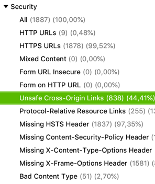
Screaming Frog could already identify between an HTTP URL, mixed content and dangerous elements, but now with the improved filter of “Unsafe Cross-Origin Links” or “Insecure Cross-Origin Links” you can quickly find problems with insecure forms, or links http and poorly executed security headers. In this sense, it seems that they want to continue expanding the information on the tool.  

APIs

Another interesting feature that we have seen is the integration of the Page Speed ​​Insights API with the new Core Web Vitals metrics, you can also see the JavaScript code that would be good to eliminate because it is not used and a summary of JavaScrip coverage in the Speed ​​Reports section of the page. This section will help you detect potential Java savings that are not used on the page. On the other hand, the obsolete API for Ahrefs integration has been removed in this version.  

New Versions of Screaming Frog

On July 15, they released version 13.1 and on August 4, version 13.2, these updates are intended to correct minor malfunctions and introduce improvements thanks to the feedback from the professionals who use the tool. Also, in version 13.2, custom search in code has been improved. We see that they are taking the improvement of the tool very seriously and all these new functionalities promise to be very interesting. We encourage you to try it and tell us about your experiences.   Enjoy one of the best SEO and web analysis tools!

How companies are increasingly betting on positioning in Google

How companies are increasingly betting on positioning in Google
Many companies in 2020 in Spain had already started to work on their positioning in Google. They knew the importance of working on SEO to achieve top positions in internet search results in order to face their competition. But there were still companies, especially SMEs, that had not left the offline world. Last March 2020, a strong crisis began in Spain due to COVID-19, which dragged multiple sectors with it. A global crisis that also affected exports and imports, and with all this, has brought a fairly strong economic and social crisis. In this situation, people remained in confinement in their homes, so that the behavior of consumers and, therefore, users, had a strong change. The trends changed, the user had to satisfy all their needs and new concerns, placing orders online with home delivery. Who was the first to benefit from this? Of course, the giant, Amazon. However, at this point, companies were quick, initiating a new strategy to take advantage of new user trends to their benefit and what e-commerce should have advanced in 10 years, it advanced in just two months. Clearly, as in all crises, there are some sectors more affected than others, but many of the SMEs that only had an offline presence could have stopped their decline earlier if they had already been present online. This is where the interest of companies towards organic positioning began, towards being visible on Google.  

Investment towards SEO for online positioning after the crisis

During the crisis, one of the benefits of organic positioning is that you can see the trends of users on the internet, Google searches, what are they looking for? what do you need? what do they want? and above all, HOW DO THEY SEARCH? Thanks to this, a company that has good SEO consultants can turn a crisis into an opportunity and redirect the steps of its strategy. According to Nielsen, 6 stages in consumer behavior have been identified during the Coronavirus:

  • Proactive purchasing (food and health oriented)
  • Reactive health management (protection with masks and hygiene products)
  • Preparation of the pantry (large food purchases)
  • Preparation for life in quarantine (increased consumption and online purchases)
  • Restricted life (stock limits and search for alternatives)
  • Living ‘normal’ (back to normal, but with more hygiene restrictions)

Due to search changes in users and traditional companies have been forced to find alternatives to face the crisis, business opportunities have multiplied, opening the door to Digital Marketing agencies. In this situation, many companies have used what they invested in offline to invest online. And, of course, you had to position yourself in Google, the search engine par excellence in Spain, in order to be present and cover all those searches of users on the internet. The advantage of positioning in Google at an organic level is that it allows you a longer-term and cheaper online presence than other Marketing strategies. A good positioning strategy in organic Google will allow you to be in the first positions so that when the user searches for certain terms, which must be studied and known, they will find us as a company through an attractive result and that, at first glance, responds to their concern and enter our website to satisfy your need. This will translate into user traffic to our website, which increases the possibility of sale.  

Importance of local positioning in Google

Another benefit of organic positioning in Google, SEO, is local positioning. Users, before leaving their homes, perform their search on Google to find what they want in their city or in their surroundings based on proximity, trust because the company has a website and contact information, has a good online presence, ratings, etc. The SEO Local allows you as a company to cover all such information that the user wants to find, to give you that confidence and achieve your search terms by a previous study of local keywords. With the COVID-19 crisis there has been a strong trend in consumers towards saving and supporting small local businesses. But, if as a company, you are not present locally on Google, you cannot easily reach those searches so that users find you and go to you. Even more so with de-escalation, where the user yearns to go out and consume outside the home after having been confined for so long.  

Changes in Google towards organic positioning

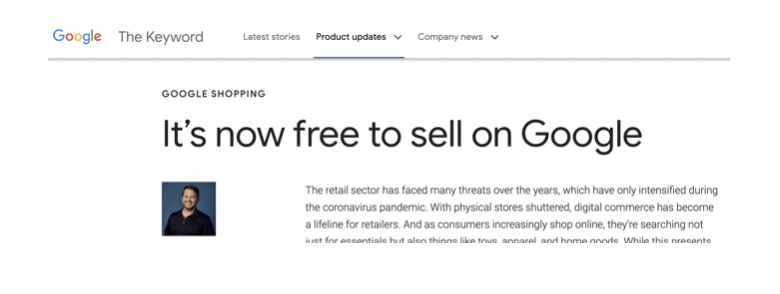
Such is the importance of local positioning in Google at an organic level that the search engine itself has been introducing in a short time many changes in its search results. A change aimed at providing users with news and results of local interest in a more prominent way, that is, due to their location. In addition, Google has improved even more search results, providing rich content and providing value to the speed interlacing of a site by means of interest to users, and thus avoid news fake and being more accurate results showing. On the other hand, Google, seeing how well positioned Amazon is due to its strong online visibility, realized the importance of organic positioning itself, so it has begun to introduce organic results in Google Shopping to address the giant in this crisis. From all this we draw a fairly clear conclusion , and that is that in times of crisis we must always reinvent ourselves and fight to get ahead always adapting , as a company, to our rescuers, users , our clients. Benefit from the internet, where users spend their days and always monitor and analyze trends to respond and be there first. The trend of buying online will be somewhat reduced when we return to normality, but this increase and progress has come to stay and with enough force.