

The End of Keywords? How AI Assistants Will Replace Search Ads

You’re late for a meeting, and you desperately need a coffee. Do you meticulously type “best-rated independent coffee shop near me open now” into a search bar? Or do you simply ask your phone, “Hey, where can I get a great coffee, like, right now?” and trust the friendly voice to guide you?

Welcome to the age of instant answers. We’ve outsourced our impatience to AI assistants like Gemini, ChatGPT, and Claude. We want information served up on a silver platter — quick, clear, and without the tedious effort of actually searching. This shift in human behavior isn’t just changing how we find a good latte; it’s sending shockwaves through the world of paid advertising. As AI-powered answers become the norm, the familiar ground of keyword bidding is starting to feel a lot less stable. For us Paid Search Managers, this isn’t a distant threat; it’s the new reality knocking at our office door. But is it an apocalypse or an opportunity? Let’s find out.

Part 1: The good old days of keyword herding and its limits

Remember when our lives revolved around Excel sheets filled with thousands of keywords? We were digital librarians, meticulously curating lists of broad, phrase, and exact match terms. We obsessed over every “KTV Karaoke in Soho” and “best nude matte lipstick“, believing that with enough granularity, we could capture every possible user query. It was a game of precision, control, and endless A/B testing of ad copy. 

But let’s be honest, it was a flawed system. 

This manual approach had its limits:

  • The long-tail blind spot: We could never keep up with the sheer volume of unique, conversational search queries. As Google has noted for years, 15% of queries every day are new searches they’ve never seen before. This manual, keyword-first approach meant we were constantly missing a growing segment of user intent.
  • The intent guessing game: A keyword is just a clue, not the full story. We were constantly trying to infer the user’s true intent, and often getting it wrong.
  • The burnout: The sheer effort of managing these sprawling campaigns was immense. It was a reactive, often exhausting, process of plugging leaks in a dam that was constantly springing new ones.

We were playing checkers while our users started playing 3D chess with their search behavior.

Part 2: The AI tsunami and the challenges it brings

Enter the AI revolution. Platforms are no longer just matching words; they’re interpreting intent. With assistants like Copilot in Microsoft Advertising and Gemini powering Google’s ad stack, the game has fundamentally changed.

In Google’s ecosystem, this shift is most visible in two key areas: Performance Max and the recent upgrades to standard Search campaigns with AI Max for Search. This isn’t a new campaign type, but an optimisation layer that infuses traditional Search with PMax-style AI. The engine behind this, Gemini, can now understand long, complex queries and match ads based on inferred intent, not just keyword syntax, to improve two main things:

  1. Search term matching: It moves beyond keyword syntax to match your ads to queries based on the inferred intent of the user.
  2. Asset optimisation: It dynamically customises your ad copy and can even expand your final URL to a more relevant landing page on your site.

This presents several challenges:

  • Shrinking visibility & plummeting CTRs: The most immediate impact is the rise of the “zero-click” search. AI overviews answer user questions directly on the SERP, meaning there’s less reason to click. Studies show this can reduce click-through rates by 8 to 12 percentage points, a staggering 20–40% relative drop. Ads are simply being seen and clicked less.
  • The great ad placement shuffle: Ads are being pushed around. As Google’s AI Overviews prioritise direct answers, ads are often relegated below the fold, especially for longer, more descriptive queries. The top spot isn’t what it used to be.
  • The CPC paradox: While CTRs may fall, the clicks we do get are often from users with higher intent who didn’t get their full answer from the AI. This leads to better-qualified traffic, but also more intense competition and higher cost-per-click for those valuable top spots.
  • From keywords to “intent layers”: As Google Ads Product Liaison Ginny Marvin explained, keywords are now just one of many signals. The system’s ability to understand a user’s goal makes our granular keyword lists less and less effective. The AI is now the one making the connection between a query and an ad.
  • The black box problem: With AI making more decisions about ad serving and asset combination — especially in PMax, which runs across all of Google’s channels — there’s a growing sense of opacity. We provide the ingredients (assets, landing pages, audience signals), but the AI is the chef, and it doesn’t always share its recipe.

The ground has shifted from “gaming the system” with keywords to genuinely “being the best answer” for a user’s underlying need. The impact isn’t uniform. The auto industry sees volatility as AI tries to answer complex, feature-based queries. Meanwhile, sectors like legal and finance face a direct threat as AI becomes capable of answering complex informational questions, potentially disintermediating them entirely.

Part 3: Ride the wave with key strategies to embrace AI in PPC

Fearing AI is like being angry at the tide. It’s coming, whether we like it or not. The good news is, we can learn to surf. Here are the key strategies to not just survive, but thrive in the age of AI-powered paid search.

Strategy 1: Feed the machine (the AI-Max approach)

The first strategy is to embrace the tools the platforms give you. The advantage of AI-Max is its ability to expand your reach and find new pockets of relevant customers you might have missed, all while (ideally) maintaining your CPA or ROAS goals. It takes the manual labor out of chasing the long tail.

However, its primary limitation is that it’s only as good as the ingredients you provide. If your creative assets are weak or your landing pages are not well-optimised, the AI has little to work with. It automates the matching, but it doesn’t solve the foundational challenge of creating highly relevant, granular ad variations at scale. For businesses with vast inventories or complex service offerings, this can still be a major hurdle.

Here are the key steps to succeed:

  • Leverage Broad Match & Smart Bidding: This is non-negotiable. Use Google’s automation to your advantage. Trust that modern Broad Match, paired with a ROAS or tCPA bidding strategy, is far more intelligent at identifying relevant traffic than manually curated keyword lists.
  • Focus on high-intent keywords: Lean into queries where AI is less likely to provide a complete, satisfying answer. These are often commercial-intent keywords that signal a user is ready to buy, book, or sign up, rather than just researching.
  • Build richer ads: In a more crowded, visually dynamic space, your ads must work harder. Use rich ad extensions — sitelinks, images, callouts, structured snippets — to provide more information at a glance and maximise your SERP real estate.

AI is only as smart as the data it’s given. Your new job is to be a master purveyor of high-quality “ingredients.” For Lead Gen, focus on assets and conversion data (with Enhanced Conversion for Leads); Without this, the AI might just optimise for cheap form fills. For Retail, a flawless product feed is your best asset! Use lifestyle imagery and focus on ROAS to tell the AI to find customers who not only buy, but who spend more.

Strategy 2: Own the Machine (The AdMachina Solution)

What if, instead of just feeding the machine, you could command an entire factory? This is where technology like AdMachina, a proprietary AI solution from Making Science, comes into play.

As explained in the article “AdMachina, the AI that creates and optimises Google Ads campaigns“, AdMachina is not just an optimisation layer; it’s a campaign generation engine. It connects directly to a business’s data sources — be it a product feed, an internal API, or a CRM — and uses that data to automatically create, manage, and optimise thousands of hyper-granular ad groups and ads.

How it works and its advantages:

  • Hyper-granularity at scale: AdMachina builds campaigns with a one-to-one structure: one keyword, one ad, one landing page. This achieves maximum Quality Score and relevance, a feat that is impossible to do manually for thousands of products or services.
  • Real-time synchronisation: If a product’s price or stock changes, AdMachina automatically updates the ad copy or pauses the ad group. This eliminates wasted ad spend on out-of-stock items and ensures ad compliance.
  • Control and transparency: Unlike the “black box” nature of some AI tools, AdMachina provides full transparency. The campaigns it builds are visible and fully under your control within your Google Ads account. You see exactly what’s being created.

While any business can benefit from automation, the perfect profile for AdMachina is an advertiser with complexity and scale. For such businesses, AdMachina turns a massive operational challenge into a powerful competitive advantage:

  • Large e-commerce & retail: Businesses with thousands of SKUs, where manual campaign creation is impossible.
  • Travel & Real Estate: Companies with constantly changing inventory (flights, hotels, properties).
  • Classifieds & marketplaces: Platforms that need to generate ads for thousands of individual user-generated listings.

The limitation? AdMachina requires a structured data source to work its magic. It’s not a fit for a small local business with five services. But for businesses whose data is their lifeblood, it turns a massive operational challenge into a powerful competitive advantage.

Conclusion

The end of keywords is not the end of paid search. It’s a transformation. It marks the end of the PPC mechanic and the rise of the PPC strategist. Our role is evolving from repetitive manual tasks to a more strategic, holistic function focused on understanding the customer journey, creating high-value content, and feeding the AI the best possible data.

AI is not here to take our jobs; it’s here to take our boring tasks. By embracing this change, we can free ourselves from the tyranny of the keyword list and focus on what truly matters: delivering value to our audience and driving better results for our businesses. So, take a deep breath. The future of search is not something to be feared — it’s something to be built.

Frequently Asked (and feared) Questions


  • Will I lose all control over my campaigns?

You’ll lose granular control but gain strategic influence. Instead of micromanaging keywords, you’ll be guiding the AI by providing the best possible assets, landing pages, and business data. Your control shifts from the “how” to the “what” and “why.”

  • How do I compete if my ads are pushed below AI Overviews?

The goal is to be cited within the AI Overview. This happens when your content is deemed authoritative and directly answers the user’s question. Furthermore, Google has confirmed that ads are a core part of this new experience and will continue to appear in various slots within and around AI Overviews.

  • Is Broad Match still a budget-killer?

Not like it used to be. Modern Broad Match, combined with smart bidding and powered by models like Gemini, is far more sophisticated. It’s less about syntactic matches and more about understanding the user’s ultimate goal, leading to more relevant, albeit sometimes unexpected, query matches.

  • How can I ensure AI optimises for lead quality, not just quantity?

Data is your best friend. As Google’s official guidance states, the more high-quality conversion data you share, the better. By implementing full-funnel conversion tracking, assigning values to different types of conversions (a “demo request” is more valuable than a “newsletter signup“), and feeding this data back into the ad platforms, you teach the AI what a high-quality lead looks like.

  • If AI Max and Performance Max overlap, which one wins?

The ad with the highest Ad Rank wins. Google’s system will select the ad — whether from a Search or PMax campaign — that it predicts will be most relevant and performant for that specific auction. You can use brand settings to keep your branded search traffic separate if needed.
Threads Ads Go Global: What Paid Social Marketers Need to Know

A New Placement, A New Opportunity

On January 21st, 2026, Meta announced that ads on Threads would be expanding to all users globally, marking the full monetisation of a platform that has quietly become one of the most significant new advertising channels in years. For paid social marketers, this isn’t just another placement toggle in Ads Manager. It’s the opening of a 400-million-strong audience that, until now, has been largely untouched by advertising.

The rollout is gradual. Meta has stated that ad delivery will initially remain low as global availability scales over the coming months. But for brands and agencies already running Meta campaigns, the time to start thinking about Threads is now.

How Threads Ads Work

If you’re already advertising across Meta’s ecosystem, Threads ads will feel familiar. The placement sits within Meta Ads Manager alongside Facebook, Instagram, and WhatsApp, meaning there’s no separate platform to learn or budget to ringfence.

Here are the key details for advertisers:

  • Formats: Image ads, video ads, carousel ads, Advantage+ catalog ads, and app ads are all supported. The 4:5 aspect ratio, already a staple of Instagram feed advertising, is also available on Threads.
  • Campaign setup: The Threads feed placement is switched on by default for new campaigns using Advantage+ or manual placements. Advertisers can opt out via manual placements if preferred.
  • Account requirements: Your Threads and Instagram usernames must match in order to run ads or manage Threads account permissions in Meta Business Suite.
  • Management: Threads accounts can now be reviewed and managed within Business Settings alongside your other Meta properties, simplifying cross-platform campaign management.

In practice, this means existing Meta advertisers can extend their reach to Threads with minimal additional effort. Your current creative assets, audience strategies, and reporting workflows all carry over.

Why Threads Matters: The Numbers Behind the Platform

Threads has experienced remarkable growth since its July 2023 launch. The platform reached 200 million monthly active users by mid-2024, grew to 320 million by January 2025, and now sits at over 400 million. For context, CEO Mark Zuckerberg has stated his belief that Threads has a realistic path to one billion users within the next few years.

Perhaps more importantly for advertisers, Threads is now outperforming its closest rival in key metrics. According to Similarweb data from January 2026, Threads recorded 141.5 million daily active mobile users globally, compared to 125 million for X (formerly Twitter). Meanwhile, a Buffer analysis of 10.2 million posts found that Threads drives a median engagement rate of 6.25%, compared to 3.6% on X. That’s a 73.6% difference.

These aren’t vanity metrics. Higher engagement rates suggest a more attentive, interactive user base, exactly the kind of environment where paid content has the potential to resonate rather than be scrolled past.

Brand Safety: A Competitive Advantage

One area where Threads has moved quickly to reassure advertisers is brand safety. Meta has extended third-party verification, already available on Facebook and Instagram feeds and Reels, to the Threads feed through its Meta Business Partners programme. Verification partners including DoubleVerify, Integral Ad Science (IAS), and Scope3 now provide independent brand safety and suitability reporting for Threads placements, with Zefr support expected in a future update.

These partners use AI-driven analysis to assess the context in which ads appear, providing advertisers with safety and suitability scores, content examples, associated risk levels, and impression-level data.

It is worth noting that Meta received MRC accreditation for content-level brand safety on Facebook and Instagram feeds in June 2025 but subsequently withdrew from the MRC’s annual auditing program in September 2025, resulting in that accreditation being revoked. Meta has stated that it wants the MRC to prioritise third-party brand safety audits instead. This doesn’t affect the independent verification provided by DoubleVerify, IAS, and Scope3 on Threads, but it is a development advertisers should be aware of when assessing Meta’s brand safety posture more broadly.

That said, this is particularly relevant when you consider the challenges facing X, which has struggled with content moderation issues, including the proliferation of illegal deepfakes. For brands operating in regulated industries or those with strict brand safety requirements, Threads still offers a notably more controlled advertising environment backed by established third-party verification.

What We’d Recommend

As with any new placement, the smart approach is to test with intention rather than dive in blindly. Here’s how we’d suggest approaching Threads ads:

Start with Advantage+ inclusion. Since Threads is on by default for Advantage+ campaigns, let Meta’s algorithm determine how much of your budget it allocates to the placement. Monitor performance at the placement level to understand how Threads compares to Facebook and Instagram feeds.

Don’t create Threads-specific creative just yet. Your existing Meta assets will work. The supported formats and aspect ratios align closely with what you’re already producing for Instagram feed. Focus on monitoring performance before investing in bespoke Threads content.

Watch your CPMs closely. Early industry estimates suggest Threads CPMs are currently lower than those on established Meta placements, though official figures from Meta are not yet available. As ad load increases and more advertisers opt in, expect these to rise. There’s a genuine first-mover advantage for those who test early.

Consider the tone of the platform. Threads is conversational and text-first. While image and video ads are the available formats, the surrounding content is predominantly text-based discussion. Ads that feel native to this environment, less polished and more direct, may outperform heavily produced creative.

Keep brand safety front of mind. If you operate in a sector with strict compliance requirements, take advantage of the third-party verification tools available through DoubleVerify, IAS, and Scope3 to ensure your ads are appearing in appropriate contexts from day one.

The Bottom Line

The global rollout of Threads ads represents one of the most significant new paid social opportunities in recent memory. With 400 million monthly active users, engagement rates that outpace X, seamless integration into Meta’s existing ad infrastructure, and robust brand safety provisions, Threads is positioning itself as a serious consideration for any advertiser already investing in the Meta ecosystem.

The window of lower competition and favorable CPMs won’t last indefinitely. For brands and agencies looking to maximise efficiency and reach new audiences, now is the time to start testing.

To learn more about how your brand can make the most of Threads advertising, get in touch with our team of experts.

Paywalls and Privacy: Why Meta’s Subscription Model is a Wake-Up Call for Marketers

Navigating Meta’s New “Consent or Pay” Ecosystem in 2026.

For over a decade, the social media contract was simple: you give Meta your data, and they give you a free platform. But as of January this year, that all changes. In response to strict regulatory pressure from the European Union’s Digital Markets Act (DMA) and the UK’s Information Commissioner’s Office (ICO), Meta has officially rolled out its “Consent or Pay” model across Europe and the United Kingdom.

As marketers, this isn’t just a platform update but a seismic shift in how we reach our audiences. If you’ve seen the new pop-up prompts on your own device, you will know that users will now be more aware than ever of how much of their privacy they are trading for ‘free’ access.

1. How the Opt-Out System Works

The system currently differs slightly between the UK and the EU due to different regulatory landscapes.

In the United Kingdom: Following guidance from the ICO, Meta offers a binary choice to ensure consent is “freely given”:

  • Ad-Supported Tier: Users continue for free but must agree to Meta using their information across accounts for personalised ads and tracking via cookies.
  • Ad-Free Subscription: For a monthly fee—starting at £2.99 on web or £3.99 on mobile—users can opt out of all ads and tracking for advertising purposes.

In the European Union (EEA): To satisfy more stringent DMA requirements, Meta introduced a third “middle ground” option in January 2026:

  • Less Personalised Ads: Users can choose a free experience that uses significantly less data. These ads are based on limited context (like age, gender, and current location) rather than deep behavioral tracking.
  • Reduced Pricing: Meta slashed EU subscription prices by 40% in late 2025, dropping web fees from €9.99 to €5.99/month to make the choice feel more “fair” to regulators.

2. How This Affects the Advertising Ecosystem

This new era of choice creates several immediate “ripple effects” for brands and digital agencies.

The “Luxury Privacy” Gap

One of the most significant concerns is audience shrinkage. Data suggests that high-income, tech-savvy, and privacy-conscious users are the most likely to pay for ad-free experiences. For luxury, finance, and premium travel brands, this means a significant portion of their most valuable target audience may become invisible to traditional paid campaigns on Meta.

CPM Inflation

Economics dictates that when supply (ad slots/audience) drops and demand remains high, prices rise. As more users move to ad-free tiers or “less personalised” tiers and therefore fewer available impressions, advertisers may expect a steady climb in CPM.

Measurement “Darkness”

Attribution is becoming increasingly complex. When users opt for less personalisation, the conversion matching between an ad click and a purchase becomes harder to track. This makes retargeting and lower funnel marketing harder than ever. As granular cross-platform tracking fades, advertisers must move away from “last-click” dependency and embrace Marketing Mix Modeling (MMM) to illuminate the true impact of their spend.

3. Strategic Pivots: Success in the 2026 Landscape

To continue to thrive independent of this change, we recommend careful consideration of the following:

  • Lean into the Meta algorithm: allow it to continue to find the most valuable users for your brand amongst the “opted-in” users.
  • Diversifying the Retargeting Mix: Multi-channel agility is no longer a luxury; it is a necessity. If a significant portion of your site traffic has opted in to Meta’s ad-free tier, those users become “invisible” to traditional social retargeting. To prevent your top-of-funnel investment from evaporating, you must establish secondary conversion bridges. Consider Programmatic Display and YouTube retargeting to maintain signal continuity. By diversifying your retargeting channels, you ensure that high-intent prospects who have paid for privacy on one platform don’t drop out of your ecosystem entirely.
  • While Meta is leading the charge into the “Consent or Pay” era, other major platforms like TikTok and Snapchat represent a strategic opportunity to maximise your in-market audience. As of early 2026, these platforms have not yet broadly implemented similar monthly subscription fees to opt out of ads, meaning their “signal continuity” remains more intact for a larger portion of their user base.
  • Organic Content is No Longer Optional: Since paid ads cannot reach all subscribers, your organic presence is essential and could be the only way to stay in their feeds. 
  • The Power of Influencers: Creators and micro-influencers act as a “backdoor” to ad-free users. A subscriber won’t see your Sponsored Post, but they will see a Reel or Story from a creator they follow voluntarily.

The Bottom Line

Meta’s rollout of the “Consent or Pay” model marks a fundamental shift in the digital landscape, turning user privacy into a premium service across the UK and EU. To thrive in this new ecosystem, marketers must remain agile, trust the Meta algorithm, and consider putting some budget behind influencer advertising. As well as this, a varied and vast media mix becomes essential for effective targeting and remarketing – especially for industries like luxury, finance, and travel.

To learn more about how your brand can thrive in this new ad-world, get in touch with our team of experts.

[button color=”accent-color” hover_text_color_override=”#fff” size=”large” url=”www.makingscience.co.uk/contact” text=”Get in touch!” color_override=”#ff0067″]

Making Science Unveils ‘AWAKE’: The AI Venture Studio Industrialising Startup Creation and AI-First Innovative Solutions

  • The disruption generated by AI enables the acceleration and industrialisation of the creation of internal solutions and start-ups through centres of excellence in Chicago, Madrid and Tbilisi.
  • This model has already proven its commercial and innovative power through the acceleration of startups like ad-machina, which has multiplied its value by 10 since joining the Making Science ecosystem.

London, 23 December 2025 —  Making Science, the global digital acceleration consultancy, today announced the launch of AWAKE Venture Studio. This “AI-first” model represents a new era in systematic innovation, designed to identify, prototype, and scale both internal proprietary solutions and independent AI-native startups with global reach.

The launch of AWAKE is motivated by the significant efficiency gains of orders of magnitude that Making Science has already achieved through the internal integration of AI. By applying these methods, the firm has achieved a 2x acceleration in tech feature development reducing time in the deployment of AI Agents. This model has already proven its commercial and innovative power through the acceleration of startups like ad-machina, which has multiplied its value by 10 since joining the Making Science ecosystem. These proven benchmarks serve as the technical foundation for AWAKE’s two interconnected engines, which formalise this efficiency into a repeatable manufacturing process for innovation.

This process begins with AI Create, a discovery and validation engine that uses internal AI tools for trend monitoring and horizon scanning. Validated concepts then transition immediately into AI Forge, the building and scaling engine. AWAKE is built upon core pillars—AI-first thinking, Global Integration, and Shared Infrastructure—that work in tandem to eliminate the traditional frictions of the startup lifecycle. By prioritising opportunities where autonomous agents and foundational models provide a 10x competitive advantage, AWAKE ensures every project has an AI-native DNA. This is amplified by a global operational structure that leverages distributed technology hubs in Chicago, Madrid, and Tbilisi, ensuring that ventures are born with a global value proposition and access to international talent from day one. By utilising a centralised infrastructure backbone, AWAKE drastically reduces the time and resources required for launch, allowing talent to focus relentlessly on disruption and market leadership.


A Declaration of Intent for the AI Era

“AWAKE is more than a venture studio; it is a declaration of intent to industrialise the next generation of AI-native solutions,” said José Antonio Martínez Aguilar, CEO and Founder of Making Science. “We have already seen the impact of this model within our own walls. By establishing this repeatable engine, we are freeing entrepreneurial talent to focus relentlessly on scale. Whether we are forging a new internal tool or a global startup, Making Science’s expertise in data and AI is the backbone of that evolution.”

Making Science Launches Creative Hub, a Performance AI Tool that Boosts Ad Sales by Up to 20%

London, 19th June 2025 — Making Science, a global consulting firm specialising in AI-powered digital acceleration and performance marketing, has today announced the launch of Creative Hub, a game-changing performance AI tool designed to give marketers full control over how they can create, measure, optimise, and scale creative assets for advertising in the age of generative AI.

Unlike other AI creative development tools available on the market, Creative Hub provides brand teams with full control over the creative process while leveraging advanced generative AI to quantify creative elements, analyse their impact, and provide actionable insights to improve campaign effectiveness. This unique technology empowers marketers to make data-driven decisions about their creative assets, ensuring every visual and message statistically correlates with business KPIs.

Whether it’s the inclusion of people; the number of people; close-ups; distance; light; shade; nighttime or daylight; nature or city backdrop, as just a few examples. Every single creative attribute is analysed and refreshed so that the creative performance gets stronger, not weaker, over time. This process is a powerful multivariable analysis, with all attributes analysed together to provide understanding about how one attribute affects the others.

“Automating the creative process with AI isn’t a new concept, but enhancing and optimising ad creative, with full control, is. Creative Hub represents the next evolution in performance marketing,” said José Antonio Martínez Aguilar (JAMA), Founder and CEO of Making Science. “With Creative Hub, our clients can overcome the challenge of creative fatigue to rapidly refresh creatives based on what the data shows is working without handing over the creative process to a black box. You’re not guessing; you’re optimising with purpose, while also ensuring that the brand messaging is consistent”.

JAMA’s message is echoed by one of Creative Hub’s early adopters, hotel chain Bahia Principe. 

“Since integrating ad-machina technology into our operations, we have experienced a fundamental transformation in our ability to manage and optimise our visual assets,” said Enrique Ortiz de Zárate, Digital Acquisition Manager at Bahia Principe. “It has allowed us to scale the production and adaptation of our creative to an unprecedented level. We can generate variants of our ads for a myriad of formats and audiences, ensuring that every image, or video we use for our holiday destinations resonates uniquely with the ideal customer. This has given us massive personalisation without compromising the visual quality that defines us as a brand.” 

By freeing up the creative teams from the most repetitive tasks, ad-machina has enabled the hotel chain to spend more time on strategic ideation and less on manual adaptation. In turn, the company has experienced a remarkable increase in the relevance and performance of its campaigns, directly linked to the implementation of ad-machina. 

“Our CTR has increased by over 43% and web traffic by more than 8%,” remarked Ortiz de Zárate. “In pure brand terms, demand has grown by almost 27% and clicks by 12.9%, with our average basket value increasing by over 13%. Furthermore, our brand and destination bookings have increased by 68% and revenue by over 61%, in addition to a 28% increase in CVR.”

JAMA explained, “With Creative Hub, ad-machina not only automates 80% of tasks that consume creative time, such as image and video resizing or copy update and variation management, but it goes a step further through the integration of agentic AI. This technology allows not only autonomy but also the decision-making capability and control over every aspect of the campaign—something that becomes fundamental as AI becomes more autonomous.”

Having pioneered the development of automation tools for performance marketing with the launch of ad-machina almost a decade ago, the addition of Creative Hub to Making Science’s ad-machina portfolio is another way in which the company is setting a new standard for the industry. 

Key features and benefits include:

  • Quantifiable creativity: Creative Hub fuses AI and traditional ad production to push creative boundaries and turn subjective creative choices into measurable data points.
  • Enhanced campaign performance: Clients can achieve up to 20% more sales, 80% faster, through AI-driven creative optimisation and rapid asset modification.
  • Creative control: Brands can retain full creative oversight while harnessing the power of AI for design and production, ensuring brand integrity and originality.

“The differentiation point for ad-machina tools, including Creative Hub, is performance. Ad-machina was originally developed for Search with textual ads by utilising the information provided by the consumer to personalise the message. The introduction of generative AI has accelerated the evolution of our software to generate text as well as enable image and video, and empower teams to analyse and optimise each element, resulting in a bigger uplift,” concluded JAMA.

Within the continuously evolving landscape of advertising, Making Science remains ahead of the curve, helping businesses accelerate growth and unlock the full potential of their creative assets.

To find out more about Making Science’s ad-machina platform and Creative Hub, visit www.ad-machina.com

Level Up Your VWO Experiments: QA Best Practices for Success

There is nothing worse than planning an experiment from scratch, having your team create an immaculate mockup and develop a test, only to realize a week later – after it has been launched that your secondary metrics were not tracking any conversions. Perhaps you notice that a potentially successful hypothesis was wasted because your cookie consent notification overlapped your new pop-up or, even worse, that your checkout funnel is now broken.

Quality assurance testing is frequently overlooked, as it is the last stage of the development process, and on-time delivery is frequently prioritized over quality. Yes, your stakeholders might be pleased with your punctuality, but final users will be disappointed by a bad experience.

Making Science has been helping out clients with their CRO efforts for the last 5 years and have realized that running successful A/B tests requires meticulous planning and execution, and validating the quality of your experiments is paramount for accurate results and meaningful insights. Over the years, we have found in VWO a powerful testing and personalization platform, equipped with useful tools for QA and pre-launch validations.

Here are some key QA best practices to incorporate into your VWO workflow:

1. Pre-Launch Checks:

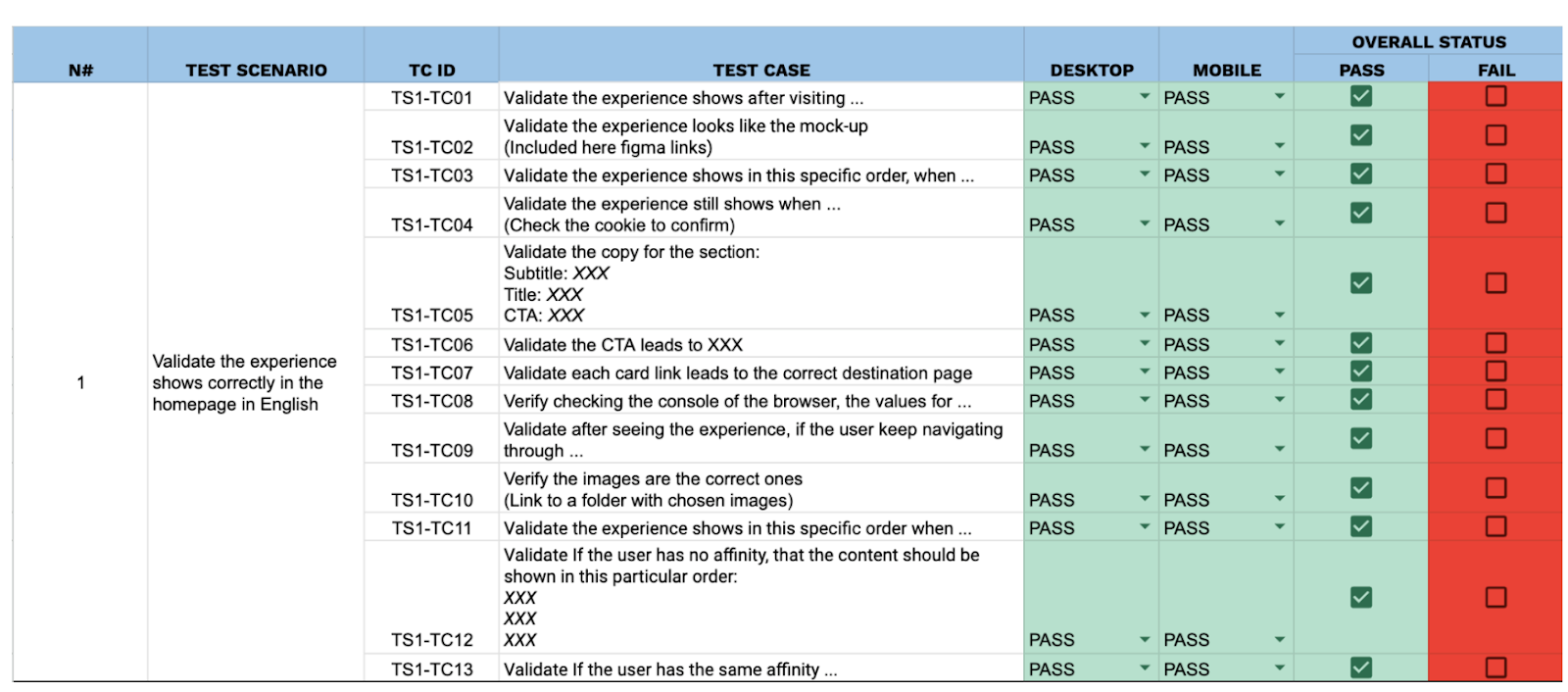
Documenting pre-launch QA is key, as you’ll have evidence and be able to map and visualize all the possible scenarios and actions a user could perform when interacting with the experience. Creating a detailed test plan file also helps optimize the bug reporting and fixing process, as you share your findings with the development team in a centralized report.

Img. 1. Test plan example

  • Thorough Visual Inspection:
    ○  Cross-browser/device testing: Verify consistent appearance and functionality across different browsers (Chrome, Firefox, Safari, Edge), operating systems (Windows, macOS, iOS, Android), and screen sizes (desktop, tablet, mobile).
    ○  Check for broken images, misaligned elements, and unexpected CSS/JavaScript conflicts.
  • Functional Testing:
    ○  Test all variations thoroughly: Ensure all elements within each variation function as expected (e.g., buttons click, forms submit, animations play correctly).
    ○  Test all user flows: Simulate user journeys within each variation to identify any roadblocks or unexpected behavior.

  • Data Layer Validation:
    ○  Confirm that all relevant events and data are being captured correctly in the dataLayer to ensure accurate tracking of conversions and other key metrics.
    ○  Use browser debugging tools (e.g., Chrome DevTools) to inspect the dataLayer and verify its contents.

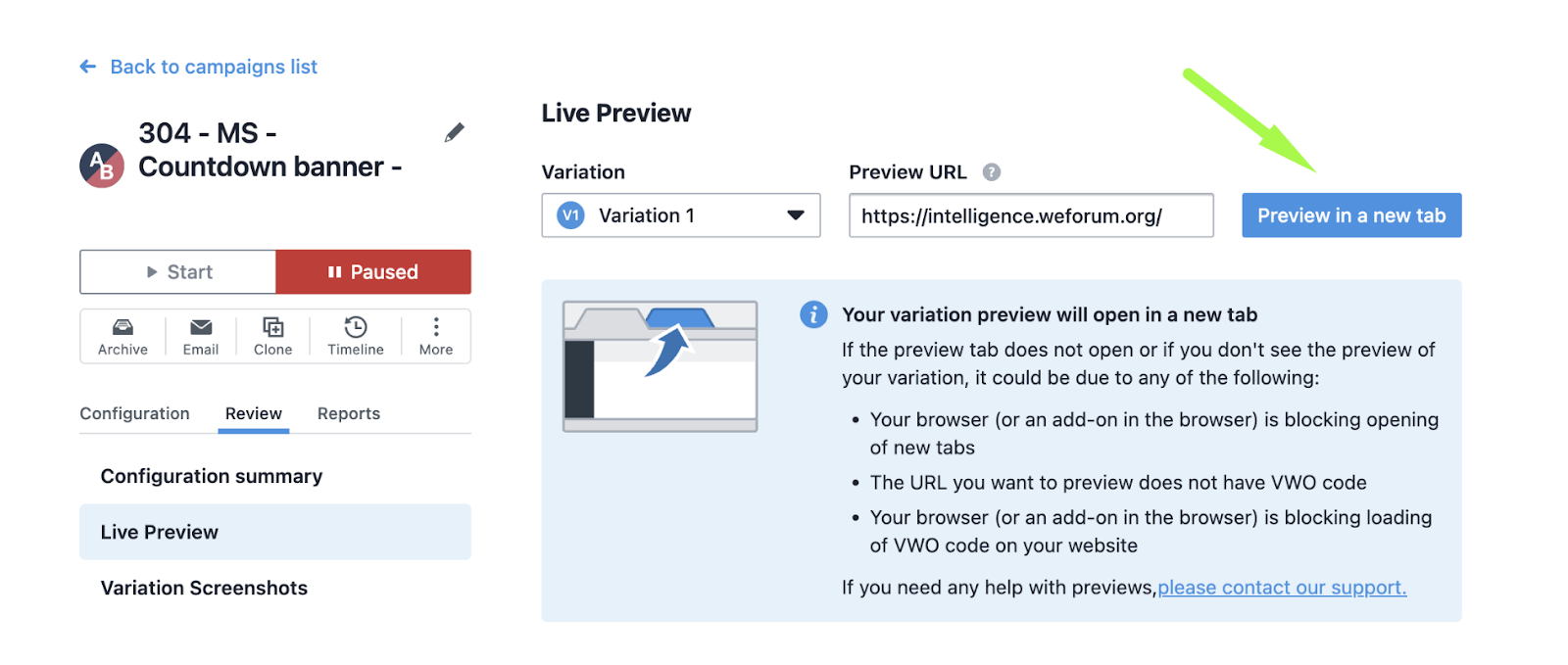
    VWO offers a Live Preview feature, offering a safe way to test and pre-visualize an experience, just by adding the URL you want to preview:

Live Preview feature location in VWO

2. During Experiment Run:

  • Regular Monitoring:
    ○  Monitor key metrics closely: Track conversion rates, traffic distribution, and other relevant metrics daily to identify any anomalies or unexpected trends. With VWO, you can use existing metrics or create new ones as guardrails. When you choose a metric as a guardrail, it’s automatically added as a secondary metric in your campaign. This lets you track it along with your main success metrics.
    ○  Use VWO’s built-in reporting and analytics features to analyze experiment performance.
  • Address Issues Promptly:
    ○  If any issues are identified (e.g., technical errors, unexpected traffic fluctuations), address them immediately to prevent data contamination.
    ○  Make necessary adjustments to the experiment setup or targeting rules.

3. Post-Launch Analysis:

  • Data Validation:
    ○  Scrutinize the collected data for any inconsistencies or outliers (e.g., Verify your 50/50 split A/B test is actually delivering each variation to half of the traffic)
    ○  Verify that the data accurately reflects user behavior and experiment performance.
  • Statistical Significance:
    ○  Ensure that the statistical significance of the results is sufficient to draw meaningful conclusions.
    VWO’s SmartStats uses Bayesian sequential testing to give you more flexibility in running A/B tests. You can adjust the statistical settings to suit your business goals and get faster, reliable results that you can confidently act on. With VWO, you can set an MDE value to ensure your tests focus on finding meaningful improvements. This is especially useful for low-traffic pages, as it provides efficient use of resources without spending time on tiny, unimportant changes. VWO’s stats engine also uses ROPE to recommend stopping a test early if the variation won’t make a big enough difference, saving you time and effort.
  • Documentation:
    ○  Document all aspects of the experiment, including hypotheses, setup, results, and learnings.
    ○  This documentation will be valuable for future reference and optimization efforts.
  • Tools and Resources:
    ○ VWO’s built-in testing tools: Utilize VWO’s features for visual testing, browser compatibility testing, and dataLayer debugging.
    ○ Browser developer tools: Leverage browser developer tools (e.g., Chrome DevTools) for inspecting elements, debugging JavaScript, and analyzing network requests.

By implementing these QA best practices, you can significantly improve the quality of your VWO experiments, increase the reliability of your results, and maximize the impact of your CRO efforts. 

Broadwick Soho picks new Agency partner – Making Science

London, 6th of June 2024 – Making Science, a global leader in digital transformation, is pleased to announce a strategic partnership with Broadwick Soho, an independent luxury hotel in the heart of London. As part of this collaboration, Making Science will oversee the hotel’s paid search, leveraging innovative digital strategies to enhance visibility and drive bookings.

“We’re excited to partner with Broadwick Soho, to elevate their presence online and advance their digital strategy via paid search.” said Xavier Klein, UK Marketing Services Director at Making Science. Through this partnership, Making Science aims to optimise Broadwick Soho Hotel’s advertising efforts. 

About Broadwick Soho Hotel:

Broadwick Soho is an independent luxury hotel in the heart of London’s West End, channelling the grit, glamour and wild energy of London’s most vibrant area into an opulent contemporary 57-room retreat, offering impeccable service and quality. 

About Making Science:

Making Science is a digital acceleration company that currently has more than 1200 employees and a presence and technological development in 15 markets: Spain, Portugal, Mexico, Colombia, France, Italy, UK, Ireland, Sweden, Denmark, Norway, Finland, Germany, Georgia and USA. As a consulting partner of Local Planet, the world’s largest network of independent media agencies, Making Science offers digital marketing, Adtech and Martech, cloud technologies and software, and cybersecurity services globally, through delivery hubs that drive job creation and the availability of highly skilled technology talent. 

Making Science is comprised of 4 business lines: the Global Digital Agency with Technology, with 360 digital advertising services that integrate strategic planning, creative, data and technology; the Cloud, Software and Cybersecurity business, with cloud-based solutions that deploy data intelligence and a specialised cybersecurity team; the Artificial Intelligence and SaaS division, with more than 400 engineers and data scientists for the development of platforms and digital solutions with AI technology applied to marketing; and the Making Science Investment area, with Ventis and TMQ, as a line of business diversification and implementation of the capabilities of all areas of Making Science.  

In addition, the company participates in various ESG initiatives, including the Climate Pledge, the United Nations Global Compact and the Pledge1% initiative, supporting non-profit organisations in its community with a strong commitment to making a positive impact on the future.


[button color=”accent-color” hover_text_color_override=”#fff” size=”large” url=”www.makingscience.co.uk/contact” text=”Get In Touch To Accelerate Your Digital Marketing Strategy!” color_override=”#ff0067″]

Why are iGaming brands still using sub-optimal CPA bidding strategies?

With a particularly skewed customer value curves – a broad industry benchmark is that the top 5% of users will deliver roughly 95% of revenue – iGaming brands stand to gain a significant improvement in ROI from adopting a value-based bidding strategy. However, the vertical also faces more challenges than most in doing so.

Here are the top 4 challenges limiting Gaming brands to inefficient CPA bidding strategies (and their solutions).

1. Long LTV Curves

LTV matures over time as players deposit and play on-site, fluctuating based on wins, losses and subsequent deposits. Most operators don’t see a positive return on players until months after acquisition, while typical pixel-based attribution windows are around 7 days. This disconnect means many advertisers rely on optimisation towards a first deposit or deposit value, which holds a limited correlation with customer LTV.

In this case, prediction is the solution, because it allows the modeler to accurately predict future value in accordance with early journey indicators.

2. LTV Customers are Tricky to Predict

Prediction itself is challenging when the business’ revenue model is built on outcomes of games of chance. Additionally, players rarely monetise in a linear fashion, they follow Eric Bradlow’s model of ‘clumpiness’. It can be hard for marketers and data analysts to spot causations between customer behaviours and LTV. Machine learning models will allow causation to be found and exploited.

3. Customer Value Distribution

Bidding algorithms work best when fed with high volumes of high-quality data at a consistent rate. Unfortunately, iGaming customer value patterns rarely follow this model. For example, the very highest-value customers are few in number, but these make up a high share of total revenue. A bidding algorithm with insufficient learning data inevitably ends up over and under-valuing customers at the extreme ends of the value distribution.

Modelling against large, historical datasets provides the volumes needed for reliability. Bidding against early journey proxy events provides the volumes needed for effective algorithmic bidding.

4. Slow Signals

The most effective VBB occurs when activated against real-time signals. Most LTV prediction takes weeks or months, and even immediately available predictions are not typically accessible as real-time bidding signals. These predictions need to be accurate, fast, and easily available for bidding activation in marketing platforms – and that requires technology. Real-time prediction and passback of a value signal are crucial to an optimised data and media strategy. In VBB, fast prediction trumps absolute precision.

VBB can have its challenges, but it’s a hugely valuable tool for performance marketers looking to optimise their bottom line. Making Science’s Gauss Smart Advertising solution is an AI-driven, predictive value modelling tool. It allows advertisers to bid in real time on predicted LTV value. It’s channel and vertical-agnostic and proven to drive 10-30% stronger ROI in activation.

To reach better bidding, reach out to our team of experts to learn more about effective bidding strategies or to kick-off your campaign!

[button color=”accent-color” hover_text_color_override=”#fff” size=”large” url=”www.makingscience.co.uk/contact” text=”Get in touch! ” color_override=”#ff0067″]

Mayborn Group, the parent group of Tommee Tippee, moves from ‘big six’ to Making Science

The partnership will cover digital media buying, including Paid Social, Search, Amazon, and Affiliate Marketing, across the EMEA region for the Tommee Tippee brand.


London, 13 November 2023 – Making Science has today announced a significant client win as Mayborn Group, owner of the Tommee Tippee brand, selects the digital acceleration company to manage its media planning and buying. The partnership will see Making Science deliver Paid Social, Search, Amazon ads, affiliate marketing and SEO across the UK, France, Italy, Germany and Spain. The brand previously partnered with performance marketing agency Reprise Digital.

Established for nearly 60 years, Mayborn strongly focuses on digital transformation and the partnership with Making Science further solidifies this. As a fast-growing, tech-driven digital company with a global presence, Making Science will deliver end-to-end digital performance and measurement across Mayborn’s media buying. 

Nicola Wallace, Head of Marketing at Mayborn Group, commented, “At Mayborn, we’re on a mission to become the world’s most-loved baby company; we’re driven to make a difference in the lives of our consumers, customers and employees. Our digital capabilities play a key part in how we deliver the experiences and services that ensure our innovative products reach families across the globe. Our new media buying partnership with Making Science reflects our journey in digital innovation, and we’re excited to be working with a fast-growing company, which has proven experience in key platforms such as Google, Meta, Microsoft, and Amazon.”

Xavier Klein, Marketing Services Director UK, at Making Science, said of the partnership, “Making Science is proud to be working with Mayborn Group as it continues its unwavering support for parents and carers through the Tommee Tippee products that it sells and the community initiatives it supports. The move comes at a time when brands are seeking greater value from their advertising partnerships. We’re seeing larger industry players consider moves to independent marketing and technology companies, like Making Science, who are delivering cost-effective measurement methods and optimised ROI for their clients, alongside digital acceleration through  cutting-edge tech solutions.”


To learn more about the partnership and our services, get in touch with info@makingscience.com.

The power [and problems] of value-based bidding

In an increasingly competitive and complex digital marketing landscape, it’s now more important than ever to ensure optimisation of both data and media to achieve marketing ROI. The best decisions are the ones informed by data and AI.

Across the two performance marketing behemoths, there are over 4 billion monthly active users worldwide on Google, and over 3 billion on Meta. Of course, not all users are created equal, far from it. Value-based bidding (VBB) gives advertisers the ability to adjust their marketing bids for their most and least valuable users. It combines the power of an advertising platform’s rich user data and AI smart bidding algorithms with a brand’s first-party conversion value data. In short, VBB drives stronger efficiencies and increased revenue for businesses by aligning the bidding goal with business outcomes.

It’s a powerful tool; Google’s study on its internal data in 2021 showed a 14% uplift in conversion value moving from tCPA to tROAS, Meta has quoted up to 35% improvement in ROI from their value bidding strategy and Making Science’s proprietary predictive VBB solution – Gauss Smart Advertising – drives 10-30% uplift in lifetime value ROI.

So why would an advertiser not harness the power of VBB? Well, it’s not always easy.

To start, advertisers need to understand clearly what value means to them – revenue, lead quality, customer lifetime value, new vs returning customer ratio, conversion propensity (and countless more) are all applicable value metrics, requiring distinct optimisation strategies.

Below the surface, advertisers need robust measurement solutions in place to track customer value in online and offline environments. This data needs to be accurate and accessible. Bidding experts are required to steer VBB algorithms through a volume, efficiency and efficacy balancing act. The necessity for predictive modelling arises when advertisers want to make quick decisions on bidding and investment.

All of this is to say that effective VBB is far from a flick of a switch. Durable VBB is best viewed as a journey to maturity, on which accuracy, speed and actionability are the guiding stars.

If you’re interested in understanding how better bidding can deliver you more ROI, please reach out.


[button color=”accent-color” hover_text_color_override=”#fff” size=”large” url=”www.makingscience.co.uk/contact” text=”Get in touch!” color_override=”#ff0067″]