Clickless Advertising: How to Measure What Isn’t Touched (and Why You Should Start Now)

How do you measure the success of a campaign if no one clicks? In the new cookieless era, the answer is not only possible but essential.

Clickless advertising has gone from being a rarity to a priority for brands focused on brand recognition, mass reach, and effectiveness in environments where the click simply doesn’t exist. With the rise of channels like YouTube on Smart TVs, DOOH, digital audio, and CTV, it is time to move beyond models based solely on direct interaction.

In this post, we tell you what clickless advertising is, why it matters in 2025, and how you can measure it effectively with Google Marketing Platform (GMP) to demonstrate real results in campaigns where visual impact is worth more than the click.


What is Clickless Advertising and Why is It Gaining Ground?

Clickless advertising encompasses campaigns where the goal is not for the user to click, but for them to remember, recognize, and interact with the brand later on. This type of impact is generated in environments where direct interaction is not possible (or does not make sense):

  • YouTube on Connected TV
  • Spotify, podcasts, or programmatic audio
  • DOOH (Digital Out Of Home), such as digital billboards or screens in shopping centers
  • CTV (Connected TV)

With the progressive phasing out of third-party cookies and the increase in media consumption without a browser, measuring without clicks is no longer an option—it is a necessity.

According to Nielsen, 65% of offline sales are influenced by advertising without direct interaction.


GMP: Your Ally for Measuring What Cannot Be Clicked

The key is to adopt new measurement tools and methods based on aggregated data, modeling, and first-party data. This is where Google Marketing Platform shines as a comprehensive solution:

🎯 Campaign Manager 360: Measuring Impressions and Viewability CM360 allows you to track impressions, viewability, frequency, and cross-channel reach. It is the central hub for validating that your message has reached the right audience.

🧠 Google Analytics 4: Behavior After Exposure Even without clicks, GA4 helps analyze user behavior after viewing an ad: direct traffic, brand searches, completed forms, etc. Thanks to its advanced attribution models, it compensates for the lack of cookies and protects privacy.

🔗 Integrated Platform: GMP as an Ecosystem The combination of CM360 + GA4 + DV360 + SA360 allows for a holistic view of campaign performance, uniting awareness and performance metrics under one umbrella.


Strategies That Work (Even if No One Clicks)

🧪 Brand Lift and Brand Awareness Use studies like YouTube Brand Lift or post-exposure surveys to measure ad recall, consideration, or purchase intent.

🗺️ Geo-testing and Incrementality Compare exposed and unexposed regions with tools like GeoLift to evaluate the real impact on searches or sales.

👤 First-Party Data and Indirect Signals Analyze direct traffic, brand searches, and completed forms after exposure. Supplement with user panels or surveys.

🔒 Consent Mode v2 and Conversion Modeling Even without cookies, you can estimate conversions with modeling and platforms like Ads Data Hub, ensuring compliance with privacy regulations.


Real-Life Cases That Prove It

  • YouTube on CTV: Campaigns with a +20% brand recall, without clicks or calls to action.
  • Spotify Ads: Direct correlation between full ad listens and peaks in brand searches.
  • DOOH in shopping centers: Increase in store visits (footfall) and geolocated sales following campaigns without digital interaction.


Conclusion: Measuring Without Clicks Is Not Only Possible, It Is Essential

In a cookieless world with increasingly dispersed consumers, clickless advertising represents the natural evolution of digital marketing. It is no longer just about chasing interactions, but about understanding the real impact of the message on the user’s mind and decisions.

GMP gives you the tools to do this with precision, respect for privacy, and an omnichannel approach.

And you, are you ready to measure without relying on the click? If you want to know how to implement this type of measurement in your strategy, let’s talk. Because the future of marketing is not measured in clicks, but in connections.
Level Up Your VWO Experiments: QA Best Practices for Success

There is nothing worse than planning an experiment from scratch, having your team create an immaculate mockup and develop a test, only to realize a week later – after it has been launched that your secondary metrics were not tracking any conversions. Perhaps you notice that a potentially successful hypothesis was wasted because your cookie consent notification overlapped your new pop-up or, even worse, that your checkout funnel is now broken.

Quality assurance testing is frequently overlooked, as it is the last stage of the development process, and on-time delivery is frequently prioritized over quality. Yes, your stakeholders might be pleased with your punctuality, but final users will be disappointed by a bad experience.

Making Science has been helping out clients with their CRO efforts for the last 5 years and have realized that running successful A/B tests requires meticulous planning and execution, and validating the quality of your experiments is paramount for accurate results and meaningful insights. Over the years, we have found in VWO a powerful testing and personalization platform, equipped with useful tools for QA and pre-launch validations.

Here are some key QA best practices to incorporate into your VWO workflow:

1. Pre-Launch Checks:

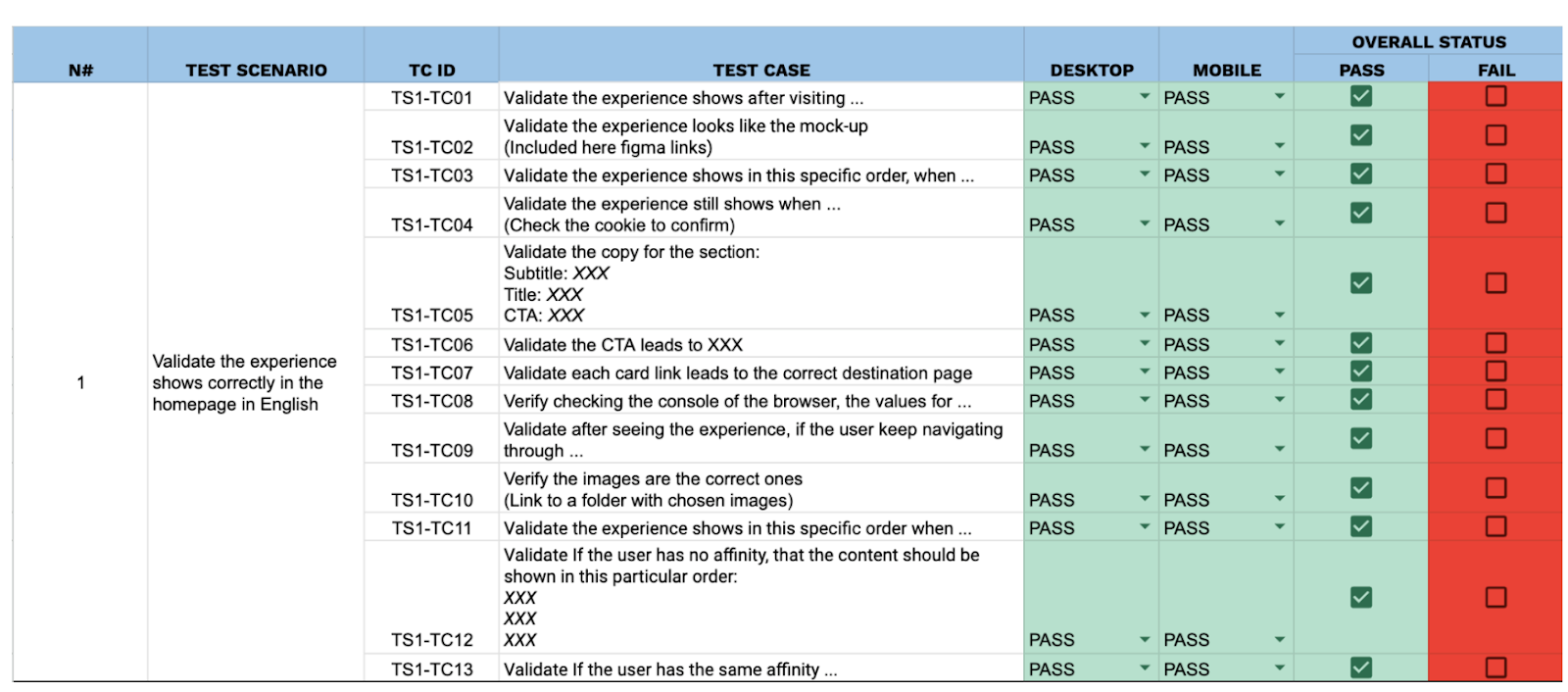
Documenting pre-launch QA is key, as you’ll have evidence and be able to map and visualize all the possible scenarios and actions a user could perform when interacting with the experience. Creating a detailed test plan file also helps optimize the bug reporting and fixing process, as you share your findings with the development team in a centralized report.

Img. 1. Test plan example

  • Thorough Visual Inspection:
    ○  Cross-browser/device testing: Verify consistent appearance and functionality across different browsers (Chrome, Firefox, Safari, Edge), operating systems (Windows, macOS, iOS, Android), and screen sizes (desktop, tablet, mobile).
    ○  Check for broken images, misaligned elements, and unexpected CSS/JavaScript conflicts.
  • Functional Testing:
    ○  Test all variations thoroughly: Ensure all elements within each variation function as expected (e.g., buttons click, forms submit, animations play correctly).
    ○  Test all user flows: Simulate user journeys within each variation to identify any roadblocks or unexpected behavior.

  • Data Layer Validation:
    ○  Confirm that all relevant events and data are being captured correctly in the dataLayer to ensure accurate tracking of conversions and other key metrics.
    ○  Use browser debugging tools (e.g., Chrome DevTools) to inspect the dataLayer and verify its contents.

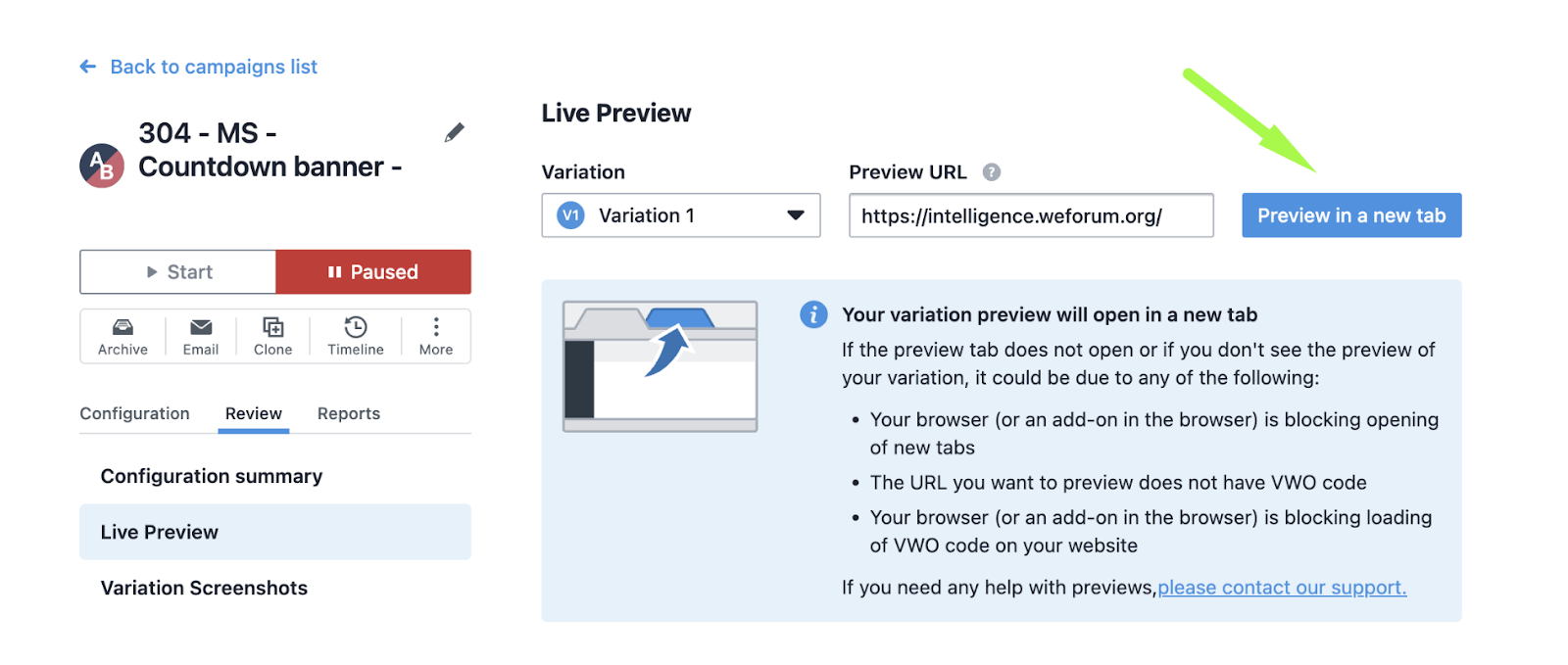
    VWO offers a Live Preview feature, offering a safe way to test and pre-visualize an experience, just by adding the URL you want to preview:

Live Preview feature location in VWO

2. During Experiment Run:

  • Regular Monitoring:
    ○  Monitor key metrics closely: Track conversion rates, traffic distribution, and other relevant metrics daily to identify any anomalies or unexpected trends. With VWO, you can use existing metrics or create new ones as guardrails. When you choose a metric as a guardrail, it’s automatically added as a secondary metric in your campaign. This lets you track it along with your main success metrics.
    ○  Use VWO’s built-in reporting and analytics features to analyze experiment performance.
  • Address Issues Promptly:
    ○  If any issues are identified (e.g., technical errors, unexpected traffic fluctuations), address them immediately to prevent data contamination.
    ○  Make necessary adjustments to the experiment setup or targeting rules.

3. Post-Launch Analysis:

  • Data Validation:
    ○  Scrutinize the collected data for any inconsistencies or outliers (e.g., Verify your 50/50 split A/B test is actually delivering each variation to half of the traffic)
    ○  Verify that the data accurately reflects user behavior and experiment performance.
  • Statistical Significance:
    ○  Ensure that the statistical significance of the results is sufficient to draw meaningful conclusions.
    VWO’s SmartStats uses Bayesian sequential testing to give you more flexibility in running A/B tests. You can adjust the statistical settings to suit your business goals and get faster, reliable results that you can confidently act on. With VWO, you can set an MDE value to ensure your tests focus on finding meaningful improvements. This is especially useful for low-traffic pages, as it provides efficient use of resources without spending time on tiny, unimportant changes. VWO’s stats engine also uses ROPE to recommend stopping a test early if the variation won’t make a big enough difference, saving you time and effort.
  • Documentation:
    ○  Document all aspects of the experiment, including hypotheses, setup, results, and learnings.
    ○  This documentation will be valuable for future reference and optimization efforts.
  • Tools and Resources:
    ○ VWO’s built-in testing tools: Utilize VWO’s features for visual testing, browser compatibility testing, and dataLayer debugging.
    ○ Browser developer tools: Leverage browser developer tools (e.g., Chrome DevTools) for inspecting elements, debugging JavaScript, and analyzing network requests.

By implementing these QA best practices, you can significantly improve the quality of your VWO experiments, increase the reliability of your results, and maximize the impact of your CRO efforts. 

Santander improved its conversions up to 37% thanks to ad-machina corporate

Banco Santander improved its conversions up to 37% thanks to ad-machina corporate, an AI-based personalization technology scaled by the company globally.

The Company

Banco Santander is a leading commercial bank, founded in 1857 and headquartered in Spain. One of the largest banks in the world by market capitalization. The group’s activities are consolidated into five global businesses: Retail & Commercial Banking, Digital Consumer Bank, Corporate & Investment Banking (CIB), Wealth Management & Insurance and Payments (PagoNxt and Cards).

In the first quarter of 2024, Banco Santander had €1.3 trillion in total funds, 166 million customers, 8,400 branches and 211,000 employees.

The challenge

Banco Santander, a leading Spanish financial institution with a global presence in over 15 countries, sought to scale its Google Ads campaigns effectively.  This presented a complex challenge due to:

  • Market Diversity: each market has unique characteristics in banking advertising, requiring distinct campaign approaches while maintaining consistent quality standards.
  • Scalability: Managing numerous Google Ads campaigns across various products, languages, and regulations demanded a scalable solution.
  • Competitive Landscape: in an increasingly competitive environment, staying ahead of the curve with innovative solutions was crucial.
  • Security and Compliance: the banking sector necessitates a high degree of security and adherence to brand quality standards.

The approach

Making Science, through its ad-machina corporate technology, partnered with Santander to address these challenges. The approach involved:

  • Generative AI for Automation: ad-machina corporate’s Generative AI capabilities automated and scaled ad creation within Google Ads, considering diverse products, languages, and local regulations.
  • Hyper-Personalized Ads: the solution leveraged AI to generate hyper-personalized ads, enhancing user experience and improving campaign effectiveness.
  • AI-driven Campaign Optimization: AI algorithms analyzed campaign data and recommended optimizations, leading to continuous performance improvements.
  • Cross-Market Reporting and Insights: ad-machina corporate facilitated the generation of cross-market reports, enabling Santander to gain valuable insights into campaign performance across different regions and identify global trends.
  • Dedicated Data Repository for Enhanced Security: a dedicated data repository provided an additional layer of security, ensuring the protection of sensitive banking data and compliance with data privacy regulations.

The results

The implementation of ad-machina corporate yielded impressive results across various countries:

  • Norway: +14% Conversions
  • Denmark: -16% CPA, +19% Conversions
  • Sweden: +13% Conversions
  • Brasil: -14% CPA, +37% Conversions
  • Mexico: -22% CPA, +15% Conversions
  • Chile: -23% CPA, +30% Conversions
  • Argentina: -6% CPA, +12% Conversions

Google Backpedals on Third-Party Cookie Deprecation: A Win for the Industry, a Focus on User Choice

Google has significantly shifted its approach to third-party cookies, opting to maintain their use while introducing a new framework prioritising user control. After years of delays and industry concerns, this decision marks a departure from the company’s plan to fully deprecate cookies. Read more about the official announcement from Google here: https://privacysandbox.com/news/privacy-sandbox-update/

The rationale behind Google’s decision is clear: they listened to industry concerns about cookie-free futures. By preserving cookies while introducing enhanced privacy controls, Google aims to strike a balance between protecting user data and maintaining a thriving digital advertising ecosystem.

The core of Google’s strategy is to empower users, as they intend to provide users with greater transparency and choice over how their data is used, allowing them to opt in or out of tracking. This approach could level the playing field, as both cookie-based and cookie-less solutions will have the opportunity to compete for user attention.

Even though details about Google’s proposed changes are still emerging, this announcement undoubtedly relieves the industry. Businesses will have more time to adapt and invest in alternative tracking technologies while also addressing privacy concerns.

Our US Nick Tiano, Chief Revenue Officer, expressed,

“I think with the steps Google took, they were clearly listening to regulators and the adtech industry. This pivot appears to be warranted and is a major commitment from Google to give users and adtech providers a choice on the matter of 3P cookies. Now the Sandbox and other privacy-forward solutions can compete on merit and user preferences (or opt outs) will dictate performance and ultimately what technologies win out, 3P cookies or alternatives.”

Ultimately, Google’s decision to maintain third-party cookies while emphasising user control represents a thoughtful compromise. It’s a move that could shape the future of digital advertising for years to come. Read more about Google’s decision here: https://www.thedrum.com/news/2024/01/04/marketers-publishers-brace-impact-1-third-party-chrome-cookies-vanish-today or get in touch with our experts.


[button color=”accent-color” hover_text_color_override=”#fff” size=”large” url=”www.makingscience.co.uk/contact” text=”Get in touch!” color_override=”#ff0067″]

Campaign Manager 360 Updates & Preparation for 3PCD

With Google’s impending deprecation of third party cookies later this year and the industry’s continued emphasis on user privacy, tried and true programmatic advertising norms and practices of the past will cease to exist. At Making Science, we believe this change gives us an opportunity to rethink our existing ways of working, and support our clients as they navigate this changing environment.

We’re shifting from one-to-one precision targeting, to focusing on first-party data. From deterministic measurement, to a future powered by modeled measurement. From data processing within AdTech product platforms, to on-device data processing. These changes also inevitably mean changes to AdTech product platforms, such as Campaign Manager 360.

Campaign Manager 360 Reporting and Attribution Recommendations

Without third party cookies, cross-site and cross-device tracking will look quite different. Luckily, due to modeling, reporting will still be possible but many existing CM360 reporting and attribution features will need to be removed and/or adjusted accordingly. 

For instance, the Attribution Modeling Tool will be significantly impacted. Data-driven attribution (DDA) will be limited, but it will still be a possible attribution model. We recommend using either DDA or Floodlight attribution models. For now, these will likely be the only attribution models available to compare via the Attribution Modeling Tool post 3PCD.

Check out this update from Google for a specific list of reports and metrics being impacted. Sign up for the Making Science Google Marketing Platform Newsletter to stay up to date on the latest product news!

Actions to Take in Preparation for 3PCD

Advancements in privacy-safe advertising techniques and these product updates mean there are some important actions for advertisers to take to update and maintain reporting capabilities.

Google recommends advertisers:

    • Use the Google Tag or Google Tag Manager as your method for deploying Floodlight tags
    • Review Floodlights and disable the attribution tracking setting for any Floodlights that aren’t needed for attribution or bidding purposes
    • Enable consent mode
  • Required in EEA
  • Turn on Enhanced Attribution in CM360
  • Confirm conversion domains at the placement level
  • If using CM360 for tracking, set up Tracking Ads Tags

Taking these actions and utilising these features will ensure your CM360 account is able to take advantage of the latest privacy-safe technology Google is integrating into their products. 

An Exciting Future Ahead

While there are clearly many product and expectation adjustments to be made, Google is confident that despite the impact from 3PCD, CM360 will still meet customer goals surrounding:

  • Enterprise campaign activation and management at scale
  • Serving and personalising display and video creatives
  • Agnostic measurement for brand and performance campaigns
  • Quantifying media impact and campaign value

These industry changes and challenges will no doubt lead to impressive innovations across the digital marketing landscape. As we all adapt to the advertising environment without third-party cookies, more and more advanced technology will continue to be developed and integrated into products. We at Making Science are excited for what’s to come and for the opportunity to learn and grow with our customers.

Reach out to Making Science today for help taking the appropriate steps to ready your CM360 account. We offer a comprehensive CM360 audit to ensure your account is efficient and you’re able to meet your advertising goals both now and when third-party cookies are officially deprecated. 

Making Science is a Google Marketing Platform Certified Partner and a leading expert in privacy-safe and compliant advertising practices. We can aid you in implementing Consent Mode, Enhanced Conversions, and more. We also have expertise in Google Analytics, Google Tag Manager, and can assist with your tagging needs. Send us a message: info@makingscience.com.

Making Science brings its proprietary technology ad-machina to Google Cloud Marketplace

With Google Cloud Marketplace, Making Science will be able to bring this innovative solution to new customers worldwide who want to optimise their Google Ads campaigns.

Madrid, Feruary 13, 2024 – Making Science, a Premier Partner of Google Cloud, is strengthening its commitment to excellence by bringing  for the first time its proprietary technology ad-machina in the Google Cloud Marketplace. Further reaffirming the technological consultancy’s expertise and abilities in using Google Cloud solutions, this long-term agreement also offers companies a tool for personalising and optimising Google Ads campaigns with Generative Artificial Intelligence (GenAI).

Through this agreement, any global Google Cloud customer can benefit from fast and efficient access to ad-machina. This multilingual technology, developed by Making Science, adapts to the market’s needs and can generate unique and personalised ads for each user based on their behaviour, which translates into an improvement in the effectiveness of advertising campaigns.

Personalisation and AI: The Key to Multiplying Conversion Rates in Response to New Market Needs

ad-machina is powered by Artificial Intelligence to learn continuously in real-time, which increases the efficiency in detecting and adapting to changes in consumer buying behavior.

On the other hand, its innovative technology allows ads to be modulated to the company’s commercial strategies, such as offers, internal policies, or social programs so that it generates new ads automatically during the periods of validity of the same.

The milestone further strengthens Making Science’s partnership with Google Cloud for advanced cloud-based solutions that drive digital transformation and advertising effectiveness.

“At Making Science, we are delighted to continue enhancing our strong alliance with Google Cloud by incorporating a tool like ad-machina into its Marketplace for the first time. Without a doubt, a tool that adds value to those companies that operate their Google Ads campaigns and want to optimise the functioning of their algorithms” explains Eduardo Sarciat, ad-machina Managing Director at Making Science.

Google Cloud Marketplace: Consolidating a Long-Term Relationship

The collaboration is founded on a solid relationship between the two companies, with over 90 Google Cloud certifications and specialisations in areas such as Infrastructure, Marketing Analytics, and Machine Learning. Google Cloud Marketplace provides enterprise-grade cloud solutions integrated with Google Cloud Platform, making it easy to find, buy, and deploy third-party software.

“Bringing Making Science to Google Cloud Marketplace will help customers quickly deploy, manage, and grow ad-machina on Google Cloud’s trusted, global infrastructure,” said Dai Vu, Managing Director, Marketplace & ISV GTM Programs at Google Cloud. “Making Science can now securely scale and support customers on their digital transformation journeys.”

About Making Science

Making Science has a team of over 1,200 experts across 15 markets, including Spain, Portugal, Mexico, Colombia, France, Italy, the UK, Ireland, Sweden, Denmark, Norway, Finland, Germany, Georgia, and the USA. As a proud consulting partner of Local Planet — the world’s premier network of independent media agencies — we deliver a suite of digital, technology, and performance marketing services to a global clientele. Our expertise spans digital marketing and MarTech, software and cloud solutions, artificial intelligence, and SaaS, all underscored by a relentless pursuit of innovation.

As part of its commitment to innovation, Making Science offers its clients end-to-end capabilities required for consulting, development, integration, and maintenance of advanced IT solutions. Our global network of delivery hubs not only fosters job growth but also serves as an incubator for cultivating top-tier tech talent, fueling projects that accelerate transformation and modernisation.

Committed to making a positive impact, Making Science actively engages in various ESG initiatives. We’ve joined forces with the Climate Pledge, the United Nations Global Compact, and Pledge1%, dedicating resources and efforts to support non-profit organisations. Through these endeavours, we are committed to driving meaningful change for a brighter, more sustainable future.

Third-party cookie deprecation is not the end of third-party data

With the deprecation of third-party cookies, there will be less third-party data available, but first-party data is also getting worse – meaning quality third-party data is more important than ever for the success of data strategies in the future.

Google’s Privacy Sandbox is starting to be tested on 1% of users. Third-party cookies are now destined to disappear, but whether Google can maintain the timelines remains to be seen.

With the deprecation, the importance of first-party data strategies continues to be the most crucial aspect of a measurement strategy. However, the limiting factor has always been effort, meaning the use of vast amounts of third-party data collected by the tech giants was easier to collect than doing it yourself.

Times are changing, third-party cookies are slowly being deprecated across all browsers, and greater privacy and technological restrictions are being enforced, restricting what data can be collected. Furthermore, this final point has a major impact on first-party data – not only is the volume of third-party data greatly reduced, but the quality is also decreasing. To overcome this problem, modelling and aggregated bidding strategies are being used.

This limitation of first-party data is more pronounced on upper funnel activities and sites where logging in and identification are not essential. Third-party data is even more important in these cases as we are looking for contextual data that may have influenced a customer’s purchase decision. For example, knowing the ideal time to sell an umbrella is when it starts to rain. Good first-party data is not needed to optimise bidding in this case, but accurate and timely third-party weather data is.

When it comes to looking for good third-party data sources, it is important to consider what influences the decisions of users in each case – are you a retailer or travel agent influenced by rainy days, or a financial service affected by interest rates and exchange rates? 

There are so many good third-party data sources available that it is worth taking the time to determine which can efficiently and effectively be incorporated into your measurement strategy. To name a few useful third-party data sources:

  • Weather data
  • Location data (e.g. store locations, proximity to services, etc.)
  • Events data (e.g. a concert, a football match, etc.)
  • Search data (e.g. Google Search Console or Google Trends)
  • Financial data (e.g. interest rates)

Incorporating these data sources into a measurement strategy is only the first step. The second is integrating it into data collection and activation. During upper funnel and display activity, solutions such as BrandMax can optimise your custom bidding algorithms to improve CPM.

In 2024, a blended data strategy will remain crucial for businesses. A company that focuses solely on a first-party data strategy is limiting themselves compared to organisations with a diverse approach are able to activate their first-party data effectively as well as find and use relevant third-party data in data-sparse environments.

Google says goodbye to the familiar SA360 interface! Everything you need to know about the migration and the new interface

Google has announced that at the beginning of 2024, the Search Ads 360 interface that we all know (one of the most popular tools of the Google Marketing Platform (GMP) marketing suite) will cease to exist for good and be replaced by a new one. The new interface was created to improve the experience for advertisers and to help achieve better results with better management of search campaigns across multiple channels.

While it may seem straightforward, not migrating to the new interface can affect advertisers. Keep reading to find out how to avoid potential conflicts!

What conflicts can arise from not migrating to the new SA360 interface?

If advertisers do not migrate, these are the issues that will arise:

  • Disconnection of the SA360 API with reporting platforms.
  • The loss of custom columns
  • Misconfiguration of conversion goals and Smart Bidding
  • Forced synchronisation issues with search engines

What are the differences between the current and new Search Ads 360 interface?

With a modern infrastructure, the new Search Ads 360 can offer better support across multiple advertising channels and search engines, including third-party partners. This means advertisers can access more features from other search engines.

  • Current Search Ads 360 has limited search engine functionality, conversion goal setting at the bid strategy level and automatic daily search engine synchronisation with manual forcing for instant updating.
  • The new Search Ads 360 interface offers expanded coverage of other search engine features, campaign/account level conversion targeting and actions, and the ability to create rules to adjust the value of conversions. In addition, it will allow us to differentiate between campaign conversion targeting, bidding strategies and budgeting strategies and automatically synchronise real-time changes to search engines.

When should you migrate to the new Search Ads 360 interface?

Before you consider this migration, we recommend that you take a look at Google’s timeline:

  • Up until January 2024, we recommend scheduling the migration of your bidding and budget management strategies to the new Search Ads 360 experience.
  • During February 2024, we recommend to proceed with the migration to ensure continuity of service.
  • Between February and April 2024, the old Search Ads 360 interface will no longer be available to all users. Google will notify all advertisers at least 60 days in advance.

Need support migrating? Our Google Marketing Platform team can help you with this migration and advise you on how to approach the new interface. 🚀

[button color=”accent-color” hover_text_color_override=”#fff” size=”medium” url=”www.makingscience.co.uk/contact” text=”Contact us” color_override=”#f00067″]

Accelerate Your Digital Business with Google Marketing Platform (GMP)

In today’s fast-paced digital landscape, having a robust marketing strategy is crucial for the success of any business. One powerful tool that can help you supercharge your digital marketing efforts is Google Marketing Platform (GMP). In this blog post, we’ll take a closer look at GMP and how it can accelerate your digital business.

What is Google Marketing Platform?

Google Marketing Platform is a suite of marketing tools and products offered by Google designed to help businesses manage their digital marketing activities more effectively and efficiently. It combines several popular marketing tools under one unified platform, making it easier for companies to plan, execute, measure, and optimise their online marketing campaigns.

GMP consists of several integrated products, including:

    1. Google Analytics 360: A powerful web analytics tool that provides in-depth insights into website performance, user behaviour, and campaign tracking. It helps businesses understand their audience and measure the impact of their marketing efforts.
    2. Search Ads 360: A comprehensive online advertising platform that allows businesses to create, manage, and optimise online ads across Google’s network, including search, display, video, and app campaigns. It helps companies to reach their target audience and drive relevant website or app traffic.
    3. Campaign Manager 360: This is an ad management and measurement system that offers a centralised tool for managing digital campaigns across the internet’s ecosystem. Campaign Manager 360 includes a robust set of features for ad trafficking, Reporting, and Verification to upload creatives, measure performance, and ensure your ads are serving correctly.
    4. Display & Video 360: A comprehensive programmatic advertising platform that allows businesses to plan, execute, and measure display and video campaigns across multiple channels, including production, video, TV, and audio. It helps companies to reach their audience with engaging ads and measure the impact of their campaigns.
    5. Google Data Studio: A data visualisation and reporting tool that allows businesses to create custom dashboards and reports using data from multiple sources, including Google Analytics, Google Ads, and other third-party data. It helps companies to gain insights from their data and make data-driven decisions.
    6. Campaign Manager 360: web-based ad management system for advertisers and agencies. It helps you manage your digital campaigns across websites and mobile. This includes robust features for ad serving, targeting, verification, and reporting.

[image_with_animation animation =”fade-in” image_url=”https://www.makingscience.co.uk/wp-content/uploads/2023/04/MS-Infografia-GMP-transparente_Mesa-de-trabajo-1-1-e1673882857811.png” delay=””] [/image_with_animation]

How GMP Can Accelerate Your Digital Business

  1. Comprehensive Data Insights: With Google Marketing Platform, you can gain valuable insights into your website or app performance, user behaviour, and campaign effectiveness through Google Analytics 360. This data can help you make informed decisions about your marketing strategies, optimise your campaigns, and identify new opportunities to drive growth.
  2. Integrated Advertising Solutions: GMP provides seamless integration between Google Ads and other tools within the platform, allowing you to create, manage, and optimise your online advertising campaigns more effectively. You can leverage the power of Google Ads to target your audience, drive relevant traffic to your website or app, and achieve your marketing goals.
  3. Website Optimisation: Google Optimize allows you to create and run experiments to optimise your website or app performance. You can test different variations of your website or app content, layout, and design to identify what resonates best with your audience and drives higher conversions. This helps create a more user-friendly and engaging experience, ultimately improving business results.
  4. Custom Reporting and Visualisation: GMP offers Google Data Studio, which enables you to create custom dashboards and reports using data from multiple sources. You can visualise your marketing data meaningfully, gain insights, and share reports with stakeholders, making data-driven decision-making more accessible across your organisation.
  5. Programmatic Advertising: Display & Video 360 provides a comprehensive programmatic advertising platform that allows you to plan, execute, and measure display and video campaigns across multiple channels. You can reach your audience with engaging ads and measure the impact of your campaigns, enabling you to optimise your ad spend and achieve better ROI.
  6. Collaboration and Efficiency: GMP provides a unified platform

In conclusion, Google Marketing Platform (GMP) is a powerful suite of marketing tools that can help accelerate your digital business. From comprehensive data insights and integrated advertising solutions to website optimisation, custom reporting, programmatic advertising, and improved collaboration, GMP offers robust features that can enhance your digital marketing efforts and drive better business results. 


If you want to take your digital marketing to the next level, consider leveraging the power of Google Marketing Platform to supercharge your efforts and achieve accelerated growth for your business. Today, Making Science has over +100 clients, cases and +300 certified professionals operating in GMP. 


[button open_new_tab=”true” color=”accent-color” hover_text_color_override=”#fff” size=”medium” url=”www.makingscience.co.uk/contact” text=”Get in touch to start your project!” color_override=””]

Maximise your sales with Marketing Mix Modeling

What is Marketing Mix Modeling?

According to the paper “Challenges and Opportunities in Media Mix Modeling” by Chan, D., & Perry, M. (2017), Marketing Mix Modeling (MMM) are the statistical model used by advertisers to measure the effectiveness of their advertising spending and exists in various forms since the 1960s. MMMs, as we will call them from now on, use aggregated historical time-series data to model sales performance as a function of advertising variables, other marketing variables and control variables such as weather, seasonality and market competition.

Metrics such as return on advertising investment (ROAS) and optimised advertising budget allocations are derived from these models because they provide valid causal results.

In other words, MMMs attempt to answer causal questions for the advertiser. For example:

  • What was my ROAS on TV last year?
  • What would my sales be if more or less money were spent next year?
  • How should my media budgets be allocated to maximise sales?

What does Marketing Mix Modeling bring to our business?

With MMM, we will achieve two different things:

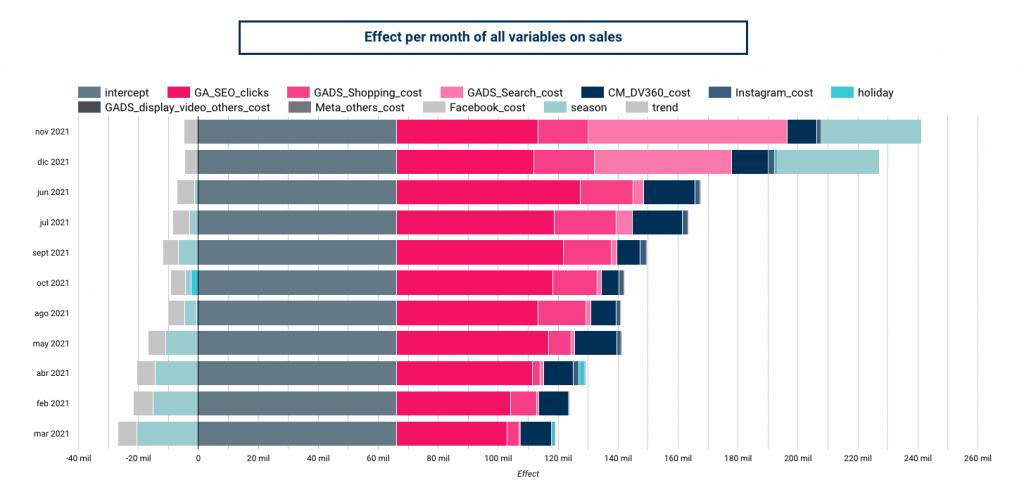
  • Attribution: we will analyse all the variables that influence the client’s business results and know which are the most relevant to enhance them. The advantage compared to user-level models is that this model does not only talk about digital data, but by using aggregated data, we will be able to incorporate offline investment data, types of offers, and seasonality, among others.
  • Predictions: we will discover which variables have been the most relevant in the period analysed; an MMM will indicate how to boost each variable and predict how the results will change in each scenario presented to it.

We will only be able to make high-value activations, but only as decision making and for this, we will need an analyst to interpret the data. However, you do not have localised users by using aggregated data, so you cannot use an MMM to activate audiences or optimise campaign algorithms.

Choosing the best model for your business

In an MMM project, we will work and create different types of models, and the initial objective will be to choose the one that best suits our business:

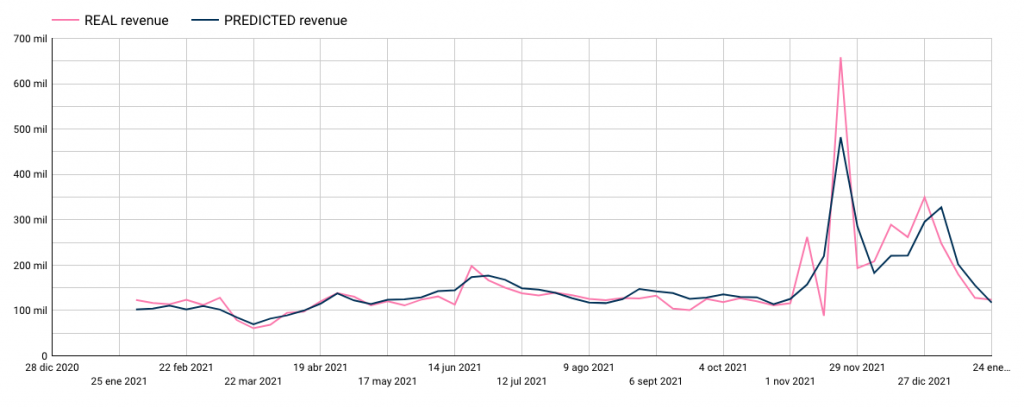
In the following graph, we can see the actual sales history of the customer (pink line) and how this model predicted that time period (blue line).

Ultimately, we will choose the model that best fits the trend and the customer’s sales peaks.

What insights can we extract from our MMM model?

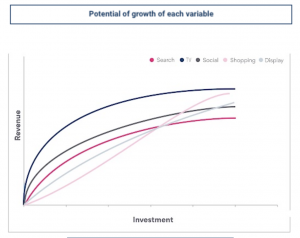
  • Prediction of potential sales increase: this graph shows all campaigns or actions included in the model. The dots are the actual investment and sales of that campaign, and thanks to the trend lines, we can see the sales potential of each campaign as we increase the investment.


  • ROI of the campaigns and variables: in the graph, we can see in dark blue the weight in the percentage of total sales that the campaign or action has had (calculated by the model). In light blue, we can see this action’s significance on the total investment (these are data that we give to the model). And finally, the orange dots show us the ROI of each action, identifying which are the most profitable for our business.

Do you want to know more about what Marketing Mix Modeling can bring to your business? Don’t hesitate to contact our team of experts. We are waiting for you! 🚀

Discover how UK companies activate their data. In a recent study, Making Science asked 600 marketing professionals how they measure and activate their data. Dowload the white paper and find out how to increase ROI.