Marketing Automation: the “dance” of contacts that will lead your organization to success

Marketing Automation: the “dance” of contacts that will lead your organization to success

The digital world has opened up multiple horizons for us when it comes to being able to interact with our clients and contacts in general. The amount of touchpoints that we can collect is so enormous that many times we have to repeat the phrase “less is more” to ourselves. The problem is that many companies try to make very sophisticated journeys without even having a well-established marketing foundation.

What is Marketing Automation?

It is not a philosophical question, nor is it a cultural trend or preference. It is a strategy that requires a good dose of technology. The marketing automation strategy can be summed up very simply in a question: “How do I interact with my customers?” As we said at the beginning of this article, we have hundreds of touchpoints with the client and the good news is that not everyone goes through sending a newsletter to them. If we specify a little more, we can say that it is the relationship I have with my clients / contacts based on the actions they perform both online and offline (as long as we are able to trace it). How does this start to smell like customization?

Phases of the Marketing Automation strategy

On the one hand there is the communications, on the other hand there is the data, and on the other hand there is the activation of the same. We put all this together in the same shaker and results in that which allows us to carry out our marketing automation strategy. In roman paladino: collect data, analyze it and communicate with the client based on the information collected. Still not well understood? Let’s double click. A customer visits our website and fills in a subscription form. Bingo! We have collected information. It depends on the information collected, we must launch our process – of course, fully automatic – in order to understand what the customer wants. Olé, we have already analyzed the information! The activation of this information will be the sending (again in an automated way) of information by us. And then? Then we will continue to collect information – or the absence of it – and we will act accordingly. Do you know what is it? A journey! And a journey, or customer journey, is the means for our Marketing Automation strategy to be successful.

Journeys are not a goal in themselves

And why do we get involved so much? If in the end, what we always want (ok, almost always) is to sell more. Well, because this “misnamed mess” allows us to improve our customer relationship metrics, the much-loved engagement . In the field of e-mail marketing we will find that the open rate improves , the CTR, the bounce rate and the unsubscriptions decrease . Why? Because we are dancing, because we go along with our contact, because we are being relevant to him. And this ultimately means bringing better web traffic (and more) to our website. And this necessarily turns into more sales. Who does not want to sell more?

So what journeys do I need in my business?

To keep it simple, we will talk about three types of journeys:

  • Capture and nurturing
  • Sale
  • Service

Each of these three types of journeys has its peculiarities and specifications. A different kind of approach. A different information. Returning to the question, you need all three types of journeys … and don’t worry, the good news is that in all of them you can (and should) try to “hook” the customer to sell more. If you want to know more about this topic, want to delve more into the world of marketing automation or would like us to help you develop your strategy, write to us at info@makingscience.com. We will be delighted to help you!

CRM is a strategy, not a tactic

CRM is a strategy, not a tactic
For a long time, when people talk about CRM, is referring to a tool. They usually talk about “what CRM do they have”, “a CRM” or “they don’t have CRM”. Perhaps this last expression is the one that is most common for everyone. But not because not everyone has a CRM tool, but today almost no one understands CRM as a strategy. Therefore, considering a CRM as a tool is a limited description of what it is. It is leaving out of the “cake” several very important pieces: strategy, processes and customers. And that is no small thing. To have a clearer picture of what a CRM is, we must talk about: CRM strategy, CRM processes, customers and CRM tools.  

CRM strategy

When we talk about CRM, we must think about its meaning first of all: Customer Relationship Management. Therefore, before thinking about what tool we want to use to carry out customer management, we must think about how I want to manage my customers. But, this doesn’t refer to manners, but to relationships. What do we want them to have from us and what do we want to get from them. Therefore, CRM, as we said at the beginning, involves a relationship strategy.  

Customers who don’t know you yet

In the strict sense of the word a customer is the person who cares and pays for your products and services, but at Making Science we like to broaden the term and make it bigger. Clients, too, are potential clients, and we also have to engage with them. So, within clients we include both Leads and Customers, which will allow us to build a relationship from the beginning of the potential sale. But, let’s not think that this is exclusive to the offline world where call centers have great relevance and the relationship is personal (one to one). Not at all. CRM, or the CRM strategy, covers all types of sales both online and offline, such as ROPO or show-rooming. And this is where one of the great strengths of the CRM strategy resides; the relationship that is built and personalized from the start.  

Processes and tools

We return to our starting point, in which currently a CRM is considered as a tool. Indeed, there are tools that allow us to support our CRM strategy, or rather, the processes that emanate from the strategy. In general, these processes can be divided into three groups:

  • Attraction processes: Where we would include the processes of lead attraction, lead management, lead nurturing, etc.
  • Sales processes: Sales management, budgeting, order and contract management
  • Service processes: Loyalty, cross selling / up-selling, servicing, etc.

These processes are the ones that are embraced and supported by CRM tools.  

First think, then act

The problem is that we live in a constantly evolving world. Companies are less and less thoughtful. There are many things to do, because perhaps the previous ones did not work as expected. We choose a CRM tool and then adapt everything to that tool. Perhaps the problem is that we stop little to think outside the box, because many times we do not define the strategy and processes correctly and clearly, which we should do before working with the tools. So, don’t forget, the key question is not which CRM tool do I choose, but which CRM tool supports my customer strategy.

GMP in cookieless 2.0

GMP in cookieless 2.0
Earlier this year, Google announced that it will remove Third Party Cookies from its Chrome browser. From Making Science, just a few months ago, we clarified in our blog “The future of cookies” that what Google really wants to carry out is the limitation of these cookies and not their elimination. After a year of technological and regulatory advances in this area, it is important to give a pill on the updates that have been developed in this context. Apple communicates to its community that, with the IOS 14 update, it will be mandatory to indicate to users what type of data they are collecting and in turn request permission to be able to track them. In September, however, he sent a communication delaying the implementation of these new privacy measures. This announcement has caused a stir among companies such as Facebook, which are already starting up to be prepared when this functionality is activated. On the other hand, very much in line with Apple, Google Chrome announced that the implementation deadline could be extended in time, despite setting 2022 as the deadline. Likewise, it highlights a very important point for them, Google will not limit third-party cookies until they ensure that the market can continue to work their ads, targeting, frequency and brand safety in a qualified way. In general, all the solutions proposed in the previous blog have evolved along with the digital environment. Of the solutions that we already knew related to media and campaign activations, Google has included two very significant improvements:

  • As for Google Audiences, Google has incorporated a new functionality that consists of automatically expanding the targeting incorporated in our campaigns, a functionality called Auto Targeting Expansion.
  • Google has enabled the ability to trigger HTML5 creatives with customer match audiences.

Regarding new solutions related to the collection of audiences and measurement:

  • Google has included Campaign Manager within the 360 and with this update they incorporated a functionality called Conversion Modeling into the platform .This new functionality has the ability to analyze attributed and unattributed conversions, taking into account impressions and clicks not measured by different browser restrictions. In summary, based on this analysis, it is able to attribute conversions based on the history of the campaigns.
  • Consent Mode is the most relevant solution regarding the issue we are addressing. The main problem with asking for express consent is that it can lead to the loss of measurement of conversions and paths of those users who reject it. That is why Google has implemented two variables in the configuration that are analytics and personalized advertising. By entering these (ad_storage and analytics_storage) it will be possible to inform our GMP tags, analytics and Google ads about the status of the user’s consent. It is because of that:
  1. If the user has accepted the Consent then the tag will be executed as normal.
  2. If the user rejects it, the tag will be executed collecting basic and aggregated information but eliminating the collection of cookie information to respect the user’s privacy. We do not lose the measurement of conversions but it does not allow us to rework those cookies.

The rest of the solutions that we already have available and that we can implement are the following:

  • Ads Data Hub
  • Server 2 Server
  • Offline conversions
  • Data managers: CDPs, 1st party data prevails
  • Programmatic Deals
  • Non-cookies devices: Smart TV & Mobile

Thanks to the GMP environment and the integration that exists between all its platforms, we are able to implement solutions safeguarding the user’s privacy and without losing the user’s qualification. Among the benefits that the GMP environment offers us in relation to this matter, the following stand out:

  • Constant technological advance: Ads Data Hub, Tag Manager Server 2 Server, Campaign Manager 360
  • Audience Volume and Qualified Segmentations – DV360 Audience module
  • The native integration that exists between platforms makes it easier for us to measure and attribution of conversions: CM 360, SA360, GA360, DV360, ADH, GTMS2S

Main connections between Google Marketing Platform (GMP)

Main connections between Google Marketing Platform (GMP)
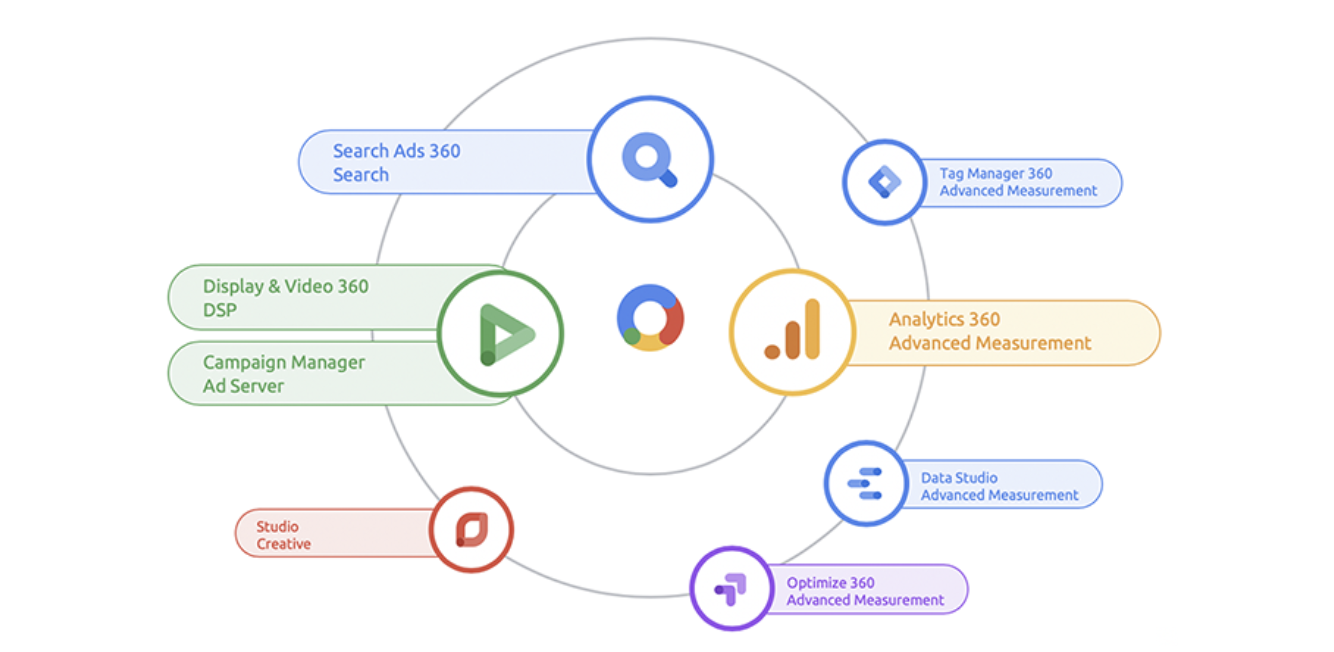
Each and every day more companies are starting to use the platforms and technology of the Google Marketing Platform (GMP) environment, which includes the following tools: One of the main advantages of GMP is the easy connection between the platforms. If all the technologies seen in the previous image are used, the connection between them is made in a few simple clicks and the data circulates like in no other type of ecosystem. However, although making the connections is something simple, you have to understand what those connections really are like and know how the data should be seen in each of them, which is usually the biggest problem that all companies encounter when using GMP . Below I will explain the main connections that exist, starting with clarifying the importance of the GMP measurement pixels, the Floodlights:

  • The connection of the Floodlights : The difference of the Floodlights with the rest of the pixels of other tools is that they will be common to four platforms: Campaign Manager (CM), Display & Video 360 (DV360), Search Ads 360 (SA360) and Studio. Although Floodlights are generally managed from CM, the 3 platforms have access to all the conversion information collected on them. This has 2 main advantages:
    1. Deduplication: The most important feature of GMP. As the floodlights are linked to the 3 platforms and therefore store all the information from the Search, Display and other traffic campaigns, the results seen on the platforms are deduplicated results, that is, REAL.
    2. Although the results that are seen in SA360 and DV360 are deduplicated, both platforms have access to all the information of the floodlights. In this way, the full path of the users is optimized and not only the assigned conversions.
  • CM – GA360 (Google Analytics) : It is one of the main connections within the GMP environment. To do it you need GA360, it is not possible to establish a connection with the free version.

This connection is one-way, only the CM data is sent to GA360. By making this connection, we start to stop using the utms in our urls. Everything is trafficked in CM and all the information will be sent to GA360 with a very important addition; It will include the information of all the impressions of the campaigns and we will be able to see it in GA360. The information will be sent in two ways:

  1. Primary dimensions: From CM the dimensions “source”, “medium” and “campaign” will be sent automatically. “Source” will always be sent as “dfa” and “medium” as “cpm”, they will be fixed values ​​from now on. Instead the “campaign” will be a dynamic field and therefore the most important of this connection. Automatically, the name of the different campaigns that are added in CM will be sent to the dimension “campaign” of GA360 and it will be treated as a primary dimension.
  2. Secondary dimensions: All other dimensions seen in CM will appear in GA360 with the prefix “DCM”. For example, we can see “DCM Placement”, “DCM Site”, “DCM creative”, etc.


  • CM – DV360 : By connecting these platforms we have different advantages:
    • The placements that we traffic in CM under the associated DV360 Site, will appear as creatives in DV360 without the need to send the tags.
    • DV360 will begin to report and optimize in deduplicated conversions with the rest of the Sites trafficked in CM, having visibility in addition to the entire path of the users. This greatly improves the performance of the tool and the results. 

This is a big difference from the DV360 over other display platforms, even with GDN, which do not have the ability to optimize to deduplicated results.

    • In CM we will see all the DV360 metrics as secondary dimensions. We can then incorporate information divided by Line Items or Insertion Orders (among others) and even include the DV360 investment in our CM results reports.
    • Audiences can be sent from CM to DV360.


  • CM-SA360 : By making this connection, without the need to traffic them, we will have all the information in CM of the campaigns stored in SA360.

All the information from SA360 will arrive in CM as a primary dimension in a single campaign that is generated automatically called “Dart Search”. However, in the CM reports we will also have all the information broken down from SA360 in secondary dimensions such as “Paid Search Campaign”, “Paid Search Ad Group”, “Paid Search Keyword”, etc. Also, as in the CM-DV360 connection, when connecting these two platforms SA360 will begin to optimize for deduplicated conversions, having the complete information of all the users registered by the Floodlights.  

  • CM-Studio : By connecting these platforms, all creatives generated in Studio can be sent to CM.

You can also use the information collected in the variables of the Floodlights and tags to generate dynamic creatives in Studio.  

  • GA360-DV360 : The premium version of Google Analytics is required. By having the CM-GA360 link, we would already have the information of the DV360 results on the GA360 platform.

However, if you want to see the information on Line Items and Insertion Orders in GA360, you need to make this link. Furthermore, by making this connection, audiences can be sent from GA360 to DV360.  

  • GA360-SA360 : Since there is a direct connection between Google Analytics and Google Ads, the GA360-SA360 connection may be the least exploited.

The premium version of Google Analytics is also required for this link.  What is gained by making this connection is including the information from the rest of the search platforms, such as Microsoft Advertising, and also audiences can be sent from GA360 to SA360.  

  • Google Analytics – Optimize : With this link we can measure the results of Optimize experiments on the GA platform.

If you have the premium version of both platforms, you can experiment in Optimize based on GA360 audiences.  

  • Data Studio : It is the platform for displaying data in real time and can be linked to Google Analytics, CM, SA360 and DV360. 

  To end the article, I would like to clarify the importance of the difference between primary and secondary dimensions when making these connections. We have seen that, when the connection between two GMP platforms is made, on many occasions the information from one platform is seen in another with secondary dimensions. Although those secondary dimensions are seen in the platforms, if we link them with another third tool those dimensions will not be sent. For example, in linking CM with DV360, we can see in CM how Line Items or Investment secondary dimensions. So if we only link CM to GA360 or Data Studio, those dimensions won’t show up on these platforms. In order to view them, they must also be linked to the DV360 platform, where they are stored as primary dimensions.

The future of cookies

The future of cookies
Who has not considered what will happen to the digital ecosystem as a result of the so-called news of the blocking of third-party cookies in browsers? A few days ago, a Google Attribution, Measurement and Omnichannel specialist, commented the following about the digital environment and the treatment of audiences: “We have lived in the Wild West”. We can not agree more. That is why we understand that the digital market, and with it the treatment of user information, is undergoing so many changes. First of all, it is essential to know the difference between own and third-party cookies. The 1st party cookies are those collected directly by the main server and the 3rd party cookies that are collected in the publisher’s landing but are sent to third-party servers, such as Campaign Manager or Facebook. Once the difference between the two is understood, the epicenter of the problem arises when Google communicates that in 2022 it will block third-party cookies in its Chrome browser. The industry, directly and indirectly, is urgently demanding a change in the digital market and with it in the treatment of data. This demand translates into three main premises :

  1. Users: the user has stated that they do not want us to control them and that is why they browse incognito or even take time to download Ad Blockers.
  2. Regulation: increasingly restrictive consent laws such as GDPR, ePrivacy Directive, CCPA, IAB transparency & Consent Framework, ECJ Planet49 case, National DPAs announcements. Increasingly strict regulations on the treatment of user data and with it, the collection of cookies.
  3. Technology: as we know, ITP (Safari) and ETP (Firefox) by default block third-party cookies and as we have commented previously, Chrome adds to this construction of a more private web environment.


Why should we care? How is it going to affect us?

This new digital ecosystem is going to require an adaptation process because it will mean a change in the way we measure the data of our business and of each client. In addition, certain functionalities of our technologies will be altered.

  1. Audiences: The collection of audiences such as tag-based audiences (Campaign Manager floodlight), frequency cap and DMP audiences will be affected. This will increase the importance of the 1st party data that each client has stored in addition to its activation.
  2. The personalization of the content of the ads will also be affected.
  3. Increase the pressure on the measurement, reporting and attribution of conversions. Reports such as the identification of unique users and overlap will be limited.
  4. The optimization strategies such as CPA or bid to maximize conversions will also be affected by lower volume cookies will experience platforms.


Today’s solutions

We must take into account this new digital context with limited cookies and begin to delve into possible qualified solutions that we already have at our disposal. The Google Marketing Platform ecosystem offers us extensive advanced solutions that we are also already exploiting today.

  1. Google audiences like Affinity and In Market: Google will continue to have a broad reach of users based on their affinities and purchasing interests.
  2. Programmatic Deals through Display & Video 360: with guaranteed programmatic agreements and other types of deals such as Preferred and Private, we can reach our target audience, thanks to the segmentations offered by the different media.
  3. Offline conversions: the GMP ecosystem allows us to import offline conversions, so this solution would allow us to obtain greater visibility on the platform of our user’s behavior and make more beneficial decisions.
  4. Customer Match: creation of audiences based on the uploading of databases of our users to platforms such as Display & Video 360 and Google Ads.
  5. Ads Data Hub:  A tool that allows you to send 1st party data to BigQuery and analyze it against the campaign data. One of the objectives of this tool is to create highly qualified audiences but in groups of at least 50 users, in order to maintain the qualification of the data without losing the user’s privacy.
  6. Server to Server: in this case a server, such as the Tag Manager Server, directly receives the information from the DataLayer from the web, stores and processes this information in order to subsequently send it to Google Analytics.
  7. Finally, the disappearance of the 3rd party cookies will not affect all contexts. Neither mobile nor Smart TV will be affected, so we also recommend exploiting these other types of environments that are also booming in the current digital ecosystem.

We are aware that this new ecosystem still has many unknowns and therefore we recommend taking time to establish a solid strategy based on it. Google is said to start testing in 2020, so we have time to catch up!

New Google Tag Manager Server Side

New Google Tag Manager Server Side
Due to the evolution of the privacy laws (GDPR, CCPA,…) and the restrictions on cookies by browsers, we have been wondering for a long time how long our measurement systems will be optimal. This has caused the need to create and develop new technologies and for us to rethink the way we store, send and use the information we have about users. Last week Google released the great news that its new GTM tool, Server-Side Tagging, was finally going to be a free and public tool for all customers. And this is why we want to tell you why we think you should start making use of it as soon as possible. At Making Science we have been implementing this product in some advanced clients since the beginning of the year. Until July we have not opted for a migration from the client side to server side version, but for a dual implementation of both containers. However, with the product news of recent weeks, we are already beginning to have customers interested in migrating to server-side as the main data collection system for digital analytics. The first thing we have to be clear about is what this new product consists of and how it works. For this we have to think differently and forget about the logic that we have used so far, since the operation of the container and what we are going to find within it, vary with respect to the traditional Google Tag Manager system.  The Server-Side Tagging takes the concepts of Google Tag Manager to the server world. Our own server that will allow us to store, mold and send the data that comes to us as information from us and not from third parties. This system will allow clients to run a Tag Manager container in the cloud (for now only through Google Cloud Platform), advertisers will be able to send data from any of their sources (websites, applications, devices, etc.), and the server container will shape and guide the data to the proper destinations. One of the strengths of Server-Side Tagging is that it allows you to control how your visitor data is collected and modified for multiple endpoints. We are going to analyze some of its strengths below:

  • Improved End User Experience. Fewer scripts on the page that increase performance and loading speed, which indirectly leads to better conversion. Moving the scripts out of the browser means that visitors have to download and run less code.
  • Better Security. Tags can gain access to all private user information on web pages. Fewer third-party tags are running on the page reduces the risk of data leakage.
  • Visitor IDs Managed by The Server. Tags can store visitor IDs on the server rather than in the browser, allowing us robust ad measurement with a high degree of data control.
  • Easy to Obtain. From now on we will have in the GTM platform itself the option to create a container type “Server” that will be configured in four simple steps.
  • Optimized Data Flow. You can get information and control what data is sent and where. You have the option of sending data to multiple destinations without a multitude of labels.

It is true that being a beta product we can find small handicaps such as, for example:

  • The tag templates that client side tagging is accustomed to are not yet available except for Google Analytics, and that means that we have to wait a little time to be able to use them, or develop them ourselves if necessary.  
  • For example, that you have to have the Google Cloud Platform service, which may carry some small costs depending on the use.

Despite these handicaps, due to our application experience in various clients, we advise to start using it as soon as possible (without forgetting the measurement we currently have), so that both methodologies coexist so that we can see, analyze and learn what we provides Server-Side Tagging as opposed to Client-Side Tagging. And above all, be prepared for what looks like the future of the now famous cookieless world. Now, if we already have a measurement system, how do we know if this investment in time and costs really compensates us? Well, basically, as Darwin said: “It is not the strongest species that survives, nor is it the most intelligent that survives. It is the one that best adapts to change”.  The digital world we know is constantly changing, and the cookieless world is something already present to which we must adapt as soon as possible if we do not want to be left behind. Server-Side Tagging will be necessary for:

  • Improved site performance on 3rd party cookie tags . Slow page speed has been correlated with higher bounce rate. Studies show that e-commerce sites see a substantial improvement in revenue when they improve site performance . Site performance is also a factor in search ranking .
  • Control over the security of 3rd party cookie tags . Server-side labeling reduces the risk of data leakage and scraping of private user information. Data leakage can carry high financial penalties.
  • Own internal MTA / 3rd party custom cookie solution . Ensures optimal performance of Google tags, which are used to rate media performance, recommending Google’s server-based tagging solution.

  We hope this article helps you better understand this new system and helps you make the right decision. Do you dare to implement it? If you need help to carry it out, do not hesitate to count on us! You can request information at info@makingscience.com.

Key Aspects in Defining The Annual Marketing Budget

Key Aspects in Defining The Annual Marketing Budget
When a company decides to establish budgets dedicated to marketing, it is never in vain. Normally, the figure of the CMO is responsible for establishing a marketing plan involving different actions, in-company and with third parties as well, expecting an optimal return on investment. But many times this might get complicated. For example, when analyzing beforehand if everything in which we invest will generate positive results for our company or not. When drawing a marketing budget, the CMO should ask himself the following questions: “Do I normally optimize my investments?” and “Do I use reliable data when investing in marketing actions?” This article is aimed at any CMO that wants to know the current trends and receive some advice to improve processes and be more efficient.   But first of all, let’s focus on three questions:

  • When it comes to meeting business objectives, what impact will the economic and financial environment have in the next 18-24 months on your company?
  • How has the investment in marketing agency services changed in the last three years?
  • What is the support of marketing in your business?

When it comes to meeting business objectives, what impact will the economic and financial environment have in the next 18-24 months on your company?

While the vast majority of CMOs globally remain positive about the growth of marketing budgets, the trend since 2014 has been declining. With this data, CMOs should consider on what are they going to invest the marketing budget in. That is, in what type of long-term key actions they will invest that will aid their marketing plan, always basing it on data, of course. On the other hand, they must be aware of the oscillation of markets and governments and, in general, of the socio-economic environment in which we move daily. It is necessary to prepare contingency plans in the event that the future is dark and there is a budget cut. This can negatively affect the actions in marketing, both in the short and long term. Every CMO should take into account all of the above, since economists have been announcing a global economic recession for some time, which will occur sooner or later, and that will affect all countries to a greater or lesser extent. Even so, almost two thirds (61%) of CMOs expect budgets to increase in 2020. Yes, this is how they continue to be optimistic in this troubled world. According to indicators, when analyzing and measuring the economic and business ecosystem including average consumer spending, the performance of last year’s marketing actions or the budgetary strategy that the company follows, they show the opposite of what economists dictate. Who will win the economic battle? The CMOs or the economists? Nobody knows, but if the CMO really wants to be sure of what is happening in its environment and have a clear vision of the current economic and business climate, he should pay close attention to the indicators and base his decisions on reliable sources of information, internal or external. Only if one relies on data, can give reliable answers to future events.  

How has the investment in marketing agency services changed in the last three years?

In recent years, investments in the main resources of CMOs, such as agencies, martech resources, media, and human capital have evolved, changing the rules of the game. Currently, the trend tells us that more budget is usually invested in internally managed marketing actions than in outsourcing of external services. Even so, CMOs should continue to invest in their marketing agencies, but optimize the budget invested in them. Likewise, a detail that can alter the equation of investment in external contracting, is the internal hiring of general specialists in martech, with a transversal experience that manages to meet changing demands and, in turn, support strategically important integrations. Another important fact to consider is the expense in Paid Media, which currently reaches 26% of the marketing budget. Of all this expense in means of payment in digital, offline, television, or search, highlights the investment in digital, which takes the highest percentage of the budget. When we talk about this investment in digital, we discover that Gartner’s 2019 studies tell us that the greatest expense is taken by the company with 23.7% of the budget, followed by a display with 20.0% and video with 19.6%.* Of course, CMOs continue to rely on the off, such as OOH, radio or print ads, but studies tell us that if at some time difficult economic times came, the investment of the marketing departments would be destined greatly part to on before off. On the other hand, it is interesting to analyze the general trend of the CMO’s investment: from the web, mobile marketing or digital advertising, dropping some money in off shares that do not represent more than 21% of the budget. The most advisable thing is that the CMO create budgetary scenarios in all media channels to be prepared when determining an annual budget and that it be supported to do so both in its internal team and in the external team. Instead of making assumptions about the effectiveness of the channels in which you want to invest, we should make investments based on our objectives and our knowledge of the audience.

  • Gartner, 2019.

What is the support of marketing in your business?

Market research and competitive insights, together with marketing analysis, continue to be the most strategically important sources on which a CMO is supported, while marketing operations continue to become more important in a strategic level. Even with all this, many times the CMO is wrong. To avoid this, analytical activities should be prioritized according to the value they bring to the company and the amount of effort required to carry them out. On the other hand, it would be appropriate to establish a figure that is responsible for the management of marketing operations, a figure that makes the processes operational in planning and execution. We must also attend to who are our biggest supporters and our detractors when it comes to helping us approve a budget dedicated to marketing. If in 2017 IT organizations were cited as the biggest detractors, they are currently one of the biggest marketing supporters. In the TOP 3 marketing support IT would be followed by the sales and business development department and finally the CX (Customer Experience) leaders. Instead, in the position of the detractors we would first find the financial organizations, followed by the legal organizations and the company’s supply chain team. And although we cannot change the reality, the CMO can “sweeten” any process by following a series of guidelines such as, for example, building trust within the financial organization by collaborating its team with the financial team to improve plans and budget dedicated to marketing. On the other hand, you can always instill the best practices to your team, ensuring that everyone agrees and is aware of strategic marketing priorities and budget allocations. When designing a budget and defining strategic actions, it is important that the CMO is set in metrics that measure both its brand, its performance, the conversion rate and the measures of loyalty and satisfaction. The data taken from these metrics are great indicators that can tell us whether or not we should invest in one or another action. It is important that in order to measure all this we have our “scorecard” that captures both short-term and long-term income measures, and of course, that with the information collected we improve processes, support learning and innovate. In addition, it is appropriate for a CMO to set expectations on what it can reasonably measure with ROI calculations. Does the measurement provide a granular view, centered on a handful of known data points that reflect cost and value or is it more a holistic view of the overall scope of marketing value? Undoubtedly, there are many issues to attend to in order to become efficient professionals that generate a better work thanks to the data. But let’s not forget that leading CMOs look beyond revenue, conversion, and awareness to define marketing success.


Email Marketing: Why does your business need it?

Email Marketing: Why does your business need it?
If you wonder why email marketing is so important and why everyone talks about it, think about what you do first when you sit down at your workplace in the morning. Probably the first thing you do is to check your inbox and select from among all your mails those that interest you. All those emails that you consider important happen to have the privilege of being read and concentrate your attention for a few seconds, and hence the importance of a good email marketing strategy. That said, the strategy is the same regardless of whether your a small neighborhood business or a large multinational business, all you need is to earn the trust and credibility of your readers to move from subscribers to customers. 5 reasons to implement an email marketing campaign:

  1. Email on any other channel: according to a MarketingSherpa study, 72% of customers prefer to receive promotional information by email rather than by any other channel.
  2. Greater conversion capacity: a good email marketing strategy means an ROI (Return on Investment) of 3,800%, probably the marketing strategy with the highest return, Fuente.
  3. Cost: although the vast majority of services are paid, depending on the volume of customers may be worth even one of their free versions. In addition, taking into account that a direct and personalized contact is established with the client, it can be considered that the price to pay is low compared to other channels.
  4. Smartphones readers: according to some studies, the most common activity with a smartphone is the revision of our email, which is why we take into account not only the desktop version but also the tablet and mobile version. Fuente
  5. Maintain your presence: without falling into the sin of SPAM, a proper email marketing campaign will make a client not forget your brand and what it offers, this will increase the chances that if your reader searches for a similar product or service, they will remember of your business.

Sending an email is something so simple and within reach of everyone, that taking care of its implementation will be crucial, the competition in this field is very high and once a reader discards an email, it will never recover it again. That’s why it’s important to know what you want to communicate and how you’re going to do it.    

Essential components of branding

Essential components of branding
The brand is the most valued asset of companies, and in many cases, the most abused. In a context in which brands evolve, define and re-define, acquire specific roles and transform themselves to arrive in an increasingly innovative and optimized way to their audiences, branding becomes the key factor that gives meaning and favors the survival of a brand through difficult times. Some examples of brands that have known how to value their branding strategy are Redbull, which opted to go beyond their product and generate a unique identity around a successful brand universe, adventure (associated with sport and adrenaline), and that it invests more than 25% of it’s income in marketing actions. Others like Oreo that have generated a consistent and ad hoc brand to relate to their audience, and that takes advantage of real time content and co-branding strategies to generate a link with the world around them. Johnny Walker and their “Keep on walking” works their brand idea under a single message and transfers it impeccably to each of  their advertising drops. We start from the fact that people like certain brands for the same reasons that we like certain people, for how they speak, for what they say, for how they dress, for their behavior, principles and concerns, in short, for their personality. Someone who tries to like everyone or who is not consistent with his speech provokes the same rejection as a brand that tries to do the same. Therefore, from the brand strategy we value the importance and repercussion of a consistent identity between what the brand wants to be, what it offers and who it is going to address. In branding we define both the verbal identity (single sales proposal, brand idea, tone, etc.), and the visual identity (colors, typography, brandscape, etc.), knowing that one does not exist without the other. To create a solid and focused brand, there are countless processes and methodologies that allow us to reach appropriate identities, and one of those tools is the Brand Platform, a type of manual that collects the DNA of the brand and projects its value proposition. . The main components of a Brand Platform are:

  • Mission and vision: the intersection between what it is, what it says it is and what it does.
  • Brand assets: equipment, infrastructure, history, etc.

So far we talk about the reality of the company, the most tangible aspects in which to support its brand territory.

  • Functional attributes and emotional values: aspects on which we base the DNA of the brand, to identify these attributes and values ​​we can use tools such as Brand Identity Prism of Kapferer.
  • Personality: a maximum of 3 or 4 attitudes that define the character of the brand, obtained through tools of Brand Being (the brand as a person).
  • Brand idea: we refer to the concept we want to create, or position that we want to occupy. It will solve the question of “why did you come to this world” or “what is your purpose”. The spirit of the company and the future actions of the brand will revolve around this idea. Tools like Bull Eye of Brand Essence help us get to this idea.
  • Value proposition: summarizes the essence of the brand and is sometimes verbalized in a Brand Claim, in a Tagline or in a Baseline, but Campaign Claim is never used.
Thanks to the creation of the Brand Platform as an essential component of branding, we are able to generate the correct messages that give meaning to the brand throughout its life, being consistent with its strategic focus (Why), and reinforcing that identity with successive campaign ideas (How), and executional ideas (What). Only then, brands will be able to position themselves, compete effectively and meet the business objectives proposed by the company.

How does the climate affect the consumer? Use of weather forecasts to improve online marketing campaigns

How does the climate affect the consumer? Use of weather forecasts to improve online marketing campaigns
A company that sells barbecues carried out an experiment activating campaigns only in some cities when the temperature was above 24 °, and in others when it was higher than 20 ° (taking into account the seasonal average of each city). In the context of buying a BBQ, we determined that we could “get close” to the user’s mood based on this data, impacting our digital marketing campaigns in an immediate and pertinent way. Another very clear example is the strategy of a famous chain of pizzas at home, which links a greater number of online campaigns when it is raining or cold, and the user is more interested to stay at home. There are many studies of neuromarketing that show the relationship between climate and purchase intention, even so, it is clear that there are products / services that are more subject to climatic influences than others. Collecting and analyzing weather data allows us to have 3 macro categories of data available:

  • Historical data: are useful for an analysis of sales and seasonality of climate over time
  • Real-time data: are the most used to activate campaigns and personalized ads
  • Predictive data: allow us to have a short-term forecast and, therefore, plan our campaigns in the most opportune way for the user