

Level Up Your VWO Experiments: QA Best Practices for Success

There is nothing worse than planning an experiment from scratch, having your team create an immaculate mockup and develop a test, only to realize a week later – after it has been launched that your secondary metrics were not tracking any conversions. Perhaps you notice that a potentially successful hypothesis was wasted because your cookie consent notification overlapped your new pop-up or, even worse, that your checkout funnel is now broken.

Quality assurance testing is frequently overlooked, as it is the last stage of the development process, and on-time delivery is frequently prioritized over quality. Yes, your stakeholders might be pleased with your punctuality, but final users will be disappointed by a bad experience.

Making Science has been helping out clients with their CRO efforts for the last 5 years and have realized that running successful A/B tests requires meticulous planning and execution, and validating the quality of your experiments is paramount for accurate results and meaningful insights. Over the years, we have found in VWO a powerful testing and personalization platform, equipped with useful tools for QA and pre-launch validations.

Here are some key QA best practices to incorporate into your VWO workflow:

1. Pre-Launch Checks:

Documenting pre-launch QA is key, as you’ll have evidence and be able to map and visualize all the possible scenarios and actions a user could perform when interacting with the experience. Creating a detailed test plan file also helps optimize the bug reporting and fixing process, as you share your findings with the development team in a centralized report.
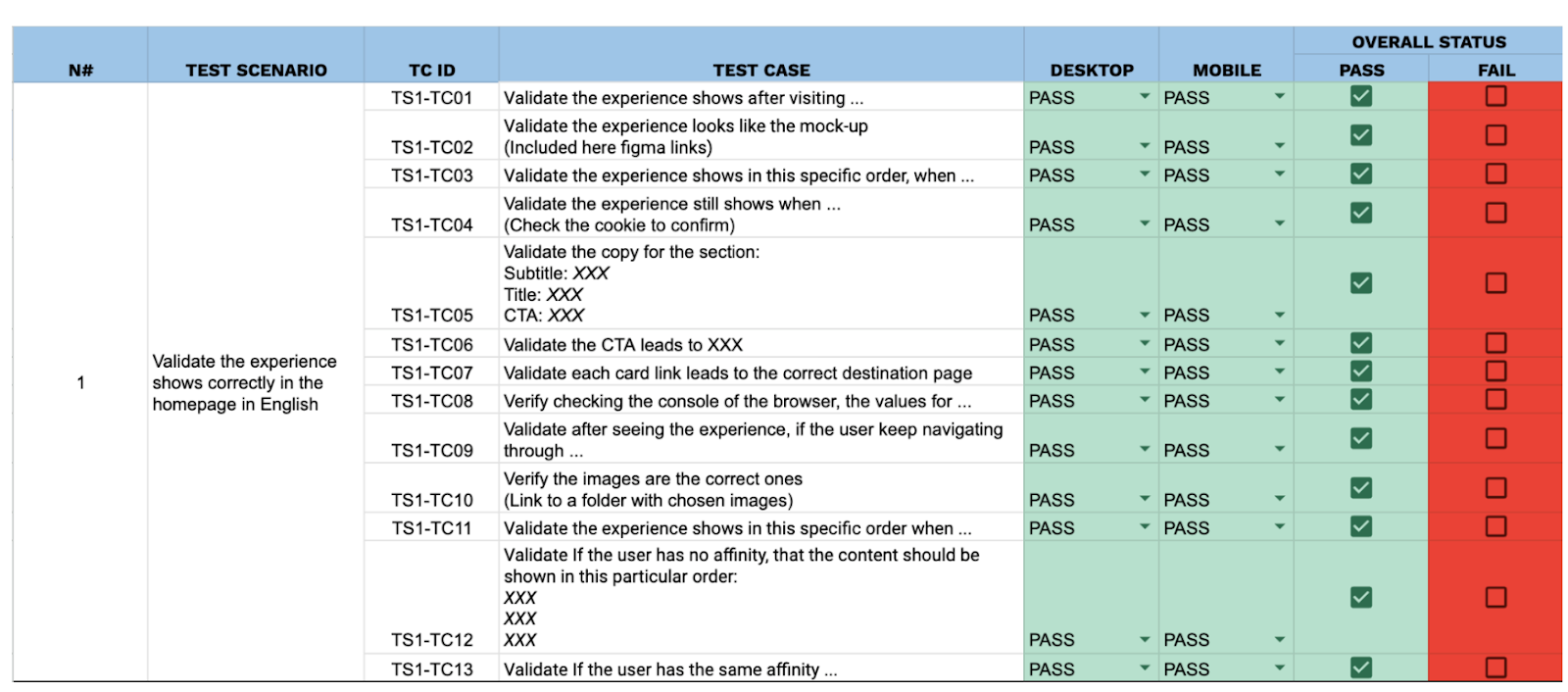
Img. 1. Test plan example

  • Thorough Visual Inspection:
    ○  Cross-browser/device testing: Verify consistent appearance and functionality across different browsers (Chrome, Firefox, Safari, Edge), operating systems (Windows, macOS, iOS, Android), and screen sizes (desktop, tablet, mobile).
    ○  Check for broken images, misaligned elements, and unexpected CSS/JavaScript conflicts.
  • Functional Testing:
    ○  Test all variations thoroughly: Ensure all elements within each variation function as expected (e.g., buttons click, forms submit, animations play correctly).
    ○  Test all user flows: Simulate user journeys within each variation to identify any roadblocks or unexpected behavior.

  • Data Layer Validation:
    ○  Confirm that all relevant events and data are being captured correctly in the dataLayer to ensure accurate tracking of conversions and other key metrics.
    ○  Use browser debugging tools (e.g., Chrome DevTools) to inspect the dataLayer and verify its contents.

    VWO offers a Live Preview feature, offering a safe way to test and pre-visualize an experience, just by adding the URL you want to preview:
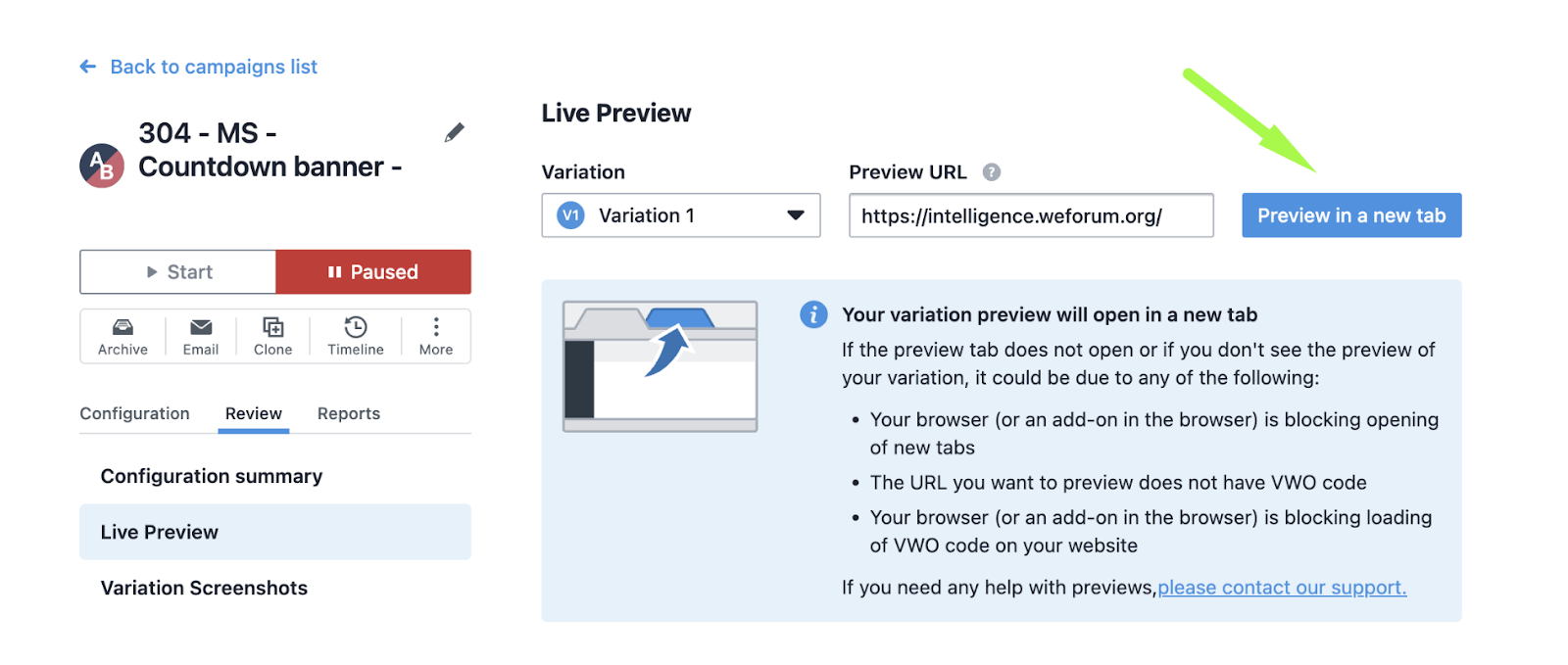
Live Preview feature location in VWO

2. During Experiment Run:

  • Regular Monitoring:
    ○  Monitor key metrics closely: Track conversion rates, traffic distribution, and other relevant metrics daily to identify any anomalies or unexpected trends. With VWO, you can use existing metrics or create new ones as guardrails. When you choose a metric as a guardrail, it’s automatically added as a secondary metric in your campaign. This lets you track it along with your main success metrics.
    ○  Use VWO’s built-in reporting and analytics features to analyze experiment performance.
  • Address Issues Promptly:
    ○  If any issues are identified (e.g., technical errors, unexpected traffic fluctuations), address them immediately to prevent data contamination.
    ○  Make necessary adjustments to the experiment setup or targeting rules.

3. Post-Launch Analysis:

  • Data Validation:
    ○  Scrutinize the collected data for any inconsistencies or outliers (e.g., Verify your 50/50 split A/B test is actually delivering each variation to half of the traffic)
    ○  Verify that the data accurately reflects user behavior and experiment performance.
  • Statistical Significance:
    ○  Ensure that the statistical significance of the results is sufficient to draw meaningful conclusions.
    VWO’s SmartStats uses Bayesian sequential testing to give you more flexibility in running A/B tests. You can adjust the statistical settings to suit your business goals and get faster, reliable results that you can confidently act on. With VWO, you can set an MDE value to ensure your tests focus on finding meaningful improvements. This is especially useful for low-traffic pages, as it provides efficient use of resources without spending time on tiny, unimportant changes. VWO’s stats engine also uses ROPE to recommend stopping a test early if the variation won’t make a big enough difference, saving you time and effort.
  • Documentation:
    ○  Document all aspects of the experiment, including hypotheses, setup, results, and learnings.
    ○  This documentation will be valuable for future reference and optimization efforts.
  • Tools and Resources:
    ○ VWO’s built-in testing tools: Utilize VWO’s features for visual testing, browser compatibility testing, and dataLayer debugging.
    ○ Browser developer tools: Leverage browser developer tools (e.g., Chrome DevTools) for inspecting elements, debugging JavaScript, and analyzing network requests.

By implementing these QA best practices, you can significantly improve the quality of your VWO experiments, increase the reliability of your results, and maximize the impact of your CRO efforts. 

Google Backpedals on Third-Party Cookie Deprecation: A Win for the Industry, a Focus on User Choice

Google has significantly shifted its approach to third-party cookies, opting to maintain their use while introducing a new framework prioritising user control. After years of delays and industry concerns, this decision marks a departure from the company’s plan to fully deprecate cookies. Read more about the official announcement from Google here: https://privacysandbox.com/news/privacy-sandbox-update/

The rationale behind Google’s decision is clear: they listened to industry concerns about cookie-free futures. By preserving cookies while introducing enhanced privacy controls, Google aims to strike a balance between protecting user data and maintaining a thriving digital advertising ecosystem.

The core of Google’s strategy is to empower users, as they intend to provide users with greater transparency and choice over how their data is used, allowing them to opt in or out of tracking. This approach could level the playing field, as both cookie-based and cookie-less solutions will have the opportunity to compete for user attention.

Even though details about Google’s proposed changes are still emerging, this announcement undoubtedly relieves the industry. Businesses will have more time to adapt and invest in alternative tracking technologies while also addressing privacy concerns.

Our US Nick Tiano, Chief Revenue Officer, expressed,

“I think with the steps Google took, they were clearly listening to regulators and the adtech industry. This pivot appears to be warranted and is a major commitment from Google to give users and adtech providers a choice on the matter of 3P cookies. Now the Sandbox and other privacy-forward solutions can compete on merit and user preferences (or opt outs) will dictate performance and ultimately what technologies win out, 3P cookies or alternatives.”

Ultimately, Google’s decision to maintain third-party cookies while emphasising user control represents a thoughtful compromise. It’s a move that could shape the future of digital advertising for years to come. Read more about Google’s decision here: https://www.thedrum.com/news/2024/01/04/marketers-publishers-brace-impact-1-third-party-chrome-cookies-vanish-today or get in touch with our experts.


[button color=”accent-color” hover_text_color_override=”#fff” size=”large” url=”www.makingscience.co.uk/contact” text=”Get in touch!” color_override=”#ff0067″]

Third-party cookie deprecation is not the end of third-party data

With the deprecation of third-party cookies, there will be less third-party data available, but first-party data is also getting worse – meaning quality third-party data is more important than ever for the success of data strategies in the future.

Google’s Privacy Sandbox is starting to be tested on 1% of users. Third-party cookies are now destined to disappear, but whether Google can maintain the timelines remains to be seen.

With the deprecation, the importance of first-party data strategies continues to be the most crucial aspect of a measurement strategy. However, the limiting factor has always been effort, meaning the use of vast amounts of third-party data collected by the tech giants was easier to collect than doing it yourself.

Times are changing, third-party cookies are slowly being deprecated across all browsers, and greater privacy and technological restrictions are being enforced, restricting what data can be collected. Furthermore, this final point has a major impact on first-party data – not only is the volume of third-party data greatly reduced, but the quality is also decreasing. To overcome this problem, modelling and aggregated bidding strategies are being used.

This limitation of first-party data is more pronounced on upper funnel activities and sites where logging in and identification are not essential. Third-party data is even more important in these cases as we are looking for contextual data that may have influenced a customer’s purchase decision. For example, knowing the ideal time to sell an umbrella is when it starts to rain. Good first-party data is not needed to optimise bidding in this case, but accurate and timely third-party weather data is.

When it comes to looking for good third-party data sources, it is important to consider what influences the decisions of users in each case – are you a retailer or travel agent influenced by rainy days, or a financial service affected by interest rates and exchange rates? 

There are so many good third-party data sources available that it is worth taking the time to determine which can efficiently and effectively be incorporated into your measurement strategy. To name a few useful third-party data sources:

  • Weather data
  • Location data (e.g. store locations, proximity to services, etc.)
  • Events data (e.g. a concert, a football match, etc.)
  • Search data (e.g. Google Search Console or Google Trends)
  • Financial data (e.g. interest rates)

Incorporating these data sources into a measurement strategy is only the first step. The second is integrating it into data collection and activation. During upper funnel and display activity, solutions such as BrandMax can optimise your custom bidding algorithms to improve CPM.

In 2024, a blended data strategy will remain crucial for businesses. A company that focuses solely on a first-party data strategy is limiting themselves compared to organisations with a diverse approach are able to activate their first-party data effectively as well as find and use relevant third-party data in data-sparse environments.