Beyond the Hype: Nick Waters´ Perspective on OMR 2025’s Biggest Trends

The Online Marketing Rockstars (OMR) festival in Hamburg is a key event for the digital marketing industry, drawing a vast and diverse crowd. After two days immersed in this dynamic environment, Nick Waters, Global CEO of Northern Europe at Making Science, reflected on the current state and future trajectory of digital marketing.

1. The Sheer Scale of Digital Marketing

OMR’s sheer scale is a spectacle in itself. It gathers everyone from industry giants to niche innovators and highlights the immense size and vitality of the digital marketing arena.

2. Navigating the Complex Vendor Landscape

The OMR exhibition floor can feel like a walk through the intricate LUMA Partners landscape. A plethora of vendors offer seemingly similar solutions: real-time insights for better decision-making, omnichannel attribution, data visualization, privacy solutions, and automated content creation. This raises a critical question for brands: How much real differentiation exists, and how can they identify the solutions that truly deliver unique value?

3. The Indispensable Role of Human Expertise

These observations underscore a crucial point: In an increasingly automated world, expert advisors are more important than ever. At Making Science, we believe that smart humans, with their strategic thinking, creative insight, and nuanced understanding, are the true differentiators in helping brands navigate this complexity and achieve their business goals.

4. The AI Tsunami is Here

Artificial intelligence is no longer a future trend; it’s a present reality, poised to disrupt the entire marketing services ecosystem. An “AI tsunami” is on the horizon, and businesses that are unprepared or underprepared risk being swept aside by its transformative power.

5. The Evolving Definition of Commerce

OMR showcased a strong emphasis on “commerce” related offerings, yet the discussion around “retail media” seemed relatively muted. This prompts questions about whether the concept of “retail media” is being repackaged, redefined, or integrated into a broader commerce narrative.

6. The Untapped Potential of Streaming TV

Streaming TV’s commercial presence in Europe still lags behind its adoption in the US, suggesting a significant growth opportunity. As viewing habits continue to shift, this channel is poised to become an increasingly important component of the marketing mix.

7. Agency Presence and the Question of ROI

The limited presence of traditional agencies at OMR is a notable observation. The high cost of participation likely leads to a critical evaluation of return on investment, forcing agencies to prioritize their event strategies.

8. The Inevitable Amplification of the AI Conversation

Looking ahead, Waters predicts that the focus on AI will only intensify. The “AI noise” will be even louder at upcoming events like Cannes and reach a crescendo at OMR 2026, demanding that the industry move beyond hype to practical application.

Conclusion: Embracing Change and Prioritizing Expertise

OMR 2025 served as a powerful reminder of the dynamic and rapidly evolving nature of digital marketing. As Nick Waters’ reflections highlight, the industry faces both immense opportunities and significant challenges. At Making Science, we believe that success in this environment requires a combination of embracing technological innovation, particularly in AI, and prioritizing human expertise. By staying ahead of the curve and providing our clients with strategic guidance, we empower them to navigate complexity, capitalize on emerging trends, and achieve sustainable growth.

Enterprise AI Agents: Transforming Business with Intelligence and Autonomy

As Artificial Intelligence continues to reshape business landscapes, Making Science and Google Cloud recently brought together industry leaders at Google’s Madrid headquarters to explore the transformative power of Enterprise AI Agents. This event highlighted how companies are moving beyond basic automation to adopt intelligent, autonomous systems that redefine customer engagement and operational efficiency.

The Strategic Evolution of Enterprise AI: From Tools to Autonomous Entities

The evolution of AI in enterprise settings has been remarkably rapid. Businesses have progressed from experimental AI in 2023 to real-world implementations in 2024. Now, in 2025, the emergence of AI agents is driving the next stage of transformation. These intelligent systems are no longer just tools but autonomous decision-makers capable of optimising operations, automating complex workflows, and accelerating business growth.

Key Themes & Insights:

From White Box to Black Box AI: Embracing Agility over Algorithmic Detail

Enterprises are moving away from the need to understand every algorithmic detail (white box AI) toward testing AI-driven outcomes (black box AI). As Large Language Models (LLMs) become more advanced, the focus is shifting to “trusting” the LLM while applying the required prompting, grounding and testing; leveraging AI’s agility, rather than dissecting every aspect of each neural network supporting each LLM in an AI Agent.. This approach allows businesses to prioritise adaptability, performance, and user experience over algorithmic transparency.

Understanding the Difference between AI Assistants and AI Agents

AI Assistants support customer interactions and internal processes but still require human supervision. AI Agents function independently, making decisions and taking actions without direct human input. However, effective governance is essential to ensure reliability and trust in fully autonomous systems.

AI Adoption: Bridging Innovation and Practical Implementation

Despite the rapid advancements in generative AI, widespread adoption in business remains in its early stages. Organisations seeking to maximise AI’s potential must focus on:

  • Seamless integration with business processes and APIs
  • High-quality, structured data to improve AI-driven insights
  • Interconnected platforms to enhance automation and decision-making

A case study presented at the event illustrated how Conversational AI and Retrieval-Augmented Generation (RAG) are transforming real estate searches. With over 30,000 successful AI-driven interactions with improved conversion rates, this solution has significantly improved customer engagement while reducing operational costs. AI-powered chatbots in real estate now maintain conversation context, understand user needs, and provide personalised recommendations. One of the key propositions of the AI Agent was the continuous incorporation of new real estate inventory and the enrichment of the data applying points of interest such as schools, hospitals, metro stops, police stations, airports, etc from Google Maps.

Expanding AI Applications Across Industries
  • Predictive Analytics – AI detects fraud and prevents network abuse by analysing suspicious activity patterns.
  • Legacy System Migration – Generative AI evaluates risks, costs, and timelines for transitioning outdated IT systems.
  • Data Integration – AI enhances cross-platform data consistency, improving analytics and business intelligence.
Security and Compliance in AI: Ensuring Responsible Deployment


As AI adoption scales, data security, privacy, and compliance remain critical priorities. Discussions at the event underscored the importance of:

  • Regulatory alignment to meet evolving data privacy laws
  • Ethical AI governance to ensure responsible decision-making
  • Robust security frameworks to prevent misuse and protect sensitive information

A well-structured approach to AI governance will be essential to maintain trust and unlock AI’s full potential.

Google Cloud’s Innovations for Enterprise AI Agents


Google Cloud continues to lead enterprise AI innovation, equipping businesses with powerful tools to integrate AI Agents effectively into their operations.

Customer Engagement Suite (CES): Gemini 2.0 and the Future of Multimodal AI

One of the key announcements at the event was the introduction of Customer Engagement Suite’s (CES) integration of Gemini 2.0, a multimodal AI solution integrated into the. This advancement enables businesses to facilitate seamless interactions across voice, text, and visual inputs, ensuring a fluid and personalised customer experience.

For example, a customer support system powered by Gemini 2.0 can interpret a mix of text-based queries, voice commands, and image uploads, all while maintaining contextual understanding. This level of interaction enhances customer satisfaction and streamlines service efficiency.

The adoption of multimodal AI represents a major leap forward in enterprise AI, providing organisations with an intuitive and adaptable engagement platform.

Revolutionising Workplace Efficiency with AgentSpace

The introduction of Google’s AgentSpace platform addresses a critical challenge in modern enterprises: the fragmentation of information and tools. By integrating advanced search capabilities with AI-powered assistance, AgentSpace transforms how employees interact with enterprise systems. This integration reduces the time spent switching between applications while enhancing decision-making through improved access to organisational knowledge. 

Employees are no longer bound by siloed data or the need to navigate multiple interfaces. AgentSpace intelligently connects relevant information, allowing for faster, more informed decisions and a more productive work environment.

NotebookLM: Advancing Enterprise Intelligence

A significant advancement in enterprise tools, NotebookLM Enterprise demonstrates the power of AI in research and information synthesis. The platform’s ability to process diverse content types – from documents to video content – while maintaining context and generating actionable insights represents a new paradigm in enterprise information management. Imagine being able to analyse a complex research paper, a lengthy video presentation, and a series of internal reports, all within a single interface. 

NotebookLM not only processes these diverse formats but also identifies key themes, synthesises information, and generates actionable insights, effectively turning raw data into strategic knowledge. This tool empowers professionals across various sectors to accelerate research, enhance analysis, and ultimately, make more informed decisions.

Looking Ahead: The Future of Enterprise AI

Enterprise AI is advancing at an unprecedented pace. The integration of intelligent AI agents marks not just an evolution in technology but a fundamental shift in how businesses operate, engage with customers, and drive innovation.

As a strategic Google Cloud partner, Making Science continues to play a pivotal role in guiding organisations through AI adoption, implementation, and optimisation. For businesses looking to leverage AI-driven transformation, our team of experts is ready to support their journey toward greater efficiency, agility, and intelligence.

The future of enterprise AI is here, and organisations that embrace it today will define the market leaders of tomorrow.

[button color=”accent-color” hover_text_color_override=”#fff” size=”large” url=”https://www.makingscience.co.uk/contact/” text=”Contact us!” color_override=”#ff0067″]


From listening to action: how brands can learn from their users

Spaniards spend an average of nearly two hours a day on social media*. But what exactly are we doing during that time?

For older generations like Gen X and Baby Boomers, social media is primarily a way to stay connected with friends and family. Meanwhile, Gen Z and Millennials are more likely to use these platforms to keep up with current events, engage with content like memes and videos, and create their own posts. While each generation has its own preferences, behaviors, and concerns, they all share one common trend: we are spending more and more time online.

For brands, understanding the audience is critical to ensure that marketing efforts reach the right people. In today’s fast-paced, ever-evolving digital landscape, simply reaching an audience is no longer enough—brands need to make an impact.

How can brands achieve this?

It’s not just about knowing who the audience is, but about understanding how to connect with them: what they enjoy, where they spend time online, what concerns them, and the communication styles they use.

To gain this insight, brands have access to powerful tools that help them analyze everything from a user’s age and profession to their daily habits and activities. Additionally, social listening platforms allow brands to track real-time user interactions and responses across social networks and digital channels.

But how can brands make the most of this information?

The answer lies in engaging with users where they are and tapping into conversations that resonate with their interests. This is a golden opportunity for brands to become more relevant by joining discussions that matter to their audience.

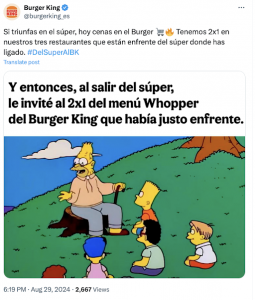
A key strategy is to adapt to the unique communication styles of each platform while maintaining the brand’s voice. For example, memes have become a staple of online culture, and tapping into their viral potential is an effective way to increase brand visibility—though it requires quick action, as trends rise and fall rapidly. Social listening tools can identify trending content, allowing brands to adjust their messaging and boost engagement by fostering a more active and personalized online community.

Speed is another essential factor. Reacting quickly to social media trends and events can amplify a brand’s impact. A prime example is “La Velada del Año,” the most-watched digital event on Twitch, which peaked at over 4 million viewers and proved that this platform isn’t just for niche audiences. With nearly half a million social media mentions, many brands, like Vicio, capitalized on the event by listening closely to what their audience wanted, breaking records for new followers and engagement.

In short, social listening not only helps brands understand user needs and preferences but also provides valuable insights for developing marketing strategies. It reveals how competitors are engaging with their audiences, uncovers user perceptions and demands, and highlights opportunities to join relevant conversations.

So, are you making the most of social media to build meaningful relationships with your target audience?

*Source: GWI Spain (16-64 years)

Broadwick Soho picks new Agency partner – Making Science

London, 6th of June 2024 – Making Science, a global leader in digital transformation, is pleased to announce a strategic partnership with Broadwick Soho, an independent luxury hotel in the heart of London. As part of this collaboration, Making Science will oversee the hotel’s paid search, leveraging innovative digital strategies to enhance visibility and drive bookings.

“We’re excited to partner with Broadwick Soho, to elevate their presence online and advance their digital strategy via paid search.” said Xavier Klein, UK Marketing Services Director at Making Science. Through this partnership, Making Science aims to optimise Broadwick Soho Hotel’s advertising efforts. 

About Broadwick Soho Hotel:

Broadwick Soho is an independent luxury hotel in the heart of London’s West End, channelling the grit, glamour and wild energy of London’s most vibrant area into an opulent contemporary 57-room retreat, offering impeccable service and quality. 

About Making Science:

Making Science is a digital acceleration company that currently has more than 1200 employees and a presence and technological development in 15 markets: Spain, Portugal, Mexico, Colombia, France, Italy, UK, Ireland, Sweden, Denmark, Norway, Finland, Germany, Georgia and USA. As a consulting partner of Local Planet, the world’s largest network of independent media agencies, Making Science offers digital marketing, Adtech and Martech, cloud technologies and software, and cybersecurity services globally, through delivery hubs that drive job creation and the availability of highly skilled technology talent. 

Making Science is comprised of 4 business lines: the Global Digital Agency with Technology, with 360 digital advertising services that integrate strategic planning, creative, data and technology; the Cloud, Software and Cybersecurity business, with cloud-based solutions that deploy data intelligence and a specialised cybersecurity team; the Artificial Intelligence and SaaS division, with more than 400 engineers and data scientists for the development of platforms and digital solutions with AI technology applied to marketing; and the Making Science Investment area, with Ventis and TMQ, as a line of business diversification and implementation of the capabilities of all areas of Making Science.  

In addition, the company participates in various ESG initiatives, including the Climate Pledge, the United Nations Global Compact and the Pledge1% initiative, supporting non-profit organisations in its community with a strong commitment to making a positive impact on the future.


[button color=”accent-color” hover_text_color_override=”#fff” size=”large” url=”www.makingscience.co.uk/contact” text=”Get In Touch To Accelerate Your Digital Marketing Strategy!” color_override=”#ff0067″]

3PC Deprecation: Why you need to take action

Chrome has already begun the 3PC (also known as third-party cookie deprecation), and it’s already impacting your business and marketing performance. In this post, we will discuss how to mitigate the change and prepare for the full phase-out.

What is happening

Following the footsteps of other browsers, Chrome has started deprecating 3PC for 1% of users from the 1st of January 2024. This share will gradually increase until 3PC cookies are deprecated for 100% of users in H2 of 2024. Google is also introducing Privacy Sandbox as an alternative to 3PC to maintain accurate, personalised and useful advertising for users and marketers.

Why it matters

Whilst other browsers have already phased out 3PC, Chrome has the most significant market share worldwide with 65% and will have the biggest impact on advertising. Secondly, this market share is more heavily adopted amongst desktop users who have historically had better conversion rates than mobile users.

Google and Meta have been heavily reliant on 3PCs in the past to help build profiles of users that advertisers can then target. Placing remarketing pixels on your websites has allowed them to see user activity across multiple domains. This makes it easy for advertisers to target users because both Google and Meta had very complete and high quality datasets that allowed for granular marketing activities – this will change.

What will the impact be

The quality of the third-party data (3PD) stored by Google will decline sharply and become incomplete and far less accurate. There will be a shift from user-level data to aggregated data. This will make marketing less efficient and reduce ROAS unless advertisers act to mitigate the change.

Making Science’s 3PC deprecation tool predictor has shown that up to 30% of conversions could be lost. This is due to several factors, including poorer quality traffic and more inefficient targeting. On average, 44% of digital advertising revenue in Europe relies on 3PC, and a recent client case of a global luxury retailer showed that they rely on an average of 30% of revenue in the past month (January 2024) being dependent on 3PC. With Making Science’s tool, we were able to predict a potential loss of up to 9% of digital revenue due to the deprecation. 

With this change, it is Google’s responsibility to provide the tools to advertisers to maintain a strong ROAS, and it is the responsibility of advertisers to implement them. As 3PC deprecation is rolled out, the importance of 3PD vs 1PD is going to shift dramatically towards 1PD – it has always been better, but 3PD has been good enough to get away with having dedicated first-party data strategies.

What can be done to mitigate the impact?

There are lots of options available to handle this change – in fact, too many. It is essential to understand the impact on your business and prioritise the available changes based on ease of implementation and impact. We can bucket the opportunities into mitigation and activation.

Mitigation

These activities are aimed at reducing the loss of data volume and quality by implementing tools provided by Google and collecting better data using durable, privacy-compliant solutions.

  1. It’s important to use a consent management platform (CMP) rather than a DIY solution for a consent banner. CMPs integrate with Google’s technical solutions and provide template consent banners that comply with the latest regulatory changes in differing markets, which can become hard to manage as more and more countries and states implement their own privacy legislation.
  2. A thorough and robust GA4 implementation will provide confidence in data, become the data source of truth for the business and stay up-to-date with privacy changes, as Google has shown its commitment to keeping GA4 compliant.
  3.  Implementing Consent Mode V2 for all Google products and Enhanced Conversions will allow for better matching by Google whilst respecting privacy. Consent Mode is now a requirement for using advertising features within Google products, and Enhanced Conversions allow conversions to be tied to impressions and clicks better, improving the understanding of campaign performance.

These are the essential requirements for dealing with 3PC deprecation, but more measures can be taken if it is justified. Implementing server-side measurement will further improve the robustness of the GA4 implementation and marketing pixels. Using the measurement protocol for key conversions to ensure 1-to-1 matching between internal databases and adtech. A greater understanding of users can be achieved by using a Customer Data Architecture (CDA) or a Customer Data Platform (CDP) and cleanroom analysis can help cluster users together for better aggregated targeting.

Activation

Creating audiences and lists for targeting through 1PD will need to be more prevalent. The first source will create GA4 Audiences that can be passed into Ads and the Google adtech stack based on user behaviour. This should be in action already, but with better data collection, the quality of the audiences that can be created should improve.

Smart Bidding will help to improve campaigns if not already in use. Smart Bidding uses Google’s AI to optimise conversions or conversion value through advanced machine learning and contextual signals. Another increasingly important tool provided by Google is Customer Match. Uploading lists into Ads will enable accurate targeting and reduce the impact of 3PC deprecation. It is an important process to automate as it can otherwise be time-consuming.

Beyond Google’s tools come more advanced methods of improving the signal provided to adtech. Scoring users with predictive modelling tools such as Gauss Smart Advertising will enhance the signals sent into Google’s algorithms, which can start optimising these signals instead.

Setting priorities and winning over stakeholders

Making Science’s 3PC deprecation tool makes planning strategies and quantifying the issue to stakeholders much easier. By analysing the results and different performances of browsers, devices, channels and campaigns – advertisers can assign a monetary value to the impact of 3PC deprecation. This makes getting technical and legal approval for changes such as enhanced conversions into sprints and implemented on-site much easier.

Managing expectations and predicting change is going to be important for marketing teams in 2024 to keep senior stakeholders happy and allow for the marketing strategy to be run without interference.

The Role of Privacy Sandbox

Privacy Sandbox is one of Google’s tools to help replace some functionality once 3PC has been deprecated. Testing and implementing solutions using the Topics API or Protected Audiences will potentially go a long way to mitigating the impact of 3PC deprecation – which is Google’s intention. However, early reports are mixed, and the UK’s Competition and Markets Authority (CMA) raised concerns that Google has answered.

The role of Privacy Sandbox will increase throughout the year, and we need to pay close attention to its capabilities and learn how it will work with advertising campaigns and the impact it will have. But for the short-term, getting these other measures in place is important, and then maximising opportunities from the Privacy Sandbox can become a priority in H2.


[button color=”accent-color” hover_text_color_override=”#fff” size=”large” url=”www.makingscience.co.uk/contact” text=”Contact Us To Get The Most Out Of Your Data!” color_override=”#ff0067″]

The power [and problems] of value-based bidding

In an increasingly competitive and complex digital marketing landscape, it’s now more important than ever to ensure optimisation of both data and media to achieve marketing ROI. The best decisions are the ones informed by data and AI.

Across the two performance marketing behemoths, there are over 4 billion monthly active users worldwide on Google, and over 3 billion on Meta. Of course, not all users are created equal, far from it. Value-based bidding (VBB) gives advertisers the ability to adjust their marketing bids for their most and least valuable users. It combines the power of an advertising platform’s rich user data and AI smart bidding algorithms with a brand’s first-party conversion value data. In short, VBB drives stronger efficiencies and increased revenue for businesses by aligning the bidding goal with business outcomes.

It’s a powerful tool; Google’s study on its internal data in 2021 showed a 14% uplift in conversion value moving from tCPA to tROAS, Meta has quoted up to 35% improvement in ROI from their value bidding strategy and Making Science’s proprietary predictive VBB solution – Gauss Smart Advertising – drives 10-30% uplift in lifetime value ROI.

So why would an advertiser not harness the power of VBB? Well, it’s not always easy.

To start, advertisers need to understand clearly what value means to them – revenue, lead quality, customer lifetime value, new vs returning customer ratio, conversion propensity (and countless more) are all applicable value metrics, requiring distinct optimisation strategies.

Below the surface, advertisers need robust measurement solutions in place to track customer value in online and offline environments. This data needs to be accurate and accessible. Bidding experts are required to steer VBB algorithms through a volume, efficiency and efficacy balancing act. The necessity for predictive modelling arises when advertisers want to make quick decisions on bidding and investment.

All of this is to say that effective VBB is far from a flick of a switch. Durable VBB is best viewed as a journey to maturity, on which accuracy, speed and actionability are the guiding stars.

If you’re interested in understanding how better bidding can deliver you more ROI, please reach out.


[button color=”accent-color” hover_text_color_override=”#fff” size=”large” url=”www.makingscience.co.uk/contact” text=”Get in touch!” color_override=”#ff0067″]